The Grow Awards 2026 🏆
Likes
Comments
Share
@Zengrower
Follow
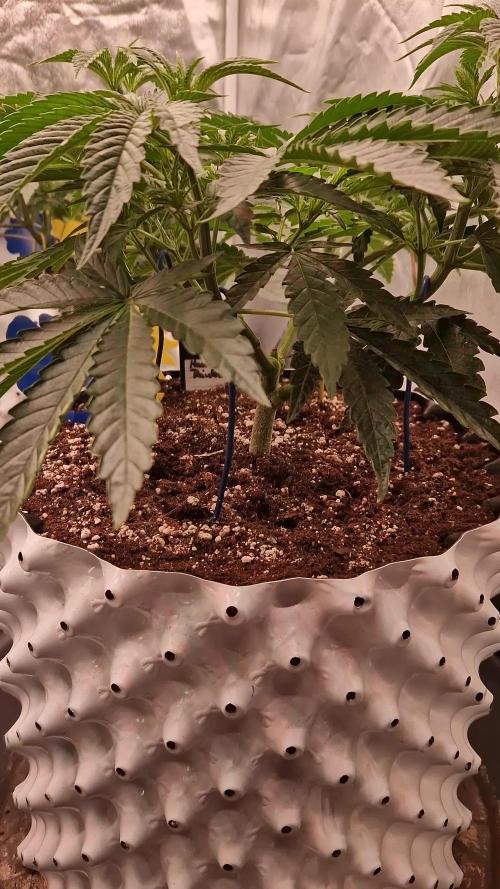
Allright! After the suspected light stress last week, the plants are in their second day of 18/6 light schedule and it looks like they are recovering. The front-left plant's upper leafs seem to be straightening out and overall the plants look healthier than last week 👌. I plan to measure the light intensity, but as things look now, there were two plants that were more susceptible to stress from the LED lights. It's not what you want in a grow, but it has taught me a valuable lesson. Don't just blindly assume a plant can handle 100% of the grow light in the third week ✌️☘️ In the end I don't think it affected the grow that much. The plant on the left corner in the back is a bit taller compared to the rest, but all plants look healthy and ready to start blooming! I have applied some LST clips on the side branches of the tallest plant. This guides the branches sideways and creates a more open structure. You can check them out at https://www.royalqueenseeds.com/growing/533-bending-clips.html 🌿🌿🌿 Mid-week update The plants have grown very fast this week and now they're all in bloom ✌️ Because of the fast growth, I've removed some of the fanleafs in the canopy, and fan leafs and small branches in the lower parts of the plants. I use the leafs for tea with liquorice in the morning and at dinnertime I chop them up for a mixed salad. The taste is really good and raw Cannabis is super healty as well.
Likes
17
Share
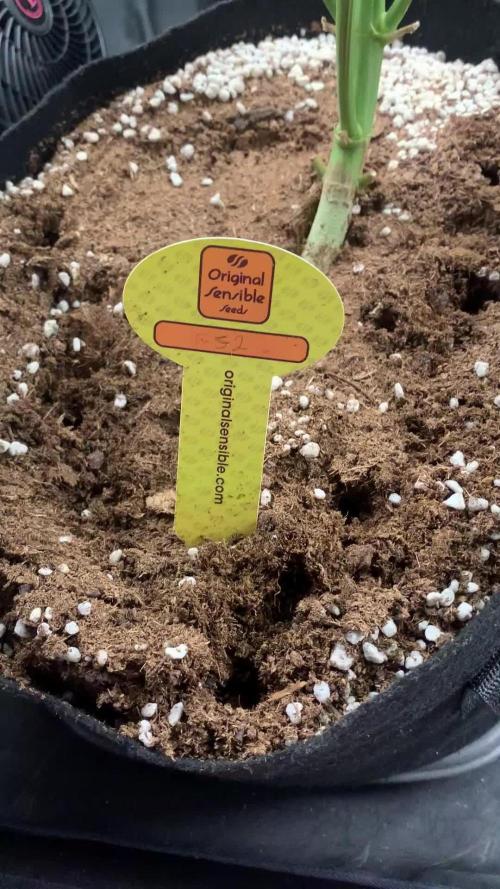
Runtz Female 7Lpot & 7 weeks. Ready to clone in the next few days. Week 7 of the Green Sensation test. Mother plant is growing at an extremely low rate, its focus was on leaf growing so over the week. I starting removing and the plant is starting to take shape. I think I'll be able to grab a nice pair of clones in 5-7 days. Days 42-46 Slowly over the past few days. I took all of the fan leaves off 1 set a day. Kept the feed low to not stress her. Hopefully I can get 2 good clones. Keeping everything simple as stated in the past few weeks. (If you want more info read back.) Ppm kept between 3-350 and master root, etc. All detailed in detail. Day 47-48 Plant has finally started growing its nodes. The two top ones are ready to go. didn't remove any leaves. I'll veg this for 4 more weeks and flip. As I've said before. This one will be kept on Xpert Nutrients. Day 49 Pheno is doing well. Amazing growth the past 24 hrs. She's coming into a real stride. I'll take 2 clones ready to start the Green Sensation Day 50 2x clones have been removed. 20% off Zamnesias entire catalogue of seeds:ZAMMIGROW2024 20% off XPERT NUTRIENTS/KANNABIA with code:GGST 20% off Oringal Sensible Seeds with code:
Likes
27
Share
September 10th, Like I mentioned in my last post. She started flowering. But i was truly amazed The flowering of rhis girl from the week is nothing like what i have witnesssed so far in my grows outdoor. Usually outdoors, plants preflower and stack up for ages.(4weeks or so) This Killer kush seems to skip time and pop out nugs all at once. Tiny balls all over this plant now. Buds ..inside, outside and.in between Cant wait so wait to see how this one progresses during weeks to come ! Weather was stormy for a few days. Fortunatly more sunshine is on it's way...according to weather model.
Likes
3
Share
Likes
16
Share
@m0use
Follow
plants are looking great, nice and thick and growing well. Smells are increasing and so is bud density. Giving them water and the occasional top dressing, They should be fine till harvest now. Added in some bokashi grains to the medium to help unlock even more potential for the plants and nutrient uptake. If that's how it works, more a less kitchen sink mentality and does not seem to hurt. Going to be hard to check the trichomes on this plant as it is so dark but will need to keep and eye on it in the next few weeks and it will be getting close to its estimated 13w harvest date. I made a little tea out of some of the flower the spider mites/thrips where not touching. in hopes some of the extract will stay on the plant and prevent them from eating it, I honestly can't tell if it did a thing, I like to think it did something but doubtful. Also got my hands on a bunch of predator mites. There where a bit past the BB date so hopefully they will still be active/alive. Side note uploading videos into the diaries is great and all, but takes to long to resize and process, can't hit save till its all done... no idea what its doing in the backend.
Likes
4
Share
Welcome to week 8 of flower!! Things are really starting to get heavy and loaded in frost! I will be checking the trichomes this week to see what plants are nearing the end and which ones will still need a bit more time to mature and finish. To say the least Im very excited to get to the finish line with these ladies! Huge shout outs go to @MarsHydroLED and Hidden Vault Genetics for their dedication on making stellar gear that making growing extra fun and really easy. Huge HUGE shout outs go to all my followers and to the people who stop into the diary alike to show their support! Keep on inspiring to grow! -The Projexx Day#50F Some of the ladies are still putting on some mass! Day#51F Pictures N/A. Macmelonz and Banana Smoothie #1 will deff need more time to finish then the rest of the ladies in this room! Day#52F Started removing some leaves from the bottom , I will be looking to continue this until harvest day. Day#53F I knew I should have installed the second net, Some of the flowers are leaning right over now haha. Going to get some stakes to add into the buckets for some support. Day#54F Checked the trichomes looking like 6 of the 8 plants will be starting their flush while Macmelonz and Banana Smoothie #1 will continue to feed for a bit longer before starting to flush. Day#55F Really digging trichome production on Creamy Cereal #2 , she's got a wild Lucky Charms aroma to her that's quite unique.
Likes
5
Share
@Ensign420
Follow
Greetings fellow growers 🖖 and welcome to my first grow ever. This adventure actually started several months ago when I decided to stop buying flower from dispensaries and just grow my own bud. How hard can it be!? This is actually my second seed of this strain. The first bean sadly died due to over watering (sorry girl, RIP). I was literally watering the cube to the point where water was dripping from the bottom, then heavily sprayed the humidity dome and tray with the vents completely closed. Everyday. Multiple times. I never let the dome or try dry out. So after about 8 days of not sprouting, there was a funky smell of rot. So that was that. Later I learned that rockwool retains a lot of water and can easily drown seeds. So a wet/dry cycle is best for rockwool germination. So even after hours of researching and digging through forums and tutorial videos, I was still under prepared for this journey. Did not consider how delicate the germination phase is. Oh well. Lesson learned. Reset and try again! I hope everyone is safe and stoned during this corona crisis. Just like everyone else in the world, I want this pandemic to be over with. But in the meantime, let's grow some weed! 🖖 [START OF WEEK 01] Day 01 - Monday - 08/03/20 - Total Days: 001 ----------------------------------- - [0830]: Light Schedule: 24Hrs/0 --- Soaked cube in 5.5 PH water for 10 min. Did not shake water out. --- NO NUTES! Only PH'd down to control the PH levels. --- Did not use the default hole (way too deep). --- Flipped cube upside down and made a shallow hole for the seed (less than 0.25" deep). --- Placed seed in and pinched hole close. No additional water added. --- Sprayed the tray and dome with straight water (5.5 PH). --- Vents are cracked opened a for ventilation (about 1/4 opened each). --- Distance between the light and tray was 53" --- AC was set to 80 °F --- Exhaust fan was set to 86 °F --- Room average temp was at 85 °F --- Dome humidity was at 85-99% when sprayed. --- Allowing to completely dry before respraying. - [2200]: Dome and tray were completely dry! Sprayed only tray and dome with more water. Day 02 - Tuesday - 08/04/20 - Total Days: 002 ----------------------------------- - [0845]: Sprayed dome and tray in the morning. Everything was dry. --- Hoping for the best! - [2130]: Everything was dry again, so sprayed dome and tray at night along with a light spray on the cube. Day 03 - Wednesday - 08/05/20 - Total Days: 003 ----------------------------------- - [0830]: Everything was dry again. Resprayed dome and tray. Slightly sprayed cube. - [2125]: Hooo damn!! She popped! Am little stub is visible! Resprayed dome and tray again. --- Still going 24/0 for lights. - [+0033]: Just checked up on her and I swear she grew a bit taller! Getting excited! Day 04 - Thursday - 08/06/20 - Total Days: 004 ----------------------------------- - [0845]: Wow! Went from a little stub to fully sprouted overnight! Everything was pretty dry again so resprayed dome and tray. - [2200]: Tap root is visible! Over 1" long too! Just resprayed dome and tray again. -- Going to prep for hydroton transplant tomorrow! Day 05 - Friday - 08/07/20 - Total Days: 005 ----------------------------------- - [0930]: She keeps growing! -- Added a bit of CalMag to the spray bottle (8 drops to 650ml of distilled water). Resprayed dome and tray. Water was at a 5.4 PH with 141 PPM. - [1045]: Prepped the bubble bucket with 4.5gal of water. Water is high enough to reach about 0.25" above the bottom of the net pot. --- Added 3 drops of Superthrive --- Added 3.5ml of CaliMagic --- Added 2ml Hydroguard --- Then PH'd down to 5.6 --- Solution Strengh: 120 PPM --- Water chiller is set to 20 °C - [1100]: Transplant time! --- Filled the net basket 1/3 with hydroton. When placed in the bucket, air bubbles are not visible, but are slightly below the surface (slight digging will reveal the water/bubbles below). --- Removed plastic on rockwool cube and placed in basket, then filled around and covered with hydroton. Making sure to block any light from passing through the net pot and into the nutrient solution. --- Covered with a half-bottle dome sprayed with the CalMag water from earlier. --- Hoping for the best! - [1300]: Raised Bucket 5" higher. Now light distance is 48" to top of bucket. - [1820]: Lowered tent exhaust temp to 76 °F --- Lowered AC to 75 °F --- Raised bucket even higher so light distance is 30" to top of bucket. - [2300]: Looking good! --- Sprayed dome and surrounding hydroton with more CalMag water. --- Attached timer to light! So new 18 Hrs On/6 Hrs Off light schedule. --- Lights On: [1600] (4pm) --- Lights Off: [+1000] (10am the next day) --- Decided to go with lights on during the evening/night and off during the later mornings/afternoon (the hottest part of the day) to see if temps can be controlled better. --- Please survive girl! Day 06 - Saturday - 08/08/20 - Total Days: 006 ----------------------------------- - [0800]: Everything was dry. Resprayed hydroton and dome. - [2000]: Here first night cycle seemed to go well! Get'n taller! --- Dry again. Removed the dome. --- PH went up to 6.5 so PH'd down to 5.7 --- Ran the top feed drip ring for a bout a minute to wet the hydroton and rockwool with the nutient solution. ---Too scared to leave the top feed on 24hrs (I don't want over water her and cause dampening-off). Will let dry before re-watering. - [2100]: After closer inspection, I think she's looking a bit yellow. --- Decided to add a bit of grow nutes to the bubbler solution. --- Added 2ml of Sensi Grow A --- Added 2ml of Sensi Grow B --- Solution strength after adding more nutes: 176 PPM --- PH went up to 6 --- I hope that the extra chelating properties of the 'PH Perfect' solution is enough of a buffer for proper nutrient uptake. Day 07 - Sunday - 08/09/20 - Total Days: 007 ----------------------------------- - [0800]: Water dropped a bit (mostly due to evaporation) so solution strength was at 190. --- Checked PH again. Was still at 6, so PH'd down to 5.4 --- Ran the top feed for a minute to wet the hydroton a bit. - [0915]: Since she's looking perky but still a bit yellow. So decided to up the nutrient concentration even more before lights out. --- Added 2ml more of Sensi Grow A --- Added 2ml more of Sensi Grow B --- Solution strength after adding more nutes: 199 PPM --- PH went up to 5.8 - [1700]: Checked nutrients. --- PH: 5.9 --- Solution strength: 202 PPM --- Added 4ml of Voodoo Juice --- Added 4ml of B-52 --- PH after adding more nutes: 5.9 --- Solution strength after adding more nutes: 238 PPM - [2130]: Decided to make a new foliar spray to address the continued yellowing. --- Started with 500ml of distilled water. --- Added 3 drops of CaliMagic --- Added 3 drops of Sensi Grow A --- Added 3 drops of Sensi Grow B --- Added 3 drops of B-52 --- Added 1 drop of Superthrive --- Solution strength: 164 PPM --- PH was at 5.9 and did not adjust. --- Gave her one spray. --- Also sprayed the surrounding hydroton. [END OF WEEK 01]
Likes
7
Share
@BIYEI
Follow
Floracion (Tiempo estimado 64 dias) Segunda Semana de Floracion 15/01/2024 - 5:00hrs y 22hrs: Se verifican parámetros básicos del agua, mantener cuidados específicos. Agua de osmosis: Ph 6.0, PPm 1000-1250, Ec 2.0-2.5, Temperatura 20°C - 26°C, Humedad 75% Ambiente: Temperatura 24 °C, Humedad 65%, Ventilación 15%, 12 hrs de luz , 12 hrs de obscuridad. 16/01/2024 - 5:00hrs y 22hrs: Se hace cambio de solucion nutritiva, con los mismos parametros de la semana, Se lavan recipientes, Se verifican parámetros básicos del agua, mantener cuidados específicos. Agua de osmosis: Ph 6.0, PPm 1000-1250, Ec 2.0-2.5, Temperatura 20°C - 26°C, Humedad 75% Ambiente: Temperatura 24 °C, Humedad 65%, Ventilación 15%, 12 hrs de luz , 12 hrs de obscuridad. 17/01/2024 - 5:00hrs y 22hrs: Se verifican parámetros básicos del agua, mantener cuidados específicos. Agua de osmosis: Ph 6.0, PPm 1000-1250, Ec 2.0-2.5, Temperatura 20°C - 26°C, Humedad 75% Ambiente: Temperatura 24 °C, Humedad 65%, Ventilación 15%, 12 hrs de luz , 12 hrs de obscuridad. 18/01/2024 - 5:00hrs y 22hrs: Se coloca una red extra para separar los tallos secundarios y entre mas la luz entre las ojas, Se verifican parámetros básicos del agua, mantener cuidados específicos. Agua de osmosis: Ph 6.0, PPm 1000-1250, Ec 2.0-2.5, Temperatura 20°C - 26°C, Humedad 75% Ambiente: Temperatura 24 °C, Humedad 65%, Ventilación 15%, 12 hrs de luz , 12 hrs de obscuridad. 19/01/2024 - 5:00hrs y 22hrs: Se verifican parámetros básicos del agua, al acomodar bien los tallos secundarios por la red por accidente troce una rama, coloque savila para ver si reconstruia la pared celular rota, queda en observacion, mantener cuidados específicos. Agua de osmosis: Ph 6.0, PPm 1000-1250, Ec 2.0-2.5, Temperatura 20°C - 26°C, Humedad 75% Ambiente: Temperatura 24 °C, Humedad 65%, Ventilación 15%, 12 hrs de luz , 12 hrs de obscuridad. 20/01/2024 - 5:00hrs y 22hrs: Se verifican parámetros básicos del agua, no se observa mejoria asi que se procede a cortar ese tallo segundario, mantener cuidados específicos. Agua de osmosis: Ph 6.0, PPm 1000-1250, Ec 2.0-2.5, Temperatura 20°C - 26°C, Humedad 75% Ambiente: Temperatura 24 °C, Humedad 65%, Ventilación 15%, 12 hrs de luz , 12 hrs de obscuridad. 21/01/2024 - 5:00hrs y 22hrs: Se verifican parámetros básicos del agua, mantener cuidados específicos. Agua de osmosis: Ph 6.0, PPm 1000-1250, Ec 2.0-2.5, Temperatura 20°C - 26°C, Humedad 75% Ambiente: Temperatura 24 °C, Humedad 65%, Ventilación 15%, 12 hrs de luz , 12 hrs de obscuridad.
Likes
4
Share
@Adrrys
Follow
10 semanas desde germinación día 11 de abril hasta corte viernes 25 de junio (día 69 corte) cultivada en maceta de 11 litros con tierra plagron all mix, inicio de floración en semana 5, día 20 de mayo
Likes
99
Share
End of this winter grow! Those ladies have been a pleasure to grow even if the very low temps may have had a negative impact. I also messed up by boosting them a bit too much before the flush but I think it helped densifing the buds in the end. Smell is awesome, trichs density is good as well as bud density, can't wait to vape test her!! My first attempt in lst was maybe more hst like, broke a few branches, stressed them too much... So I will be more gentle next time and I hope the hardware I'm working on will help me in that.
Likes
5
Share
Likes
78
Share
@AsNoriu
Follow
Day 172. Some strains ended up frosty, smelly and nuggy, so I already have 76 g from first Strawberry, rest should bring some buds too, couple plants will go untrimmed to my friends as presents, one was already given away ... Think I will have like 300 g easy, and my friends got same amount as presents. Not a bad project, with loads of issues, happily almost no care was given or needed, so I count it as a result achieved : 1. I know that Hermie is bringing other hermies. 2. UK weather is only for autos, that lesson should be learnt long time ago, but I still hope to find mold resilient strain... No updates or other strain harvests will be done, have no time to play ... Happy Growing !!!
Likes
11
Share
@sweetkaya
Follow
The ladies are growing fine and faster. Fertigating till run-off. Light increased at 50%
Likes
13
Share
Day 14, some supercropping Day 15 .. it’s under control 😂🤣 Day 19 lights almost maxed to tent height unless I zip tie led to the top ceiling frame, last bit of monster cropping. Lost 2 top nugs to physical led burn but it’s ok. Everything is fine. Still going very hard on soluble N, and Pk along with b+, fishsh!t, microbial mass, humic acid. Carbs every day with organic booster
Likes
60
Share
This week the weather is better. The buds are getting fat and she is developing well. Terpes are amazing, sweet fruits and fresh mint.
Likes
47
Share
What's in the soil? What's not in the soil would be an easier question to answer. 16-18 DLI @ the minute. +++ as she grows. Probably not recommended, but to get to where it needs to be, I need to start now. Vegetative @1400ppm 0.8–1.2 kPa 80–86°F (26.7–30°C) 65–75%, LST Day 10, Fim'd Day 11 CEC (Cation Exchange Capacity): This is a measure of a soil's ability to hold and exchange positively charged nutrients, like calcium, magnesium, and potassium. Soils with high CEC (more clay and organic matter) have more negative charges that attract and hold these essential nutrients, preventing them from leaching away. Biochar is highly efficient at increasing cation exchange capacity (CEC) compared to many other amendments. Biochar's high CEC potential stems from its negatively charged functional groups, and studies show it can increase CEC by over 90%. Amendments like compost also increase CEC but are often more prone to rapid biodegradation, which can make biochar's effect more long-lasting. biochar acts as a long-lasting Cation Exchange Capacity (CEC) enhancer because its porous, carbon-rich structure provides sites for nutrients to bind to, effectively improving nutrient retention in soil without relying on the short-term benefits of fresh organic matter like compost or manure. Biochar's stability means these benefits last much longer than those from traditional organic amendments, making it a sustainable way to improve soil fertility, water retention, and structure over time. Needs to be charged first, similar to Coco, or it will immobilize cations, but at a much higher ratio. a high cation exchange capacity (CEC) results in a high buffer protection, meaning the soil can better resist changes in pH and nutrient availability. This is because a high CEC soil has more negatively charged sites to hold onto essential positively charged nutrients, like calcium and magnesium, and to buffer against acid ions, such as hydrogen. EC (Electrical Conductivity): This measures the amount of soluble salts in the soil. High EC levels indicate a high concentration of dissolved salts and can be a sign of potential salinity issues that can harm plants. The stored cations associated with a medium's cation exchange capacity (CEC) do not directly contribute to a real-time electrical conductivity (EC) reading. A real-time EC measurement reflects only the concentration of free, dissolved salt ions in the water solution within the medium. 98% of a plants nutrients comes directly from the water solution. 2% come directly from soil particles. CEC is a mediums storage capacity for cations. These stored cations do not contribute to a mediums EC directly. Electrical Conductivity (EC) does not measure salt ions adsorbed (stored) onto a Cation Exchange Capacity (CEC) site, as EC measures the conductivity of ions in solution within a soil or water sample, not those held on soil particles. A medium releases stored cations to water by ion exchange, where a new, more desirable ion from the water solution temporarily displaces the stored cation from the medium's surface, a process also seen in plants absorbing nutrients via mass flow. For example, in water softeners, sodium ions are released from resin beads to bond with the medium's surface, displacing calcium and magnesium ions which then enter the water. This same principle applies when plants take up nutrients from the soil solution: the cations are released from the soil particles into the water in response to a concentration equilibrium, and then moved to the root surface via mass flow. An example of ion exchange within the context of Cation Exchange Capacity (CEC) is a soil particle with a negative charge attracting and holding positively charged nutrient ions, like potassium (K+) or calcium (Ca2+), and then exchanging them for other positive ions present in the soil solution. For instance, a negatively charged clay particle in soil can hold a K+ ion and later release it to a plant's roots when a different cation, such as calcium (Ca2+), is abundant and replaces the potassium. This process of holding and swapping positively charged ions is fundamental to soil fertility, as it provides plants with essential nutrients. Negative charges on soil particles: Soil particles, particularly clay and organic matter, have negatively charged surfaces due to their chemical structure. Attraction of cations: These negative charges attract and hold positively charged ions, or cations, such as: Potassium (K+) Calcium (Ca2+) Magnesium (Mg2+) Sodium (Na+) Ammonium (NH4+) Plant roots excrete hydrogen ions (H+) through the action of proton pumps embedded in the root cell membranes, which use ATP (energy) to actively transport H+ ions from inside the root cell into the surrounding soil. This process lowers the pH of the soil, which helps to make certain mineral nutrients, such as iron, more available for uptake by the plant. Mechanism of H+ Excretion Proton Pumps: Root cells contain specialized proteins called proton pumps (H+-ATPases) in their cell membranes. Active Transport: These proton pumps use energy from ATP to actively move H+ ions from the cytoplasm of the root cell into the soil, against their concentration gradient. Role in pH Regulation: This active excretion of H+ is a major way plants regulate their internal cytoplasmic pH. Nutrient Availability: The resulting decrease in soil pH makes certain essential mineral nutrients, like iron, more soluble and available for the root cells to absorb. Ion Exchange: The H+ ions also displace positively charged mineral cations from the soil particles, making them available for uptake. Iron Uptake: In response to iron deficiency stress, plants enhance H+ excretion and reductant release to lower the pH and convert Fe3+ to the more available form Fe2+. The altered pH can influence the activity and composition of beneficial microbes in the soil. The H+ gradient created by the proton pumps can also be used for other vital cell functions, such as ATP synthesis and the transport of other solutes. The hydrogen ions (H+) excreted during photosynthesis come from the splitting of water molecules. This splitting, called photolysis, occurs in Photosystem II to replace the electrons used in the light-dependent reactions. The released hydrogen ions are then pumped into the thylakoid lumen, creating a proton gradient that drives ATP synthesis. Plants release hydrogen ions (H+) from their roots into the soil, a process that occurs in conjunction with nutrient uptake and photosynthesis. These H+ ions compete with mineral cations for the negatively charged sites on soil particles, a phenomenon known as cation exchange. By displacing beneficial mineral cations, the excreted H+ ions make these nutrients available for the plant to absorb, which can also lower the soil pH and indirectly affect its Cation Exchange Capacity (CEC) by altering the pool of exchangeable cations in the soil solution. Plants use proton (H+) exudation, driven by the H+-ATPase enzyme, to release H+ ions into the soil, creating a more acidic rhizosphere, which enhances nutrient availability and influences nutrient cycling processes. This acidification mobilizes insoluble nutrients like iron (Fe) by breaking them down, while also facilitating the activity of beneficial microbes involved in the nutrient cycle. Therefore, H+ exudation is a critical plant strategy for nutrient acquisition and management, allowing plants to improve their access to essential elements from the soil. A lack of water splitting during photosynthesis can affect iron uptake because the resulting energy imbalance disrupts the plant's ability to produce ATP and NADPH, which are crucial for overall photosynthetic energy conversion and can trigger a deficiency in iron homeostasis pathways. While photosynthesis uses hydrogen ions produced from water splitting for the Calvin cycle, not to create a hydrogen gas deficiency, the overall process is sensitive to nutrient availability, and iron is essential for chloroplast function. In photosynthesis, water is split to provide electrons to replace those lost in Photosystem II, which is triggered by light absorption. These electrons then travel along a transport chain to generate ATP (energy currency) and NADPH (reducing power). Carbon Fixation: The generated ATP and NADPH are then used to convert carbon dioxide into carbohydrates in the Calvin cycle. Impaired water splitting (via water in or out) breaks the chain reaction of photosynthesis. This leads to an imbalance in ATP and NADPH levels, which disrupts the Calvin cycle and overall energy production in the plant. Plants require a sufficient supply of essential mineral elements like iron for photosynthesis. Iron is vital for chlorophyll formation and plays a crucial role in electron transport within the chloroplasts. The complex relationship between nutrient status and photosynthesis is evident when iron deficiency can be reverted by depleting other micronutrients like manganese. This highlights how nutrient homeostasis influences photosynthetic function. A lack of adequate energy and reducing power from photosynthesis, which is directly linked to water splitting, can trigger complex adaptive responses in the plant's iron uptake and distribution systems. Plants possess receptors called transceptors that can directly detect specific nutrient concentrations in the soil or within the plant's tissues. These receptors trigger signaling pathways, sometimes involving calcium influx or changes in protein complex activity, that then influence nutrient uptake by the roots. Plants use this information to make long-term adjustments, such as Increasing root biomass to explore more soil for nutrients. Modifying metabolic pathways to make better use of available resources. Adjusting the rate of nutrient transport into the roots. That's why I keep a high EC. Abundance resonates Abundance.
Likes
5
Share