The Grow Awards 2026 🏆
Likes
Comments
Share
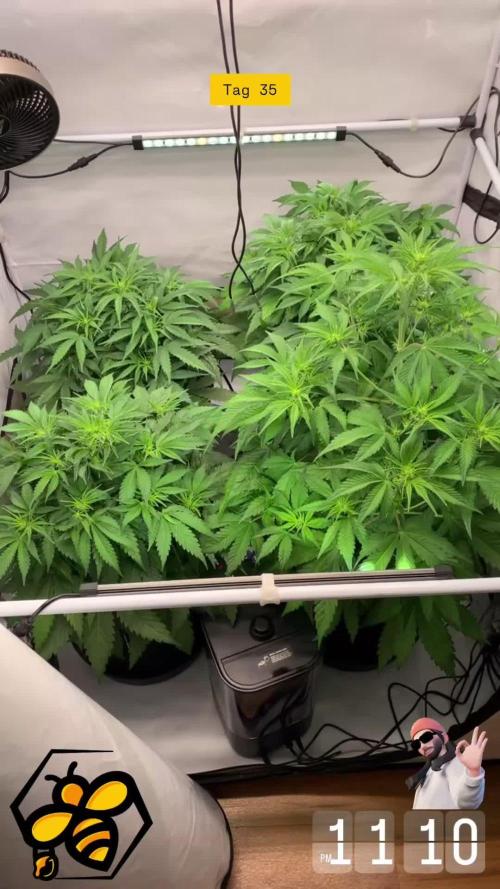
Another week down a whole week of 12/12 and I won’t say she’s stretching yet, I would have thought ild see son pistols by now but no.i know she’s healthy the cutting I took only took two days to fully root A few new things to add to the list of nutrients, this week she’s had a heavy top dress. Reaper, soil candy, and barley to kick start bloom, grow plus to make sure she has enough to stretch properly and the knf. Which I’ve add fermented fruit juice to now for bloom, Fermented fruit juice - I’ve gone hard to ferment this properly since using shop bought fruits, Bananas for potassium, blackberries and blueberries because that’s how I imagine a moonberry would taste 😂 I know it’s no going to influence the terps but still LAB for microbes and jsm ( leaf mould and potato in water to collect microbes in the water) And finally molasses. This brew took about three weeks. The light stayed the same high flipped to 12 hours and turned up to 75%. She will stay there until the plant reaches 30cm from the light. I thinkkkkk that wraps this week up might be a bit boring from here on out work wise butttt will be exciting watching her blow up, till next week. Let’s get it 💪🏽
Likes
8
Share
Wetter war wieder sehr Abwechslungsreich. Die Photos wachsen weiter gut. Das Stickstoff Reservoir (hornspäne als Langzeit Dünger) ist noch nicht aufgebraucht. Larry Lemon und AK wachsen gleichermaßen gut und verzweigen schön. Die automatischen sind in der vollblüte und stehen noch ca. 2 Wochen, wenn vorher kein Schimmel kommt... Soweit so gut 👍 bis nächste Woche ✌️
Likes
Comments
Share
@madlangs
Follow
All going well. No problems 1.11.25 WW 43cm and 31cm Pineapple 29cm Afgooey 37cm n lights 48cm & 48cm Sleepy Joe 29cm Papaya zoap 53cm Pure glitter 18cm 1.11.25 Pure glitter 2L
Likes
371
Share
D36. We started the sixth week of veg, and the girls are rocking it in the tent. Today, I moved the humidifier to the front and installed the scrog net. I'll let the girls fill the net before flipping them into flowers. I gave each girl 2 liters of water @ pH 6.4, with 10ml/liter homemade bokashi juice. ------------------------------ D38. I gave each girl 2-5-liters of water @ pH 6.4, with 10ml of humic acid. ------------------------------ D39. The girls are slowly filling in the scrog. I'll leave them for another few days and then flip at the start of next week. Removed a few leaves below the scrog. (I like to defoliate as I go along.) I moved the mushroom kit over to the side of the tent. No shrooms yet, but it will be more out of the way there. ------------------------------ D40. Brewed a simple compost tea (worm castings, rock dust, molasses) and gave each girl 2 liters @ pH 6.4. These ladies don't like too much light during veg, and I'm seeing taco leaves toward the end of the day, indicating that they have had enough. I will slightly drop the DLI tomorrow and see how they respond. ------------------------------ D42. The last day in the sixth and final week of veg. The girls are looking great! The scrog is a bit empty in the middle of the second girl, but I'm hoping some lower branches will fill those holes in the coming days. Healthy and vibrant, and they are ready to move on. I flipped the lights to the flower-inducing program after the girls went to sleep to give them a fresh start when waking up. The clones I took last week have rooted, and I'll transplant them into 1-liter pots tomorrow. I hooked up a drip watering system as I'll be traveling soon, and I want enough time to dial it in correctly before leaving. Finally, I gave the girls a fulvic acid foliar spray. One of their last foliar sprays as we're heading into flower. ------------------------------
Likes
9
Share
Vamos familia, es la cuarta semana de floración, y estás Kritical aparte de carencias que vamos a solventar ya, van progresando bastante bien, las flores ya están agarrando bien los tricomas y ya empiezan a brillar de por si. Es una variedad bastante rápida a ver si soluciono las carencias esta semana y ya comenzamos recta final. Agrobeta: https://www.agrobeta.com/agrobetatiendaonline/36-abonos-canamo Mars hydro: Code discount: EL420 https://www.mars-hydro.com/ Las maximas de temperatura no superan los 26 grados y las mínimas no bajan 20, así que no me puedo quejar. Los niveles de humedad también son los correctos van entre 50%/65% de humedad relativa. Por supuesto el Ph lo estamos dejando alrededor de 6. Hasta aquí es todo, buenos humos 💨💨💨.
Likes
12
Share
@Adrrys
Follow
Esta semana la GG auto 1 se le ha doblado la punta por el viento que hizo
Likes
16
Share
Good day guys! Well it's been a beautiful adventure with these baby's! Il be chopping them up in the coming days.. Will leave them a full 2 days in the dark to boost tricomes and then down they go! You guys have to try The great white shark guys! Unbelievable strain to grow! Thank you greenhouse genetics 👍🏻
Likes
63
Share
@AsNoriu
Follow
Day 65. Girls are okish, calmag mini def is still after me, now even Gorillas show off some reddish leaves stems, hope they just cant keep up with speed and amount... In flowering its bad to have unhealthy plants, so CalMag today and full bloom tommorrow eve. Girls started to drink really fast. Control garden is my joy now, Outside Cookie is a pity tho.... We shall see.... In plans to raise lights back to 60 cm from canopy, girls stretched a bit, need to adjust and i just cant wait couple more weeks till first round of defoliation :))) hope to do it on day 18 of flower latest.. Canopy is too packed, need better air and light. Thinking to get heavy artillery out, epsom salt dresing :)) thats my last hope to fight that reddish-violet and make it green again. It takes two weeks to kick inn, but works always for me... Day 66. Girls are happy, hungry and in full blast. Control garden has such healthy green its hard to describe... Cookies on other hand streched as f@%k, will have to lolitop them really high, so no proper grow and small harvest, taste is the only thing that can save them... Worthless for now.... All girls streched like 5 cm in one day, they loved CalMag. Lights been raised like 7 cm. Lets see... Day 68. Changed plans a bit, girls got silica acid with plain water and they loved it! They are happy campers and grow really fast, now only to have patience till defoliation. Girls are super packed, will have to care about them 2x more than avarage, thinking to plug in conditioner, but its still coldish weather outside, so hope to last two more weeks without that beast, no tv or orher aplaincies while this beast runs :)))) Day 68, evening. First time checked my girls after light switch to flower and i am lost, will they make it? Canopy height is like 30-35 cm, they had small lolitopings on lower levels during vegetation ( see week 8 first video just mute it, they where striped like this on week 5 as well) in video its even hard to see, but its jungles!!!! Have one fresh air fan, double fan set with carbon out, inside two standing fans and powerful conditioner, will i make it with only defoliation or should i clear them hard aswell? Never growed such low and dence plants before. Please advice or show diary to read. Plus a 30 days old Incredible Bulk, almost no feed, no germination or transplanting, straight to soil and no direct light above. Hope you will see this same strain grower :) Peace.
Likes
38
Share
9/18: I harvested one of them. Washed and hung to dry. 9/21: I harvested a couple more. Washed and hung to dry. 9/23: I harvested the last one. Washed and hung to dry. 10/7: I smoked some. I liked it. 10/8: I smoked some more. I'm really glad I have almost 15 ounces of it.😋 a) 69g b) 79g c) 93g d) 84g e) 88g Final thoughts: Easy to grow and train. The two I did some training on produced the most. The buds are dense while growing and remain so after they've dried and started to cure. They redden up beautifully in the jar and have a very mild but sweet minty/flowery smell that comes through in the flavor as well. It's a very strong Sativa buzz which is surprising considering they were the fastest FFT's to finish...among mostly Indica varieties. Potency: 8/10 Yield: 8/10 Flavor: 8/10 Aroma: 8/10 Bag-appeal: 8/10 Trouble-free: 10/10 NOTE: I couldn't find the photos I took of the first one I harvested, but it was the smallest (and stinkiest) of the bunch.
Likes
27
Share
Let’s go day 43!!!! Week went real well , girls started preflower so sometime this week I will be switching up the nutrients for flowering! We are stable and looking super healthy! Can’t wait to see what these ladies do this week! Hope you all enjoy !
Likes
3
Share
09-12-2019 I had to harvest her she was crying out and i couldn't take it no more. I also needed the room for bigger things. I have one seed left of this strain so she will return. I enjoyed my time with her but for now it's time to move to Greener Grows. Scales come in a few weeks but now expecting much as the buds were soft and loose. Thanks everyone for watching!😎
Likes
57
Share
Welcome to Bud Boutique Grow Diary - really appreciate all your love and support :) Dont forget to check out my other current grows! 🗓️ This Week: - Day 38: looking super beautiful - stacking up slowly - both Phenos #1 and #2 got amazing purple leaves - Day 41: look at this color play Thank you for still staying with me 💚 ___________________________________________ --- 🌱 Strain (Sponsor) 🌱 --- 🏷️ PEACH GIRL by Art Genetix https://www.artgenetix.world/product-page/peach-girl --- 🥗 Nutrients and Feeding (Sponsor) - (APTUS Ambassador) --- 🍸 APTUS: full nutrient schedule extreme -- Regulator, N-Boost, P-Boost, CaMg-Boost, K-Boost, Allin1 Liquid, Startbooster, Topbooster, Enzym+ every feeding -- Fulvic-Blast, NutriSpray as Foliar each once a week 🔗 https://aptus-holland.com/ --- ♻️ Grow Control (Sponsor) --- TROLMASTER: TENT-X + LM14 Light Adapter to dim/sunrise/sunset lights + Temp & rH Sensor all remote on App 🔗 https://www.trolmaster.eu/ --- 🚿 PetraGrow (Sponsor) --- CannaFogger Foliar Spray 🔗 https://www.petratools.com/product/petragrow-cannafogger-atomizer-new-mini-fogger --- 🏭 Grow Setup --- 💡LUMATEK Zeus Pro 600 * 🏠🌿 Indoor: Homebox 120x120x200cm (4x4) * 📐🌀 PrimaKlima exhausting Fan 1180m3/h (running on 60-80%) * 🌀 Can Light Filter 800m3/h & 1x Fanbox 1x Dyson fan for Air circulation 🔗 https://lumatek-lighting.com/zeus-600w-pro-29/ 🔗 https://primaklima.com/de/shop/ventilatoren-de/ec-ventilatoren/pk160ec-tc/ 🔗 https://canfilters.com/products/filters/ All Likes and comments are highly appreciated!!! 👨‍🌾 don't forget to check out my Instagram for daily educational content: budboutiquee - Bud Boutique
Likes
14
Share
@Stork
Follow
Day 104 Mon PH 5.8 EC 0.0 DLI 12h PPFD Water 16-24c Day 106 Wed Add ph up PH 5.6 - 5.8 EC 0.0 DLI 12h PPFD Water 16-24c Day 107 Thu PH 5.6- 5.8 EC 0.0 DLI 12h PPFD Water 16-24c Day 109 Sat PH 5.8 EC 0.1 DLI 12h PPFD Water 16-24c
Likes
37
Share
@Hawkbo
Follow
Just started them all on the Green Buzz Liquid Organics and will run it the rest of the way. I'm not going to add much to the line just some calmag, enzymes maybe terpinator I have to experiment with it a little bit. The first feed went extremely well the plants instantly reacted within an hour after the feed especially the next day. The additives in this line barely raised PPM at all which I liked. It also doesnt stink like other liquid organics I've used. This is still one of my favorites I love the structure and seems like it should have some variation from the first pheno. It's going to get its second feed with the GBL nutes today with the rest of the crop. Day 21 of flower.
Likes
35
Share
2x Plants with liqui cannabiz doing very - ghe tri 2x coming along (adjusted their nutes) lets hope for the ge best..ill be doing some fimming through out he week.. Hopefully side branches eill catchup during stretch period.. Looks like 2 showing signs of flowering.. Hectic week ahead @ work - will try my best not 2 f&#k things up..sofar so good.. Had some issues with LC buckets - looks like ektra NSol solving the issue.. Lets see changing all nutes 2morrow
Likes
226
Share
~_~_~_~_~_~_~_~_~_~_~_~_~_~_~_~_~_~_~_~_~_~_~_~_~_~_~_~_~_~_~_~_~_~_~_~_~_~_~_~_~_~_~_~_~_~_~_~_~_~_~_~_~_~_~_~_~_~_~_~_~_~_~_~_~_~_~_~_~_~_~_~_~_~_~_~_~_~_~_~_~_~_~_ 08/13/21: 😺Week 5 is here!!🐱 they're growing fast and the yellowing seems to have corrected on its own (keeping the feeding routine consistent) .. we removed some growth from the mainline and topped at the ends (we decided to try topping at 3rd node for a wider plant, we'll see what happens lol), our goal is for 4-6 mains per side. All the BigBud plants need to be re-potted this week into their final homes..we're running a little low on promix so 50% will be reused..thanks for reading, drop a like if you made it this far lol..we'll update midweek ❤️🐱💡🌱 ~_~_~_~_~_~_~_~_~_~_~_~_~_~_~_~_~_~_~_~_~_~_~_~_~_~_~_~_~_~_~_~_~_~_~_~_~_~_~_~_~_~_~_~_~_~_~_~_~_~_~_~_~_~_~_~_~_~_~_~_~_~_~_~_~_~_~_~_~_~_~_~_~_~_~_~_~_~_~_~_~_~_~_ 8/14/21 😽Everyone was up-potted to 5- 6 gallon containers toady..I also cleaned out a tent and moved a light, creating a space just for the ILGM Big Bud 😺👌 ~_~_~_~_~_~_~_~_~_~_~_~_~_~_~_~_~_~_~_~_~_~_~_~_~_~_~_~_~_~_~_~_~_~_~_~_~_~_~_~_~_~_~_~_~_~_~_~_~_~_~_~_~_~_~_~_~_~_~_~_~_~_~_~_~_~_~_~_~_~_~_~_~_~_~_~_~_~_~_~_~_~_~_ 8/16/21: 😺I think my transplant solution was a little too spicy for them, we're starting to get glossy and claw (pics) but no dead tips yet..definitely water only for a little while... ~_~_~_~_~_~_~_~_~_~_~_~_~_~_~_~_~_~_~_~_~_~_~_~_~_~_~_~_~_~_~_~_~_~_~_~_~_~_~_~_~_~_~_~_~_~_~_~_~_~_~_~_~_~_~_~_~_~_~_~_~_~_~_~_~_~_~_~_~_~_~_~_~_~_~_~_~_~_~_~_~_~_~_ 8/18/21 😻Crazy fast new growth after last topping despite looking over fed.. this seems to be a very forgiving strain.. A+ so far 👊🐱 ~_~_~_~_~_~_~_~_~_~_~_~_~_~_~_~_~_~_~_~_~_~_~_~_~_~_~_~_~_~_~_~_~_~_~_~_~_~_~_~_~_~_~_~_~_~_~_~_~_~_~_~_~_~_~_~_~_~_~_~_~_~_~_~_~_~_~_~_~_~_~_~_~_~_~_~_~_~_~_~_~_~_~_
Likes
8
Share
14-05-2021 (DAY 59) Se realizó el cambio de solución. Las plantas vienen espléndidas y con el Safe roots de Hydrotek ya no tuve mas problemas de raíces. Está entrando la flora mas potente y formándose los Buds.
Likes
25
Share
ANTHOCYANIN production is primarily controlled by the Cryptochrome (CR1) Photoreceptor ( !! UV and Blue Spectrums are primary drivers in the production of the pigment that replaces chlorophyll, isn't that awesome! 1. Diverse photoreceptors in plants Many civilizations, including the sun god of ancient Egypt, thought that the blessings of sunlight were the source of life. In fact, the survival of all life, including humans, is supported by the photosynthesis of plants that capture solar energy. Plants that perform photosynthesis have no means of transportation except for some algae. Therefore, it is necessary to monitor various changes in the external environment and respond appropriately to the place to survive. Among various environmental information, light is especially important information for plants that perform photosynthesis. In the process of evolution, plants acquired phytochrome, which mainly receives light in the red light region, and multiple blue light receptors, including his hytropin and phototropin, in order to sense the light environment. .. In addition to these, an ultraviolet light receptor named UVR8 was recently discovered. The latest image of the molecular structure and function of these various plant photoreceptors (Fig. 1), focusing on phytochrome and phototropin. Figure 1 Ultraviolet-visible absorption spectra of phytochrome, cryptochrome, phototropin, and UVR8. The dashed line represents each bioactive absorption spectrum. 2. Phytochrome; red-far red photoreversible molecular switch What is phytochrome? Phytochrome is a photochromic photoreceptor, and has two absorption types, a red light absorption type Pr (absorption maximum wavelength of about 665 nm) and a far-red light absorption type Pfr (730 nm). Reversible light conversion between the two by red light and far-red light, respectively(Fig. 1A, solid line and broken line). In general, Pfr is the active form that causes a physiological response. With some exceptions, phytochrome can be said to function as a photoreversible molecular switch. The background of the discovery is as follows. There are some types of plants that require light for germination (light seed germination). From that study, it was found that germination was induced by red light, the effect was inhibited by subsequent far-red light irradiation, and this could be repeated, and the existence of photoreceptors that reversibly photoconvert was predicted. In 1959, its existence was confirmed by the absorption spectrum measurement of the yellow sprout tissue, and it was named phytochrome. Why does the plant have a sensor to distinguish between such red light and far-red light? There is no big difference between the red and far-red light regions in the open-field spectrum of sunlight, but the proportion of red light is greatly reduced due to the absorption of chloroplasts in the shade of plants. Similar changes in light quality occur in the evening sunlight. Plants perceive this difference in light quality as the ratio of Pr and Pfr, recognize the light environment, and respond to it. Subsequent studies have revealed that it is responsible for various photomorphogenic reactions such as photoperiodic flowering induction, shade repellent, and deyellowing (greening). Furthermore, with the introduction of the model plant Arabidopsis thaliana (At) and the development of molecular biological analysis methods, research has progressed dramatically, and his five types of phytochromes (phyA-E) are present in Arabidopsis thaliana. all right. With the progress of the genome project, Fi’s tochrome-like photoreceptors were found in cyanobacteria, a photosynthetic prokaryotes other than plants. Furthermore, in non-photosynthetic bacteria, a homologue molecule called bacteriophytochrome photoreceptor (BphP) was found in Pseudomonas aeruginosa (Pa) and radiation-resistant bacteria (Deinococcus radiodurans, Dr). Domain structure of phytochrome molecule Phytochrome molecule can be roughly divided into N-terminal side and C-terminal side region. PAS (Per / Arndt / Sim: blue), GAF (cGMP phosphodiesterase / adenylyl cyclase / FhlA: green), PHY (phyto-chrome: purple) 3 in the N-terminal region of plant phytochrome (Fig. 2A) There are two domains and an N-terminal extension region (NTE: dark blue), and phytochromobilin (PΦB), which is one of the ring-opening tetrapyrroles, is thioether-bonded to the system stored in GAF as a chromophore. ing. PAS is a domain involved in the interaction between signal transduction-related proteins, and PHY is a phytochrome-specific domain. There are two PASs and her histidine kinase-related (HKR) domain (red) in the C-terminal region, but the histidine essential for kinase activity is not conserved. 3. Phototropin; photosynthetic efficiency optimized blue light receptor What is phototropin? Charles Darwin, who is famous for his theory of evolution, wrote in his book “The power of move-ment in plants” published in 1882 that plants bend toward blue light. Approximately 100 years later, the protein nph1 (nonphoto-tropic hypocotyl 1) encoded by one of the causative genes of Arabidopsis mutants causing phototropic abnormalities was identified as a blue photoreceptor. Later, another isotype npl1 was found and renamed phototropin 1 (phot1) and 2 (phot2), respectively. In addition to phototropism, phototropin is damaged by chloroplast photolocalization (chloroplasts move through the epidermal cells of the leaves and gather on the cell surface under appropriate light intensity for photosynthesis. As a photoreceptor for reactions such as escaping to the side of cells under dangerous strong light) and stomata (reactions that open stomata to optimize the uptake of carbon dioxide, which is the rate-determining process of photosynthetic reactions). It became clear that it worked. In this way, phototropin can be said to be a blue light receptor responsible for optimizing photosynthetic efficiency. Domain structure and LOV photoreaction of phototropin molecule Phototropin molecule has two photoreceptive domains (LOV1 and LOV2) called LOV (Light-Oxygen-Voltage sensing) on the N-terminal side, and serine / on the C-terminal side. It is a protein kinase that forms threonine kinase (STK) (Fig. 4Aa) and whose activity is regulated by light. LOV is one molecule as a chromophore, he binds FMN (flavin mononucleotide) non-covalently. The LOV forms an α/βfold, and the FMN is located on a β-sheet consisting of five antiparallel β-strands (Fig. 4B). The FMN in the ground state LOV shows the absorption spectrum of a typical oxidized flavin protein with a triplet oscillation structure and an absorption maximum wavelength of 450 nm, and is called D450 (Fig. 1C and Fig. 4E). After being excited to the singlet excited state by blue light, the FMN shifts to the triplet excited state (L660t *) due to intersystem crossing, and then the C4 (Fig. 4C) of the isoaroxazine ring of the FMN is conserved in the vicinity. It forms a transient accretionary prism with the tain (red part in Fig. 4B Eα) (S390I). When this cysteine is replaced with alanine (C / A substitution), the addition reaction does not occur. The effect of adduct formation propagates to the protein moiety, causing kinase activation (S390II). After that, the formed cysteine-flavin adduct spontaneously dissociates and returns to the original D450 (Fig. 4E, dark regression reaction). Phototropin kinase activity control mechanism by LOV2 Why does phototropin have two LOVs? Atphot1 was found as a protein that is rapidly autophosphorylated when irradiated with blue light. The effect of the above C / A substitution on this self-phosphorylation reaction and phototropism was investigated, and LOV2 is the main photomolecular switch in both self-phosphorylation and phototropism. It turns out that it functions as. After that, from experiments using artificial substrates, STK has a constitutive activity, LOV2 functions as an inhibitory domain of this activity, and the inhibition is eliminated by photoreaction, while LOV1 is kinase light. It was shown to modify the photosensitivity of the activation reaction. In addition to this, LOV1 was found to act as a dimerization site from the crystal structure and his SAXS. What kind of molecular mechanism does LOV2 use to photoregulate kinase activity? The following two modules play important roles in this intramolecular signal transduction. Figure 4 (A) Domain structure of LOV photoreceptors. a: Phototropin b: Neochrome c: FKF1 family protein d: Aureochrome (B) Crystal structure of auto barley phot1 LOV2. (C) Structure of FMN isoaroxazine ring. (D) Schematic diagram of the functional domain and module of Arabidopsis thaliana phot1. L, A’α, and Jα represent linker, A’α helix, and Jα helix, respectively. (E) LOV photoreaction. (F) Molecular structure model (mesh) of the LOV2-STK sample (black line) containing A’α of phot2 obtained based on SAXS under dark (top) and under bright (bottom). The yellow, red, and green space-filled models represent the crystal structures of LOV2-Jα, protein kinase A N-lobe, and C-robe, respectively, and black represents FMN. See the text for details. 1) Jα. LOV2 C of oat phot1-to α immediately after the terminus Rix (Jα) is present (Fig. 4D), which interacts with the β-sheet (Fig. 4B) that forms the FMN-bound scaffold of LOV2 in the dark, but unfolds and dissociates from the β-sheet with photoreaction. It was shown by NMR that it does. According to the crystal structure of LOV2-Jα, this Jα is located on the back surface of the β sheet and mainly has a hydrophobic interaction. The formation of S390II causes twisting of the isoaroxazine ring and protonation of N5 (Fig. 4C). As a result, the glutamine side chain present on his Iβ strand (Fig. 4B) in the β-sheet rotates to form a hydrogen bond with this protonated N5. Jα interacts with this his Iβ strand, and these changes are thought to cause the unfold-ing of Jα and dissociation from the β-sheet described above. Experiments such as amino acid substitution of Iβ strands revealed that kinases exhibit constitutive activity when this interaction is eliminated, and that Jα plays an important role in photoactivation of kinases. 2) A’α / Aβ gap. Recently, several results have been reported showing the involvement of amino acids near the A’α helix (Fig. 4D) located upstream of the N-terminal of LOV2 in kinase photoactivation. Therefore, he investigated the role of this A’α and its neighboring amino acids in kinase photoactivation, photoreaction, and Jα structural change for Atphot1. The LOV2-STK polypeptide (Fig. 4D, underlined in black) was used as a photocontrollable kinase for kinase activity analysis. As a result, it was found that the photoactivation of the kinase was abolished when amino acid substitution was introduced into the A’α / Aβ gap between A’α and Aβ of the LOV2 core. Interestingly, he had no effect on the structural changes in Jα examined on the peptide map due to the photoreaction of LOV2 or trypsin degradation. Therefore, the A’α / Aβ gap is considered to play an important role in intramolecular signal transduction after Jα. Structural changes detected by SAXS Structural changes of Jα have been detected by various biophysical methods other than NMR, but structural information on samples including up to STK is reported only by his results to his SAXS. Not. The SAXS measurement of the Atphot2 LOV2-STK polypeptide showed that the radius of inertia increased from 32.4 Å to 34.8 Å, and the molecular model (Fig. 4F) obtained by the ab initio modeling software GASBOR is that of LOV2 and STK. It was shown that the N lobes and C lobes lined up in tandem, and the relative position of LOV2 with respect to STK shifted by about 13 Å under light irradiation. The difference in the molecular model between the two is considered to reflect the structural changes that occur in the Jα and A’α / Aβ gaps mentioned above. Two phototropins with different photosensitivity In the phototropic reaction of Arabidopsis Arabidopsis, Arabidopsis responds to a very wide range of light intensities from 10–4 to 102 μmol photon / sec / m2. At that time, phot1 functions as an optical sensor in a wide range from low light to strong light, while phot2 reacts with light stronger than 1 μmol photon / sec / m2. What is the origin of these differences? As is well known, animal photoreceptors have a high photosensitivity due to the abundance of rhodopsin and the presence of biochemical amplification mechanisms. The exact abundance of phot1 and phot2 in vivo is unknown, but interesting results have been obtained in terms of amplification. The light intensity dependence of the photoactivation of the LOV2-STK polypeptide used in the above kinase analysis was investigated. It was found that phot1 was about 10 times more photosensitive than phot2. On the other hand, when the photochemical reactions of both were examined, it was found that the rate of the dark return reaction of phot1 was about 10 times slower than that of phot2. This result indicates that the longer the lifetime of S390II, which is in the kinase-activated state, the higher the photosensitivity of kinase activation. This correlation was further confirmed by extending the lifespan of her S390II with amino acid substitutions. This alone cannot explain the widespread differences in photosensitivity between phot1 and phot2, but it may explain some of them. Furthermore, it is necessary to investigate in detail protein modifications such as phosphorylation and the effects of phot interacting factors on photosensitivity. Other LOV photoreceptors Among fern plants and green algae, phytochrome ɾphotosensory module (PSM) on the N-terminal side and chimera photoreceptor with full-length phototropin on the C-terminal side, neochrome (Fig. There are types with 4Ab). It has been reported that some neochromes play a role in chloroplast photolocalization as a red light receiver. It is considered that fern plants have such a chimera photoreceptor in order to survive in a habitat such as undergrowth in a jungle where only red light reaches. In addition to this, plants have only one LOV domain, and three proteins involved in the degradation of photomorphogenesis-related proteins, FKF1 (Flavin-binding, Kelch repeat, F-box 1, ZTL (ZEITLUPE)), LKP2 ( There are LOV Kelch Protein2) (Fig. 4Ac) and aureochrome (Fig. 4Ad), which has a bZip domain on the N-terminal side of LOV and functions as a gene transcription factor. 4. Cryptochrome and UVR8 Cryptochrome is one of the blue photoreceptors and forms a superfamily with the DNA photoreceptor photolyase. It has FAD (flavin adenine dinucle-otide) as a chromophore and tetrahydrofolic acid, which is a condensing pigment. The ground state of FAD is considered to be the oxidized type, and the radical type (broken line in Fig. 1B) generated by blue light irradiation is considered to be the signaling state. The radical type also absorbs in the green to orange light region, and may widen the wavelength region of the plant morphogenesis reaction spectrum. Cryptochrome uses blue light to control physiological functions similar to phytochrome. It was identified as a photoreceptor from one of the causative genes of UVR8 Arabidopsis thaliana, and the chromophore is absorbed in the UVB region by a Trp triad consisting of three tryptophans (Fig. 1D). It is involved in the biosynthesis of flavonoids and anthocyanins that function as UV scavengers in plants. Conclusion It is thought that plants have acquired various photoreceptors necessary for their survival during a long evolutionary process. The photoreceptors that cover the existing far-red light to UVB mentioned here are considered to be some of them. More and more diverse photoreceptor genes are conserved in cyanobacteria and marine plankton. By examining these, it is thought that the understanding of plant photoreceptors will be further deepened.
Likes
3
Share
Looking better and better each day Hopefully starting 12/12 before the plants fully revegged isnt super detrimental to the whole process.
Likes
11
Share
Creo que me gustan mucho las semillas automáticas no son plantas muy grandes pero si son rápidas y con buena pinta El equipo de fast buds me sorprendió buena genética yo pensando que serían las más pequeñas y una gorila glue está con unos cogollos bastante chonchos y cristalinos super feliz con mis pequeñas auto... happy grow a todos!