The Grow Awards 2026 🏆 






Likes
Comments
Share
@Terpyboyz
Follow
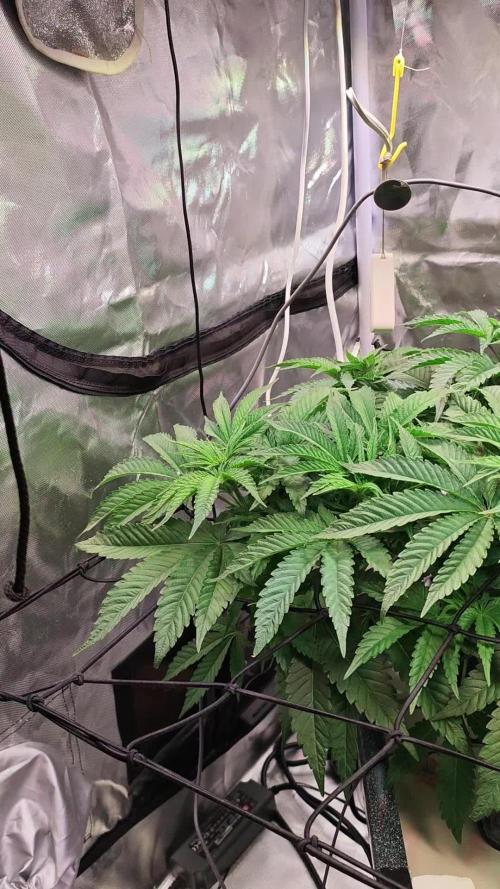
Hi everyone 👊🏻 thanks for checking in 😏, so we have started flowering this week on the bigger tent using the 2 Lumii 720w LEDs, we might or might not run into some hight issues well see…
And we have the other 1.2 tent set up for the clones there under 1 Lumii 720w led delivered until I can another one sorted few weeks 🤙🏻 get them under that for a few weeks then get them flowering as well. Keep eyes open for progress 👌🏻


Likes
82
Share
@Streptokok
Follow
Purple Buds are amazing.I could not be happier with their color, buds are chunky and frosty, the smell is indescribable. It reminds me a certain sweet from the childhood :) and I bet it will taste even better. Later, I will show some more pictures for Industrial CBD which is doing fine. I will move Purple Buds tomorrow out of my tent for two days in the darkness and then - harvest time :) CBD has got one more week to go I think. Happy growing to everyone.


Likes
27
Share
@phobic94
Follow
De plantjes staan nu al een paar dagen in bloei. Ik heb ze paar dagen alleen maar water gegeven omdat ze wat donker van kleur waren nu geef ik weer voeding. Heb net mijn netje geplaatst en binnen paar dagen schakel ik over naar bloeivoeding.


Likes
12
Share
@Exploding_buds
Follow
Pues muy contento de tener por fin esta variedad en mi indoor ya que llevaba tiempo queriendo probarla y me esta sorprendiendo la manera de su crecimiento tan rapido y parejas las 4 iguales!!un 20 de 10 les doy💪🚀🚀🚀🌱

Likes
9
Share
@Staffedition
Follow
Привет друзья.
Наше знакомства продолжается с новым сортом автоцветущих растений от Smail_Seeds сорт ORIGINAL AUTO CHEMZKITTLEZ F1 reg.
Сегодня растению 66 дней.
Растение очень хорошо развивается, ни каких сбоев в генетике не наблюдается.
Шишки наливаются очень хорошо😀
Так же стрессую, что бы получить пыльцу.
Скоро будут феминизированные растения.
Сорт выводим сами.
Смотри мой профиль, у нас всегда есть что то интересное.
Не забудь поставить лайк❤️, если понравилась как прошла неделя
И читайте наш TELEGRAM: https://t.me/smail_seeds
#Smail_Seeds 😀
Likes
120
Share
@OrganicNature420
Follow
Germination date 🌱 02/12/2021
Day 87 02/03/2022
Strain 🍁 Barneys Farm Biscotti Mintz
(Biscotti x Mintz)
THC% • 30% 🤤
💡 Mars Hydro FC-E6500
• Power draw 650W + 5%
• Max coverage 5 x 5
• LED 3978 pcs high quality chips
• Max Yield 2.5g / watt
• Noise level 0 DB
• Removable Driver & Light bars
• Daisy chain
• Fast cool system
https://marshydroled.co.uk/ 🇬🇧
PROMO CODE • (organicnature420) DISCOUNT
https://www.mars-hydro.com/ 🇺🇲
PROMO CODE • (ORG420) DISCOUNT 👍🏻
⛺ Mars Hydro 150 x 150 x 200cm
📤📥 AC infinity 6inch
💧 10lt dehumidifier
❄️ 3.1kw air con system
💉 Nutrients GreenBuzzLiquids 🇩🇪
⭐⭐⭐⭐⭐
Organic Grow Liquid • 1-4ml until 2wk flower
Organic Bloom Liquid • 2-4ml flower stage
Organic More PK • 2-4ml +wk3 of flower
Organic Calmag • 1-2ml/lt whole grow
Fast Plants Spray • first 2wks at night lights off
More Roots • 2-5ml veg +2wks flower
Fast Buds • 5ml 12days before flower until wk1
Humic Acid Plus • 2-5ml whole grow
Growzyme • 2-5ml whole grow
Big Fruits • 2-5ml flower stage
Clean Fruits • 5ml flush 1wk
Ph powder
Root Gel
Living Organics
https://greenbuzzliquids.com/
PROMO CODE • organicnature420 15% off ✌️🏼
🥥 Growing Media • Coco Coir
Notes 📝
Packed on some lovely weight the last week. I could easily flush this tomorrow with clean fruits for the next week but definitely want to see if she will get bigger. Only a slight Amber on the trics so another week will be fine. Girls look a little different, ones alot more ginger than the other but both look fire 🔥
Remember to give GreenBuzzLiquids a follow, I promise you won't be disappointed 👍🏻
Discount codes in bio for Mars and GreenBuzzLiquids 👍🏻 game changers 🏆

Likes
12
Share
@Staffedition
Follow
Привет друзья. Моей растихе сегодня 80 дней.
Растение хорошими темпами приходит в себя.
Через неделю буду переводить на цвет.
Начал применять LST технику на 19 дне и продалжаю применять её через день, а 18 августа добавил ДЕФОЛИЗАЦИЮ
С 20.08 ДЕФОЛИЗАЦИЮ делаю каждые 3,4 дня
С 20.08 LST технику делаю каждые 4.6 дней
На сегодняшний день влажность 54%
5.09.2023 заметил высокий Ph 7.9
С 48 дня Ph не ниже 5.8
На сегодняшний день Ph 6.0
Начал кормить с 60 дня Canna Terra Vega
PPM 550
Погладитель влажности хорошо справляется со своей задачей. Рекомендую
Всем мира и добра!
Не забудь поставить лайк❤️, если понравилась как прошла неделя
И читайте наш TELEGRAM: https://t.me/smail_seeds
#Smail_Seeds 😀
Likes
53
Share
@Pr3m_85
Follow
More than a day in the drying tent and I'll give you the report on the weight, the taste and the effects!
‐-----------------------------------------------------------------------------
FINAL WEIGHT : 153,5 g
Effect : very pleasant. I have the impression of being in a cotton field.
Taste : cream berries 🍓🍓🍓🍓
Peace to all ✌️🏽✌️🏾✌️✌️🏿✌️🏻✌️🏼
------------------------------------------------------------------------------
✔️Pheno 1 : the appearance of the flower is much more purple than the other two phenotypes. Her effect is much more sativa as well.
✔️Pheno 2 : The strawberry taste is much more pronounced. In this phenotype, there is a not at all unpleasant mint aftertaste !!
✔️Pheno 3 : the effect is felt very quickly. In a few seconds, you find yourself in a state of joy. It's very nice !!!!

Processing
Likes
6
Share
@AbbyRose
Follow
These autoflower are just doing better than I could have ever imagined I'll definitely be growing more.
Likes
10
Share
@ZweetZkittlez
Follow
Poda apical tardía pero trabajando fuerte con LST para lograr la estructura de plantas que deseamos. Además para lograr esquejar la genética y poder mantener los fenos que nos gustan.
Sumé a la carpa un feno de Zombie Bride que salió bueno y no queria perderlo. En el video se puede ver.

Likes
6
Share
@gr3g4l
Follow
Semana de lluvias y cuando llueve a resguardo y así llevo mejor controlado el tema de los riegos, de dejar que se mojen con el agua de lluvia me descontrola bastante la alimentación y me limpia el preventivo de las hojas..
Con 70 dias una altura de 166 ctms, la nº1 y 138 ctms la nº4
Siguen floreciendo a buen ritmo al igual que también siguen creciendo. Están en plena jauria y empiezan a deshacerse de las hojas más viejunas. Partes bajas.


Likes
26
Share
@TheCannaProphet
Follow
Week 4
8/9 - All the girls are still moist so no water today as I'll let them dry out a bit until tomorrow when I'll check them again in the morning. The FastBuds Purple Lemonade and Seedsman Gelato OG girls are ALL getting it done! They are all 8" and bushy as hell! I've been tucking leaves, gently bending branches and doing my daily LST on all the girls to stay on top of them in this stretch before flower.
8/10- Checked the soil on all the ladies and it was very moist down deep, but fairly dry in the top 4" so I gave all the ladies a small drink (1 quart each) of de-chlorinated water ph'd to 6.8 @ 77deg. OMG they are really starting to bush out and stretch now, especially the girls in the Fox Farm/Natures Living Soil Autoflower Concentrate mix, they're literally exploding! FastBuds Purple Lemonade and Seedsman Gelato OG's continue to lead the pack with growth and overall looks although the rest are now looking like they're gonna give them a run for their money!
8/11- No water for the girl's today. Mail Call! The Nematodes arrived today, 10 million of them, goodbye Fungus Gnats!😀 Temp's, RH and VPD all remain on point with day temps running 75-84 deg. and 68-74 deg. during the 5 hour dark period, RH maintaining @ 50-55% (I've been running the humidifier set @55% and I'm adjusting the ph to 6.5 on the water in it as well and the VPD runs from .90 to 1.18. Started a batch of Compost Tea ( 4g de-chlorinated 6.9ph water, 4 cups Worm Castings, 2/3 cup Kelp Meal, 2/3 cup Alfalfa Meal, 1/4 cup Bat Guano, 2 scoops Great White Mycorrhiza, 4 tbsp. Neptune's Harvest Seaweed Extract, 2 tbsp Alaskan Fish Extract and 1/3 cup unsulfured molasses) for the girls breakfast in 2 days. They're all growing like crazy now and the FastBuds Crystal Meth is beginning to flower along with one of the FB Purple Lemonades, the rest shouldn't be far behind.
8/12- Applied the Nematodes to all the girls this morning mixed into 2 gallons of 75 deg de-chlorinated 6.8ph water divided equally among them. I continued with my daily mild LST on all the girls, continuing to spread them out to allow light to reach all parts of the plants. I also cranked up the HLG 650R's to 450 watts each for a total of 900w @ the wall hung @ 36" from the soil. After I eventually have them cranked to max during flower I may drop them slightly depending on how the girls react.
8/13- Compost Tea for breakfast! Fed the girl's 1/2g each through the top with tea (840ppm, 1780EC, 7.6ph @ 81 deg), tucked shade leaves and LST'd where needed. FastBuds Purple Lemonade's and Crystal Meth's are all in flower, still waiting on Seedsman! Growth is phenomenal, girls are healthy looking with the exception of the Seedsman Gelato OG in SOHUM Living Soil - she is getting what appears to be tip burn, I'll be keeping an eye on her.
8/14- Well well...almost the end of Week 4 and I thought it would be prudent to calibrate my Blue Labs Soil PH Pen and TDS/EC Pen, which I did. I then proceeded to check all of the ladies mediums ph and OMG am I glad I did! All of the Natures Living Soil/Happy Frog mixes ph'd between 6.2 and 6.8 which is perfect! The SOHUM Living Soil with the Seedsman Gelato OG in it also had an acceptable ph of 6.4 ----BUT, and I mean a BIG but, the SOHUM Living Soil with the FastBuds Crystal Meth #2 in it had a ph of 5.2-5.4 checked at four places around the pot!...WTF! I double checked everything and same result. The plant looks generally healthy, although not as robust as it's sister in NLS/FF mix. Gonna sleep on this and ponder my next move. The rest of the ladies are on FIRE😍 They are all in flower now with the Seedsman Zkittles the furthest behind and the FastBuds Crystal Meth #1 and both of the Purple Lemonade's are the furthest along so far. No water today as they got a healthy dose of compost tea yesterday but I did do my daily leaf tucking and light LST to keep the light penetration good into the lower bud sites. Speaking of light penetration, I cranked the HLG 650R's up to 450w at the wall each for a total of 900w hitting my girls now and lowered both of the 650R's 4" from 36" to 32" and will see how the ladies respond.
8/15- Well, I slept on what to do with the Crystal Meth #2 in the SOHUM Living Soil with the ACIDIC ph. Today I ran 4 1/2 gallons of de-chlorinated water @ 7.7 ph to try to get some ph back. I measured the ph and PPM/EC of the runoff and more surprises awaited. The runoff had a PH of 4.2, repeat FOUR POINT TWO, 1480 PPM and an EC of 6550 @ 77 deg. I don't know how this girl looks as good as she does considering that she's basically living in ten gallons of between black coffee and tomato juice! I'll check the ph of her medium tomorrow and see where we go from here. I gave all the rest of my girls 1 gallon of de-chlorinated water ph'd to 6.9 @ 76 deg. and defoliated a couple of leaves on the OG's, Zkittles and lightly LST'd everybody, even the girl living in a pot of coffee!...LMAO😂 ONWARD to Week FIVE!!! Whoo Hoo!!!👍💪


Likes
2
Share
@Hontsa
Follow
This week has been with tropical temperatures, just one day with the passage of a cold front dropping temperatures by ten degrees celsius...
We continue to grow without problems and are waiting for the beginning of flowering... ☀️⛈️💪🍀😉

Processing
Likes
8
Share
@BigBaby420
Follow
Left them alone this week except for a watering. First strong one I gave them. Found a mushroom in my soil a couple days later. Think I might have disturbed him because he died on me.

Likes
6
Share
@Prof_Weed
Follow
Removed 2 leaves.
Has got a little bit of deficencies, i think the pot is to small, not easy to feed..
But Overall happy!
Likes
14
Share
@ostrwahuio
Follow
Beatiful smell of fruit came in from this girl! Althought I had overfert problems, the situation seems to be under control. After 9 days from the root flushing the girl seems to be very strong and her flowers grows fast!
Likes
2
Share
@Gnrlymsntrp81
Follow
Added the second EVO3-100 and put them in their final Position. They grow pretty even in hight, are hungry af. Deciding this week which branches to keep. So far no problems, roots are nice and smell good too.
Air Temp: 25,5°C
Leaf Temp: 21°C-23°C
VPD : 1,1kPa

Likes
144
Share
@roro_204
Follow
I received the clones from An out of province breeder.
It reached me after three days of driving on the road with no light. Their future was not certain.
I didn’t think I would need that many fans for the clones because they are so tiny, I figured they didn’t need that much maintenance.
I was 100% wrong when I’m working with this many plants.
I ended up getting mild mildew on top of the soil on the first week because there was barely any air circulation.
At this point I didn’t have any Ventilation put up yet. And one fan on the floor. I ended up installing three fans in one room. No issues