The Grow Awards 2026 🏆
Likes
30
Share
@Jamesg
Follow
Had defoliated a few times in the last half of the grow so not too much to do during harvest. Caught the bud rot early so it didn't trouble me through drying. Passed the 'snap test' in 11 days of hanging in 60% ending with 48% humidity in 19°C.
Likes
31
Share
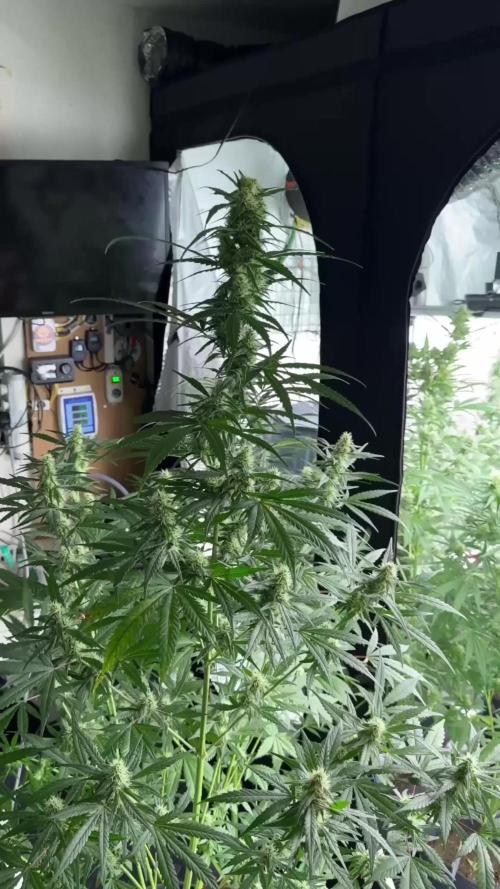
Week 4 Flower – Supercrop Week: Taming the Moon-Shooter Both Sundae Driver girls are thriving, stacking bud sites and frosting up fast. Pheno #2 tried to aim for the moon, so this week I performed a supercrop to keep the canopy even and unlock more lateral sites. She bounced back within days and is already curving up; new sites are catching light beautifully. I also did a light, targeted defoliation to open airflow, nothing heavy. Feed & Mix (this week) Testing a hybrid Aptus + Plagron approach at low solution EC to complement the rich, pre-amended soil. • Plagron Power Buds – 1 ml/L • Plagron Green Sensation – 1 ml/L • Plagron Sugar Royal – 1 ml/L • Aptus Regulator – 0.15 ml/L • Aptus CalMag Boost – light dose, just to keep LED demand covered Why low feed? The living/“easy” soil we built is still hot and active (medium EC ~2.96 mS/cm), so I’m keeping the solution EC ~0.4–0.5 mS/cm with pH ~6.1. That lets the soil do most of the work while I steer with gentle inputs and avoid salt stacking or tip burn. ⸻ Deep Dive: Supercropping (What, Why, When, How) What it is Supercropping is a high-control, high-reward training move: you soften (pinch) the inner stem tissues and bend the stem over without tearing the skin. The plant heals with a strong “knuckle,” redistributes hormones, and pushes more energy to side shoots. Result: flatter canopy, better light use, more productive sites. Why do it (Week 4 Flower)? • Pheno #2 outpaced the canopy and was nearing the lights • Even canopy = more uniform PPFD and bud development • Bending redirects auxins to lower sites → more usable bud sites • A late stretch check without heavy cutting Best timing • Ideal: late veg through early flower stretch (Weeks 2–4 of flower) while stems are still pliable. • Later than Week 4: be more cautious—stems lignify and snap easier. Step-by-step 1. Hydrate first: Slightly hydrated plants bend better than very dry ones. 2. Choose the internode you want to lower (usually the tall outlier). 3. Pinch and roll the stem gently between thumb and forefinger for 5–10 seconds to soften the pith. 4. Bend to ~45–90° toward an open space in the canopy. 5. Support: If the skin shows micro-cracks, wrap loosely with plant tape; add a soft tie or stake to hold position. 6. Aftercare: Keep airflow up, avoid heavy feeding changes for 24–48h, and don’t stack stress (no major pruning at the same time). What to expect after • Leaves may droop for a few hours; prayer and curve-up typically return within 24–72 hours. • A hardened knuckle forms in 3–7 days, strengthening the stem. • Side sites along the bent branch accelerate; top re-orients upward. • Usually less foxtailing later because tops are kept at ideal distance from the light. Risks & how to avoid them • Snap/tear: Don’t bend dry or cold stems; soften first and bend slowly. • Infection: If skin splits, tape loosely and keep humidity in check. • Over-stressing: Avoid combining with heavy defol or big feed changes on the same day. ⸻ Canopy & Care Notes • Minor defoliation only this week—just a few broad fans that shaded key sites. I prefer leaf tucking elsewhere to preserve photosynthetic “engines.” • Aroma is coming on; both phenos are stacking clean white pistils with visible trichome build on sugar leaves. • I took the girls outside the tent for a careful studio shoot—this might be the last time. Intentional supercropping is great; accidental branch breaks during handling are not. ⸻ Why this recipe (and why it’s gentle) • Power Buds helps flower initiation/transition behave predictably. • Green Sensation brings a compact PK + micro package and carbs; paired at low EC to avoid over-layering with the soil’s nutrients. • Sugar Royal supports metabolism and aroma precursors. • Regulator + CalMag keep cell walls strong, transpiration steady, and LEDs fed. • With substrate EC ~2.96, I’m letting biology and amendments supply most macros; the solution (~0.4–0.5 EC, pH ~6.1) is a steering wheel, not the engine. ⸻ What’s Happening Now • Stretch is nearly done; supercrop leveled the canopy without stalling growth. • Bud sites multiplying and beginning early stacking. • Trichomes appearing across sugar leaves; calyx build just starting. What to Expect Next (Week 5+) • Expect: • Stretch to taper off; energy shifts into stacking and calyx swell • Noticeably more trichomes; first hints of terp profile intensifying • The supercropped knuckle to fully harden; consider stakes or light trellis to support future weight • Don’t expect (yet): • Final density or full resin push—that’s more a Weeks 6–8 game • Heavy leaf stripping; I’ll keep it light to protect photosynthesis • Keep an eye on: • Humidity management as flowers bulk—tighten RH stepwise to mid-50s to reduce microclimate risk • Mg/K demand under strong LEDs (watch for interveinal fade or edge crisping) • Wound sites from supercrop—good airflow, no standing moisture ⸻ Connection & Monitoring I’ve logged a set of videos this week: TrolMaster data screens plus hands-on canopy time. Daily check-ins are still the best way to catch tiny changes before they become big ones—and it keeps the grower-plant connection strong. ⸻ Closing Week 4 is the hinge between stretch and stack. One deliberate supercrop turned a moon-shot into a level, efficient canopy, opening light to more sites without slowing momentum. With a living soil doing the heavy lifting and a gentle, targeted feed, both Sundae Drivers are on track for a clean, aromatic finish. Cant wait for the stacking phase. 📲 Don’t forget to Subscribe and follow me on Instagram and YouTube @DogDoctorOfficial for exclusive content, real-time updates, and behind-the-scenes magic. We’ve got so much more coming, including transplanting and all the amazing techniques that go along with it. You won’t want to miss it. • GrowDiaries Journal: https://growdiaries.com/grower/dogdoctorofficial • Instagram: https://www.instagram.com/dogdoctorofficial/ • YouTube: https://www.youtube.com/@dogdoctorofficial ⸻ Explore the Gear that Powers My Grow If you’re curious about the tech I’m using, check out these links: • Genetics, gear, nutrients, and more – Zamnesia: https://www.zamnesia.com/ • Environmental control & automation – TrolMaster: https://www.trolmaster.eu/ • Advanced LED lighting – Future of Grow: https://www.futureofgrow.com/ • Root and growth nutrition – Aptus Holland: https://aptus-holland.com/ • Nutrient systems & boosters – Plagron: https://plagron.com/en/ • Soil & substrate excellence – PRO-MIX BX: https://www.pthorticulture.com/en-us/products/pro-mix-bx-mycorrhizae • Curing and storage – Grove Bags: https://grovebags.com/ ⸻ We’ve got much more coming as we move through the grow cycles. Trust me, you won’t want to miss the next steps, let’s push the boundaries of indoor horticulture together! As always, this is shared for educational purposes, aiming to spread understanding and appreciation for this plant. Let’s celebrate it responsibly and continue to learn and grow together. With true love comes happiness. Always believe in yourself, and always do things expecting nothing and with an open heart. Be a giver, and the universe will give back in ways you could never imagine. 💚 Growers love to all 💚
Likes
10
Share
@Hix57
Follow
Cette semaine, l'aventure de nos plantes de cannabis continue avec des hauts et des bas. L'une d'entre elles prospère, tandis que l'autre fait face à une petite brûlure depuis deux semaines, même si elles suivent la même diète. Pour apaiser la plante touchée, je lui offre une dose d'eau claire pour un petit rafraîchissement, pendant que sa compagne se régale de nutriments sans aucune réticence. En passant aux Nutriments Final Part, je m'attends à deux semaines d'excitation pour stimuler le développement des saveurs, des trichomes, et tout ce qui rend nos chères plantes si spéciales. Restez à l'écoute pour la suite de cette folle aventure végétale 🌱
Likes
6
Share
Die 4. Woche beginnt, haben sich soweit schön entwickelt, beide sind sehr kräftig 💪 Werde etwas Mg geben weil sie mir etwas zu "fleckig" aussehen. Könnte demnächst auch umtopfen, die nächsten Töpfe stehen schon bereit : es geht in 20l airpots Tag 24 habe ich umgetopft - es wurde auch höchste Zeit!! Aber ich wollte eigentlich warten bis das Zelt frei ist und die Mädels umziehen können, doch die Töpfe waren einfach zu klein und sie zeigten leichten Mg Mangel, also musste ich jetzt doch schneller umtöppeln
Likes
7
Share
@DIY95
Follow
Blütewoche 7: Nachdem ich den Großteil meiner Frustration über den Fehlschlag verarbeitet hatte, entschied ich mich dazu den Plan doch nochmal zu überdenken und separierte die gezwitterte Übeltäterin ins leere Nebenzelt um diese schonmal auf die letzte Reise zu schicken. Wie man auf den Bildern erkennen kann kontrollierte ich die Pflanzen an Tag 100 noch einmal genaustens auf Pollensäcke. Diese ließen auch nicht all zu lange auf sich warten und es waren doch mehr als gedacht. Aber als ich mir die Terpene anschaute und feststellte, dass der Großteil schon milchig ist und die Pflanze im Vergleich zur ChocolateHaze beispielsweise von Samen wirklich verschont ausschaut, stellte ich mir folgende Frage.. Ist es unter diesen Umständen nicht sinnvoller , die Pflanze zu nehmen wie sie ist und dafür das Risiko zu minimiere nur noch mehr Samen zu züchten? Natürlich würde ich sie lieber noch 2 Wochen in Blüte lassen, aber wer weiß wie viel Müsli in 2 Wochen nachkommen können.. Ich will es nicht herausfinden 😒😅 Also bereitete ich einen letztzen Trank zu, welcher der Pflanze für die kommenden Tage etwas " beruhigen " sollte. - To be Continued -
Likes
10
Share
📅 D29 - 12/09 📜 Entering in the 4th week of vegetation, almost ready for preflowering. Today I made a big defolation and tied up the main branches with LST. Focus strongly on res as it has a strange behavior (EC falling and pH static). If tomorrow will be again like this, I will completely change the water and I will set a lower EC. T and H are now under control. ✍️ 1,3 EC ♒ 5,5 pH 🌊 9,5 L (added 1 L) 📏 9 cm 📅 D30 - 13/09 📜 Today I made a big defolation, cutting all the branches not interesting. Sadly I cut also one of main branch by mistake. Too bad, I'm very upset. Added 1,5 L of water with EC = 1,43 and pH = 5,8. ✍️ 1,29 EC ♒ 5,8 pH 🌊 10 L (added 1 L) 📏 9 cm 📅 D31 - 14/09 📜 I made some LST in order to cover the space of the broken stem and leave more space to the other branches. Today I not feed her, waiting for tomorrowv to add 1,5 L. Lucy is almost ready for SCROG. I think she will start soon, for sure this week. The res EC and pH seems stable now. T and H are under strict control. ✍️ 1,29 EC ♒ 5,8 pH 🌊 10 L (added 1 L) 📏 9 cm 📅 D32 - 15/09 📜 I start ScrOG training today. Tommorow I will change the res as I don't like how pH and EC are moving. pH tester is broken again, I purchase a professional one for a lot of money. I hope this will do his job for long time. ✍️ 1,2 EC ♒ 6 pH 🌊 8,5 L (added 1 L) 📏 11 cm 📅 D33 - 16/09 📜 Big News: Lucy starts preflowering. A little bit earlier than my tought but I think I can manage, as she looks great right now. I also changed the res, pushing the EC until 1,45 and turned on the flowering lights.The ScroG Net is working fine, I guess. Update: T is really too high (now near 36 °C) as I turn on the bloom lights. I'm trying to fix the problem in a creative way: I put some dry ice just in front of area injector and T lowered a little. H is in between 70% - 85%. ✍️ 1,4 EC ♒ 6 pH 🌊 10 L (new res) 📏 15 cm 📅 D34 - 17/09 📜 Lucy in ple flowering stage and the buds are starting grow very fast. The ScrOG net works good until now. I've some problem with the Temp, cause it's always around 35 °C that is too much.. I need to keep the H in between 75% - 85% to balance such high Temp but it's quite difficult. The reason of such high T is because I turned on the bloom lights. Also, today I had a strange beahavior of pH that is decreasing. Now I fix it on 5,5 but I've to be prepared to change res again. Made also some defolation. ✍️ 1 EC ♒ 5,6 pH 🌊 9 L 📏 15 cm 📅 D35 - 18/09 📜 Last day of fouth week and last of vegetation. Today pH gone again down 5,5. I added 1 L. of water with normal nuts, pH+ and also GHE Pro Bloom, raising both pH and EC. I will change the res on monday, as soon as I will have affordable measuring tools. SCroG seems working very well and Lucy looks healty. ✍️ 1 EC ♒ 5,8 pH 🌊 9,5 L 📏 15 cm
Likes
16
Share
Seedling managing 93F 30%RH, around 20 DLI. Vpd is in the 3's. No I don't recommend. Signum Magnum. "A great sign appeared in the sky a woman clothed with the sun with the moon under her feet and on her head a crown of twelve stars. Sing ye to the Lord a new canticle: because He has done wonderful things. Glory to the Father, and to the Son, and to the Holy Spirit As it was in the beginning, and now, and ever shall be, world without end." The plant nutrient nitrogen exists in forms with both positive and negative charges. Ammonium (NH4+)(immobile in soil)(Cation) has a positive charge, while nitrate (NO3-) (highly mobile in soil)(Anion)has a negative charge. Nitrogen is unique among plant nutrients in that it can exist in both positively charged (ammonium, NH₄⁺) and negatively charged (nitrate, NO₃⁻) forms in the soil. This makes it a special nutrient. In that it is responsible for providing balance for reactionary trade offs when it comes to ph. Because ph itself in the medium will always slowly drift towards acidicity, such is nature. 80% of nitrogen should be nitrate and no more than 20% ammoniacal nitrogen. Ca, mg, and K are the big 3 cations related to soil composition, pH & base saturation. When nitrogen is in the form of ammonium, it can compete with calcium, magnesium, and potassium for absorption sites in the plant root. This competition can lead to a reduction in the uptake of these other essential nutrients. Nitrogen, particularly in its nitrate form (NO3-), can increase soil acidity, which can also affect the availability of calcium, magnesium, and potassium. The form of nitrogen applied (ammonium vs. nitrate) can influence its interactions with other nutrients. Ammonium nitrogen can have a more pronounced negative effect on the uptake of calcium, magnesium, and potassium compared to nitrate nitrogen. Common forms of ammonium nitrogen include ammonium ion (NH4+), urea, and ammonium compounds like ammonium nitrate, ammonium sulfate, and ammonium phosphate. Common forms of nitrate nitrogen include potassium nitrate (KNO3), sodium nitrate (NaNO3), calcium nitrate (Ca(NO3)2), and ammonium nitrate (NH4NO3). Phosphorus is an essential plant nutrient, and its availability in the soil is strongly linked to the presence of oxygen. Plants primarily absorb phosphorus as phosphate (PO4), and oxygen is a key component of this molecule. Furthermore, the availability of phosphorus in the soil can be impacted by factors like soil aeration and temperature, which in turn affect the oxygen supply to the roots. Phosphorus uptake in plants is most critical during the early stages of growth, particularly within the first few weeks of plant development. Young plants actively growing tissues have a high demand for phosphorus. They may absorb up to 75% of their total phosphorus requirements within the first few weeks of vegetative growth, with up to 51% of uptake happening overnight, primarily in the first few hours or early nightfall. ⑨Anaerobic root respiration, or respiration without oxygen, is detrimental to plants because it's less efficient and produces toxic byproducts, leading to reduced energy production, nutrient uptake issues, and ultimately, root damage and plant stress. ⑨Anaerobic respiration, unlike aerobic respiration, doesn't utilize oxygen as the final electron acceptor in the electron transport chain. This results in a significant drop in the amount of energy (ATP) produced, which is necessary for various plant functions, including growth, nutrient uptake, and maintenance of cellular processes. ⑨In the absence of oxygen, plants produce byproducts like ethanol and lactic acid during anaerobic fermentation. These byproducts can be toxic to the roots and inhibit their function, ⑨When oxygen is depleted in a medium, the pH tends to decrease (become more acidic) due to the production of metabolic byproducts. This is particularly relevant in biological systems where aerobic respiration relies on oxygen as the final electron acceptor. ⑨When oxygen is scarce, plants may switch to anaerobic respiration. This process produces carbon dioxide (CO2) as a byproduct. ⑨CO2 dissolves in water to form carbonic acid (H2CO3). This acid lowers the pH of the medium, making it more acidic. ⑨Anaerobic conditions can impair a plant's ability to regulate its internal pH, leading to a drop in cytoplasmic pH and potentially cellular acidosis. ⑨The change in pH can also affect the availability of certain nutrients to the plant, as pH influences the solubility of micronutrients like iron, manganese, zinc, copper, and boron. ⑨The lack of oxygen in the plant medium leads to a decrease in pH due to the production of carbon dioxide during anaerobic respiration and impaired pH regulation within the plant. In plant cells, cellular acidosis, a drop in the internal pH of the cytosol, is a significant stress response, particularly during conditions like flooding or hypoxia. This acidification can be triggered by a decrease in oxygen levels, leading to the production of metabolic byproducts like lactic acid and CO2. The plant's ability to tolerate and recover from these conditions depends on its cellular mechanisms to regulate pH and mitigate the effects of acidosis. When plants are subjected to low oxygen environments, such as those experienced during flooding, anaerobic metabolism, which produces lactic acid and ethanol, becomes the primary source of energy. This can lead to a build-up of these acidic metabolites in the cytosol, causing a drop in pH. OXYGEN Atomic oxygen (single oxygen atom, O) is the lightest form of oxygen, as it has the lowest mass of the oxygen molecules. Oxygen also exists as a diatomic molecule (O2) and an allotrope called ozone (O3), which have higher masses due to the number of oxygen atoms combined. Atomic Oxygen (O): This refers to a single oxygen atom, which is the most fundamental form of oxygen. Molecular Oxygen (O2): This is the common form of oxygen we breathe, consisting of two oxygen atoms bonded together. Ozone (O3): This is an allotrope of oxygen, meaning it's a different form of the same element, consisting of three oxygen atoms bonded together. Since atomic oxygen has the fewest oxygen atoms, it naturally has the lowest mass compared to O2 or O3. Ozone (O3) Lifespan: Ozone has a relatively long lifespan in the stratosphere, particularly at lower altitudes. For example, at 32 km in the middle latitudes during spring, ozone has a lifetime of about 2 months. Oxygen (O) Lifespan: Atomic oxygen, on the other hand, has a much shorter lifespan. At the same altitude, its lifetime is about 4/100ths of a second. Ozone-Oxygen Cycle: The ozone-oxygen cycle involves the rapid exchange between atomic oxygen (O) and ozone (O3). UV radiation can split molecular oxygen (O2) into atomic oxygen (O), which then reacts with O2 to form ozone (O3). Ozone can also be photolyzed by UV radiation, creating atomic oxygen again, which can then react with O3 to reform O2. Dominant Form: The partitioning of odd oxygen (Ox) between ozone and atomic oxygen favors ozone in the lower stratosphere. This means that a much larger proportion of odd oxygen exists as ozone than as atomic oxygen, especially in the lower stratosphere. Recombination: Atomic oxygen has a high energy and reactivity. When it encounters another oxygen atom, they can combine to form O2. This process releases energy, contributing to the heating of the atmosphere. Ozone Formation: Atomic oxygen can also react with molecular oxygen (O2) to form ozone (O3). Ozone plays a significant role in absorbing harmful UV radiation. Other Reactions: Atomic oxygen can react with various other molecules in the atmosphere, like nitrogen (N2), water (H2O), and carbon dioxide (CO2), forming different compounds. UV light below 240nm (peak 185nm) creates ozone (O₃) through a process called photolysis, where UV light breaks down dioxygen molecules (O₂) into single atomic oxygen atoms (O). These single oxygen atoms then react with other oxygen molecules to form ozone (O₃). Specifically, UV-C light with wavelengths shorter than 240 nm can cause this photolysis. UV light with wavelengths between 240-280 nm, (peak 254 nm) breaks down ozone (O₃) into dioxygen molecules (O₂) and atomic oxygen atoms (O). 280nm does not have the energy potential to break apart the stable bond of (O₂) into enough (O) to make (O₃) At ground level, atomic oxygen (single oxygen atoms) has a very short lifespan. This is because it's highly reactive and quickly combines with other molecules to form stable diatomic oxygen (O2) or other compounds. While the exact timeframe varies depending on the specific circumstances, its lifespan is typically measured in nanoseconds or picoseconds.
Processing
Likes
16
Share
@GrowZex
Follow
Hello beautiful people! Another week of veg! The girls are doing great! I topped them once. I pulled them down for some LST, will continue to pull down most new shoots. Nute schedule still the same. Its already clear this is a heavy sativa strain. Thats it! Love & Peace 4 all!
Likes
37
Share
@Aleks555
Follow
Eternity Grow Cup 2025 with Plagron and Zamnesia 🌱 Runtz - Zamnesia Seeds We’ve reached week 12 from seed and week 8 of flowering, and our beauty is still thriving, thanks to the incredible nutrients from Plagron. Last week, we harvested a small bud from a middle branch, and after trying it, we were blown away by the flavor and strength—it’s delicious and packs a punch! Now, as we enter the final stage, we’ve begun flushing with water, but not just any water. We’re using a special homemade feed made from the very leaves we trimmed off, blended into a rich solution to give back to the plant in its last days. Plagron has been a game-changer for us, boosting not only growth but resin production, ensuring the buds are dense, sticky, and full of flavor.
Likes
26
Share
@B4niTa
Follow
Super easy grow, it was a first time when i transplant auto, and she recovered well after😁
Likes
72
Share
@Papa_T
Follow
Well here we are finally out of the three week germination/seedling stage and now we’re on to week 1 of vegetation phase of Penelope’s life. Wednesday Sep 15 Day 22 W/k 4 -No water pot still heavy -First day of vegetation have celebrate with her first topping -She’s got to learn this is a harsh world -Removed janky leaves -Sink or swim -Let’s go Day 23 W/k 4 -No water -She’s grown significantly since yesterday -Topped two lower branches -Very happy with her progression -She’s adapting to her condition and responding well to training -Leaf blemishes are just battle scars -Don’t be making no bitch ass plants up in this garden Day 24 W/k 4 -No water -Not much really to say today -Just grow Day 25 W/k 4 -Same as yesterday -Grow Day 26 W/k 4 -Feeding day with aerated tap water two gallons 62.5 PPM base -Add 1 tsp Cal/mag - 319 PPM -Add 1.5 tsp Grow - 708 PPM -Final - 2 Gallon 6.2 PH - 717 PPM -Runoff 1.5 L 5.58 PH 3510 PPM -It’s been an abusive day -Getting water boarded -Getting some more topping HST -Bottom fan leaves will probably curl and get trashed -She’ll be fine -Told her I was sorry and I won’t do it again -That’s a lie haha Day 27 W/k 4 -No water -Bottom leaves curled a bit as expected after the waterboarding -She’s just loving life and exploding -Get yet knickers on for the ride -Smacked her around some more with a light defoliation and topping two branches -This is it for topping I’ve got her set up the way I want now Day 28 W/k 4 -No water -Perked up again today after more defoliation and LST -Taking to LST well -Not much more to say Was a pretty abusive week for Penelope. She’s pulled through like a champ though. So she’s all HST’d up and set up for how I want to develop her. Now it’s three weeks of veg! She’s gonna be a brute!! LET’S GO!!
Likes
47
Share
Off to a killer start, I rarely seen genetics being this fast to germinate. 18 hrs 1/4” tap root and 24 hrs later was 1/2” out of the medium. 5 days later they are approximately 3-4” with second set of leaves. Nothing different with this grow except dialling in my mixes and top dresses at more appropriate times. For a change I have all my supplies for this grow to run with hiccups. Why Crystal Candy FV? Sweet Seeds were generous to provide seeds and supposedly 6-7 weeks only Flower would prove spectacular should the quality be comparable to Fem seeds. Stay safe and Feel free to drop some comments, always interested of learning new stuff. If you own a Crystal Candy diary watch out I’m coming with Like 💣
Likes
8
Share
@DoMoNe
Follow
Following https://www.royalqueenseeds.com/blog-how-to-grow-autoflowering-cannabis-n83 "WEEK 9: THE FINISH LINE APPROACHES" #57 10.5. - #63 16.5. #57 10.5. -Watered with 1,5liters/pot #58 11.5. -nothing done today #59 12.5. -its been VERYwarm (on our standards) today, so tent temp gone up to 32degrees, ill have to and open up the side vent clearly #60 13.5. -temps still too warm. #61 14.5. -watered/flushed #62 15.5. -nothing done yet #63 16.5. -watered/flushed
Likes
6
Share
Heard good things about this strain so decided to give it a go and maximise my grow tent with plants no point in not using the space time and energy when I could be filling it with a new seedling lol. She has taken 4 days to germinate which is the usual time it seems to take when placed directly in the substrate