


Likes
Comments
Share


@420HOODFARMER
Follow
Plants starting to smell a bit when it gets warm in the tent. Buds are starting to swell more and more. Can’t wait until this is finished guessing another 4 weeks

Likes
25
Share


@MadeInGermany
Follow
Info:
Unfortunately, I had to find out that my account is used for fake pages in social media.
I am only active here on growdiaries.
I am not on facebook instagram twitter etc All accounts except this one are fake.
Have fun with the update.
Flowering day 61
since time change
to 12/12 h.
Hey everyone ☺️.
Today the time has finally come and the last week of flowering has begun 😍.
She looks beautiful and her buds smell very tasty 👍.
The trichomes are 70% milky and 30% amber.
The lady comes in complete darkness for 48 hours before the harvest.
Of course, as always, there will be a small interim update of the harvest before the last major update.
Until then, I wish you all a lot of fun and stay healthy 👍🙏🏻
You can buy this Strain at :
www.Zamnesia.com
Type:
Purple Punch
☝️🏼
Genetics:
Granddaddy Purple x Larry OG
👍
Vega lamp:
2 x Todogrow Led
Quantum Board 100 W
💡
Bloom Lamp :
2 x Todogrow Led
Cxb 3590 COB 3500 K 205W
💡💡☝️🏼
Soil :
Canna Coco Professional +
☝️🏼
Fertilizer:
Green House Powder Feeding
☝️🏼🌱
Water:
Osmosis water mixed with normal water (24 hours stale that the chlorine evaporates) to 0.2 EC. Add Cal / Mag to 0.4 Ec Ph with Organic Ph - to 5.5 - 5.8 .

Likes
27
Share


@RDWCGrowing
Follow
I had a lot of fun with this strain and it was grown against 400 growers so let me say PHENO hunting is a true thing. Overall the Bud was a nice dense structure and the smoke on it was smooth and the high nice and even.


Likes
4
Share


@JardineiroBr
Follow
Uma planta estava muito travada e pela minha experiência não vale a pena o custo da manutenção dessas plantinhas é chato mas preciso do espaço e do tempo para cultivar plantas que deem resultado.
Coloquei um gancho leve em cada planta hoje para ver se aumenta a área verde.

Likes
2
Share


@KeemBboomin
Follow
It’s now time to start flower. They are looking amazing and I’m going to go ahead and throw his crocs in there. I have one tent that I have not put in flower yet just for the main fact that one of my seats became a auto flower so I’m letting them run more time to let that auto flower finish and see what that becomes
Likes
13
Share


@DrewbieDoobieNoobie
Follow
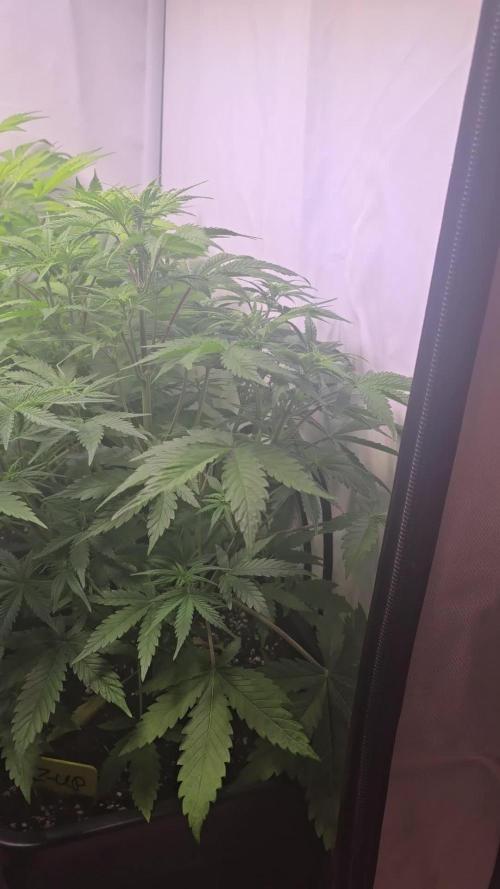
48 hrs. of dark are up and its time to chop. pots have dried from the last flush. These did not stretch as much as I would have liked I will have to adjust my light better next time and there was a lot of lower development near the media, hence not enough air flow. when I flushed the pots the water level went up to the lower growth on the Think different and the bottom was wet and rotted the bottom half. I did a mild lollypop on them I'm early flower it just was not enough, LESSON LEARNED. Chopped on 2/8/20 whole plant drying low and slow 54% RH 68F for 10-14 days then will trim and jar. 981 grams wet with the lumber. lets see how they dry. I got a rosin press coming today I will squeeze all the trim and larffy buds into dabs yummy! All in all I recommend these genetics I will try the think different again I'm sure I just got a recessive dwarf gene. I have seen other grows of this same strain same breeder that are huge and stacked. thanks again to Fast Buds 420 and Green Buzz Nutrients for suppling the goods for the grow. Stay tuned for the harvest pics and vids along with the rosin squish. Be cool to one another we could really use it these days.👏 please fell free to comment on the grow as this is my first true auto flower grow. If any one out there is experienced with rosin pressing and you have any tips for beginner's let me know I will incorporate them in the next videos. thanks





Likes
31
Share


@Growi
Follow
Tag 85
Aufgrund des wechselhaften Wetters ist das mit der Luftfeuchtigkeit so ne sache , Schwanke immer mal zwischen 40-60 %
So langsam Befinden wir uns aber auf der Zielgeraden .Die buds Gewinnen sichtbar an Masse ,
noch ca 4 Wochen und sie sollten ernte reif sein ,aber bis dahin kauf ich mir noch eine lupe um sicher zu stellen das die Trichomeköpfe soweit sind :)
Von T.A habe ich mir noch einen Flash Cleaner zugelegt und dann wird zum ende Hin nochmal gespült das die Plfanze wirklich rein ist .
Keep Growing Fam , bis zum nächsten Update. 💪

Likes
65
Share


@TheBudWhisperer
Follow
Week 4 of flower and the boys have finally spilled the pollen. It’s bloody everywhere in there so I expect that no bud has gone undefiled😎. The females have all witnessed a pretty significant nitro deficiency now that they’re trying to produce seed instead of flowers. We changed out the nute mix to 1/3 grow and 2/3 bloom and they immediately showed improvement. No slight against Druid at all - we moved to a different brand simply to conserve it for the flowering runs where it really matters👍.
The lone separated spicy bitch female that entered flower early is looking really sexy. I very much doubt she’ll have escaped full pollination with this much in the air however. We won’t use any seed from this girl but if we’re lucky we might be able to pull out some sample bud.
We’re taking down all the males today now that their job is done and we’ve also decided to harvest from the one specific cum dumpster male that has shown as the most vigorous. Doubt we’ll get around to using it before it’s shelf life expires but u never know. The details on that will be in the harvest entry coming up. Other than that - we’re through the fornication stage and it’s all just keeping the ladies alive until it’s time to extract some seeds👍😎👍. Still workn on the potential cross names - that’s the best part😉. Until next week🤟👊.
Background
Fingers crossed that these Spicy Bitch regs provide at least one male so that we can back build some stock of it. In the event that does take place we’ve got a single clone of each strain from the previous pollen chuck to sit in the tent with them so they can make babies for the next few months. The whole point of the last year was to start making some foundational genetics for a third generational cross we could call our own. If you’ve been following along than you’ll know that it’s been anything but easy. Our previous pollen picks didn’t pan out at all so we’re back to the drawing board with a new option from ExoticSeeds.
This’ll be a 10 plant run with 5 regs and 6 strains for pollination including the strain itself.
We’re running in a 2x4 MarsHydro grow tent all powered by a Mars Sp6500. That’s a little more than 600w packed into half the recommended footprint😳. Why? you ask - because we like our buds big and overcompensatory😂. Really, I’m just of the mind that we can pack more light into this space than recommended and get much better results. The math doesn’t lie. At least not as long as I wasn’t high when using the calculator again…..
Many thanks to @MarsHydroLED for the opportunity to test run the equipment👊.
In addition, we’ve also moved to a new nutrient system - Druid Nutrients out of the Netherlands. They don’t really have a presence on GD yet but you’ll be hearing about them very soon I’m sure. The beauty of this system is that it’s literally a 1 (one) component system for the entirety of the plants grow cycle. It really has changed the game in terms of ease of feeding and maintenance. It’s also very versatile and seems to provide everything needed across multiple different strains in the same ratios. Keep your eyes peeled for these folks. Pretty much a guarantee that they absolutely blow up once more people know about them👍👌😎.
Strain Background
Spicy Bitch: predominantly sativa, heavy yielder with a daytime kinda trip profile. It’s a cross of Queen Mother and a Pre-2000 AK47. We’ll pull what pollen we can and hope to have a female run out a larger supply of seed for the future.
Many thanks to @Exoticseeds for the chance to give these beans a go👍👊.
Pollination Strains:
Holy Surfer S1 - this is one of the focal points for this cycle. A fellow growmie was kind enough to ship over some S1 genetics I took an interest in. The only ask back was that if I did cross it to send a few his way for testing👍. Shoutout and cheers to @blendmedmedman. Hoping to have something back to ya in short order. For full details on this alluring hybrid option check my buddies link at seedfinder -
https://en.seedfinder.eu/strain-info/Holy_Surfer/Smiling_Tiger/
Northern Lights - this came from a particularly interesting batch of seeds that have shown a very dependable variegation trait. It’s a compact and squat plant requiring very little maintenance. Typical for the strain really. It’s been chosen as an option to potentially mellow out the high , shorten the stature of the resulting hybrid and inject it with some of that mellow indica effect.
Boogie Nights - total shot in the dark. Still haven’t even tried the strain myself yet but it was available at the right time and interesting enough to make a salad with. Big thanks to AMS who’ve been nothing short of an excellent seedbank to collaborate with. Expect similar growth characteristics to that of the Northern Lights. Better resilience however.
Blueberry - this particular clone is from extremely strong stock. Spliff seeds broke the mold with this strain. She’s lower maintenance than the NL, more resilient than anything else we’ve got on the menu and the terp. Profile on this girl is out of this world. If we can bring any of these qualities to the cross, then it could be magic👌.
White Widow - garrghh, I just can’t get away from this particular plant. Again, still haven’t even tested the buds yet and all I can say is that the growth characteristics are extremely vigorous and desirable. This plant is one of 3 unicorns that I have yet to tame due to a combo of extremely bad luck and circumstance.
All told, it’s still the same story: a VERY experimental breeding project designed to shotgun a broad swath of genetics against a reliable and dependable Breeder who’s put out proven fire 🔥🤟😎👍.


Likes
10
Share


@Boomdrawfyah
Follow
80 dias y han empezado a florecer la mas avanzada es la 1051 que es la variedad con mas predominancia indica.
He empezado la primera semana de floracion con la tabla de elicitación y nutrición de terranabis, subiendole 0.2 ml de Terrateina y terra vigor , vamos a ver como responden

Likes
39
Share


@Grileon
Follow
10% discount code for Zamnesia shop - GROWITGD
--
Another series of topping done, so that there will be 8 main branches.
Roots look amazing, healthy, white, and bushy.
UPDATE:
Did some heavy defoliation for fan leaves and LST on all 8 main branches.
Likes
5
Share


@HegauHillsFarmers_D23
Follow
In dieser Woche hat sich sehr viel getan , die Blüten sind herangereift und haben nochmal etwas an Volumen dazu gewonnen.😍
Der Geruch ist sehr stark und die Terpene intensiver geworden.
Es sind vorallem, Benzin und süße Düfte wahr zunehmen 🍬⛽️ Der Runtz Teil überwiegt leicht .
Die Skywalker OG Runtz Auto brauch nicht sehr lange um die Blüten auszureifen.
Deshalb habe ich hab dieser Woche, begonnen die Pflanze mit Flawless Finisch zu spülen und so auf die Ernte vorzubereiten 🍁🙌🏻
Likes
19
Share


@OldDabKing
Follow
Dropped seeds into water for 24 hours, and acclimated the fabric pots to the tents conditions. One 3gal, one 5gal, and one 7gal are going to be used for this grow to see the different outcomes of pot size.
Likes
24
Share


@DogDoctorOfficial
Follow
🌱 Divine Seeds Week Five Report 🌱
Hey, fellow growers! 🌿✨
Welcome back to our weekly update on the Divine Seeds journey. We’ve now entered Week Five, and all our plants are in the flowering stage. This week brought some necessary changes as we adjusted the light schedule to 12/12 due to the rapid growth of our Big Demon. Here’s the latest on our Moon Rock, Opium, and Big Demon plants.
🌟 Week Five Highlights 🌟
All plants are now officially in the flowering stage, and we made an important adjustment to our light schedule to accommodate the vigorous growth of the Big Demon. Here’s a detailed look at each plant’s progress:
1. Moon Rock 🚀
• Growth: Maintaining its compact and sturdy structure.
• Flowering: Buds are developing nicely, with a healthy formation and density.
• Notes: Moon Rock remains strong and healthy, adapting well to the 12/12 light schedule.
2. Opium 🌸
• Growth: Balanced growth with a steady flowering transition.
• Flowering: Buds are forming uniformly, showing excellent health and structure.
• Notes: Opium continues to flourish gracefully, with beautiful bud development.
3. Big Demon 💪
• Growth: Rapid and robust, necessitating a change in light schedule.
• Flowering: Finally transitioning into flowering, with buds beginning to form.
• Notes: Big Demon’s vigorous growth prompted the switch to a 12/12 light schedule to manage its size and ensure it flowers properly.
🌟 Light Schedule Adjustment 🌟
Due to Big Demon’s impressive and rapid growth, we decided to switch to a 12/12 light schedule. Here’s why:
• Inducing Flowering: The 12/12 schedule simulates the natural shortening of days, signaling to the plants that it’s time to flower. This is crucial for photoperiod strains like Big Demon ( yes she turned out not an auto).
• Managing Plant Size: Big Demon’s rapid growth risked outgrowing the grow space. Switching to 12/12 helps control its size by focusing energy on flowering rather than continued vegetative growth.
• Uniform Development: Ensuring all plants are on the same light schedule helps maintain uniformity in the grow room, making it easier to manage and monitor their progress.
🌟 Environmental and Nutrient Strategy 🌟
Our current environmental parameters and nutrient strategy remain consistent:
• Water:
• TDS: 400 ppm
• pH: 6.2
• Temperature: 18°C
• Grow Room Conditions:
• Temperature: 30.3°C
• Relative Humidity (RH): 51%
🌟 LED Lighting and Control System 🌟
We continue to rely on the Lumatek Zeus 465 Compact Pro LED to provide optimal lighting. This LED delivers a balanced spectrum and ensures even light distribution across our canopy, which is crucial during the flowering stage.
The TrolMaster Hydro X controller with its 3-in-1 sensor for temperature, humidity, and light detection helps us maintain ideal growing conditions. This system ensures our plants receive the perfect environment for healthy growth and flowering.
🌟 Nutrient Strategy 🌟
Our feeding regimen includes:
• Regulator (0.15ml/L): To reduce stress and improve overall plant health.
• CaMg-Boost (0.25ml/L): To provide essential calcium and magnesium, supporting strong cell wall development and photosynthesis.
The rich organic soil, combined with these supplements, continues to support robust growth and healthy flowering.
🌟 Key Observations 🌟
• Plant Health: All plants are super healthy, with no signs of nutrient deficiencies or stress.
• Growth Patterns: Moon Rock remains the most compact, Opium is gracefully flowering, and Big Demon is transitioning into flowering after the light schedule change.
• Environmental Control: The grow room conditions are stable, with ideal temperature and humidity levels supporting healthy development.
🌱 Next Steps 🌱
As we move further into the flowering stage, our focus will be on:
• Monitoring Bud Development: Keeping a close eye on bud formation and ensuring optimal conditions for flowering.
• Adjusting Nutrients as Needed: Observing plant responses and adjusting the nutrient regimen if necessary.
• Maintaining Optimal Conditions: Continuing to use the Lumatek LED and TrolMaster controller to ensure perfect growing conditions.
Stay tuned for more updates as our Divine Seeds continue to flourish in the flowering stage. We’re excited to see the results of the 12/12 light schedule and share every milestone with you on this incredible journey!
Happy growing, and may your gardens be ever green! 🌿💚
#DivineSeeds #WeekFiveVegReport #FloweringStage #AptusHolland #MoonRock #Opium #BigDemon #GrowDiaries #PlantMagic #GreenThumb #Inspiration #LumatekZeus #TrolMasterHydroX
Germination method 🌱 @thecannakan
Genetics
@divine.seeds
Nutrition
@aptusholland 🌿
@aptus_world 🌎
@aptus_es 🌍
@aptusbrasil 🌱
@aptus_thailand 🌿
@aptus_portugal 🌳
@aptususa_officiala 🍀
@aptusplanttechnz 🌺
@aptusplanttechaus 🍃
Ambient controls🎮
@trolmaster.eu @trolmaster.eu.support @trolmaster.support @trolmaster.agro
Soil @promix_growers_eur @promix_cannabis
LED - @lumatekeu
Watering- @autopot_usa @autopot_global
Love and attention- @dogdoctorofficial
#aptus #aptusplanttech #aptusgang #aptusfamily #aptustrueplantscience #inbalancewithnature #trolmaster #trolmastereurope #trolmastersecrets #Autopots
#GreenJoy
As always thank you all for stopping by, for the love and for it all , this journey of mine wold just not be the same without you guys, the love and support is very much appreciated and i fell honored and so joyful with you all in my life 🙏
With true love comes happiness 💚🙏 Always believe in your self and always do things expecting nothing and with an open heart , be a giver and the universe will give back to you in ways you could not even imagine so 💚
More info and complete updates from all my adventures can be found ⬆️link in the profile description ⬆️
Friendly reminder all you see here is pure research and for educational purposes only
💚Growers Love To you All 💚


Likes
2
Share


@Mr_nugs_lover_David
Follow
Suuuper sweet and tropical smell, beautiful fragrance of the buds man! By far the sweetest nuggets I have in my garden currently even more than my bslck cherry punch plants, awesome strain, such a beautiful surprise, I'll grow her more times now that I know her, she's fading out perfectly showing purple on the leafs because of the cold weather, and I'm seeing a lot of yellow leafs,let's see what happens at the end! ✌️👨🌾🌱💚
