


Likes
Comments
Share


@ToastFarmer
Follow
No deficiencies thus far adding some molasses each feeding 1 tbls per gal water


Likes
5
Share


@Mrg7667
Follow
Day 8 ish all sorts of different sprout rates, looks like the #7 are lagging behind but i know those where the smelliest so mucb worth the wait!


Likes
1
Share


@CannaBreeze
Follow
Unfortunately, one of the two seedlings succumbed to the intense sunlight exposure of a single day and exhibited classic signs of stress and stem damage, succumbing within the first week. With only one seedling remaining, I decided to proceed by faithfully following the established nutrient schedule.
Here are the nutrients administered:
May 8th:
250ml of water
0.5ml of RootJuice
0.5ml of BioHeaven
0.5ml of Activera
EC: 450 nS
pH: 6.5
May 10th:
350ml of water
1ml of RootJuice
1ml of FishMix
1ml of BioHeaven
1ml of Activera
EC: 850 nS
pH: 6.5
Likes
15
Share


@Dunk_Junk
Follow
Looking absolutely gorgeous this week.
Incredibly stinky!
Incredibly sticky!
Really fat buds.
And she's done. Will be chopped in 24h.
Likes
30
Share


@Hawkbo
Follow
Everything is still alive thankfully and smells fuckin tremendous. The pictures were taken on day 49 or 50. I'll probly start flushing some of them over the next week the citradellic are lookin close. They kinda all look close even tho I expected some 70 dayers with the mostly sativa crosses but I gotta get in there and check the trichs.
Somehow I didn't get full plant pics of the first one but I'll get some next feed. Alot of shots without the flash I didnt take all the pics.

Likes
2
Share


@EtnoGrow
Follow
bueno se hizo una por primera vez una cosecha por partes, como indicamos en el post anterior, se cosecho los cogollos donde la luz pegaba mas al parecer y estaban mas desarrollados, la cosecha fue con tricomas blancos tendiendo a transparentes con pocos ambar, en opinion ya luego de una semanas y una segunda cosecha, es que cosechamos pronto por temor al pasarnos al ser primera vez, entonces posiblemente nos apresuramos un poco ligeramente o confundimos los tricomas tendiendo a ser transparente por los blancos que es lo que indica la teoria el punto de corte, pero no nso quejamos quedo genial! subiremos el segundo punto de corte luego de 2 semanas . LAS ULTIMAS FOTOS LAS DE LAS 2 SEMANAS MAS 2DO CORTE.
Likes
40
Share


@GYOweed
Follow
Keeping this just for maybe flowering it later.
It doesnt like small containers

Likes
5
Share

@TerpCloudzZz
Follow
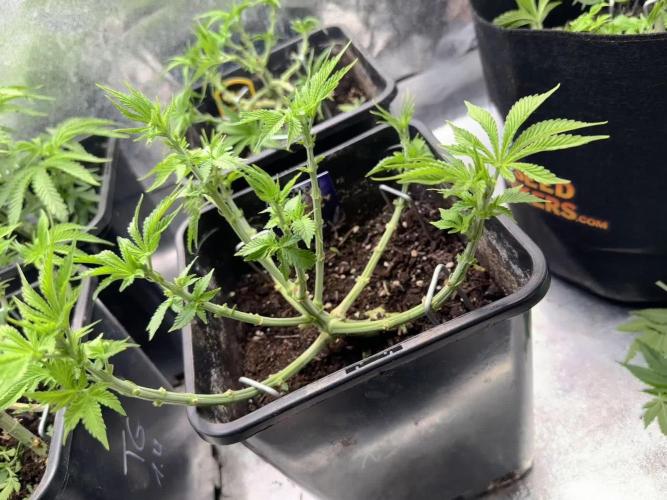
Start Woche 6: Jetzt wird final “gesetzt”. Nach dem strukturierten Aufbau in Woche 5 liegt der Fokus diese Woche darauf, die Pflanzen in eine stabile, performante Endform zu bringen: gleichmäßiges Canopy, saubere Lichtverteilung und eine Rootzone, die das Topfvolumen aktiv nutzt. Ziel ist, dass jede Top-Zone unter vergleichbaren Bedingungen arbeitet – das ist die Grundlage für eine effiziente nächste Phase. 🌿✅
Canopy / Training
• Feintuning statt Stress: LST wird nur noch gezielt nachjustiert, um Tops auf eine Ebene zu bringen und Schattenzonen zu minimieren.
• Struktur sichern: Triebe werden so geführt, dass Luftfluss im Inneren bleibt und keine überlappenden Blattpakete entstehen.
• Priorität: gleichmäßige Spitzenhöhe + klare Triebführung → maximale Nutzfläche unter der Lampe.
Klima & Licht (Wachstum pushen, ohne zu überfahren)
Woche 6 entscheidet oft, wie “smooth” der Übergang später läuft. Daher:
• Klima stabil halten, sodass Transpiration sauber läuft (keine kalten Bremsen, kein stehender Dampf).
• Licht/Abstand so einstellen, dass die Pflanzen aktiv wachsen, aber ohne unnötigen Stress (Leaf-Pray, keine aufrollenden Kanten).
Bewässerung / Rootzone
Mit 7-L Pots ist jetzt wichtig, dass die Rootzone konstant arbeitet:
• Rhythmus beibehalten, nicht hin- und herspringen.
• Ziel: gleichmäßig feucht + maximaler Sauerstoff → aktive Wurzelspitzen = schnellerer Zuwachs.
• Wenn der Topf schneller leicht wird, ist das ein gutes Zeichen: mehr Wurzelmasse, höherer Verbrauch.
Plan für diese Woche
Diese Woche wird die Form final fixiert: Canopy glätten, Mikroklima verbessern, Rootzone stabil halten. Wenn alles sauber läuft, ist das die perfekte Ausgangslage, um die Pflanzen kontrolliert in die nächste Phase zu führen. 🔥🏆


Likes
15
Share


@dinni5yn
Follow
Day 21: week 4 starts today so going on this 4th week kind of strong b4 I stave em a bit and shift up....
Stay in that low gear and build them nutrient PGR's up recline a bit. Thinking about raising my ph a bit....low 6 but think it needs to go up to @ least 7 to take advantage of the high octane nutrients going into this.
On another note already setting up my next grow. Going with 10qt pots on these only because they will be FF's so gonna make sure I have sufficient room for extreme growth. Think these will be my permanent's that will eventually go outdoors.
So feeding probably last veg mix this week and will probably wait til the weekend and let em starve a bit.
Oh wow the mail came and the packaging is pretty dope... 420FB!!!
Day 22: Can't believe I just saw John "MF'n" Daly hit a tee shot that give's him a nice birdie op in the Open!!!! Dude looks pretty Shaggy like some type of hippy grower!!!! Fuck'n love it.
So went against my thoughts and fed "Feed me Seymore" style. Gave em their weekly feeding yesterday around 6ish and watched. Sprayed with sensi cal. Speaking of which, finally getting
a bit more organized and labeled foliage sprays and got em ready. 3 different bottles, sensi cal, Heavenly goddess, and Grease. Keeping an eye for any type of yellow pigments and spraying
both over and under. Kind of worried about lockage so got some ph up/down. Wanna get my ph up just a hare so improve absorption of nutrients and get larger plants. This is my very 1st grow
and my future is looking pretty dense with the addition of the FF's but needing this grow to make the next grow even better.
Keeping my humidity up during this veg stage and staying away from any cutting for now. I think that the uv for a week has done something to my growth or maybe stunted a bit but proud of my stem work as these girls got Christian Louboutin Heels for stalks. That breeze blowing thought their leaves like "working women on a windy day" with their hair blowing in the wind!! Head turners!!
So with the weekend coming not much but observing and maybe some light misting but getting ready to jump to that next level in the coming weeks but honestly trying to keep em from flowing until they get a bit larger. Maybe I can get a week 6 of veg but honestly with the Bud Blood this will be somewhat easy.
Bud Blood or Bud Igniter......Been thinking about this one. I hear BB is the go to but can be very strong and possibly burn your plants. Igniter does the same thing so really on the fence but don't think I'll be disappointed. Think I'm gonna do a split maybe 4 using BB and 3 using BI just to see how they work.
Things will definitely be picking up in a few so will post as the journey continues.
RIP Tony Bennett......Dude you will be missed and I totally expect to see your face on a Stamp in the next 10 years!!!
Noonish...decided that my air exchange if off so leaving my tent door open a bit to get fresh air flowing into the tent better. My CO2 bag is xlarge so think maybe too much. Gonna roll with this half open tent for a few and see.
Day 23: So watered my plants outer zone with the vpt mix just to get maximum exposure to roots. Benn spraying the foliage with Grease and Green Goddess and just paying attention. Also am experimenting with the foliage spray and light reduction for a couple of hours just to get the plant to take the spray nutrients. Think the flowering is staring to come on but trying to slow it down by maybe a week just to try and get that 5th week of veg in b4.
My plants are looking really robust and are taking the nutrients with no bad effects it seems. My PH up/down is coming today but still contemplating that whole ph up =bigger plants scenario.
Also threw the training wheel milk carts back on my girls and am running a fan beneath my plants so that the pots can get fresh air through the root system. Have not experienced run through yet from watering so think I'm doing a pretty good job of keeping my watering in check.
6ish: went down on the lights earlier 2day just and came back to 1400is and plants are looking great. Sprayed with Grease and am gonna go with one more veg feeding b4 I pull out the BB with the IB and prep for flower, so thinking one more veg feed b4 we move into this next stage.
Got some plant trainers coming Monday so figure if I go with a feeding in the morning and then lights all day Monday will start training to get these branches their own space to grow.
So with the night nothing but maybe foliage spray and an early lights out but hopefully I can get these plants a bit more dry b4 feeding so might try to stretch the week out and give the soil a bit of time to dry out b4 this final veg feeding.
Day 24: Had some light issues and my babies didn't get much sleep so gonna get back to my 18-6 with only breeze in sleep. Attempted to train a few of my branches with some 90° plant trainers but said nah, save em for my ff that I'm gonna veg/flower/veg/fl.....
Looking back @ the last 28 days I realize just how much work, time, research and dedication to do this. Talk about stress relief!!! Keep's me uplifted and positive.
On another note, getting the AC Infinity bars to keep my tent from doing a Hal 2112 S.O. on my grow!!

Likes
10
Share


@KcKush
Follow
*Increased PPM from 800 to 850
*Week 2 of flowering tomorrow.
*Out of the 4 only one looks like it’s more advance into flowering.
*Did some Lolipoping.

Likes
35
Share


@Compassionate_Gardener
Follow
At the end of week 10 the 18 CANNALOPE HAZE plants from DNA-GENETICS are ready to harvest. The plants have all started to fade and get yellow leaves and hardly have any whit pistils anymore. I check the trichomes with a handheld microscope and see that they have all turned milky and some even amber...now is the PERFECT MOMENT to harvest them, they have reached PEAK-THC now. The colas on each plant are HUGE and COVERED IN TRICHOMES. A strong 'hazy' aroma is filling out the tent, its an earthy and mildly sweet smell, very enticing, I cant wait to try my medicine after its dry. The plants on the left side under the LUMATEK ZEUS 600W PRO are less uniform (=some are taller, some are smaller) and less compact than on the other side. The right side under the two SANlight Q6W-Gen.2 LED-lamps has grown more uniform (all plants have almost the same height) and with more compact buds. The trichome production was very good on both sides, the quality of the buds is OUTSTANDING!


Likes
18
Share


@Silverback_Guerilla
Follow
10/2:
My soil mix was too hot and I accidentally killed 11 of the 12 Fastbuds seedlings I had going. So, I started about 20 Candy Cane hybrids in rapid rooters wetted with myco, tricho, and beneficial bacteria. All but one popped up. One of them did a cobra-basket and petered out.
The beans all came from tray trash that accumulated while I was smoking three diff strains, so I probably won't know what they are until they are flowering.
10/4:
Looks like I'll have enough growing that I have to cull the weakest few. I can feasibly (possibly) squeeze 14 into the lower section of the closet under 720w if they act right and if I do some training, and another 4 in the top under 200w if I keep them at 30" or less in height.
10/6:
I think I'll veg everybody in the bottom section until I'm out of space, then move the shorter 4 or maybe 5 into the top section as necessary...and move the tiniest ones outdoors to finish. I just don't have the heart to kill anything that's got a potential yield of a half-ounce or more. Some of the most diminutive plants I've grown produced the stankiest buds..
I've currently got the 200w 3500k+660nm running at about 32" in the middle of the closet, and one of the 3 pairs of 120w 3000k+660nm quantum boards running at about 36" and should be sufficient coverage for the next week or so. Then I'll kick on the pair of boards closest to the doorway and spread them out a bit..and then I'll move the 200w light to the top section along with the best 4 short plants. At that point I'll turn on the center 2 qb's and install a 2 foot Solacure Flower Power UV light in the perpendicular center channel of my frame.
10/7:
I installed my new AC Infinity 6" fan in the attic and hooked up a 16" carbon filter today. I used some sound deadening foam on the rafter that I mounted it to and removed 100% of the vibration. I haven't programmed the thermo/hygro stuff yet, but tested it on high and I can't hear a thing anywhere in the structure.👍
I'm also purchasing a dual 120mm fan system from AC Infinity in the door, behind the grille I already installed to serve as fresh air intake. It also has a thermostat feature that will allow me to set it to only come on when the temps are too high, so I'm optimistic that it will allow me to manage the temperatures in this closet with about 1000w running for 18-20 hours a day.🙏
I moved the 200w 3500k+660nm to the top section today and lowered my QB frame to 32" above the plants. I have two pairs of them running now, and received the replacement HLG 240-48A driver today for the third pair. I'll hook it up later..dont need it now..
10/8:
I fed most of them today for the first time...about 16 oz of solution containing grow big, big bloom, kelp me kelp you, boomerang, and armor si.
I hooked up the 3rd pair of qb's today....wow that's bright....they're gonna love it!😎
The last of the sprouts has been planted and is growing. That's a total of 19.... 3 of them still in 1 liter pots and getting plain distilled water.
I also foliar fed all of them with a little big bloom and kelp me kelp you.
10/9:
I got some Axiom to apply onto them tomorrow. It's got a good amount of Harpin a|b proteins which trigger rapid plant growth and other defensive traits that are proven to be canna-friendly, like enhanced resin production and increased resistance to molds, mildews, and fungi.
I foliar fed them today with big bloom kelp me kelp you, and the day following the Axiom application I plan to foliar feed them with Biotabs BoomBoom Spray to negate any initial ill-effects caused by the Axiom. I'll probably just mist them with distilled water for a day or two following that regimen to ensure that it's all rinsed off. But, following that break in the foliar feeding routine, I've got some Fulvic/Humic acid to rain gently over them for a couple of days.
10/11:
End of week 1, and I'm happy with their progress thus far.😀
They had no trouble with the "Harpin protein attack" I engaged them with yesterday... at all, and even look quite a bit bigger than I expected. They also had their first "night time* last night...4 blissful hours in 74f temps with 48%RH.💤
Likes
15
Share

@Dunk_Junk
Follow
Well she's racing to the finish! Plain water feeding for her now. She smells STRONG!!!!
Likes
11
Share

@Growtopus
Follow
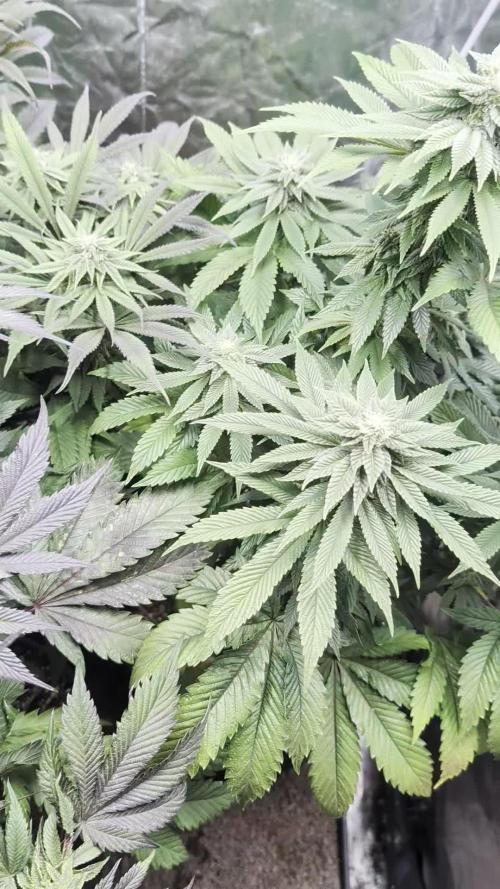
Die Seifuku kommt wohl gar nicht klar mit dem schlechten VPD und niedrigen Temperaturen bei Nacht. Ich bin ja schon froh, dass ich diese auf mindestens 17° C bekommen habe.
Chem Cake von Paradise Seeds ist erwartet stabil und lässt sich fast nicht stören von den Umständen, Cookies and Cream ist so dazwischen würde ich sagen.
Aktuell ist der insgesamte Stand aber wie erwartet wie bei jedem Winter Grow, die niedrigen Temperaturen und der schlechte VPD fordern die Pflanzen schon sehr. Allerdings sieht man auf den Fotos von Chem Cake aufnder Paradise Seeds Seite auch keine fetten Blüten, sondern schön feine mit viel Harz. Abwarten, mehr kann ich eh nicht mehr machen. 4 Wochen haben sie wahrscheinlich locker noch 🤷🏻


Likes
15
Share


@Brianm420
Follow
Plants are growing good. I accidentally broke the tip off of the Norther light plant. Ahh 😱

Likes
11
Share

@TerpTurtle
Follow
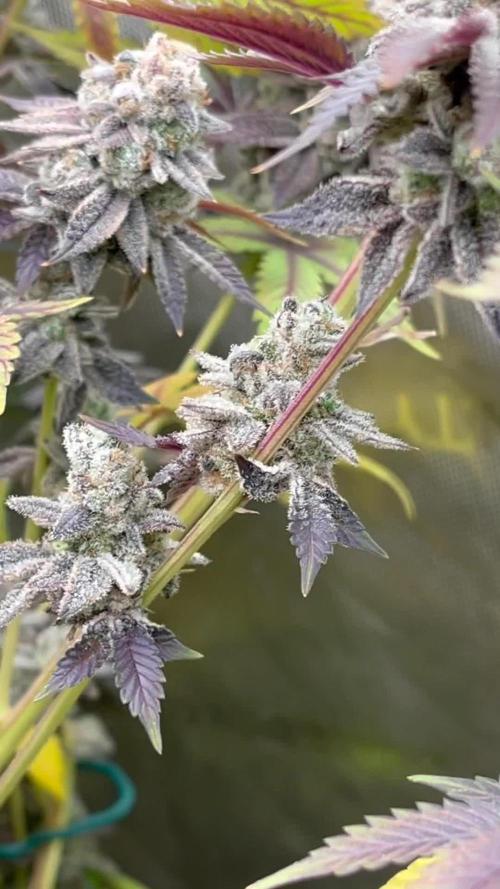
Earthbox pics of Strawberry Truffle s1 | Perpetual grow 👽🐢👽🐢
harvest coming on new moon, flipping veg tent👍


Likes
30
Share

@NoProbation4Weed
Follow
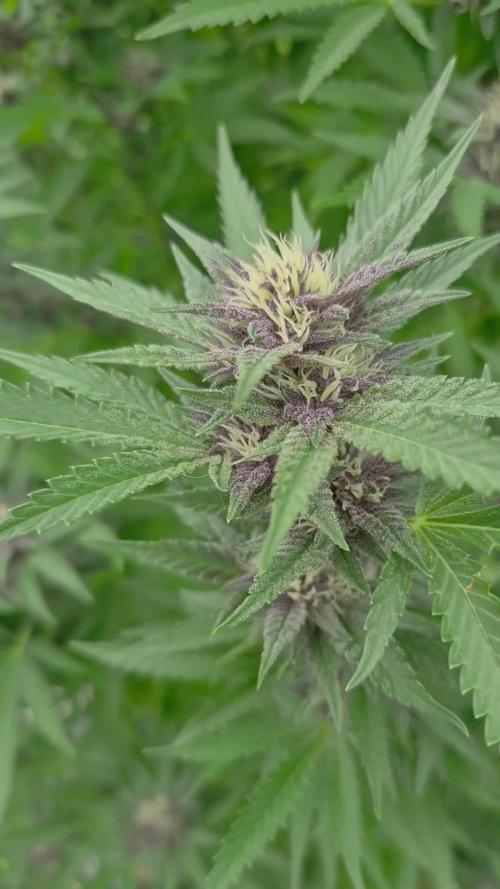
the indoor Plant got harvested and delivered 307g dry. the dry result is frosty, nice dense buds with loads of terpenes. Nice purple colour as well.
The flavour is dark berrys, mintz and cheescake in the background.
Outdoor is is week 4 of flower and the weather is good as well. Its not as warm anymore but at least dry days with sunshine. Today still no signs of powdery mildew or spider mites. She go the final defoliation this week so she can send all her energy into the buds for the last weeks. She is already stinky and you can smell it from far away. Very very intense terps tangy, minty, berry flavours.
Likes
121
Share


@ctm_dzagi
Follow
Daily breakthrough of foliage and correction of sprouts in order to maintain symmetry of their growth.
I create more comfortable conditions for a lagging sprout.
