Likes
Comments
Share
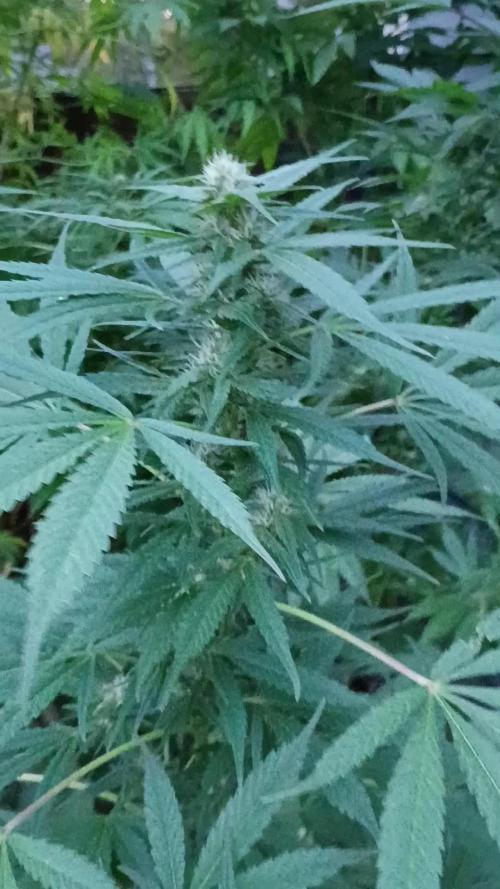
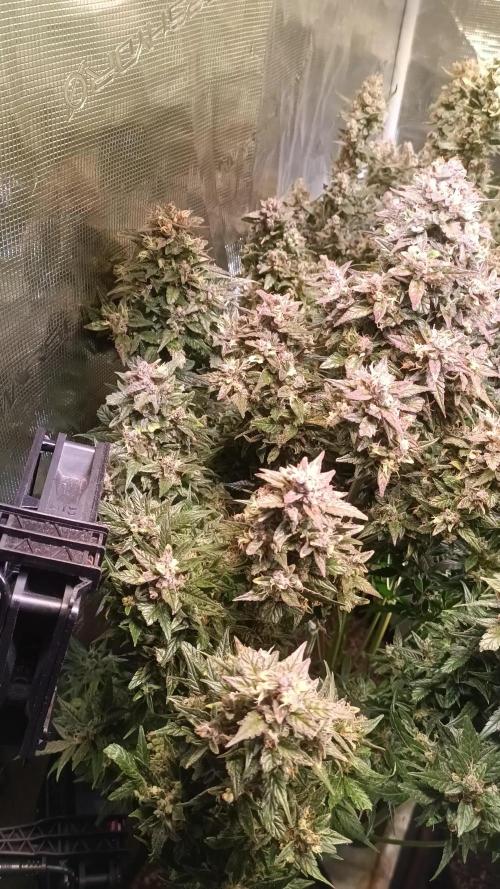
These are close to done! I’ll be chopping one some time in the next few days and the other one a week or so later!
Likes
45
Share
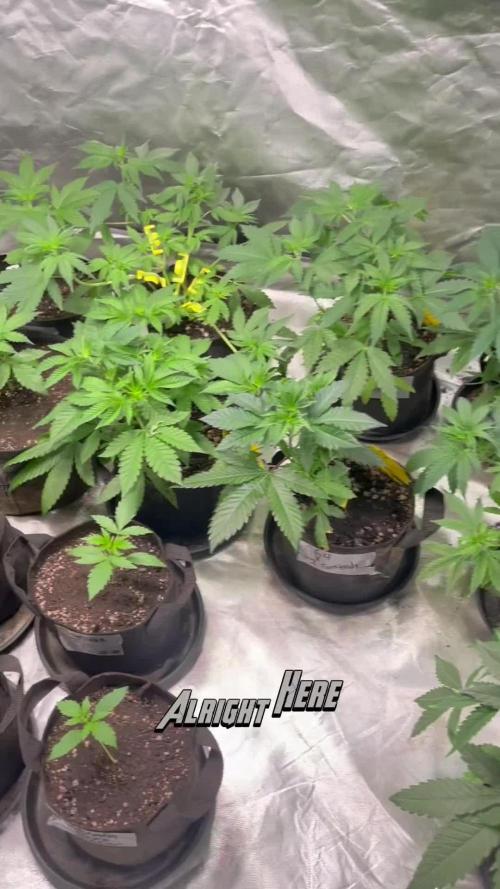
~_~_~_~_~_~_~_~_~_~_~_~_~_~_~_~_~_~_~_~_~_~_~_~ 🌱💡😽💨 Awesome week!! These plants are definitely my favorite of the bunch. I love the shape and node spacing. I think these will be the highest yielding.. bud sites are forming fast and they're praying to the Solux most of the time.. we raised the light a few more inches..the tops of one of the kush is getting bleached.. this may be due to our calmag shortage too..we ordered more and plan to hit them all with a full dose when it arrives.. We still have the Solux at 75% power and this seems to be more than adequate for now..we'll turn it up to 100% a little later in flower..not too much else to report, awesome lighting and forgiving plants make for easy weeks.. thanks as always for dropping by and happy harvests everyone!!🤘🐱❤️🌱 ⚡Hortibloom/Solux 350⚡ Specifications ⚙️: Diodes: Samsung LM281 Pro / Osram DR (1,440 total)💡 Driver: Inventronics 350 watt🔌 PPF: 1015 μmol/s ☢️ PPE: 2.9 µmol/j 〰️〰️ Lifespan: 50k+ hrs ⌛ Weight: 14.3lbs lbs (6.5kg) Veg Coverage: 5 x 5 ft 🌱 Flowering Coverage: 4 x 4 ft 🌼 -Uses an aluminum heatsink (no fan), quiet while operating 👂⬇️ -IP65 waterproof ratings, tolerant to high humidity grow environments 💦 -May be daisy-chained via RJ14 and managed from a single controller 💡~💡~💡~💡~💡 🌎 https://hortibloom.com/products/solux-350-led-grow-light ~_~_~_~_~_~_~_~_~_~_~_~_~_~_~_~_~_~_~_~_~_~_~_~_
Likes
124
Share
Day 1 drying: Really nice strain! Easy to grow, medium dosage of nutrients. Smells amazing, I’m really curious how they will end up after the drying. Let’s see in some days. Drying day 7: finished and damn the terps are amazing! Smells and taste amazing. It reminds me of amnesia but in a mix with mimosa. Super special. I do really recommend trying this one out. But I would recommend using living soil over coco!
Likes
170
Share
@nonick123
Follow
Día 69 (25/03) Gorilla Cookies FF muestra una ligera necrosis... me preocupa... Día 70 (26/03) Necrosis en Gorilla Cookies muy avanzada en solo 2 días. Hablo con el gran @dogdoctorofficial y me hace ver que estoy regando mal... He dejado que se seque demasiado el sustrato! (como en la fase vegetativa) Y la Gorilla Cookies FF al ser la planta más grande y que más agua pide, está demasiado sedienta... Voy a modificar los patrones de riego para que el problema no persista en Gorilla Cookies FF ni aparezca en las otras plantas! Riego 0,5 Litro H20 sin nutrientes. TDS 225 PPMs - pH 6,6 Día 71 (27/03) Riego 1,25 Litro H20 + Wholly Base 3 ml/l + Solid Green 1,75 ml/l + Early Flower 0,75 ml/l + Big Bloom 1,5 ml/l de Gen1:11 TDS 1150 PPMs - pH 6,2 Día 72 (28/03) La necrosis en Gorilla Cookies FF se ha detenido 😁 y las flores siguen creciendo Observa alguna mancha de necrosis también en Wedding Cheesecake FF y decido a subir un poco la lámpara Ahora el PPFD en apical es de unos 830 PPFD Día 73 (29/03) Riego 0,5 Litro H20 sin nutrientes. TDS 225 PPMs - pH 6,6 Día 74 (30/03) Riego 1,25 Litro H20 + Wholly Base 3 ml/l + Solid Green 1,75 ml/l + Early Flower 0,75 ml/l + Big Bloom 1,5 ml/l de Gen1:11 TDS 1150 PPMs - pH 6,2 Día 75 (31/03) Detecto una ligera necrosis en Purple Lemonade FF y en Wedding Cheesecake FF. Voy a aumentar un poco la distancia de la lámpara para tener un DLI de 37, por si fuese estrés por luz. 💦Nutrients by Gen1:11 - www.genoneeleven.com 🌱Substrate PRO-MIX HP BACILLUS + MYCORRHIZAE - www.pthorticulture.com/en/products/pro-mix-hp-biostimulant-plus-mycorrhizae
Likes
91
Share
@CANNASIM
Follow
GENERAL COMMENT. This week ran nicely for the two girls, of course one is going slower than the other. RQS STRESS KILLER AUTO. Super happy with the results so far, she grew nice size buds, in the surrounding and a big fat main cola, just beautiful. As we are entering the last week, of last tree days, I choose to lollipop and take do a pre harvest defoliation, the reasons for that is mould and rot, I started to become insecure because she didn’t have airflow and as i was flushing humidity started to raise, all good, and now just approaching harvest! Flushing with flawless finish and tap water.
Processing
Likes
5
Share
Son fotos y videos de múltiples cultivos debido a que nunca e realizado un seguimiento como tal, espero realizar uno ahora! Nutrientes Utilizados en general Trybac y Trypack biobizz. Las criticas siempre serán bien recibidas!😋 Espero les guste el contenido!
Likes
7
Share
Organic 1 gallon drip irrigation is actually working out very well. Check out my YouTube for the videos they won't let me upload here https://youtube.com/@aestheticgenetix?si=5ty1Lo028s0boMtZ
Likes
69
Share
@nonick123
Follow
Día 73 (12/08) Riego 500 ml H2O pH 6,55 Todas las plantas muestras las preflores hembras! (excepto LemonPaya) Día 74 (13/08) Riego 250 ml H2O pH 6,55 . Están muy bien hidratadas Pequeños ajustes de LST Día 75 (14/08) Hoy día de lluvias torrenciales Riego 250 ml H2O pH 6,55 Día 76 (15/08) Detecto mosca blanca en varias plantas. Aplico Spruzit a 10 ml/l ahora que aún no estamos en floración Riego 500 ml H2O pH 6,55 Día 77 (16/08) Riego 500 ml H2O pH 6,55 La mosca blanca ha desaparecido completamente Día 78 (17/08) No riego. Mañana a primera hora aplico Top Dress y riego profundo Va a empezar la floración! Día 79 (18/08) Alimentemos el suelo con Top Dress! 💥 Aplicamos 4 g/L sustrato de Tasty Flowers TD by Lurpe Solutions. Total = 84 gramos / maceta Riego con 1 Litro H2O pH 6,5 con 25 ml/L de Humus de Lombriz Liquido Aplicación foliar Kelp hidrolizado de Lurpe Solutions a 0,25 ml/l 💦Nutrients by Lurpe Solutions - www.lurpenaturalsolutions.com 🌱Substrate PRO-MIX HP BACILLUS + MYCORRHIZAE - www.pthorticulture.com/en/products/pro-mix-hp-biostimulant-plus-mycorrhizae
Likes
8
Share
Divine Seeds Website says this Auto Candy could be as tall as 100-120 cm. My Auto Candy is 41 inches which translates to 104cm. On POINT. What started out to be a little on the bushy side ended up sprouting up like a teenager. Divine Seeds Website says this Auto Candy should be flowering in 60 days. My Auto Candy is flowering in 42 days--WHY??--Why is it flowering 18 days sooner?? Please advise. Maybe it is this wonderful @advancenutrient jungle juice that I am using:) I do know that the past couple of weeks have been excruciatingly HOT. This week is incredible cool--Thank you Jesus for the break in weather. It will be very interesting to see what this cooler weather does during this flowering season. Keep the comments and conversations coming this way. Be Happy!!
Likes
4
Share
@deFharo
Follow
Bienvenidos cultivadores de marihuana! 🖐️ 👨‍🌾 - 21 semanas desde que puse la semilla a germinar! 🌱 - 18 semanas desde el trasplante a la maceta final. - 17 semanas desde el primer corte apical - 13 semanas desde que hice un segundo corte apical. - 13 semanas desde el cambio a horario de floración a 12/12H. - 12 semanas de floración... 🌼🌼🌼! 3M 🍋 Black Lemon RIP *08/09/25 †28/01/26 Tus parientes no te olvidan: Tangieland x Honey Mints ========================== Hoy, después de pasar el día a la intemperie, como último deseo, he saqueado esta bonita planta. Me ha dado pegajosos cogollos, muy densos y olorosos. Ahora, después de la manicura de las hojas, cuelgan delante del extractor de la carpa de cultivo, estarán ahí 3-4 días, para que pierdan rápidamente la humedad inicial, después los tendré unos días más en la malla de secado y por fin los meteré en botes de cristal durante un par de semanas y después comenzaré a fumar. 😁 HASTA LA PRÓXIMA. SALUD Y SALUDOS PARA TODOS! ============================= BLACK LEMON FEM "Versión feminizada, con niveles de THC que alcanzan un impresionante 25-27% , esta variedad está diseñada para fumadores experimentados que buscan efectos potentes." - Genética: Tangieland x Honey Mints - 50% Sativa, 50% Índica - Tiempo de Floración: 9 Semanas - 450 - 500 G/M2 https://www.exoticseed.eu/products/black-lemon-fem ==============================
Likes
1
Share
@Amboss
Follow
Strech is over … take a lot of leafs of …
Likes
11
Share
@Tmasm
Follow
Saudações Iniciar diários fast buds Encomenda chegou dentro do prazo, muito discreto. Dia 16/11/2023 Selecção de 5 sepas, colocando em papel toalha Dia 17/11/2023 Colocando em vaso final, com um cúpula para manter umidade alta. Agora é esperar que corra tudo bem Não se esqueça de ver novidades em https://2fast4buds.com
Likes
52
Share
Lacewings seemed to have mostly killed themselves by flying into hot light fixtures. I may have left the UV on which was smart of me :) Done very little to combat if anything but make a sea of carcasses, on the bright side its good nutrition for the soil. Made a concoction of ethanol 70%, equal parts water, and cayenne pepper with a couple of squirts of dish soap. Took around an hour of good scrubbing the entire canopy. Worked a lot more effectively and way cheaper. Scorched earth right now, but it seems to have wiped them out almost entirely very pleased. Attempted a "Fudge I Missed" for the topping. So just time to wait and see how it goes. Question? If I attached a plant to two separate pots but it was connected by rootzone, one has a pH of 7.5 ish the other has 4.5. Would the Intelligence of the plant able to dictate each pot separately to uptake the nutrients best suited to pH or would it still try to draw nitrogen from a pot with a pH where nitrogen struggles to uptake? Food for stoner thought experiments! Another was on my mind. What happens when a plant gets too much light? Well, it burns and curls up leaves. That's the heat radiation, let's remove excess heat, now what? I've always read it's just bad, or not good, but when I look for an explanation on a deeper level it's just bad and you shouldn't do it. So I did. How much can a cannabis plant absorb, 40 moles in a day, ok I'll give it 60 moles. 80 nothing bad ever happened. The answer, finally. Oh great........more questions........ Reactive oxygen species (ROS) are molecules capable of independent existence, containing at least one oxygen atom and one or more unpaired electrons. "Sunlight is the essential source of energy for most photosynthetic organisms, yet sunlight in excess of the organism’s photosynthetic capacity can generate reactive oxygen species (ROS) that lead to cellular damage. To avoid damage, plants respond to high light (HL) by activating photophysical pathways that safely convert excess energy to heat, which is known as nonphotochemical quenching (NPQ) (Rochaix, 2014). While NPQ allows for healthy growth, it also limits the overall photosynthetic efficiency under many conditions. If NPQ were optimized for biomass, yields would improve dramatically, potentially by up to 30% (Kromdijk et al., 2016; Zhu et al., 2010). However, critical information to guide optimization is still lacking, including the molecular origin of NPQ and the mechanism of regulation." What I found most interesting was research pointing out that pH is linked to this defense mechanism. The organism can better facilitate "quenching" when oversaturated with light in a low pH. Now I Know during photosynthesis plants naturally produce exudates (chemicals that are secreted through their roots). Do they have the ability to alter pH themselves using these excretions? Or is that done by the beneficial bacteria? If I can prevent reactive oxygen species from causing damage by "too much light". The extra water needed to keep this level of burn cooled though, I must learn to crawl before I can run. Reactive oxygen species (ROS) are key signaling molecules that enable cells to rapidly respond to different stimuli. In plants, ROS plays a crucial role in abiotic and biotic stress sensing, integration of different environmental signals, and activation of stress-response networks, thus contributing to the establishment of defense mechanisms and plant resilience. Recent advances in the study of ROS signaling in plants include the identification of ROS receptors and key regulatory hubs that connect ROS signaling with other important stress-response signal transduction pathways and hormones, as well as new roles for ROS in organelle-to-organelle and cell-to-cell signaling. Our understanding of how ROS are regulated in cells by balancing production, scavenging, and transport has also increased. In this Review, we discuss these promising developments and how they might be used to increase plant resilience to environmental stress. Temperature stress is one of the major abiotic stresses that adversely affect agricultural productivity worldwide. Temperatures beyond a plant's physiological optimum can trigger significant physiological and biochemical perturbations, reducing plant growth and tolerance to stress. Improving a plant's tolerance to these temperature fluctuations requires a deep understanding of its responses to environmental change. To adapt to temperature fluctuations, plants tailor their acclimatory signal transduction events, specifically, cellular redox state, that are governed by plant hormones, reactive oxygen species (ROS) regulatory systems, and other molecular components. The role of ROS in plants as important signaling molecules during stress acclimation has recently been established. Here, hormone-triggered ROS produced by NADPH oxidases, feedback regulation, and integrated signaling events during temperature stress activate stress-response pathways and induce acclimation or defense mechanisms. At the other extreme, excess ROS accumulation, following temperature-induced oxidative stress, can have negative consequences on plant growth and stress acclimation. The excessive ROS is regulated by the ROS scavenging system, which subsequently promotes plant tolerance. All these signaling events, including crosstalk between hormones and ROS, modify the plant's transcriptomic, metabolomic, and biochemical states and promote plant acclimation, tolerance, and survival. Here, we provide a comprehensive review of the ROS, hormones, and their joint role in shaping a plant's responses to high and low temperatures, and we conclude by outlining hormone/ROS-regulated plant-responsive strategies for developing stress-tolerant crops to combat temperature changes. Onward upward for now. Next! Adenosine triphosphate (ATP) is an energy-carrying molecule known as "the energy currency of life" or "the fuel of life," because it's the universal energy source for all living cells.1 Every living organism consists of cells that rely on ATP for their energy needs. ATP is made by converting the food we eat into energy. It's an essential building block for all life forms. Without ATP, cells wouldn't have the fuel or power to perform functions necessary to stay alive, and they would eventually die. All forms of life rely on ATP to do the things they must do to survive.2 ATP is made of a nitrogen base (adenine) and a sugar molecule (ribose), which create adenosine, plus three phosphate molecules. If adenosine only has one phosphate molecule, it’s called adenosine monophosphate (AMP). If it has two phosphates, it’s called adenosine diphosphate (ADP). Although adenosine is a fundamental part of ATP, when it comes to providing energy to a cell and fueling cellular processes, the phosphate molecules are what really matter. The most energy-loaded composition for adenosine is ATP, which has three phosphates.3 ATP was first discovered in the 1920s. In 1929, Karl Lohmann—a German chemist studying muscle contractions—isolated what we now call adenosine triphosphate in a laboratory. At the time, Lohmann called ATP by a different name. It wasn't until a decade later, in 1939, that Nobel Prize–-winner Fritz Lipmann established that ATP is the universal carrier of energy in all living cells and coined the term "energy-rich phosphate bonds."45 Lipmann focused on phosphate bonds as the key to ATP being the universal energy source for all living cells, because adenosine triphosphate releases energy when one of its three phosphate bonds breaks off to form ADP. ATP is a high-energy molecule with three phosphate bonds; ADP is low-energy with only two phosphate bonds. The Twos and Threes of ATP and ADP Adenosine triphosphate (ATP) becomes adenosine diphosphate (ADP) when one of its three phosphate molecules breaks free and releases energy (“tri” means “three,” while “di” means “two”). Conversely, ADP becomes ATP when a phosphate molecule is added. As part of an ongoing energy cycle, ADP is constantly recycled back into ATP.3 Much like a rechargeable battery with a fluctuating state of charge, ATP represents a fully charged battery, and ADP represents a "low-power mode." Every time a fully charged ATP molecule loses a phosphate bond, it becomes ADP; energy is released via the process of ATP becoming ADP. On the flip side, when a phosphate bond is added, ADP becomes ATP. When ADP becomes ATP, what was previously a low-charged energy adenosine molecule (ADP) becomes fully charged ATP. This energy-creation and energy-depletion cycle happens time and time again, much like your smartphone battery can be recharged countless times during its lifespan. The human body uses molecules held in the fats, proteins, and carbohydrates we eat or drink as sources of energy to make ATP. This happens through a process called hydrolysis . After food is digested, it's synthesized into glucose, which is a form of sugar. Glucose is the main source of fuel that our cells' mitochondria use to convert caloric energy from food into ATP, which is an energy form that can be used by cells. ATP is made via a process called cellular respiration that occurs in the mitochondria of a cell. Mitochondria are tiny subunits within a cell that specialize in extracting energy from the foods we eat and converting it into ATP. Mitochondria can convert glucose into ATP via two different types of cellular respiration: Aerobic (with oxygen) Anaerobic (without oxygen) Aerobic cellular respiration transforms glucose into ATP in a three-step process, as follows: Step 1: Glycolysis Step 2: The Krebs cycle (also called the citric acid cycle) Step 3: Electron transport chain During glycolysis, glucose (i.e., sugar) from food sources is broken down into pyruvate molecules. This is followed by the Krebs cycle, which is an aerobic process that uses oxygen to finish breaking down sugar and harnesses energy into electron carriers that fuel the synthesis of ATP. Lastly, the electron transport chain (ETC) pumps positively charged protons that drive ATP production throughout the mitochondria’s inner membrane.2 ATP can also be produced without oxygen (i.e., anaerobic), which is something plants, algae, and some bacteria do by converting the energy held in sunlight into energy that can be used by a cell via photosynthesis. Anaerobic exercise means that your body is working out "without oxygen." Anaerobic glycolysis occurs in human cells when there isn't enough oxygen available during an anaerobic workout. If no oxygen is present during cellular respiration, pyruvate can't enter the Krebs cycle and is oxidized into lactic acid. In the absence of oxygen, lactic acid fermentation makes ATP anaerobically. The burning sensation you feel in your muscles when you're huffing and puffing during anaerobic high-intensity interval training (HIIT) that maxes out your aerobic capacity or during a strenuous weight-lifting workout is lactic acid, which is used to make ATP via anaerobic glycolysis. During aerobic exercise, mitochondria have enough oxygen to make ATP aerobically. However, when you're out of breath and your cells don’t have enough oxygen to perform cellular respiration aerobically, the process can still happen anaerobically, but it creates a temporary burning sensation in your skeletal muscles. Why ATP Is So Important? ATP is essential for life and makes it possible for us to do the things we do. Without ATP, cells wouldn't be able to use the energy held in food to fuel cellular processes, and an organism couldn't stay alive. As a real-world example, when a car runs out of gas and is parked on the side of the road, the only thing that will make the car drivable again is putting some gasoline back in the tank. For all living cells, ATP is like the gas in a car's fuel tank. Without ATP, cells wouldn't have a source of usable energy, and the organism would die. Eating a well-balanced diet and staying hydrated should give your body all the resources it needs to produce plenty of ATP. Although some athletes may slightly improve their performance by taking supplements or ergonomic aids designed to increase ATP production, it's debatable that oral adenosine triphosphate supplementation actually increases energy. An average cell in the human body uses about 10 million ATP molecules per second and can recycle all of its ATP in less than a minute. Over 24 hours, the human body turns over its weight in ATP. You can last weeks without food. You can last days without water. You can last minutes without oxygen. You can last 16 seconds at most without ATP. Food amounts to one-third of ATP production within the human body.
Likes
10
Share
Hallo zusammen 🤙. Sie wächst sehr schön und macht keine Probleme. Rabattcode für den BIOTABS-Webshop https://biotabs.nl/en/shop/ GDBT420, damit erhalten Sie 15 Prozent
Likes
24
Share
Growing feminized seeds from White Label Seed Company is an affordable and easy method of obtaining a high quality harvest. White Label was the first company associated with the Sensi gene-bank to make feminized varieties available to the public. As the popularity of growing feminized cannabis has grown, the number of White Label feminized varieties has increased to keep pace with the demand. Starting to add some enzymes and some nutrients with the roots booster. Giving more place for the plants to grow, adding the MH to increase light coverage. Plants started to grow, it’s nearly the time to transplant into bigger pots. Pots gets lightweight faster, and need to get water more often, but feeding and adding nutrients to the water only once a week, at this stage, is enough ! (I’m looking for a job in the Cannabis industry as Master Grower, Mineralogist, Quality Control)
Likes
18
Share
Que pasa familia, vamos con la tercera semana de vida de estas Tropicana Cookies Fast Flowering, de FastBuds. Vamos al lío , las 3 plantas se colocaron en macetas de 7 litros definitivamente. El ph se controla en 6.2 , la temperatura la tenemos entre 21/24 grados y la humedad ronda el 60%. Ir van creciendo y no llevan ni mal ritmo ni mal como, veremos como avanzan las próximas semanas. Mars hydro: Code discount: EL420 https://www.mars-hydro.com/ Agrobeta: https://www.agrobeta.com/agrobetatiendaonline/36-abonos-canamo Hasta aquí todo, Buenos humos 💨💨💨
Likes
4
Share
Week 4 I had some problem with humidity go down and up many time will see where will end up thanks everyone
Likes
14
Share
November 6th day 63 is the day to harvest. May change but i am checking trichomes daily. Few clear trichs left and most are cloudy. Planning on flushing this weekend for a week. We are at day 56 flowering and most trichomes are cloudy. preparing to start Flawless Finish flush and let the girls ripen. Ill give an update half way through the next week. Thanks for checking in.