The Grow Awards 2026 🏆
Likes
Comments
Share
@Jacks_Pot
Follow
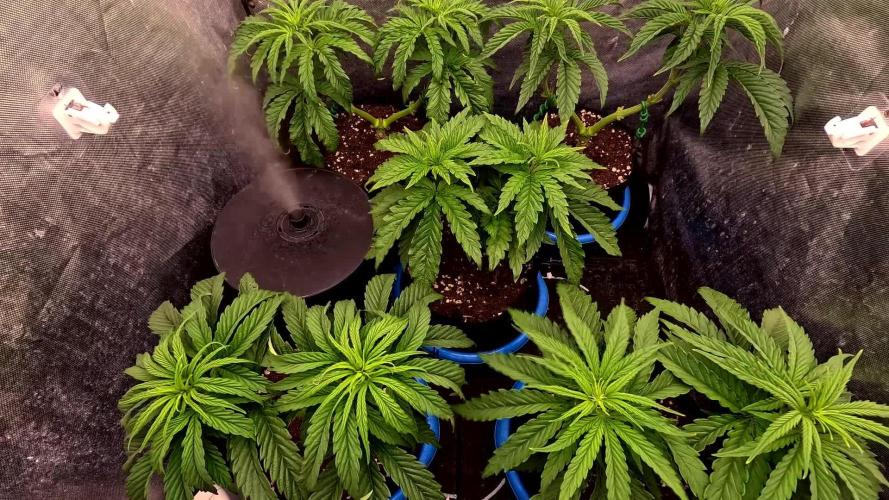
The first week of the 12/12 cycle went without any problems. The scrog is going fine and I've done some pruning & defoliation underneath the screen making it easier to water them. On day 40 (5th day of this week) I spotted the first pre-flowers. I gave them tapwater with Plagron nutrients once this week. The rest of the week I gave them ph adjusted tapwater every other day (Ec 0.46 - ph 6.1 - 1 liter each/48h) The cobs stayed at the same height and power as last week (43 cm/17 inch and 188 watt – DLI 28 – PPFD 648) On the last day it got a bit brighter again with the cobs at 40 cm/15.75 inch and 208 watt. (DLI 30.2 – PPFD 699) I sprayed them once with a CannaCure solution (50 ml CannaCure + 200 ml tapwater, ph 6.1) Temperatures stayed between 20 – 25 °C (68 – 77 °F) and humidity levels between 49 – 66 % C u next week! ✋ Do you want to grow this strain? 👉 https://www.barneysfarm.us/pineapple-chunk-weed-strain-15 👈
Likes
9
Share
I soaked my seeds for 24 hours in a mixture of 6.3 ph water, BioAg Ful-a power & Aloe Vera. i then inoculated the soil with the mixture of all the nutrients I listed above then placed the seeds 1/4” down into the soil. I then sprayed the top with my pump sprayer & put them under a humidity dome. 75 F degrees & 89% humidity.
Likes
567
Share
Day 29: one plant is a beast but the other one i don’t know what happened there😂 Day 31: everything is going fine and the autopots are doing a great job! I’m using (torus hydro) to manage the ph! Mars hydro SP3000 High PPFD at 2.8 umol/j, average yield at 2.5g/w, increasing your yield 50% or more compared with old blurple and HPS lights, 300 watts output. Dimmer knob added, more convenient to adjust the brightness. Up to 30 lights can be daisy-chained and control together on just one light, or just have one lamp in 120x60 tent is perfect for light. https://www.instagram.com/marshydro_aliexpress2/
Processing
Likes
43
Share
Bonjour à tous les padawans et maîtres jedis Jour98 grosse defoliation et léger arrosage Jour101 arrosage avec 2, 5 litres d'eau ph6.3
Likes
5
Share
@Salokin
Follow
Big shout out to bold____ for passing by with this amazing cut. Here’s the detailed MARKUSH GMO x Triangle Mints x Triangle Mints AKA Trophy Wife Bold
Likes
56
Share
What's in the soil? What's not in the soil would be an easier question to answer. 16-18 DLI @ the minute. +++ as she grows. Probably not recommended, but to get to where it needs to be, I need to start now. Vegetative @1400ppm 0.8–1.2 kPa 80–86°F (26.7–30°C) 65–75%, LST Day 10, Fim'd Day 11 CEC (Cation Exchange Capacity): This is a measure of a soil's ability to hold and exchange positively charged nutrients, like calcium, magnesium, and potassium. Soils with high CEC (more clay and organic matter) have more negative charges that attract and hold these essential nutrients, preventing them from leaching away. Biochar is highly efficient at increasing cation exchange capacity (CEC) compared to many other amendments. Biochar's high CEC potential stems from its negatively charged functional groups, and studies show it can increase CEC by over 90%. Amendments like compost also increase CEC but are often more prone to rapid biodegradation, which can make biochar's effect more long-lasting. biochar acts as a long-lasting Cation Exchange Capacity (CEC) enhancer because its porous, carbon-rich structure provides sites for nutrients to bind to, effectively improving nutrient retention in soil without relying on the short-term benefits of fresh organic matter like compost or manure. Biochar's stability means these benefits last much longer than those from traditional organic amendments, making it a sustainable way to improve soil fertility, water retention, and structure over time. Needs to be charged first, similar to Coco, or it will immobilize cations, but at a much higher ratio. a high cation exchange capacity (CEC) results in a high buffer protection, meaning the soil can better resist changes in pH and nutrient availability. This is because a high CEC soil has more negatively charged sites to hold onto essential positively charged nutrients, like calcium and magnesium, and to buffer against acid ions, such as hydrogen. EC (Electrical Conductivity): This measures the amount of soluble salts in the soil. High EC levels indicate a high concentration of dissolved salts and can be a sign of potential salinity issues that can harm plants. The stored cations associated with a medium's cation exchange capacity (CEC) do not directly contribute to a real-time electrical conductivity (EC) reading. A real-time EC measurement reflects only the concentration of free, dissolved salt ions in the water solution within the medium. 98% of a plants nutrients comes directly from the water solution. 2% come directly from soil particles. CEC is a mediums storage capacity for cations. These stored cations do not contribute to a mediums EC directly. Electrical Conductivity (EC) does not measure salt ions adsorbed (stored) onto a Cation Exchange Capacity (CEC) site, as EC measures the conductivity of ions in solution within a soil or water sample, not those held on soil particles. A medium releases stored cations to water by ion exchange, where a new, more desirable ion from the water solution temporarily displaces the stored cation from the medium's surface, a process also seen in plants absorbing nutrients via mass flow. For example, in water softeners, sodium ions are released from resin beads to bond with the medium's surface, displacing calcium and magnesium ions which then enter the water. This same principle applies when plants take up nutrients from the soil solution: the cations are released from the soil particles into the water in response to a concentration equilibrium, and then moved to the root surface via mass flow. An example of ion exchange within the context of Cation Exchange Capacity (CEC) is a soil particle with a negative charge attracting and holding positively charged nutrient ions, like potassium (K+) or calcium (Ca2+), and then exchanging them for other positive ions present in the soil solution. For instance, a negatively charged clay particle in soil can hold a K+ ion and later release it to a plant's roots when a different cation, such as calcium (Ca2+), is abundant and replaces the potassium. This process of holding and swapping positively charged ions is fundamental to soil fertility, as it provides plants with essential nutrients. Negative charges on soil particles: Soil particles, particularly clay and organic matter, have negatively charged surfaces due to their chemical structure. Attraction of cations: These negative charges attract and hold positively charged ions, or cations, such as: Potassium (K+) Calcium (Ca2+) Magnesium (Mg2+) Sodium (Na+) Ammonium (NH4+) Plant roots excrete hydrogen ions (H+) through the action of proton pumps embedded in the root cell membranes, which use ATP (energy) to actively transport H+ ions from inside the root cell into the surrounding soil. This process lowers the pH of the soil, which helps to make certain mineral nutrients, such as iron, more available for uptake by the plant. Mechanism of H+ Excretion Proton Pumps: Root cells contain specialized proteins called proton pumps (H+-ATPases) in their cell membranes. Active Transport: These proton pumps use energy from ATP to actively move H+ ions from the cytoplasm of the root cell into the soil, against their concentration gradient. Role in pH Regulation: This active excretion of H+ is a major way plants regulate their internal cytoplasmic pH. Nutrient Availability: The resulting decrease in soil pH makes certain essential mineral nutrients, like iron, more soluble and available for the root cells to absorb. Ion Exchange: The H+ ions also displace positively charged mineral cations from the soil particles, making them available for uptake. Iron Uptake: In response to iron deficiency stress, plants enhance H+ excretion and reductant release to lower the pH and convert Fe3+ to the more available form Fe2+. The altered pH can influence the activity and composition of beneficial microbes in the soil. The H+ gradient created by the proton pumps can also be used for other vital cell functions, such as ATP synthesis and the transport of other solutes. The hydrogen ions (H+) excreted during photosynthesis come from the splitting of water molecules. This splitting, called photolysis, occurs in Photosystem II to replace the electrons used in the light-dependent reactions. The released hydrogen ions are then pumped into the thylakoid lumen, creating a proton gradient that drives ATP synthesis. Plants release hydrogen ions (H+) from their roots into the soil, a process that occurs in conjunction with nutrient uptake and photosynthesis. These H+ ions compete with mineral cations for the negatively charged sites on soil particles, a phenomenon known as cation exchange. By displacing beneficial mineral cations, the excreted H+ ions make these nutrients available for the plant to absorb, which can also lower the soil pH and indirectly affect its Cation Exchange Capacity (CEC) by altering the pool of exchangeable cations in the soil solution. Plants use proton (H+) exudation, driven by the H+-ATPase enzyme, to release H+ ions into the soil, creating a more acidic rhizosphere, which enhances nutrient availability and influences nutrient cycling processes. This acidification mobilizes insoluble nutrients like iron (Fe) by breaking them down, while also facilitating the activity of beneficial microbes involved in the nutrient cycle. Therefore, H+ exudation is a critical plant strategy for nutrient acquisition and management, allowing plants to improve their access to essential elements from the soil. A lack of water splitting during photosynthesis can affect iron uptake because the resulting energy imbalance disrupts the plant's ability to produce ATP and NADPH, which are crucial for overall photosynthetic energy conversion and can trigger a deficiency in iron homeostasis pathways. While photosynthesis uses hydrogen ions produced from water splitting for the Calvin cycle, not to create a hydrogen gas deficiency, the overall process is sensitive to nutrient availability, and iron is essential for chloroplast function. In photosynthesis, water is split to provide electrons to replace those lost in Photosystem II, which is triggered by light absorption. These electrons then travel along a transport chain to generate ATP (energy currency) and NADPH (reducing power). Carbon Fixation: The generated ATP and NADPH are then used to convert carbon dioxide into carbohydrates in the Calvin cycle. Impaired water splitting (via water in or out) breaks the chain reaction of photosynthesis. This leads to an imbalance in ATP and NADPH levels, which disrupts the Calvin cycle and overall energy production in the plant. Plants require a sufficient supply of essential mineral elements like iron for photosynthesis. Iron is vital for chlorophyll formation and plays a crucial role in electron transport within the chloroplasts. The complex relationship between nutrient status and photosynthesis is evident when iron deficiency can be reverted by depleting other micronutrients like manganese. This highlights how nutrient homeostasis influences photosynthetic function. A lack of adequate energy and reducing power from photosynthesis, which is directly linked to water splitting, can trigger complex adaptive responses in the plant's iron uptake and distribution systems. Plants possess receptors called transceptors that can directly detect specific nutrient concentrations in the soil or within the plant's tissues. These receptors trigger signaling pathways, sometimes involving calcium influx or changes in protein complex activity, that then influence nutrient uptake by the roots. Plants use this information to make long-term adjustments, such as Increasing root biomass to explore more soil for nutrients. Modifying metabolic pathways to make better use of available resources. Adjusting the rate of nutrient transport into the roots. That's why I keep a high EC. Abundance resonates Abundance.
Likes
8
Share
@pzwags420
Follow
I switched the light timer to 12/12 and turned the carbon filter on. I wish I had more space to grow vertically, but the height of my box and grow light distance limits me from vegging too long. I hope to have a larger set up in the future 😀. At the start of week 7 The girls are chugging along (Cal/Mag really seemed to help) and I'm looking forward to seeing the bud structure and that Blueberry smell! I will be going on vacation in a little over a week for 8 days 😅. This is also why I started flowering now..so that I can be home during the majority of the stretch period(12 days from flip). The day I leave I will apply nutrients and thoroughly saturate the coco and then the girls will be watered with the blumats from my 5 gal reservoir (hopefully that is enough and there isn't too much PH drift). On day 5 of week 7 I applied 1 gal of nutrients until runoff. Week 7 went well.
Likes
10
Share
@Jerrza
Follow
New week, plants start to produce loads of sugar and a strong smell is coming trough
Likes
3
Share
Our Tangerine Dream have a name and promise scents that remind us of our land and so let's go home! Remember that we are growing 1 Plant worked with the techniques and one left to grow without cutting techniques are with a bit of LST. She has been in bloom for two days, these days we consider them vegetative and from the next we will narrate the deeds of the buds that form. Comparison is the salt of experience so the plant of the other diary will be worked very differently go and see it to compare them. We have started the Plagron fertilization program, we are in 100% organic configuration, the soil is recycled Promix + 1/3 fresh soil + 10% Perlite + RQS Mycorrhiza Mix (4 g in the mix, 1 g under the small fiber pot). We are administering // 1 ml/l Power Roots - 1 ml/l Pure Zym - 1 ml/l Sugar Royal - 3 ml/l Alga Grow We sprayed Vita Race Foliare 3 ml/l. https://plagron.com/en The doubts about the compatibility between Pure Zym and mycorrhizae have been dispelled, they can get along according to Plagron experts. If someone tells you that enzymes eat mycorrhizae, which in principle may seem possible, explain to them that it is not true. https://www.royalqueenseeds.it/growing/452-easy-roots-mix-di-micorrhize.html Taste this strain a little bit, it's a cross of legendary strains ---- // https://www.zamnesia.io/en/10966-zamnesia-seeds-tangerine-dream.html Short Description Zamnesia // When legendary genetics are crossed, something exceptional can only be born. Tangerine Dream is the result of crossing classic strains. With citrus and sweet aromas and flavors, vigorous growth and euphoric and stimulating effects, Tangerine Dream by Zamnesia Seeds has it all. But don't take our word for it: order your seeds now and discover it for yourself. You can find the whole world of growing at Zamnesia and much more take a tour of the site and you will find "all the best that nature has to offer" in various shapes and colors. The new strains are fantastic and the old ones are no exception... --- // www.zamnesia.com
Likes
19
Share
@AsNoriu
Follow
Day 50. Tallest Kush chopped by breeders recommendations, but in my conditions like a week at least away. Had max 20% milky, most clear, plant suffered some deficiency and was faiding slowly, still. Instead of Christmas flowers - 5 colas surprised my friends, colours and crystals are amazing. She was watered last 4 rounds with water and i will compare taste and effect , but i think it's a loosing tactics - such early crop. Not more than 40 expected from what left ;))) 5 out of 17 colas was taken away. I will add a third of weight, for real feel in totals. Day 67. After 24 hours of darkness all girls are chopped. Will make review and update in a week or so.
Likes
4
Share
🌿 Week 2 Flower – Super Silver Haze Queens by Zamnesia Two weeks into flower, and the Super Silver Haze girls are showing us why they carry the weight of legend. Despite a week where photos were few, the video walkthrough tells the story: the tent is alive, the room is humming, and the girls are thriving. Their transition into bloom is unmistakable, pistils, morphology shifts, and that unmistakable “flowering energy” filling the air. ✨ Recap of the Journey So Far From the start, these seeds germinated strong, three for three. Early veg was compact and stable, surprisingly stress-free for haze genetics. Transplanting into 11L Zamnesia fabric pots with a tailored Aptus soil mix gave roots the space and nutrients to explode. Week after week, they’ve grown strong under a spectrum of full power LEDs, with an environment tuned by hand and tech alike. Now in flower, they carry the old-school spirit of Super Silver Haze, a strain with cups, history, and heavy nostalgia, now represented by Zamnesia, but forever rooted in the haze heritage. This isn’t just another grow. It’s a living tribute. 🌱 Feeding Recipe This Week The girls are feeling the switch from Start Booster to Top Booster (0.25 ml/L), and the difference shows. Morphology is shifting beautifully. On top of that, we’re layering in some Plagron support — a little experiment to push the expression further: • Aptus Regulator – 0.15 ml/L • Aptus CalMag Boost – 0.25 ml/L • Plagron Power Buds – 1 ml/L • Plagron Sugar Royal – 1 ml/L • Plagron Green Sensation – 1 ml/L • Aptus Top Booster – 0.25 ml/L The Aptus All-In-One Liquid is staying aside for now, since the pellets in the soil are still doing their job beautifully. EC in the soil is ~2.0, with incoming solution at ~0.6. pH around 6.1. Watering is based on substrate moisture, waiting until ~19–20% dryness before irrigation. Average uptake: 1.5–2L per day. 🌡️ Environmental Conditions • Room Temp: Peaks up to 34°C (a bit higher than ideal, AC unit arriving soon!) • Humidity: 50–70% depending on the day • VPD: ~1.8–1.9 (not perfect, but plants are handling it well) • CO₂: ~700 ppm • Soil Temp: 25°C • PPFD: 760–780 μmol/m²/s across canopy zones ⚙️ Gear & Ecosystem The grow room is evolving into a proper ecosystem: • Lights: • ThinkGrow Model on and ICL-300 LEDs • Future of Grow Black Series 600W • Lumatek Zeus Compact Pro 465W Together delivering a full, balanced spectrum across the 8x8 tent. • Airflow & Extraction: • 2 × 6-inch extractors (Trolmaster Aerofan + Spider Farmer) with carbon filters. • Trolmaster unit fully integrated, Spider Farmer on its GGS controller. • Automation: • The Trolmaster WCS substrate sensor is a game-changer — giving live readings of soil EC, pH, and moisture. • Tent-X brain keeps everything connected, making hand-watering smarter and data-driven. 🌼 The Girls This Week Compact, stable, symmetrical, both phenos are tracking almost identically. Pistils are pushing fast, leaves are deep green, internodes are filling with energy. It feels like they’re already a week ahead, and yet, they’re right on schedule. 🐝 A Moment for the Bees This week, alongside the plants, we pause to thank the bees. A photo of one busy bee pollinating a flower reminds us: without these tiny workers, there would be no flowers, no fruits, no life as we know it. In the fairytale of the growroom, the lights are the sun, the soil is the earth, and the bees are the quiet guardians of the cycle. May we never forget how important they are. 🙏 Closing Thoughts Week 2 flower, and already the tent is bursting with energy. Genetics this stable, this historic, deserve respect. The environment isn’t perfect, temps and humidity will improve once the AC kicks in, but the girls don’t seem to mind. They’re thriving, and the journey is only just beginning. To the growers, the sponsors, the community, the lovers and the haters alike — thank you. You make the journey worth sharing. This is more than just a grow: it’s a story, a legacy, and a chance to honor the Queen that is Super Silver Haze. 📲 Don’t forget to Subscribe and follow me on Instagram and YouTube @DogDoctorOfficial for exclusive content, real-time updates, and behind-the-scenes magic. We’ve got so much more coming, including transplanting and all the amazing techniques that go along with it. You won’t want to miss it. • GrowDiaries Journal: https://growdiaries.com/grower/dogdoctorofficial • Instagram: https://www.instagram.com/dogdoctorofficial/ • YouTube: https://www.youtube.com/@dogdoctorofficial There’s a new series blooming and it’s more than just plants. It’s about process, patience, and paying attention. ⸻ Explore the Gear that Powers My Grow If you’re curious about the tech I’m using, check out these links: • Genetics, gear, nutrients, and more – Zamnesia: https://www.zamnesia.com/ • Environmental control & automation – TrolMaster: https://www.trolmaster.eu/ • Advanced LED lighting – Future of Grow: https://www.futureofgrow.com/ • Root and growth nutrition – Aptus Holland: https://aptus-holland.com/ • Nutrient systems & boosters – Plagron: https://plagron.com/en/ • Soil & substrate excellence – PRO-MIX BX: https://www.pthorticulture.com/en-us/products/pro-mix-bx-mycorrhizae • Curing and storage – Grove Bags: https://grovebags.com/ ⸻ We’ve got much more coming as we move through the grow cycles. Trust me, you won’t want to miss the next steps, let’s push the boundaries of indoor horticulture together! As always, this is shared for educational purposes, aiming to spread understanding and appreciation for this plant. Let’s celebrate it responsibly and continue to learn and grow together. With true love comes happiness. Always believe in yourself, and always do things expecting nothing and with an open heart. Be a giver, and the universe will give back in ways you could never imagine. 💚 Growers love to all 💚 P.S.- Why These Plagron Additives? – A Deep Dive I’ve decided to complement the Aptus base with three Plagron boosters. Each one has its own role in the flowering process, and together they form a very balanced support system for the Mango Kush ladies. 🌸 Power Buds (1 ml/L) • Purpose: Early flowering stimulator • What it does: Power Buds encourages the plant to initiate bud development faster. It shortens the “transition phase” from veg into bloom, helping flowers form sooner and more consistently across the canopy. • Why now: We’re in Week 2 Flower, the exact point where we want to signal the plants: “It’s time to build flowers.” Power Buds sends that hormonal nudge. ⸻ 🍯 Sugar Royal (1 ml/L) • Purpose: Enhances resin, aroma, and stress resistance • What it does: Sugar Royal contains amino acids that stimulate the plant to produce more chlorophyll and secondary metabolites. In plain terms: richer terpene profile, stickier resin, stronger smell, deeper taste. • Extra benefit: It also reduces stress from heat or drought, very useful right now since our temps have been spiking up to 34°C. • Why now: As stretch continues, plants need to stay strong and not waste energy on stress. Sugar Royal helps them thrive despite less-than-ideal VPD. ⸻ 💎 Green Sensation (1 ml/L) • Purpose: All-in-one bloom enhancer for the second half of flower • What it does: Green Sensation is a powerful 4-in-1 booster that improves: • Flowering: denser, heavier buds • Resin production: frostier flowers • Nutrient uptake: more efficient feeding • Soil health: stimulates beneficial microbial activity • Why now: Even though it shines brightest in late flower, starting early allows the soil ecosystem and plant metabolism to adapt gradually. By the time we hit peak bloom, the system is fully primed. ⸻ 🌱 How They Work Together • Power Buds → Kickstarts flower sites • Sugar Royal → Enhances resilience + resin quality • Green Sensation → Boosts density and overall flower performance The trio works like a team of specialists: one accelerates the start, one polishes the quality, and one pushes yield potential. Combined with the Aptus base (Regulator for strength, CalMag Boost for structure, Top Booster for bloom push), it’s a balanced, experimental, but very promising recipe. 💚 Growers love to all 💚
Likes
7
Share
@Ereks007
Follow
These are part of week 12
Likes
283
Share
FD36 - True to form I completely forgot to take any pics before the lights were out. The third week in a row. I'm detecting a pattern... lol FD37 - Pics! FD38 - Today, I was proactive in trying to prevent botrytis (budrot) since I have had problems in the past when temperatures and humidity get too high in late flower. I started with defoliating hard by removing fan leaves. That should lower the humidity in the tent as there are fewer leaves to transpire moisture, and also increase the airflow around the buds. Finally, I put my small humidifier in the tent to further lower the humidity. FD41 - The anti-humidity measures are working. The tent went from an average RH in the high 60s to the high 40s. (The average RH in the last 24 hours was 48.9%.) I'm happy with that, which should be enough to avoid budrot. Better safe than sorry, so I did additional LST to open up the plants and thus increase the airflow around the buds. It's also helpful to increase light penetration, so win-win. FD42 - We're at the end of the sixth week of flower, and things are chugging along in the tent. The buds are slowly fattening up, but it will take some time before they are done. There isn't much to do in the tent this late in flower besides watering. Today, each girl got 2.5-liters of water @ pH 6.5.
Likes
16
Share
@Stinkfox
Follow
She’s been a bit fussy, with some color draining from a few leaves. But she’s been just a bit fussy the whole time. It looks like I’ll be getting more color change this round.
Likes
7
Share
@Car1bGrow
Follow
Plants are growing healthy, actually did some low stress training on the two plans in potting soil and they are taking a liking to the conditions.
Likes
4
Share
Vamos familia, actualizamos la tercera semana de floración de estas Terp & Tonic de Seedstockers. La temperatura que estuvo entre los 24-26 grados y humedad dentro de los rangos correctos. En cuanto a las plantas las veo verde sano, estiraron bien y ensancharon bastante también. Se nota que los nutrientes de la marca Agrobeta hacen sus funciones. Las flores empezaron a formarse, por el momento todo correcto, os dejé también alguna novedad y un cambio en la sala, el nuevo TSW2000, que dará que hablar estos proyectos. - os dejo por aquí un CÓDIGO: Eldruida Descuento para la tienda de MARS HYDRO. https://www.mars-hydro.com Hasta aquí todo, Buenos humos 💨💨💨
Likes
17
Share
@Stupenico
Follow
So harvest time finally. Only 2 plants at the end but still I am happy with the result. After cutting them I placed them for 4 days inside the dark tent. I struggle a bit with the humidity as the air was really dry. So now its time for curring. I have placed the bud inside jars. Lets wait for a few weeks to have a first try ! See you for the smoke review.
Likes
36
Share
@BlaKX
Follow
Die Ernte war relativ einfach da sie wenig Blätter ausgebildet hat und mehr Blüten Masse! Viel länger hätte sie auch nicht mehr stehen lassen können da die Blüten Masse bei der dicke schlecht Belüftung in der mitte hat und mir das schimmel Risiko zu hoch ist .
Likes
9
Share
Commencing week 3 - Day 15 on December 15th Change has taken place. Switched out COBs for SolarStorm 440. Currently on VEG mode. BS is a freak. Still has 4 cotyledons and now is displaying Tri-whorled mutation 🤔😄👍 Thanks for your time and attention!
Likes
39
Share
@Festerus
Follow
This week I pushed the net down, raised the light, and continued to tie down, weave and defoliate promoting a nice bonsai :) She is loving my feed/feed/flush. It’s about every 3-4 days with 3 gallons to achieve runoff. She has all her preflower sex sites and is a nice skunky aroma coming through, I unfortunately have to hold off the light flip for a little longer, but I’m very very excited 😜