The Grow Awards 2026 🏆
Likes
Comments
Share
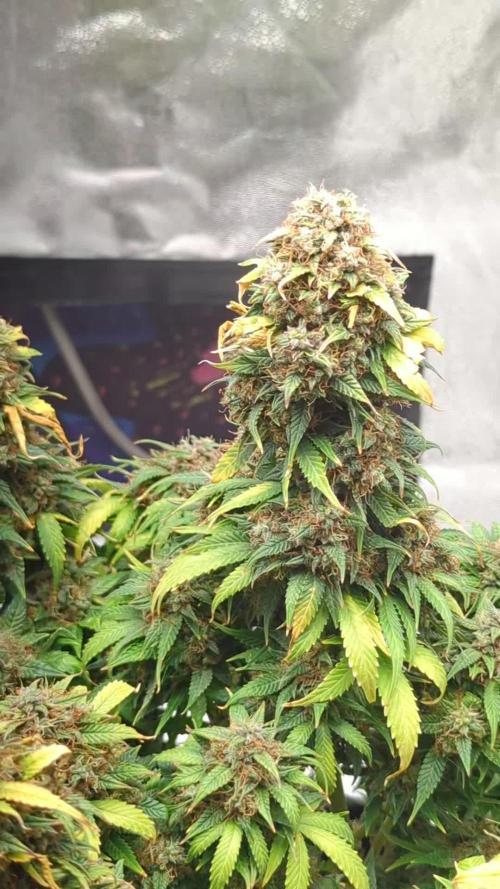
Día 48. El frío ha afectado bastante el crecimiento. Pero aún así va a salir algo interesante. Creo que la mala genética puede tener mucho que ver. Por el momento falta poco para que los cogollos se terminen de cerrar. Calculo que en una semana cuando se cierran ya paso a usar el overdrive. Entre tanto, ya está abriendo la semilla para la próxima madre. Calculo que en 3 días ya va a estar para poner en el sistema hidropónico. Seguiré viendo que sucede.
Likes
25
Share
Likes
8
Share
8/26 - sporty looking great, praying hard! Posh is working on it. But look who finally showed up to the party! I’m calling her Baby spice. She sprouted 12 days after going in the soil. Way to be a fighter girl! This is going to be a tricky thing to manage I feel like my gals are tracking a week apart. I’ll keep this journal’s timeline on sporty spice. -1 week for posh and -2 weeks for baby spice. spice girls let’s grooooow! 8/30 - exactly two weeks from sprout for Sporty and Posh. Pretty wild how big a difference there is between the two. Baby is getting her footing. Now. Sporty already pushing 4-5 nodes and I saw a tiny root through the drain hole. Wanted to pot her up! About 8 cups pro mix, one cup perlite. About 1.5 tbs of Gaia green 4-4-4, some worm castings and sprinkled mycorrhiza around where the rootball would be. God speed girly! 9/3. Potted up Posh today. About a half gallon pro mix, plus about 1.5 tbsp of the Gaia green 4-4-4. Plus about a cup of worm castings, perlite, and mycorrhiza. Sporty is looking very happy, 5 nodes and counting. Added back my second light, let’s go girls!!! 9/5. Wrapping up week 2 here, so far I’ve been really impressed with the pro mix Gaia green and soil support so far. The girls seem happy and healthy. See you in week 3!
Likes
15
Share
This week was very hot. They stressed a lot some heat stress and some fan stress that came up to uptake look down. The weedding cake was that must sofer. Shr was still recovering from that led issue...and she gets direct sun light in the hottest hour. Black cream in the other hand sofer a lot with fan stress bleaching the leafs in direct contact. Couskush its a beautifull lady and growing nice. Bomberry is late but showing some promissing buds. Chears BrotherHood
Likes
16
Share
28 días de mis hermosas nenas... A una semana lo más probable las pasare a florar!!!
Likes
17
Share
@Chucky324
Follow
Hello. This is the end of week 9 and the beginning of week 10 of veg. The week started out with normal weather, then the high pressure ridge came in and it was over 35* c in here for the last 2 days. But the plants look good. I put up the shade cloth I had, when I saw that the temps were going up. I'll roll the shade cloth back when the temps cool some. I live near the ocean which moderates our temp fairly well. The summer time ocean temp is around 55* f and 45* f in the winter. (Funny - being old school, I still use old imperial temps)😄 The plants have been getting some food each day with my reservoir pump being hooked up to a timer. I also gave about 1 gallon of rain water to each plant yesterday. They are filling out their space nicely. I have to get in there in a couple of days and put all the branch tips down under the table again. With about 2 weeks before flipping to flowering things are going great. Be Great. Chuck.
Likes
15
Share
@38PLAN
Follow
Siamo all'8 settimana le piante hanno sviluppato fiori ben formati,ora dobbiamo avere pazienza ed aspettare che diventino ancora più grandi,la maggior parte dei pistilli é ancora bianca e le piante ancora verdi,questo significa in grandi linee che la pianta può ancora produrre,incredibile la pianta in fondo a sinistra ha quasi toccato il soffitto,un autofiorente di eccezionali dimensioni,ancora all'inizio della fioritura
Likes
1
Share
@Kalyx
Follow
still got enough and waiting a bit longer to harvest
Likes
6
Share
@Chubbs
Follow
420Fastbuds FBT2302/Week11 What up everyone. Hopefully all are having an amazing weekend. Weekly update in these two little ladies. The flowers on these have definitely swollen up more this week and starting to show some amber when looking at the trichs. They both are super frosty and smell absolutely delicious. Did take off most of the bigger fan leafs this week allowing more light to the lower flower sites before getting the chop in a couple days. All in all Happy Growing
Likes
18
Share
@Chubbs
Follow
Weekly update: Crazy how time flies when your having fun. Seems like yesterday I did last week's update. I did some defoliating and lollipoping on them this week and switched from grow nutes to bloom. Wild how fast the preflower sites grow as it looks like they're everywhere. I'm still feeding 16oz per day, some are drinking more then others but overall Happy Growing.
Likes
6
Share
Totally happy with the defoliation and LST seems to be doing trick
Likes
13
Share
7/20 Went over this morning to plants soaking wet and heavy rain. Went back around 4pm and plants actually look really good. The rain has stopped for a bit and the girls looked great. Apart from some septoria leaves I needed to defoliate on the first plant I treated. I also noticed a few others on other plants so it's spreading albeit slowly. I treated the three in the middle with their second dose of Plant Doctor at 3tsp/1gal. One gallon administered to each plant via root drench. I think I may treat the other plant showing signs with a diy Dr. Zymes using citric acid as the active ingredient. That way I Gould start treatment right away without having to rely fully on plant doctor. Plus it would kill any pests. Ive seen damage but the birds do a number on them. I dont want to spray my plants with a bunch of chemicals if I don't have too. I shouldve replaced the pallets and cleaned the cage better. I think I did a good job sanitizing as I have no wpm. Just this septoria I probably got when the lady mowing the lawn cut all tjis fucking grass and blew it in my pen, throwing bird seed and I'm sure tons of disease into my grow bags. I literally had to harvest a bunch if fucking sunflowers. It looked like my plants had been mulched. Just with small disease carrying shrubs. At some point some of this stuff has to be on purpose. You CAN'T be that stupid. A couple kushes in the back look hungry. I think I may need to up my feed. I've written to much. I'll keep this updated. Thanks if you made it this far. 7/21 I guess it rained last night. Oh well. It was blue skies for hours before dark. It must've rained late/early morning. I'm sure the app of plant doctor will be fine. Like I said I'm considering using citric acid as a foliar spray to help with the septoria and clean up any pests. I don't have enough pests to warrant spraying. I just don't want to put all my eggs in the plant doctor basket. Today is overcast and windy. The wind has really assisted in spreading this virus. I remove anything I see infected immediately and since these plants are reveges they have plenty of leaves. Plants are really stretching. I know I talk about the septoria a lot but realistically if someone looked through my garden they'd have a hard time spotting it. I don't want to exaggerate the problem but I don't like dealing with ANY fungus or molds. 7/22 It was 55° this morning when I went over. I defoliated some septoria leaves and a few that were fading or damaged. I saw almost a whole leaf eaten so it's probably a good idea to move forward with citric acid. I can add that to the plants I've already treated with plant doctor. This is the first year it's been so noticeable. It's the reveg 10th planet that started this off. Oh well. I've dealt with MUCH worse. Plants LOOK good (other than septoria leaves (on bottom of plant). Today is water day for me but it's been raining and it's a lot cooler today. Bags still had weight to them. I want them to have a proper wet dry cycle. Temps top out at 75° so I'll monitor during the day and if something NEEDS WATER I'll give it to it. I'm suprised I have ZERO WPM. The septoria is much more identifiable but pm is usual present in these conditions bur I don't have a spot of it. I may do some defoliation today. I also need to add supports for flowering but one thing at a time. EDIT: Went over around noon. 70°. Bags seem to be holding weight (it was easier to tell as ONE plant was substantially lighter than the rest) so I decided to hold off on watering. At least until tonight. There are three plants (at least that are going to NEED water). They look phenomenal now though and we've had lots of rain. Plan is to go over later and get the light ones and mix the water for the others so I can administer it in the morning quickly. I have an early doctor's appointment but I don't to overwater or water unnecessarily just because. But when you grow alone sometimes you need to do things when your able. I have people there that would help if I asked. And I have before but its late . I'm very grateful. I defoliated quite a few septoria leaves. They were all from the bottom of the plant. A couole wete bottom interior. I know there are worse things to contend with but still a pain. EDIT #2 WENT BACK AT FOUR AND PLANTS LOOKED FANTASTIC AND STILL HELD WEIGHT. THE REVEG MK ULTRA IN EARLY FLOWER "MAY" HAVE STARTED TO DROOP AND "SEEMED" LIGHT. THE LARGE SPECIAL KUSH FUETHEST IN FLOWER BY THE DOOR WAS ALSO EXRRENELY LIGHT. I HAVE AN EARLY DOCTORS APPOINTMENT BUT DONT WANT TO OVER WATER MY PLANTS JUST BECAUSE IM IN A HURRY. ITS COOLER THIS WEEK. 70 TODAY AND HIGH OF 80 TOMORROW BUT DAD SAID THATS NOT UNTIL THE AFTERNOON. I MIXED UP ENOUGH WATER TO WATER EVERYTHING IN THE MORNING IF IT NEEDS IT. I HAVE AN IMPORTANT DOCTORS APPOINTMENT EARLY THAT WILL TAKE ME AWAY AND IM FEELING A LITTLE ILL SO I WANTED TO GET DONE WHAT I COULD TODAY. WATERED THE TWO THAT NEEDED IT WITH TWO GALLONS A PIECE (30GAL REVEG MK ULTRA AND THE BIG SPECIAL KUSH IN FRONT I DIDNT TOP THATS FLOWERING THE FASTEST. EVERYTHING ELSE CAN WAIT. 7/24 Surprisingly the plants still held weight this morning! The looked pretty good too! However its going to be highs in the 80's for the next 7 days. Since the plants still had some heft to them I watered everything just a gallon. I gave the 10s a half gallon and skipped the 50gal container plant. I think this is a good happy medium. I'm still seeing random septoria leaves but still no WPM. I defoliate daily sometimes a couple times. I need to get a minute to myself and add a foliar spray. I'll start with a dih Dr. Zymes while I'm looking into other products like bicilus (i have bt but its a different bicilus) or trichodermia. I need to feed sometime this week too. 7/25 Plants looked great this morning. I watered the 10th planet on the end that hadn't been watered in forever. I think I had been overwatering during those 100° days. I didn't water today as everything looks great and they don't seem to need it. I'll check later today. I did water the pink kush beside the 50 as it was much lighter (1/2 gal) to get it on par with the others. I'm starting to see pest damage as well so I think an app of Dr. Zymes would be a good idea. Both for pests and septoria. Plants are REALLY stretching. One special Kush is far ahead of the others. EDIT:WENT OVER AT NOON AND 4PM. PLANTS LOOKED GREAT APART FROM MIRE SEPTORIA ON THE 10TH PLANET. I NEED TO WATERING DIFFERENT IN THESE TEMPS. IT WAS BREEZY AND 80° BUT THE BAGS DIDNT FEEL TOTALLY LIGHT AND THE PLANTS LOOKED AWESOME! THE HUGE EARLY FLOWERING SPECIAL KUSH IS PRETTY DAMN LUGHT BUT ITS PRAYING AMD LOOKING GREAT. I DECIDED TO WATER AND FEED IN THE MORNING AND HOPFULLY APPLY A DR. ZYMES PRODUCT ON THE ENTIRE GARDEN IN THE EVENING. PLANTS LOOK HUNGRY AND I HAVE RANDOM PESTS. ITS MOSTLY FOR THE FUNGACIDE ASPECT. PLANT SOCTOR SEEMS TO BE WORKING GREAT ON TWO OUT OF THE THREE I USED IT ON. THE THIRD IS A REVEG AND HAS TONS OF FOLIAGE I NEED TO ADDRESS AND CLEAN OUT. IT SEEMS LIKE IT WILL SPIT OFF SOME SEPTORIA LEAVES A DAY OR TWO BEFORE ANOTHER APP IS DUE. I'M LOOKING INTO MY OPTIONS. IF ANY OF YOU HAVE A SURE DIRE WAY TO DEAL WITH LEAF SEPTORIA IN EARLY FLOWER HIT ME UP! IM NOT TOO WORRIED THOUGH. I CAN SUPPRESS IT ENOUGH IF I HAVE TO EVEN IF I GOTTA SPRAY THE LEAVES WITH THAT 9.0PH ALKALINE WATER. 7/26 Supposed to be REALLY hot with thunderstorms. I watered the two thirstiest with a gallon and a half. Everything else got a gallon (but the 10th planet on the end that was still heavy and the 50). I fed everything too. I SHOULD'VE done the DIY Dr. Zymes spray but I wanted to keep feeding and adding an unknown foliar spray seperate in case of any reactions. A day before plant doctor is due to be applied again the 10th planet in the 20 starts showing signs of septoria again. I've defoliated quite a few septoria leaves. I'm not giving up. I assume I'll do something tonight and I MAY just look to see what I can find on Amazon. Luckily my plants still look beautiful. I hope it continues and I can stay on top of it.
Likes
52
Share
Lacewings seemed to have mostly killed themselves by flying into hot light fixtures. I may have left the UV on which was smart of me :) Done very little to combat if anything but make a sea of carcasses, on the bright side its good nutrition for the soil. Made a concoction of ethanol 70%, equal parts water, and cayenne pepper with a couple of squirts of dish soap. Took around an hour of good scrubbing the entire canopy. Worked a lot more effectively and way cheaper. Scorched earth right now, but it seems to have wiped them out almost entirely very pleased. Attempted a "Fudge I Missed" for the topping. So just time to wait and see how it goes. Question? If I attached a plant to two separate pots but it was connected by rootzone, one has a pH of 7.5 ish the other has 4.5. Would the Intelligence of the plant able to dictate each pot separately to uptake the nutrients best suited to pH or would it still try to draw nitrogen from a pot with a pH where nitrogen struggles to uptake? Food for stoner thought experiments! Another was on my mind. What happens when a plant gets too much light? Well, it burns and curls up leaves. That's the heat radiation, let's remove excess heat, now what? I've always read it's just bad, or not good, but when I look for an explanation on a deeper level it's just bad and you shouldn't do it. So I did. How much can a cannabis plant absorb, 40 moles in a day, ok I'll give it 60 moles. 80 nothing bad ever happened. The answer, finally. Oh great........more questions........ Reactive oxygen species (ROS) are molecules capable of independent existence, containing at least one oxygen atom and one or more unpaired electrons. "Sunlight is the essential source of energy for most photosynthetic organisms, yet sunlight in excess of the organism’s photosynthetic capacity can generate reactive oxygen species (ROS) that lead to cellular damage. To avoid damage, plants respond to high light (HL) by activating photophysical pathways that safely convert excess energy to heat, which is known as nonphotochemical quenching (NPQ) (Rochaix, 2014). While NPQ allows for healthy growth, it also limits the overall photosynthetic efficiency under many conditions. If NPQ were optimized for biomass, yields would improve dramatically, potentially by up to 30% (Kromdijk et al., 2016; Zhu et al., 2010). However, critical information to guide optimization is still lacking, including the molecular origin of NPQ and the mechanism of regulation." What I found most interesting was research pointing out that pH is linked to this defense mechanism. The organism can better facilitate "quenching" when oversaturated with light in a low pH. Now I Know during photosynthesis plants naturally produce exudates (chemicals that are secreted through their roots). Do they have the ability to alter pH themselves using these excretions? Or is that done by the beneficial bacteria? If I can prevent reactive oxygen species from causing damage by "too much light". The extra water needed to keep this level of burn cooled though, I must learn to crawl before I can run. Reactive oxygen species (ROS) are key signaling molecules that enable cells to rapidly respond to different stimuli. In plants, ROS plays a crucial role in abiotic and biotic stress sensing, integration of different environmental signals, and activation of stress-response networks, thus contributing to the establishment of defense mechanisms and plant resilience. Recent advances in the study of ROS signaling in plants include the identification of ROS receptors and key regulatory hubs that connect ROS signaling with other important stress-response signal transduction pathways and hormones, as well as new roles for ROS in organelle-to-organelle and cell-to-cell signaling. Our understanding of how ROS are regulated in cells by balancing production, scavenging, and transport has also increased. In this Review, we discuss these promising developments and how they might be used to increase plant resilience to environmental stress. Temperature stress is one of the major abiotic stresses that adversely affect agricultural productivity worldwide. Temperatures beyond a plant's physiological optimum can trigger significant physiological and biochemical perturbations, reducing plant growth and tolerance to stress. Improving a plant's tolerance to these temperature fluctuations requires a deep understanding of its responses to environmental change. To adapt to temperature fluctuations, plants tailor their acclimatory signal transduction events, specifically, cellular redox state, that are governed by plant hormones, reactive oxygen species (ROS) regulatory systems, and other molecular components. The role of ROS in plants as important signaling molecules during stress acclimation has recently been established. Here, hormone-triggered ROS produced by NADPH oxidases, feedback regulation, and integrated signaling events during temperature stress activate stress-response pathways and induce acclimation or defense mechanisms. At the other extreme, excess ROS accumulation, following temperature-induced oxidative stress, can have negative consequences on plant growth and stress acclimation. The excessive ROS is regulated by the ROS scavenging system, which subsequently promotes plant tolerance. All these signaling events, including crosstalk between hormones and ROS, modify the plant's transcriptomic, metabolomic, and biochemical states and promote plant acclimation, tolerance, and survival. Here, we provide a comprehensive review of the ROS, hormones, and their joint role in shaping a plant's responses to high and low temperatures, and we conclude by outlining hormone/ROS-regulated plant-responsive strategies for developing stress-tolerant crops to combat temperature changes. Onward upward for now. Next! Adenosine triphosphate (ATP) is an energy-carrying molecule known as "the energy currency of life" or "the fuel of life," because it's the universal energy source for all living cells.1 Every living organism consists of cells that rely on ATP for their energy needs. ATP is made by converting the food we eat into energy. It's an essential building block for all life forms. Without ATP, cells wouldn't have the fuel or power to perform functions necessary to stay alive, and they would eventually die. All forms of life rely on ATP to do the things they must do to survive.2 ATP is made of a nitrogen base (adenine) and a sugar molecule (ribose), which create adenosine, plus three phosphate molecules. If adenosine only has one phosphate molecule, it’s called adenosine monophosphate (AMP). If it has two phosphates, it’s called adenosine diphosphate (ADP). Although adenosine is a fundamental part of ATP, when it comes to providing energy to a cell and fueling cellular processes, the phosphate molecules are what really matter. The most energy-loaded composition for adenosine is ATP, which has three phosphates.3 ATP was first discovered in the 1920s. In 1929, Karl Lohmann—a German chemist studying muscle contractions—isolated what we now call adenosine triphosphate in a laboratory. At the time, Lohmann called ATP by a different name. It wasn't until a decade later, in 1939, that Nobel Prize–-winner Fritz Lipmann established that ATP is the universal carrier of energy in all living cells and coined the term "energy-rich phosphate bonds."45 Lipmann focused on phosphate bonds as the key to ATP being the universal energy source for all living cells, because adenosine triphosphate releases energy when one of its three phosphate bonds breaks off to form ADP. ATP is a high-energy molecule with three phosphate bonds; ADP is low-energy with only two phosphate bonds. The Twos and Threes of ATP and ADP Adenosine triphosphate (ATP) becomes adenosine diphosphate (ADP) when one of its three phosphate molecules breaks free and releases energy (“tri” means “three,” while “di” means “two”). Conversely, ADP becomes ATP when a phosphate molecule is added. As part of an ongoing energy cycle, ADP is constantly recycled back into ATP.3 Much like a rechargeable battery with a fluctuating state of charge, ATP represents a fully charged battery, and ADP represents a "low-power mode." Every time a fully charged ATP molecule loses a phosphate bond, it becomes ADP; energy is released via the process of ATP becoming ADP. On the flip side, when a phosphate bond is added, ADP becomes ATP. When ADP becomes ATP, what was previously a low-charged energy adenosine molecule (ADP) becomes fully charged ATP. This energy-creation and energy-depletion cycle happens time and time again, much like your smartphone battery can be recharged countless times during its lifespan. The human body uses molecules held in the fats, proteins, and carbohydrates we eat or drink as sources of energy to make ATP. This happens through a process called hydrolysis . After food is digested, it's synthesized into glucose, which is a form of sugar. Glucose is the main source of fuel that our cells' mitochondria use to convert caloric energy from food into ATP, which is an energy form that can be used by cells. ATP is made via a process called cellular respiration that occurs in the mitochondria of a cell. Mitochondria are tiny subunits within a cell that specialize in extracting energy from the foods we eat and converting it into ATP. Mitochondria can convert glucose into ATP via two different types of cellular respiration: Aerobic (with oxygen) Anaerobic (without oxygen) Aerobic cellular respiration transforms glucose into ATP in a three-step process, as follows: Step 1: Glycolysis Step 2: The Krebs cycle (also called the citric acid cycle) Step 3: Electron transport chain During glycolysis, glucose (i.e., sugar) from food sources is broken down into pyruvate molecules. This is followed by the Krebs cycle, which is an aerobic process that uses oxygen to finish breaking down sugar and harnesses energy into electron carriers that fuel the synthesis of ATP. Lastly, the electron transport chain (ETC) pumps positively charged protons that drive ATP production throughout the mitochondria’s inner membrane.2 ATP can also be produced without oxygen (i.e., anaerobic), which is something plants, algae, and some bacteria do by converting the energy held in sunlight into energy that can be used by a cell via photosynthesis. Anaerobic exercise means that your body is working out "without oxygen." Anaerobic glycolysis occurs in human cells when there isn't enough oxygen available during an anaerobic workout. If no oxygen is present during cellular respiration, pyruvate can't enter the Krebs cycle and is oxidized into lactic acid. In the absence of oxygen, lactic acid fermentation makes ATP anaerobically. The burning sensation you feel in your muscles when you're huffing and puffing during anaerobic high-intensity interval training (HIIT) that maxes out your aerobic capacity or during a strenuous weight-lifting workout is lactic acid, which is used to make ATP via anaerobic glycolysis. During aerobic exercise, mitochondria have enough oxygen to make ATP aerobically. However, when you're out of breath and your cells don’t have enough oxygen to perform cellular respiration aerobically, the process can still happen anaerobically, but it creates a temporary burning sensation in your skeletal muscles. Why ATP Is So Important? ATP is essential for life and makes it possible for us to do the things we do. Without ATP, cells wouldn't be able to use the energy held in food to fuel cellular processes, and an organism couldn't stay alive. As a real-world example, when a car runs out of gas and is parked on the side of the road, the only thing that will make the car drivable again is putting some gasoline back in the tank. For all living cells, ATP is like the gas in a car's fuel tank. Without ATP, cells wouldn't have a source of usable energy, and the organism would die. Eating a well-balanced diet and staying hydrated should give your body all the resources it needs to produce plenty of ATP. Although some athletes may slightly improve their performance by taking supplements or ergonomic aids designed to increase ATP production, it's debatable that oral adenosine triphosphate supplementation actually increases energy. An average cell in the human body uses about 10 million ATP molecules per second and can recycle all of its ATP in less than a minute. Over 24 hours, the human body turns over its weight in ATP. You can last weeks without food. You can last days without water. You can last minutes without oxygen. You can last 16 seconds at most without ATP. Food amounts to one-third of ATP production within the human body.
Likes
15
Share
11/09/2023 The size of the buds may seem rather ridiculous, but without fertilizer, using only 50% enriched soil, with the remaining 50% lacking nutrients, only 10 liters pots, and 100W of LED, I am really surprised by the results. The smells and the quality is quite amazing for someone like me who's always consumed only black market products. I'm looking forward to the harvest, but #3 is not ready yet(Main cola seems good but the trichomes on the lower part of the buds are still transparent.) , so I continue to remove the yellow-brown leaves that almost fall off on their own. I cant put the video in 1080p I'm limited to 720p.
Likes
14
Share
Day 43 of flower and its looking good moved some branches around to improve light penetration love to Hear from you guys in the comments Day 44 ph 6.1 ppm at 350 Day 46 ph 6.3 ppm 270 Day 49 ph 5.9 ppm 300 removed the nuts added the dense nut at 300ppm will do this for 2 days and flush after that for a week or so so close to done one of the tops of the small plant got bud mold was removed hope it will be the only one to happen to
Likes
19
Share
this diary is a week ahead. will get in back in line soon. day 0-7 to be as week 1 not including the germ week. This banner kept much shorter than its brother. its also in a slightly shallower tub of soil so this one is flowering a bit quicker than its counterpart too. to keep it at the same height as all my others ive raised it from the floor slightly and then put the screen over top to bend the top cola. buds forming nicely now. i said fuck it. full organic feed for you.! nutes then fresh water twice then nutes again. deinking now a litre every 3 days. hardy plant but a couple white spots on the leaves... slight calmag to give prob.. end of week 5 flowering up to day 35. week 6 as of 36--> ps if anyone has a spare grow tent that they could donate me that would help a brother out ;) day 40. adjusted to normal schedule
Likes
6
Share
We are almost at operational capacity .... last week of veg under this massive light for batch 001... included pic of veg tent which is technically batch 001.... Need help sexing the middle plant! it came from bagseed (black ice gelato) and I need to avoid crosspollination. over feeding but I'm glad i'm learning now ahead of next batches.. dialing in things nicely... happy with growth and health of the plants.... just a matter of time.... love the support so far ... please help me with identifying males if you can! :)