The Grow Awards 2026 🏆 






Likes
Comments
Share
@GanjaGecko
Follow
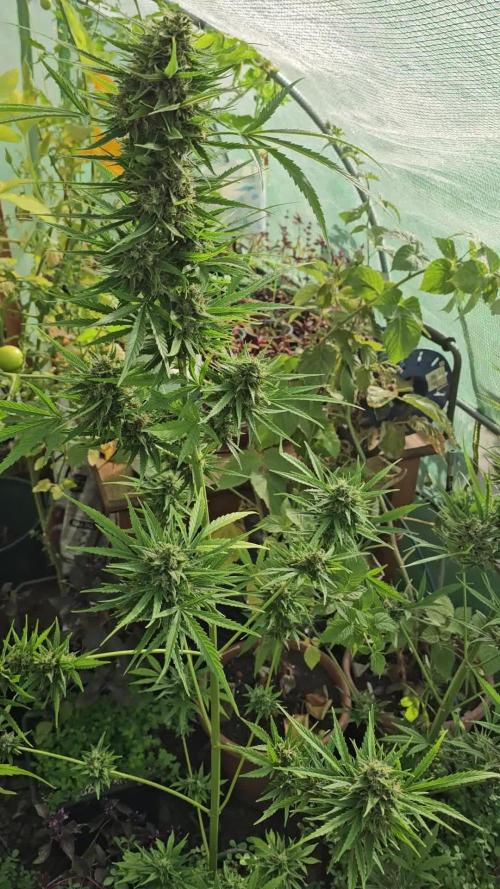
In der Woche hat es wieder scheiße geregnet. Ich musste zwar nur einmal gießen, allerdings mussten nach der Woche ⅓ vom Mainbud und zwei Teile der sidebuds weg, weil sich dort schimmel bemerkbar gemacht hat. Kann man sicht viel machen wenn die Ladys der Witterung komplett ausgesetzt sind.
Ich hatte die Woche nur einmal gegossen. Zusätze waren 1g/L BioEnhancer von GreenHouseFeeding, 1ml/L PowerBuds, 0.3ml/L GreenSensation von Plagron und 0.8ml/L BioBloom von BioBizz. Das ganze auf einen ph-Wert von 6.8 gebracht. Jede Lady bekam unterschiedlich viel. Je nach Gewicht des jeweiligen Topfes.
Ich hoffe das sich das Wetter langsam an den Sommer anpasst und die restliche Zeit ohne schimmel verläuft und mit mehr Sonne als Regen🍀💚

Likes
11
Share
@julian100614
Follow
Aqui traemos la ultima semana de esta maravillosa Amnesia Haze Automatic de Royal Queen Seeds 🔥🔥
Una autentica bomba 💣en todos los sentidos
Un cuidado realmente sencillo, donde agradece un clima intermedio y una temperatura suave. La producción es bastante buena para ser una auto y nada que envidiar a otras variedades.
El olor es bastante potente y rico 😋🤤👌
Lo único que podría haber estado mejor es la produccion de tricomas, que a pesar de no estar nada mal, siendo sincero esperaba mas pegamento en las flores 💐🤷
Despues de un buen lavado de raices, vamos a dejarla durante esta semana libre de nutrientes para pronunciar mas su sabor natural y eliminar los restos de químicos y asi tener una fumada mas suave 😊🔥💯
BUENOS HUMOS 🚬😉

Likes
18
Share
@valiotoro
Follow
The buds shine like a shooting star mad sticky too⭐️
First thing that hits me with the smell straight up like canned pineapples in syrup🤤🍍


Likes
16
Share
@Naujas
Follow
the second week passed smoothly and without any problems, maybe the temperature is a bit high during the day, because Summer is not going away and it's 30+ outside, so it's normal that it's 28 ° in the tent, but everything looks good :) good luck to everyone:).

Processing
Likes
7
Share
@Mrg7667
Follow
FUCKING FINALLY!! cant believe there tranplanted and about to be flipped its been about a total of 40 weeks since the two bigs have started and maybe weeks 25 since another 1-2 and the the rest about 15 weeks WAYYY to dam long but thats how it goes its all learning curve, and life happens for sure!
There roots are absolutely massive they where so ovegrown for the 2 gal once again so thats all on me.
Only snagged 1 root on one of the bigger guys, got caught on my LST hole i made on the pot.
Took of all LST training stick because im going to use a trellise to train all down for ecen canopy before i flip!
Next post will be day 1 flower! WHOOO 🕺🤦♂️
Added great white to soil when transplanted 2 teaspoon for 5 gal pot

Likes
44
Share
@SooSan
Follow
12/12 + 109 jours
Vu qu’il y a 16 plantes mais que sur growdiaries on ne peut mettre que 8 variétés j'ai divisé en 2 diaries pour le bas de la tente
1️⃣
🏠 90x60x90
☀️ FC-E 4800 => puissance a 75%
🍁
Black Bomb / Philosopher Seed
Amnesia Lemon / PEV Seeds
Amnesia Lemon /PEV Seeds
Blueberry / PEV Seeds
Blueberry / 00 Seeds
Wappa / Paradise Seed = 11g
Dark Phoenix / Green House Seed
Quick Sherbet / Exotic Seeds
Mango Cream / Exotic Seeds
Banana Frosting / Sensi Seed = 11g
Hindu Kush / Sensi Seed
Mix 1 / Sweet Seed
Mix 2 / Sweet Seed = 15g
Mix 3 / Sweet Seed
Mix 4 / Sweet Seed
📎 https://growdiaries.com/diaries/122084-grow-journal-by-soosan
📎https://growdiaries.com/diaries/124052-grow-journal-by-soosan
2️⃣
🏠 30x60x50
☀️TS1000 => 100w = 54g
🍁
Quick Sherbet - Exotic Seed = 12g
Quick Sherbet - Exotic Seed = 12g
Quick Sherbet - Exotic Seed = 17,5g
Quick Sherbet - Exotic Seed = 12,5g
📎 https://growdiaries.com/diaries/122080-grow-journal-by-soosan


Likes
55
Share
@w33dhawk
Follow
19.07.21 Anfang der 4 blüte Woche alles läuft soweit OK hab die Lampe heut wieder 3cm höher gehängt da einige Blatt spitzen anfangen zu verblassen denke mal das das Licht zu intensiv war, hoffe natürlich das ich die Ladys nicht über düngt habe. Hab auch die bloom dosis um 1ml/L herabgesetzt also jetzt nur noch 3ml/L anstatt maximaldosis 4ml/L. Blätter von den gegenüberliegenden buds fern halten war heut auch wieder angesagt und unterm netz halten sowieso......
20.04.21 wie gedacht hatte meine Pflanze Licht stress glaub ich zumindest die oberen Blätter sind heller geworden aber jetzt fängt sie auch noch an ihre Zähne am Rand der Blätter hoch zu Rollen glaube das ist überdüngung Hab es mal wieder übertrieben......
21.04.21 danke erstmal an alle die mir so schnell auf mein Hilfe gesuch geantwortet haben. Ich hab mir diesbezüglich meine Gedanken gemacht und mich entschlossen das ich den Dünger wieder runter schraube da ich ja auf gut abgestimmter Erde und nicht auf coco züchte sollte ich wohl eher weniger benutzen dessen bin ich mir jetzt bewusst geworden (hätte ich auch selbst drauf kommen können ich dussel). Die Lampe lasse ich jetzt auf 30cm Abstand da ich nicht das Gefühl habe das nach 2 Tagen 30cm das verblassen weiter fort schreitet (wird aber weiter beobachtet). Morgen ist giessen dran werde dann nur Wasser mit green sensation geben und beim nächsten giessen dann wieder mit minimal Düngung weiter machen um die Pflanzen nicht zu sehr zu stressen....
22.04.21 hab heute gegossen und auf dünger verzichtet soweit bis auf Green sensation 1ml/L und hab nochmal drüber nachgedacht wann das Problem mit den hoch rollenden Zähnen der Blätter anfing das war nach dem letzten giessen 2tage später nach dem ich wieder sugar royal gegeben hatte hätte den wohl lieber wieder weiter unten anordnen sollen von der menge her naja ich lerne dazu Fehler müssen sein sonnst hätte ich ja nix zum lernen is ja auch langweilig......
23.04.21 glaube die Ladys mästen sich jetzt da wo gestern noch minimale Lücken an den buds waren sind jetzt keine mehr das Wachstum is eingestellt seid 4 Tagen kam nix mehr an Höhe dazu. Ab jetzt kann sie Dann auch Figur an nehmen und ordentlich Gewicht zu legen hoffe es geht weiterhin so gut voran bis jetzt bin ich mega glücklich das es so gut klappt Ach ja und das Blätter runter schieben unters netz hab ich jetzt ein gestellt es wird einfach zu klebrig da zwischen den buds und ich will die trichom Köpfe nicht permanent berühren, nicht das ich noch irgendeine krankheit mit an schleppe oder andere Keime bzw. Beschädigungen anrichte an den Köpfen (ich desinfizieren meine Hände immer gründlich bevor ich an den Pflanzen hand anlege meistens doppelt und dreifach, hab aber trotzdem schiss man Weiss ja nie was so an Bakterien und keimen überlebt).....
24.04.21 hab heute nix ich wiederhole NIX gemacht an den Pflanzen war einfach zu faul war sogar zu faul zwischen durch mal zu schauen was die Temps und die Feuchtigkeit so machen deshalb kann ich heute nicht viel erzählen.......
25.04.21 diese woche lief auch wieder garnicht mal so schlecht ich bin echt erstaunt darüber das die Pflanzen so gut voran schreiten drückt mir die Daumen das das so bleibt.......

Likes
4
Share
@TheCannaHouse
Follow
6/21/22-Presoaked in water
6/22/22-Damp paper towel
6/23/22- Planted in medium and watered
6/25/22-Germination!!


Likes
18
Share
@Ananas_Comosus
Follow
Sunday, 27-02-2022
Fungicidal treatment with potassium bicarbonate on 20-02-2022 resulted in significant leaf burn on plants after foliar spray of 8.9 ml/liter potassium bicarbonate with unmeasured amount of Breakthru sticker spreader. I had dusted the plants and pots with insecticidal powder the night before and there seemed to be no ill effects. Rain fell that same night and the leaves were splashed with dirt from the pots so I decided to "rinse" them off with a fungicidal spray of potassium bicarbonate. At the time I was confident this would have no ill effects but now I am wondering if I just didn't remember previous phytotoxic effects caused by this spray. I am also thinking that because I didn't measure the amount of sticker spreader, I may have overdosed the mix and that caused some of the burning by literally breaking through any protective covering on the leaves and possibly penetrating the plant cells. As I sprayed the leaves water soaked spots immediately appeared and within a few hours there was obvious curling and burn, particularly on spots that had small clumps of insecticidal powder.
Throughout this past week the visual symptoms of phytotoxicity progressed so much that by the middle of the week I settled my mind that this grow would be terminated this weekend. On Friday night when I came home and saw the plants in the dark I was more hopeful and in the light of day on Saturday morning I was quite pleased with their recovery. Lots of the oldest fan leaves were almost completely brown and yellow with light green veins and some newer leaver have been deformed. Thankfully there is little visual damage to most of the newest growth and after removing the worst of the damaged leaves I am remain hopeful for this grow.
Continuing my theme of living in the moment of the grow, I am choosing to think of this incident two ways. First as a "trial by fire" for the plants that only the strongest leaves survived and second as chemical pruning of leaves that I would have removed anyway, just not quite yet. I will be seeking thoughts on the forum as to whether these plants still have hope or if unseen damage has been done that will eventually ruin them. Regardless, I will progress with this grow as long as possible to see for myself what the actual long term effects are.
I have also noted what seem to be big hairy balls growing on plant #2 and have asked the forum their opinion.
In keeping with my plan to quadline these plants I have clipped the last untopped plant and removed nodes 1 and 2 of all plants. After doing these procedures the plants really just look like heavily defoliated specimens waiting for further training, I am pleased. Despite the phytotoxicity, there was enough growth of the 4 new stems of plants 3-5 that I was able to tie them down. I am waiting for confirmation that #2 is a male to cull it, if not I will tie it down as well. Only fed yesterday because I was watching to see how the plants would do over the week.
Wednesday, 02-03-2022
Culled confirmed male plant, thanks @m0use 😃👊! Fed and foliar sprayed with 12 ml/gal CAB and 7.5 ml/gal Cytokin. Used 9ml Ph down in 5 gallon tap water. Ph using ph paper 😞 was approximately 5.0 so I added unph'd 500 ml tapwater to my jug and added the 5.0 water to complete the gallon. Ph was approximately 6.
Likes
40
Share
@KingSalomonsWeed
Follow
06.12. Tag 72 Blüte 46.
Hi. Niemals aufgeben, dann gibt es sowas. Erstaunlich.
16 h Licht ab jetzt.
09.12. Na gut, ich gebs zu. Ab jetzt macht es Spaß. Denn da hängt doch mehr drann, und in besserer Qualität als ich dachte.
Lehrreich war der für mich bisher auf jeden Fall. Ich habe viel zu scharf gedüngt zu anfang.
Stellt euch vor, diese weißen Blätter leben noch. Klar wo braun ist nicht. Aber sonst.
11.12. Seht ihre wunderschönen grünen Blätter, eine Pflanze die euch das Wasser im Munde zerfließen lässt.
( Argh ein winziges grünes Blatt. Eines! Ihr dürft gerne selber suchen.)
... ( allerdings, die Riecht guhhht, das ist richtig)
Und stark, also stärker als diese Sorte sonst riecht. Ich kenne sie.

Likes
69
Share
@AsNoriu
Follow
Day 92. Trim day. Wet trim chosen. Result could be better, but 100 will be reached I guess for sure ;)))
Day 101. My friend has new record ! Not bad for screw up run ;)))))
Happy Growing !!!

Likes
28
Share
@SooSan
Follow
Dans l'ordre :
Blueberry
Dutch Passion
Blueberry
00 Seed
Blueberry
PEV Seed
Blueberry
Bulk Seed
Animal Cookies x Blue Monkey
Exotic Seed
Red Hot Cookies
Sweet Seed
DoSiDos x Purple Punch
PEV Seed
Purple Shot
Exotic Seed


Processing
Likes
13
Share
@BedroomGrower
Follow
I am updating the harvest pages with the new images taken with the microscope, you can find here the extra images for the varieties not included in the diary, while for the varieties in the diary you find the images in the harvest pages.
Processing
Likes
20
Share
@CanadianFillmore
Follow
Start of week 2 of flowering, both girls were drooping heavily and the medium was dry and pots were very light feeling. Removed the worst leaves from each plant and a few large fan leaves. Overall, I'm very happy with the weeks growth and development.

Likes
11
Share
@Mo_Powers
Follow
it has grown 5 cm in the last week. the weather has been very changeable and it has rained a lot. so far it makes a good and stable impression. the next week will be very sunny and i think it will make a good leap in growth.
Likes
5
Share
@UnorthadoxDude
Follow
Welcome to week eleven for Fraya, an Auto Fractal by Divine Seeds.
Day 71 - photographed
Day 74 - photographed
Day 76 - photographed
Thanks to Shogun for providing the nutrition for this grow, and to Divine Seeds for providing the seeds.
If you are not already a part of the cannabis community on X (formerly Twitter), I recommend joining! I have the same username over there.

Processing
Likes
36
Share
@Island
Follow
Week 5
The soil started to stabilize, the plants are less stressed and the production is satisfactory.
Apparently the worst is over, I have watered every 2 days on average.
These strains are for approximately 9 weeks of flowering, soon HARVEST.
In the half of week 5, it was add 205W of Citizen and Epstar COBs.
TOTAL 565W.
Processing
Likes
19
Share
@Oldmanbud__50
Follow
So iam into my 2nd week flower. Iv had a few problems but got over them. They are all but 1 about 55". But have a beast in the corner she's 4and half foot tall and looking amazing. On wards n upwards.
Likes
21
Share
@Big0zGrower420
Follow
Not much going on, just keeping things going and staying on track. Just been watering and checking up on them daily. Getting closer on the cookies.