Likes
Comments
Share
Likes
6
Share
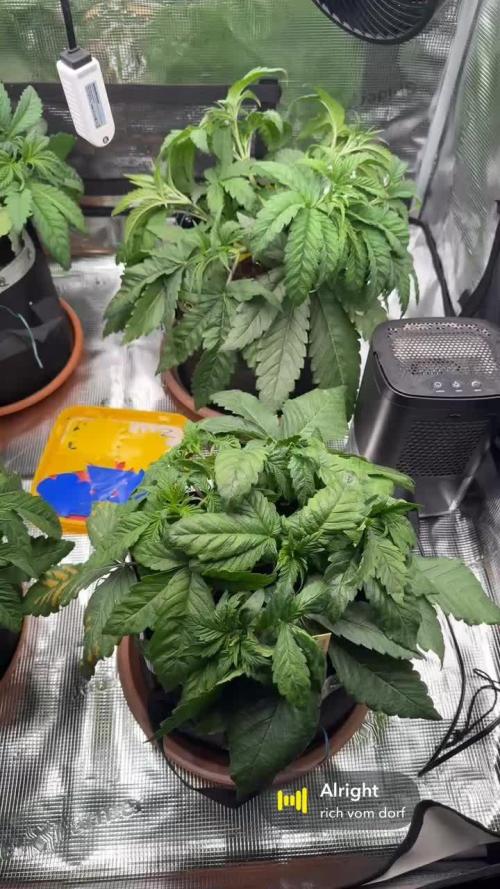
💚 Amnesia Haze Auto by Zamnesia – Pheno B Week 9 | The Tiny Pot That Refuses to Be Tiny 🌱💚 Welcome back to another chapter of the 8×8 Adventure! I think we have reached the point where I have to officially admit something. This girl is ridiculous. 😂 Not the plant. The pot. She's standing there, proud and tall, at around 135 cm, carrying herself like a perfectly respectable flowering plant... while sitting in only 11 litres of soil. Eleven. Litres. At this point, every time I look at her container, I honestly wonder: Where the hell are all those roots? 😂 Because whatever is happening inside that little pot... it's working. And working hard. 🌱 The Smallest Pot Is Still the Biggest Surprise When we started this experiment, the 11-litre container was something I was genuinely curious about. Most of the other plants in this room are sitting in larger containers. Pheno B got the little one. And I wanted to see what would happen. Well... Now I know. Apparently, what happens is: The plant doesn't care. 😂 She's not behaving like a plant restricted by a tiny container. She's not behaving like a plant struggling to support a large canopy. She's not behaving like a little plant at all. She's behaving like a plant that has decided: "That's my pot. That's enough. Now give me water." And then asks again. And again. 💧 The Thirsty Girl This is probably the characteristic that has fascinated me the most. This little pot is demanding attention. As she continues growing and flowering, her water consumption has become something I simply can't ignore. I'm having to irrigate her twice a day to keep up with what she's demanding. Think about that for a second. An 11-litre pot. A plant around 135 cm tall. And she's drinking as if she's sitting in a much larger root zone. That's what makes this phenotype so interesting. The container is small. The plant isn't. And the appetite certainly isn't. 😂💚 🔬 What Is Happening Down There? Of course, I can only speculate about what is happening inside the substrate. But looking at the plant's behaviour, one thing seems very clear: That little container is being used. The plant is maintaining a large canopy. She's continuing to flower. She's maintaining strong, healthy foliage. And she's demanding frequent irrigation. That makes me wonder just how extensively that small volume of substrate has been colonized by roots. I can almost picture it down there: No empty seats. No vacancy. Fully booked. Roots everywhere. 😂🌱 And that's probably one of the most valuable lessons this phenotype has given me. Container volume is important... but it isn't the only story. 🌿 Small Pot. Big Plant. This is the part that still makes me smile. If you showed me the plant without showing me the pot, I would never guess she was growing in only 11 litres. She's tall. She's beautifully structured. She's carrying plenty of healthy foliage. And the flowering sites continue developing throughout the plant. She doesn't look like a plant that is apologizing for her root volume. Quite the opposite. She looks confident. She looks established. She looks like she owns the place. And then you look down... 11 L. 😂 It's almost like growing a clone in a Solo Cup... except somebody forgot to tell the plant that she's supposed to stay small. 🌸 Flowering Continues While the container story is hilarious, the flowers are the real reason we're watching her. And she's continuing to progress beautifully. The flowering sites are becoming more established, the structure is becoming increasingly defined, and the plant is moving deeper into the flowering cycle with plenty of healthy green still supporting the development. The photographs this week show that progression nicely. There is a beautiful contrast between the mature foliage and the developing flowers. The pistils remain prominent. The flowers continue building. And the plant still has that characteristic balance that made me interested in this phenotype from the beginning. She's not trying to be her sister. She's doing her own thing. And she's doing it very well. 🍃 Still Lush. Still Proud. One of the things I really appreciate about this girl is that the small pot hasn't stopped her from looking like a proper, healthy plant. She's still lush. She's still green. She's still vigorous. She's still producing. And she's still standing proud. There are no apologies here. No: "Sorry, I'm in the small pot." No. She's more like: "Yes, I'm in the small pot. And?" 😂 That's the personality of Pheno B. ✂️ No Need to Turn Her Into Someone Else I'm continuing to look at her as an individual phenotype rather than comparing her to what another plant might be doing. That's been one of the biggest lessons of this entire 8×8 Adventure. The plants don't read the manual. They don't care what the other phenotypes are doing. And they certainly don't care what we think they should look like. Pheno B has created her own balance. She's developed her own architecture. She's found her own rhythm. So my job is simply to observe, document and respond to what she actually shows me. And right now... she's showing me a very healthy, very hungry little giant. 💧 The Root-Zone Lesson This girl has also changed the way I think about small containers. Not because I suddenly believe that small pots are better. Quite the opposite. If anything, this experiment has shown me how much more attention a small root volume can demand. A smaller container gives you less buffering capacity. Less room for water. Less room for nutrients. Less margin for error. And that means you have to pay attention. With Pheno B, that attention has become particularly obvious because the plant is consuming what is available so quickly. She's basically turned the 11-litre container into a full-time job. 😂 And that's an enormous lesson. 🧠 The Lesson: I'm Not Doing This Again And now we arrive at my conclusion. After watching this girl grow... After watching her reach approximately 135 cm... After watching her flower... After watching her demand irrigation twice a day... After watching that tiny container apparently become a completely packed root zone... I have learned something very important. I'm not doing small pots in soil again. 😂 At least... not voluntarily. Because this is ridiculous. The plant keeps growing. The plant keeps drinking. The plant keeps demanding. And I'm standing there looking at this tiny pot thinking: "How are you possibly fitting all of that in there?" 😂🌱 But that's precisely why I'm glad I did the experiment. Because now I know. 💡 Same Room. Same Adventure. Different Lesson. And once again, this is exactly what makes the 8×8 Adventure so much fun. Twelve plants. One room. One general growing philosophy. One 12/12-from-seed experiment. And every phenotype finds a different way to teach me something. Pheno B decided hers would be: "Never underestimate a small root zone." She's been teaching me about plant size versus container size. About irrigation demand. About root-zone management. About genetic differences. And about the fact that sometimes the plant completely ignores what you thought the experiment was going to show you. I thought I was testing a small pot. Instead, the plant tested me. 😂💚 🌡️ Current Conditions The current GrowDiaries data shows: 🌸 Flowering: Week 9 📏 Height: 135 cm 💡 Light schedule: 12/12 🌡️ Day temperature: 29°C 🌙 Night temperature: 25°C 💧 Relative humidity: 60% ⚗️ pH: 6.0 ⚡ EC: approximately 2.0 mS/cm 🌡️ Solution temperature: 25°C 🌱 Substrate temperature: 26°C 🌬️ CO₂: 639 ppm ? Pot size: 11 L 💧 Watering: approximately 1.2 L per plant / 24h in the current log, with irrigation frequency requiring two watering events The environment remains consistent. And that consistency makes the behaviour of this phenotype even more interesting. Same room. Same conditions. Tiny pot. Big plant. 📸 This Week's Gallery I took another good look at this girl through the camera this week, and I think the photographs capture her personality perfectly. The full-plant photographs show that she's absolutely not a small plant. The closer shots show the developing flowers and healthy foliage. And then there are those photographs where you can see the relationship between her size and her container. That's the photograph that tells the whole story. 135 cm of plant. 11 litres of soil. 😂 It's almost comical. But it's also fascinating. Because this isn't a little plant surviving in a tiny container. This is a substantial flowering plant that has somehow made that little root zone work incredibly hard for her. 🌱 The Little Pot That Could If I had to rename this phenotype today, I think I'd call her: The Little Pot That Could. Because she keeps proving that she can. She can grow. She can flower. She can build. She can drink. She can demand. And she can apparently turn a tiny container into a very busy underground city. 😂🌱 She's one of the most educational plants in this entire run. Not necessarily because she's the biggest. Not because she's the fastest. But because she's making me question assumptions I thought I already understood. And that's exactly what a good experiment should do. 🔮 Looking Ahead We're now entering another interesting stage of the flowering cycle. I'll continue watching her flower development closely. I'll continue paying attention to the root-zone behaviour. And, most importantly... I'll continue trying to keep up with this girl's thirst. 😂 Because apparently, 11 litres is enough for her. I just need to keep convincing myself of that. Every. Single. Day. 💚 Small Pot. Big Lesson. Pheno B started this adventure as the plant with the smaller container. Today, she's standing around 135 cm tall, flowering beautifully and demanding irrigation with the appetite of a plant that apparently believes she's growing in the ground. And I absolutely love it. Because this is why we experiment. Sometimes the result confirms what you expected. Sometimes it surprises you. And sometimes it looks you straight in the face and says: "You thought this little pot was going to stop me?" 😂💚 Well... No. Apparently not. She keeps standing. She keeps growing. She keeps flowering. She keeps drinking. And she keeps teaching me. One thing is certain: The pot may be tiny. The plant is definitely not. And after this experience... I have a feeling my future soil containers are going to be considerably bigger. 😂🌱 🙏 Thank You Thank you so much for following another chapter of the 8×8 Adventure. A huge thank you to: 💚 GrowDiaries — for providing the platform where we can document these experiments, compare phenotypes and learn together. 🌱 Zamnesia — for providing the genetics behind this fascinating Amnesia Haze Auto phenotype. 💜 Plagron — for the nutrition supporting this adventure. 💡 Future of Grow LED — for powering the room and keeping the light side of this experiment moving. 🌿 TrolMaster — for helping maintain and monitor the environment and giving me another window into what is happening around these plants. ✨ Lumiflora — for bringing the under-canopy lighting into the experiment and adding another fascinating variable to observe. And thank you to everyone following along, commenting, asking questions and sharing this journey with me. This girl has given me one of the biggest lessons of the entire 8×8 Adventure. Don't judge the plant by the size of the pot. Because sometimes... the little pot contains a freaking jungle. 😂🌱💚 She may be living in only 11 litres... but she's certainly not living small. Growers Love, my friends! 💚🌱
Processing
Likes
88
Share
@Fergie
Follow
HEY guys so another week has passed and the end is in sight . had to buy some alternitive mag and calcium supps as calmax isn't available at present here 😑 but been run a week now and no problems as of yet . Gave a wee vid update of my nutrients and supplements im using at present and will add more with different grows . Til next week 😀
Likes
2
Share
@800peace
Follow
May have over done the nutes, so just ph’d water and enzymes for the next feeding or two. Then I’m switching to Roots Organic HPK. 4 more weeks until I harvest Mama Mia.
Likes
9
Share
Que pasa familia, vamos con la décima semana de floración de estas Barcelona Puff feminizadas de Seedstockers. Vamos al lío ,se trasplantaron en macetas de 7 litros definitivamente. El ph se controla en 6.0 , la temperatura la tenemos entre 25/21 grados y la humedad ronda el 50%. El ciclo de floración puse 12h de luz, el foco está al 75% de potencia. De momento tienen un buen color, la flor está madurando y a tricomado bastante, por el momento todo bien. Agradecer a Agrobeta por el envío del kit gold series para la temporada 🙏. - os dejo por aquí un CÓDIGO: Eldruida Descuento para la tienda de MARS HYDRO. https://www.mars-hydro.com Hasta aquí todo, Buenos humos 💨💨💨
Processing
Likes
1
Share
everything changed on week 4 grow tent and cob led came to show how a good light is important. from now til last 2 weeks, only indoor growing goodbye CFL's, you worked well. + LST and ferts (2ml + 0.25) Defoliation started Removed branches from 1st node
Likes
76
Share
SETUP: -MIGRO 100 -Grow space 60X60X160 (Mammoth PRO 60). -Grow medium is Gold Label Special Mix Gold edition Premium, Airpot (10l). _____________________________ 29th August - Day 6 (Day 8 Beer Cup) - Gave them 50ml of 💧each. The Beer Cup one is looking like she needed more water. _____________________________ 1st September - Day 9 (Day 11 Beer Cup that's been transplanted) - I need to support both cause the tip over if not :( _____________________________ 6th September - Day 14 (Day 16 "Beer Cup") - Gave Final Pot 100ml of 💧. Nothing for "Beer Cup". Increased the LED from 1/5 of strength to 2/5 of strength.
Likes
27
Share
This grow was so amazing!! The purple punch’s came out super sticky dense nugs, super frosty , an a huge smell of blueberry muffins! Super fun grow along with the Forbiddin Runtz definitely one of the sweetest berry smelling strains of ever grown, highly recommend everyone to try out the purple punch’s, you will be highly satisfied!! Stay tuned for next grow!!
Likes
18
Share
3/24 start of wk 3 of flowering. This strain has decent internodal spacing. About 1 or so inches in between each bud spot. Looking forward to how the buds progress. There hasnt been too much of a stretch since flowering has started 3/29 starting to produce some smell
Likes
77
Share
Day 14 - This girl was topped above the second node! She's showing some variegation, but is growing very strong! She's growing in Schultz premium potting mix, and is getting watered with de-chlorinated tap water at a dosage of 1 red solo cup every day from days 1-7, then 2 solo cups from days 7-14.
Likes
30
Share
Assez fier la bud principales pèse 90g humide :D et l'odeur est lourde dans 10j un smoke report éclairera tout ça !
Likes
44
Share
Info : Unfortunately, I had to find out that my account is used for fake pages in social media. I am only active here on growdiaries. I am not on facebook instagram twitter etc All accounts except this one are fake. Hi everyone :-) Flowering day 2 since time change to 12/12 h. If you don't see it live every day you just can't believe how extreme it grows in Aerophonic :-). That's why I'm already in bloom again. I hope it grows so perfectly into the net and the height like the last time it was with the Kosher Tangie Kush 🙏🏻. That I already had the phenotype of Runtz a few times and know the strong strech, I suspect that it will grow extremely full this time 😅. She will continue to receive the veggie fertilizer for a few more days. As soon as the first blossoms are there, you switch to flower fertilizer. Next week I'll turn the watering timer down because it has more than enough roots. You can see that in the fact that roots are already moving through the drain into the tank 😂👍. She also has extremely large leaves :-). It was cleaned and the plant checked for pests, although I haven't noticed a single fly or anything else at Aerophonic. Have fun and stay healthy 👍 You can buy this Strain at www.Zamnesia.com Type: Runtz ☝️🏼 Genetics: Zkittlez X Gelato 👍 Vega lamp: 2 x Todogrow LED CXB3590 COB 55 W 1 x Sanlight S2W 62 W 💡 Flower lamp : 2 x Todogrow LED CXB3590 COB 55 W 1 x Sanlight S2W 62 W 💡 ☝️ Grow Aero System : Growtool 0.8 ☝️ Fertilizer: Canna Aqua Vega A + B , Canna Aqua Flores A + B , Rizotonic, Cannazym, CANNA Boost, Pk 13/14, Canna Cal / Mag, Canna Ph - Grow, Canna Ph-Bloom ☝️🌱 Water: Osmosis water mixed with normal water (24 hours stale that the chlorine evaporates) to 0.2 EG. Add Cal / Mag to 0.4 Ec Ph with ph- to 5.2 - 5.8 💦 💧
Likes
17
Share
Gracias al equipo de Orinal Sensible Seeds, Marshydro y XpertNutrients sin ellos esto no sería posible. 💐🍁 Slapz: Los elevados niveles de THC te sumergirán y envolverán cuando cultives nuestra nueva variedad de Cali, Slapz. Nuestro último híbrido americano es un cruce de Greasy Monkey y Runtz, y esta dama de la costa oeste es una verdadera intérprete y extremadamente gratificante para cultivadores de todos los niveles, ya que produce generosas cosechas de potentes cogollos pegajosos cargados de potentes tricomas de THC. El limoneno es el terpeno más dominante y produce un exquisito aroma y sabor a caramelo dulce afrutado con un ligero fondo floral y un toque de diésel. Estoy usando el FC6500 como luz principal 💡, con su potencia y espectro, espero un crecimiento fuerte y buena floración 🌱✨, también usaré los Adlite UV55 de 55W para complementar las primeras etapas. En cuanto a nutrientes, he optado por XpertNutrients 💧, que es conocido por su fórmula equilibrada y fácil de usar. Sus productos están diseñados para ofrecer una nutrición completa durante todo el ciclo de cultivo, ayudando a las plantas a alcanzar su máximo potencial. 📆 Semana 5: Esta semana la Slapz sigue pegando un estirón brutal y empieza a engordar los cogollos con ganas. Los tricomas asoman con fuerza y el olor cada vez es más intenso, tirando a dulce con un fondo terroso que promete. Los Adlite de Mars Hydro están marcando la diferencia. La penetración lumínica es una locura: hasta las ramas bajas están formando flores densas, cosa que en otros cultivos me costaba más ver. La temperatura y humedad se mantienen estables gracias a su sistema de disipación, lo que me da más margen para apurar sin estrés. En cuanto a nutrición, sigo con el plan de XpertNutrients, ajustando los niveles de PK para esta fase. Se nota la calidad: las hojas están verdes, sanas, sin señales de carencias ni excesos. El tándem luz + nutrientes está funcionando como un reloj. Ahora solo queda seguir vigilando tricomas, ajustar algo de riego si hace falta, y dejar que la magia siga su curso.
Likes
2
Share
Likes
15
Share
📆 Semana 8 El engorde continúa con fuerza y los cogollos siguen ganando volumen y densidad. Los cálices continúan hinchándose, los pistilos permanecen mayoritariamente blancos y la producción de tricomas sigue aumentando, dejando las flores y hojas de azúcar completamente cubiertas de resina. Ambas plantas mantienen un elevado consumo de agua y nutrientes, respondiendo de forma excelente. La más vigorosa continúa marcando el ritmo de desarrollo, mientras la segunda evoluciona de manera uniforme, consolidando una floración muy equilibrada. ⚡ EC: 1.8–1.7 💧 pH: 6.2–6.5 🌡️ Agua: 21°C 🌫️ Humedad: 45–50% 💡 Intensidad: 1000–1050 PPFD 🔥 Nota de cultivo: Mantener un clima estable y una nutrición equilibrada será clave para completar el engorde y maximizar la producción de resina y la calidad final de las flores. Seguimos creciendo fuerte 💪!
Likes
5
Share
@420Hydro
Follow
Clones got flipped before i wanted mom plant was getting to big. Just trying squeeze quick run in before move. Still trying dial in my new nutrient line.. masterblend 0 12 24 and cal nit
Likes
7
Share
LSD — Week 12 12/12 from seed. Late flower. Full expression. Quiet hands, heavy flowers. This is the stage where the grow starts asking less from us — and more from our patience. By now, most of the work is already done. Structure is built. Feeding has done its job. Environment has stayed stable. Roots have carried the weight. And now the plant is doing what it was always meant to do: Finish. This is not the week for chasing numbers. Not the week for aggressive changes. Not the week for “fixing” what clearly isn’t broken. This is the week for restraint. For observation. For letting the plant complete the final chapter on its own terms. And LSD is doing exactly that. ⸻ Quick recap — how we got here This run was never about force. It was about rhythm. From the start, LSD showed what stable genetics + stable conditions can do when they’re allowed to work without interruption. No dramatic swings. No constant corrections. No overhandling. No chasing deficiencies that weren’t there. No feeding for ego. Just consistent inputs, controlled environment, steady root-zone conditions, and enough discipline to leave healthy plants alone. That’s what built this finish. Now, in week 12, we’re seeing the result of every quiet decision made weeks ago: * strong vertical structure * dense flower stacking * steady resin production * proper late-flower fade * increasing floral mass * and a plant that is still focused on ripening, not surviving That matters. Because this stage is no longer about growth. It is about conversion. The plant is no longer trying to become bigger. It is trying to become heavier, louder, stickier, and more chemically complete. And it shows. ⸻ Late flower, properly explained This is one of the most misunderstood stages in the cycle. To newer growers, this phase can look confusing. Leaves begin to fade. White hairs begin to darken. Growth appears slower. The plant drinks differently. Some leaves curl. Some flowers swell unevenly. The plant looks “older.” And that is exactly what should be happening. This is not decline. This is maturation. Late flower is the point where the plant shifts energy away from expansion and into completion. That means: * less vertical push * less fresh green growth * slower water demand * increased resin output * calyx swelling * terpene maturation * pistil oxidation * nutrient drawdown from stored reserves The plant is not slowing down because something is wrong. It is slowing down because it is finishing correctly. ⸻ Trichomes — what they are, and what they are not This is where the real story is now. Trichomes are not “frost.” They are not cosmetic sparkle. They are not just visual proof that a plant “looks strong.” And they are definitely not just sugar. Trichomes are glandular resin heads — microscopic biochemical factories built by the plant. Their job is protection. They exist to defend the flower from: * UV stress * heat * dehydration * pests * fungal pressure * environmental stress And inside those tiny resin glands is where the plant stores much of what we care about most: * cannabinoids * terpenes * flavonoids * volatile compounds * aromatic oils So when we say a plant is “getting frosty,” what we actually mean is: The plant is reaching peak resin production and chemical expression. That frost is chemistry made visible. And right now, LSD is deep in that phase. The resin is no longer just forming. It is maturing. That distinction matters. Early trichomes are mostly clear — immature, still developing, not yet fully expressed. Then they move cloudy/milky — peak cannabinoid development, strongest active expression. Then amber begins — oxidation, degradation, and chemical transition into later-stage ripeness. This is why trichomes matter more than pistils. More than fan leaves. More than fade. Because trichomes tell you what the flower is doing chemically — not just visually. And right now, these plants are no longer building resin. They are finishing it. ⸻ The “curl” in the leaves One of the easiest late-flower details to misread. At this stage, some sugar leaves begin to curl, claw, or fold inward around the flower. New growers often panic here. But in late flower, this is often not a feeding issue. It is not always heat. It is not automatically toxicity. Sometimes, very simply: There is just too much flower and too much resin sitting on too little leaf. At this point the plant is carrying weight, stacking density, and coating nearby leaf tissue in resin so heavily that those small leaves begin to tighten, curl, and fold into the flower. It is a late-stage pressure response. Part mechanical. Part environmental. Part genetic. Very often normal. Context matters. And in this context — dense tops, heavy trichome load, stable temps, no major stress signals — this reads like maturity, not trouble. ⸻ Pistils — why the white hairs are changing This is another classic late-flower marker. Those white hairs are pistils. Early on, they emerge bright white as the flower actively builds and reaches. As the flower matures, those pistils begin to: * darken * curl inward * oxidize * retract into swollen calyx tissue That change from white to orange/brown is not the plant “dying.” It is the flower aging into ripeness. Fresh white pistils usually signal active new flower development. Darkened pistils usually signal that part of the flower is maturing and beginning to finish. This is why late flower often shows both at once: * older pistils darkening * newer pistils still pushing That is normal. Flowers do not ripen all at once. They ripen in layers. And that’s exactly what we’re seeing now. ⸻ Feeding — why less is doing more This is the point where overfeeding does more harm than underfeeding. The plant no longer needs to be pushed. It needs to be allowed to finish. Right now the feed is still simple, controlled, and appropriate: * Pure Zym * Sugar Royal * CalMag Pro * Terra Bloom * Power Buds * Green Sensation Nothing excessive. Nothing chaotic. No late-game bottle collecting. No panic additives. Just enough to support: * final bulking * resin maturity * metabolic efficiency * clean finish That’s the right move here. And yes — next week is likely the point where feedings begin to step down or stop entirely. Not because the plant is starving. Because the plant is done demanding. That’s the difference. Late flower feeding is not about force-feeding weight. It is about supporting the final metabolic steps without leaving excess behind. The closer we get to harvest, the less the plant needs to be fed — and the more it needs to be left alone. ⸻ Environment — why nothing is changing This room is still stable. And stable is exactly what late flower wants. * 26°C day * 18°C night * 60% RH * ~21°C root zone * ~18°C solution * 12/12 unchanged * CO₂ stable * watering controlled And most importantly: The plants clearly like it. So we do not change what is working just because we are close to harvest. Late flower is not the time to start experimenting. Not the time to suddenly drop temperatures. Not the time to force stress. Not the time to chase color. Not the time to “improve” a stable room. Consistency is what got the plants here. Consistency is what finishes them properly. ⸻ Weight gain — where the real growth is now The plant is not stretching anymore. But it is absolutely still growing. Just differently. This is density growth now. Mass growth. Calyx stacking. Internal swelling. Resin thickening. Water redistribution. Final weight. This is where flowers stop looking bigger every day — but start feeling heavier every day. That is late flower. Less visible movement. More invisible gain. And this is where growers who harvest too early lose the most. Not because the plant looked unfinished. Because the final weight had not landed yet. That weight is landing now. ⸻ What to expect next week Next week is likely transition week. Not dramatic. Not aggressive. Just the beginning of the final slowdown. Expect: * less water demand * slower daily movement * more pistil darkening * more calyx swelling * heavier tops * continued fade * trichomes shifting deeper into maturity * feed reduction or full stop approaching This is the point where observation becomes more important than intervention. The job next week is simple: Watch closely. Touch less. Finish clean. ⸻ Final thoughts This is one of the most beautiful parts of the cycle. Not because it is explosive. Because it is precise. This is where good structure becomes good flower. Where patience becomes weight. Where resin becomes chemistry. Where restraint becomes quality. LSD is no longer trying to impress. It is trying to finish. And it is doing that exactly right. To everyone following along — the growers, the learners, the skeptics, the silent watchers, the day-ones, the new names, the longtime supporters, the curious minds, the community, the platform, the sponsors, the believers, and even the doubters: Thank you for being here. Week by week. Plant by plant. Lesson by lesson. Almost there. 📡 DELETED @ 1K Please stay tuned.we never quit https://www.youtube.com/@TheDogDoctorOfficial NEW 🙏 Thank you for your patience and continued support. FOR DISCOUNT CODES AND MORE JUST FOLLOW THE LINK https://website.beacons.ai/dogdoctorofficial 📲 Don’t forget to Subscribe and follow me on Instagram and YouTube @DogDoctorOfficial for exclusive content, real-time updates, and behind-the-scenes magic. We’ve got so much more coming, including transplanting and all the amazing techniques that go along with it. You won’t want to miss it. GrowDiaries Journal: https://growdiaries.com/grower/dogdoctorofficial Instagram: https://www.instagram.com/dogdoctorofficial/ YouTube: https://www.youtube.com/@dogdoctorofficial Deleted by Youtube - https://www.youtube.com/@TheDogDoctorOfficial NEW Vimeo : https://vimeo.com/dogdoctorofficial Under construction stay tuned ⸻ Explore the Gear that Powers My Grow If you’re curious about the tech I’m using, check out these links: 🔆 Lighting & Environmental Control • Future of Grow — Advanced LED lighting technology https://www.futureofgrow.com/ DISCOUNT CODE: DOG20 • Lumiflora — Under-canopy LED lighting https://lumiflorade.com/ • TrollMaster — Environmental controllers and automation gear (past collaboration) ⸻ Genetics • Zamnesia Seeds — Genetics used in this project https://www.zamnesia.com/ ⸻ 🌱 Soil, Substrates, Boosters & Root Support • Plagron — Substrates, bio mixes, and supportive products https://plagron.com/en/ ⸻ 🎒 Storage, Curing & Preservation • Grove Bags — Curing and storage solutions https://grovebags.com/ ⸻ 📸 Photography Equipment & Tools (Not sponsors, but part of my creative toolkit) • Sony A6700 • Sony full-frame macro lens + few more • Stacking photography workflow - learning • iPhone (for behind-the-scenes shots) We’ve got much more coming as we move through the grow cycles. Trust me, you won’t want to miss the next steps, let’s push the boundaries of indoor horticulture together! As always, this is shared for educational purposes, aiming to spread understanding and appreciation for this plant. Let’s celebrate it responsibly and continue to learn and grow together. With true love comes happiness. Always believe in yourself, and always do things expecting nothing and with an open heart. Be a giver, and the universe will give back in ways you could never imagine. 💚 Growers love to all 💚 📸 P.S. – The Eye Behind the Lens All photos in this diary (for now — except for the ones showing the camera, which I took with an iPhone) are taken with a Sony A6700 paired with a Sony full-frame macro lens and a few more. Photography is part of the story — it’s how we share the fine textures, the glow, and the quiet details that words can’t always capture. I’ve also started experimenting with photo stacking — a technique where multiple images, each taken at a slightly different focus point, are layered together to create one perfectly sharp image from front to back. It’s not digital enhancement or AI; it’s pure photography — a way to reveal the plant’s beauty in microscopic depth, from trichome to petal. You’ll even see a few shots of "ghost me" capturing the shots — camera, lens, setup — because every grow deserves not just to be cultivated, but documented like art. FOR DISCOUNT CODES AND MORE JUST FOLLOW THE LINK https://website.beacons.ai/dogdoctorofficial NEW DISCORD - Official Server Invite Link : https://discord.gg/ksjAkA5T74
Processing
Likes
34
Share
@Mr_Gezeta
Follow
-Esta semana simplemente las he regado un par de veces con un litro y medio cada una. -A una de las GG ya estoy haciéndole el flush final -Empiezan a enfermarse las hojas. Puede ser falta de calcio, potasio, magnesio...no lo se. Les he echado uns buena dosis de potasio y las que están más afectadas les he echado sgua limpia y un poco de potasio. -una de las GG le falta poco para cortar. El resto les quedará poco menos de un mes
Likes
6
Share
Happy with my plants 😊🙏