


Likes
Comments
Share


@Organic473
Follow
Fed her some fish fertilizer based on her dull green look. She is definitely a long-flowering girl. I was going to pollinate her however i believe i have enough seeds at the moment.

Processing
Likes
3
Share


@Ilusionweed1
Follow
Buena semana para estas nenas,creciendo de manera impresionante y con unas buenos brazos, teniendo algunos problemas con las hojas, resuelta que el humificador el agua no era purificada lo que implicó que las hojas de las niñas se estaba llenando de mucho calcio que no la dejaba respirar bien, trate de quitarle las manchas y quedo peor, pero de todo se aprende, cambie el 💧 a agua purificada y listo aunque algunas quedaron manchadas 🔮del resto quedando hermosas muy sanas y con tallos muy fuertes 🌾seguiré informando como van estas nenas 🍃

Likes
38
Share


@Hempface86
Follow
Well another week is upon us and so far I've still just been giving her pH water .. the mother earth performance soil has been working well she hasn't been growing as fast as the plant next to her but that's because that other plant is an auto and has already stretched.. as I stated last week I will be repotting this girl soon and putting her in the tent where my Lamb's bread is and she's going to have a very own home to rock out.. I didn't top this plant this time because I wanted to see her as she it naturally is.. next run of this train I will be topping.. I have a feeling I'm going to have to go back to my maxi Bloom and Cal mag silica mix because the performance soil isn't going to last especially for flower.. I want again thank seedsman for the opportunity to grow this 1 to 1 .. I also want to mention this is the strongest one to one that I have seen with the THC content of 21% and CBD 18% of course those are optimal conditions but those are the numbers we're shooting for.. sorry the pictures aren't the greatest they will be better here soon when I get a better camera.. definitely more from seedsman on the way.. everybody stay safe and happy growing ✌️


Likes
2
Share


@High_Grade_Dadli
Follow
Buds size growth on #1 is good for the stage she's at will breed a branch or two later down....
Growth on #2 is just great..if u been following u will see exactly what am talking about or u can take a stroll 🔙
Likes
21
Share


@NG420
Follow
Fattys are growing and seem to be thirstier.Used foliar spray to help the leaves and also started tucking. When the plant was topped pistils were seen for first time.

Likes
21
Share


@Trickybis82
Follow
Hi all,
Finally at that stage and I am so excited to be able to write this out.. have been Flushing these 2 beautiful girls since Friday just passed.
They have also been flushed for 2days with flashclean so I just cannot wait now :)
Will have a harvest next week with some weights to follow early after that...
Good luck growmies.. stay tuned 😉 🌿🌱

Likes
6
Share


@Green_Dream
Follow
Nice development this week. The girl in the back is keep getting taller, I’m impressed.
I’m slowly getting back on track with the uploads, I’ve been a bit behind.

Likes
23
Share


@goodcall
Follow
All I can say is god damn she's beautiful, pistils coming out from everywhere.
This week I'm focusing on keep her low and dropping the veg nutes a bit and pumping with the bloom nutes.
Likes
40
Share


@Chubbs
Follow
420Fastbuds
FBT2314/Week1
Week 1 update on these new sprouts. Been a week since they sprouted and so far seems good. I did switch from misting the top soil with my sprayer to feeding 500ml of water and 1/4tsp/gal strength General Hydroponics Calimagic about every other day. Over all Happy Growing
Likes
4
Share


@MML420
Follow
Mid of the week I topped the first 14 plants. They were stressed a bit but recovered well. I installed a Levoit Humidifier for better humidity management. Its starts when humidity is under 60% and stops when is over 70%.

Likes
19
Share


@budshaman
Follow
The Autos seems to move much slower than Photos. You can see the difference in growth from seed in the same amount of time. In order to accommodate everything that sprouted, I decided to take the chance of moving the Blueberry Fem and White Widow Fem out of the 5 gallon plastic grow bags and put everything into tall 3 gallon fabric grow bags. Now I can fit 8 plants in the grow tent.
Since the flowering schedule is pretty loose, I sprouted a Strawberry Cheesecake which is in the incubation chamber now. It will be one of the eight. But the 2-3 Gelat.OGs that will be left will have to either be given away or I have one other idea. Tell me what you think. Leave them in the Solo cups right in the tent, in the spaces between the pots. They'll be limited in size, but they will flower. That would be a total of ten plants in the space.
Pretty outrageous. Watch it work.
Likes
3
Share


@GroloCup
Follow
Great week, plant hit it's stride and the time lapse shows it. Upping the EC to 1750 and letting her rip now. Should be seeing pistils soon.


Likes
260
Share


@SlowpokeFuegobud
Follow
🐒 🍌 🌴🐒 🍌 🌴🐒 🍌 🌴🐒 🍌 🌴🐒 🍌 🌴🐒 🍌 🌴🐒 🍌 🌴
So here we are! (sniff) ❤️ That was a fun grow! 🐒 🐒
Maybe interesting to mention that my light was running on 75% the whole time. 💡
Fun fact: the Monkey that was standing directly under the lights produced 2/3 of the whole harvest while (logically) the monkey on the side only produced half the amount of her sister's! WOW! 😬
Thanks everybody who jumped on the monkey train with me UHUH UH!! 🙏 😘
This variety is great, just get a good carbon filter, growmies! 😜
Thanks, my growmies for visiting and reading and commenting, I love reading your comments! Mwah! 😘
Thank you, @Kannabia, for sponsoring this grow, aaaaand for the amazing gift pack! 😍 I hope to make you proud! 🧡
Special shouts out to my fantastic sponsor @GreenBuzzNutrients! Thank you for trusting me with your awesome products, I'm a longtime fan! 💚 🙏 Green + juicy growmie hugs to my Greenbuzzers!! 😘 Get a generous discount code for their products in my set up section ⬇️ !!
Grower Love everybody!!!11 💚 💚💚💚💚💚💚💚
Wishes do come true, they just take a lot of time sometimes.. ✨
__________________________________________________________________
https://www.kannabia.com/en/feminized-cannabis-seeds/monkey-grease
Monkey Grease
Its own personality
At Kannabia Seeds we have put all our effort into bringing out our own feminized Monkey Grease, a cross between Monkey Grease x White Widow, focusing above all on giving it its own personality in flavor and aroma (frankly unmistakable) and, of course, in Highly demanded characteristics, such as high resistance to diseases and pests, and adaptability to all types of growing conditions, making it close and easy to grow to the widest possible range of growers. The result is a really powerful and versatile indica-sativa marijuana seed, with a powerful relaxing effect, ideal for those moments when you want to disconnect from the madding crowd.
Cultivation of Monkey Grease
Which cultivation method would be most appropriate for this variety? Good question… and one that is easy to answer. Its versatility and adaptability make it a true all-rounder, with remarkably uniform results, whether you choose SOG, SCROG, hydroponics or guerrilla growing. Moreover, we invite you to experiment and play, varying the techniques from moment to moment, and to draw your own conclusions. We are convinced that in all cases, apart from minor variations, the results will always be optimal, giving remarkable yields and in a short time.
Attention should be paid to its high bud production, which can be fat, dense and heavy, although its sturdy branches are able to bear heavy loads without major problems. If you are a fan of extractions, our Monkey Grease is also optimal, given its high production of caramelised resin.
If it is already amazingly productive indoors, this variety excels on its own merits outdoors, where it can easily reach 200 cm in height, and can reach between 700 and 800 grams per plant.
It is therefore an easy and grateful plant, which demands little from its gardeners, making do with simple basic care, and with little or no propensity to develop diseases or mildew, or to attract pests (despite its striking aroma!).
Taste and effect of Monkey Grease
Our Monkey Grease stands out first and foremost because of its powerful, strong smell, which is hard to camouflage. A penetrating aroma that unfolds, in a balanced way, on the palate in the form of a wide range of spicy and sweet flavours, reminiscent of wild honey, nougat and cinnamon, and distant notes of milk chocolate. A delicious treat to be savoured calmly, without haste, as a preamble to its pleasant effect: extremely relaxing and narcotic, powerful, ideal for meditation and moments of introspection and meditation.
Don’t be in a hurry with Monkey Grease. It can be your perfect ally to treat those stress and anxiety problems, but for that you must let yourself go, surrender to its charms, especially if you are inexperienced.
________________________________________________________
Setup:
140x70x200 cm Spiderfarmer tent
2x Monkey 16W fans (not oscillating)
1x box fan 50W oscillating (on lowest level)
LED
Full Spectrum 320W AGLEX AGL-320W-MA
5,6 kg
foldable, dimmable
864 pieces Samsung LH301H
864umol/s
2,7umol/J
full spectrum white + RED 660nm + IR 740nm
wavelength range 380-780nm
covering 3x4ft
Green Buzz Nutrients https://greenbuzzliquids.com/
❗ Use code GD42025 for generous 25% discount (for orders of minimum 75€) 💚
Plagron Growmix
Can Lite Filter 125/ 400cm³/h
PrimaKlima exhaust EC 125-400/240 cm³/h
tab water pH 8 - EC 0,25 with Calmag to 0,5
Advanced Hydroponics pH minus Grow + Bloom to pH 6.2 💧
🐒 🍌 🌴🐒 🍌 🌴🐒 🍌 🌴🐒 🍌 🌴🐒 🍌 🌴🐒 🍌 🌴🐒 🍌 🌴

Likes
8
Share

@Chubbs
Follow
420 Fastbuds Week 1
Cherry Cola Auto
Hey hey what up grow family. Started another couple seeds from 420Fastbuds of this amazing looking strain Cherry Cola Auto. Germination started on 9/21 and 48hrs later after soaking in a glass of water they where put into the soil. Fast forward 48 more hours and we have sprouts that appear to be healthy.
All in all Happy Growing


Likes
2
Share

@Ufokop
Follow
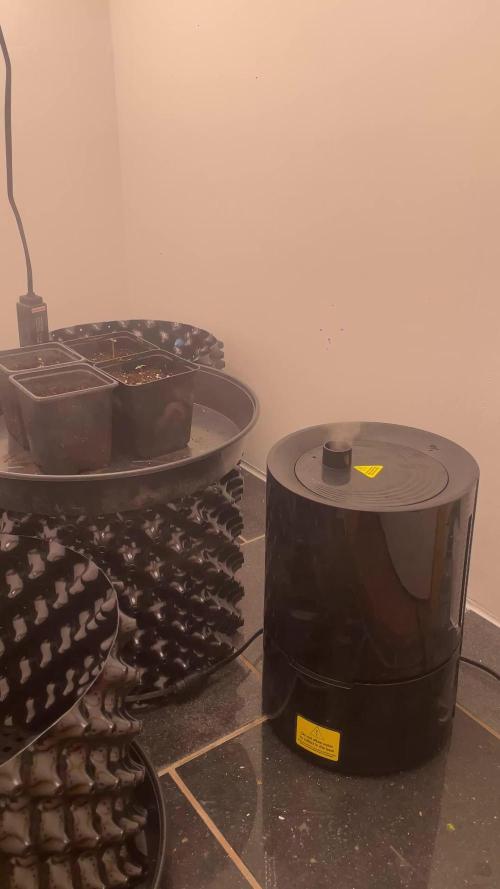
Semínka jsem nechal přes noc prasknout ve vodě, a druhý den jsem je dal do 0,3L kvetiňáčů se substrátem Plagron-Light mix do boxu.
Likes
Comments
Share


@eldruida_lamota
Follow
Vamos familia, actualizamos la quinta semana de crecimiento de estas Black Rainbow de Seedstockers, salieron las 3 de 3, 100% ratio éxito.
Aplicamos varios productos de Agrobeta, que son increíbles para aportar una buena alimentación a las plantas.
Temperatura y humedad dentro de los rangos correctos dentro de la etapa de crecimiento.
La tierra utilizada es al mix top crop, por cambiar.
De 3 ejemplares seleccioné los 2 mejores para completar el indoor y trasplanté directamente a macetas de 7 litros, cambien el fotoperiodo a 12/12 y aplique una buena poda de ramas bajas, se ven bien sanas las plantas, tienen un buen color y progresan a muy buen ritmo por el momento.
Agrobeta:
https://www.agrobeta.com/agrobetatiendaonline/36-abonos-canamo
Hasta aquí todo, Buenos humos 💨💨💨


