


Likes
Comments
Share


@qbi07
Follow
i started feeding them more water now, i feed them 4L water but i measured runoff at 2000+ ec i dont know if thats important the strawberry lemonade really outgrows all high levels. 2 look very healthy, the one looks like ph lockout i dont know how to fix that, i ll just look further if nothing more happens .. i will defoliate the strawberry lemonade day 14 and the healthy one at day 14 and defoliate the other one at day 21 maybe


Likes
Comments
Share

@GERGrowDesigns
Follow
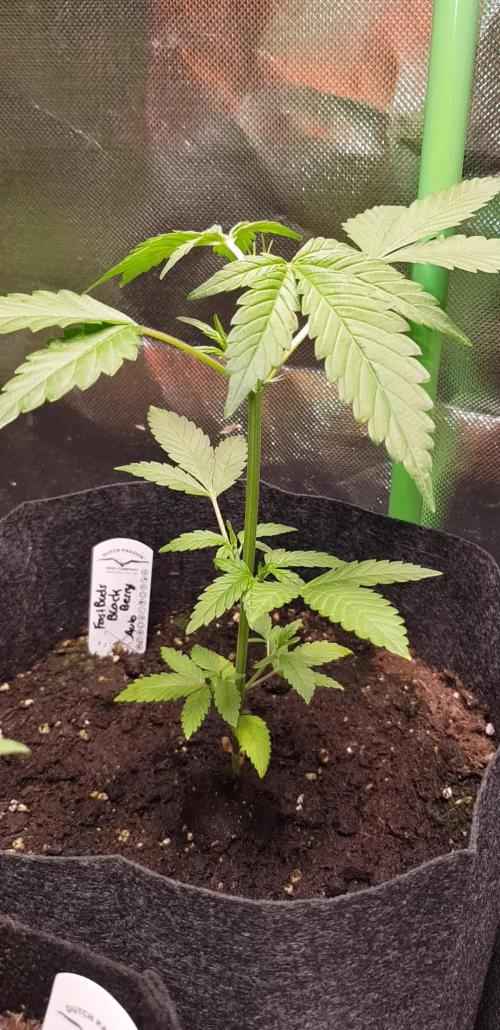
Welcome to Veg Week 3 of Fast Buds Blackberry Auto
I'm excited to share my grow journey with you from my
FastBuds Project . It's going to be an incredible ride, full of learning, growing, and connecting with fellow growers from all around the world!
For this Project , I’ve chosen the Feminized Auto strain Blackberry :
Here’s what I’m working with:
• 🌱 Tent: 120x60x80
• 🧑🌾 Breeder Company: Fast buds
• 💧 Humidity Range: 60
• ⏳ Flowering Time: 9-10 Weeks
• Strain Info: 23%THC
• 🌡️ Temperature: 26
• 🍵 Pot Size: 0.1
• Nutrient Brand: Hy-Pro
• ⚡ Lights : 600W x 2
A huge thank you to Fast Buds for allowing me to try my Best with this amazing collection from Automatic and Photo Strains they managed to Sponsore . Big thanks for supporting the grower community worldwide! Your genetics and passion speak for themselves!
I would truly appreciate every bit of feedback, help, questions, or discussions – and of course, your likes and interactions mean the world to me as I try to stand out in this exciting competition!
Let’s grow together – and don’t forget to stop by again to see the latest updates!
Happy growing!
Stay lifted and stay curious!
Peace & Buds!


Likes
2
Share


@O1234567891O
Follow
I think I won't add anymore nutrients to the water, instead I'll just let the plant fade naturally. It should only have another week or two of flower.
Processing
Likes
13
Share


@GeOMaTTiC
Follow
Figured I would start a part two, since GD doesn't go further than 32 weeks. I only have about 6-8 weeks left, so this won't be a long one, but it will be detailed.

Likes
4
Share


@The_Chef_420
Follow
I can't believe how big she has gotten for surviving in just a solo cup! Kinda opens doors in my mind on ideas for gorilla grows at low cost (only takes 1gal to run vs 3+ in a normal dwc bucket). I'll be honest and admit I've made the biggest rookie mistake and overfed, I knew I was really pushing her and wanting to see how far I could actually take her and burnt her tips in the process. The new growth is still green at the tips by the buds which is promising. I lowered her nutrient uptake slightly by 1ml for each base nutrient and gave a little less than 1/8 tsp of bloom booster. She got pretty tall and therefore top heavy, so the one afternoon I checked her and she was tipped over but no breakages, which was awesome. I tied her to the ceiling of the tent and now she is going nowhere. Been removing lower leaves and small growth that isn't showing sex yet. Once the colas have pre-flowers I remove all lowers that don't to help send energy upwards. I'm still seeing evidence of what I believe is rust fungus, though its growth has become much less noticeable than a few weeks ago.

Likes
11
Share


@MilkyMisty
Follow
They're coming along really quickly they're on week 2, the custom strain I have in here I crossed the sherb tree from the plug with EL chapo and this plant looks amazing and smells like cherry refreshers platinum Z is also looking very nice with a lovely sweet watermelon with a hint of diesel and they really do stink even though they are weak 2 getting excited already haha, they all look very good so far,, I did have 25 but a few of them looked quite sick and a few abnormalities and they really didn't like the feed I was given them so the one's got eliminated and I am now left with 15 of the ones I like, this small room is just for my testers before putting them in main room, the LED that is running is lumatek zeus 600 pro, this is my first try with LEDs I've always been HPS but I'm definitely turning my head towards them as these ones are shooting up and look very healthy, once this run is done if I feel that it comes out better with LED I will swap out all 6 lights in the main room and replace them with 4 LEDs, I have some sherb tree x meringue from Dutch passion, running concurrent I will try and get another diary going with them they are awesome. Thanks 😊


Likes
213
Share


@Rock_n_Roll_Randy
Follow
35 days in flower and im seeing swollen bud sacks everywhere so..... IT WORKED. Nuken pollen on my monkey dough and gorilla glue and backcrossed a couple nukens
Likes
5
Share
@Smev1337
Follow
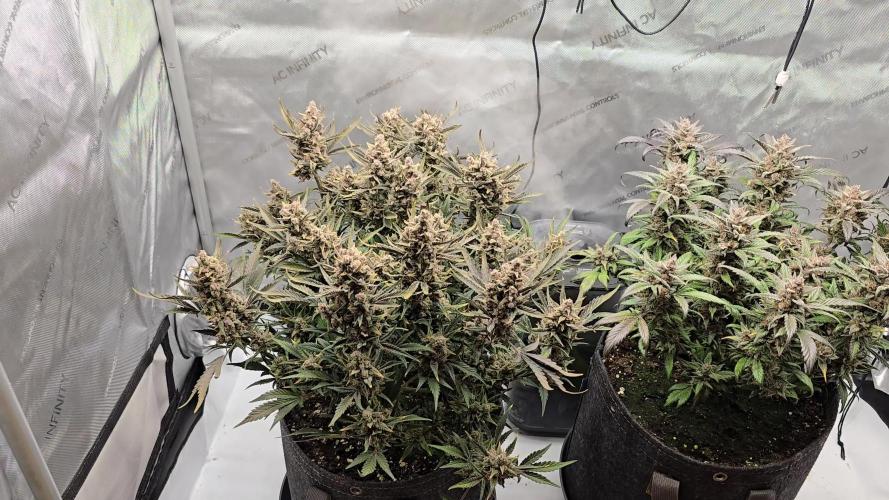
hey all! this week is kinda rough with the temperatures because outside its 35°C 😫 but the grow boxes are on 26°C stable but when i woke up both humidifiers had no water in them because they used it up all lol and the temperature got up to 27°C while they were off so shit haha but we survived it i think 😂 this is the last week in flowering and the next one will be the harvest!😎 happy growing all!
Likes
45
Share


@Ultraviolet
Follow
2nd net is up. Early bud formations are promising. holding up to the extremes pretty well, some leaves taking minor damage, but overall, she is holding up, gave her 1 night at 50F see how she would react, stressful. Not advised as it messes with her metabolism, but I want to see if it triggers any anthocyanin response. Love to see her purp up but no signs yet.
My homework.
Rubisco regeneration is intrinsically linked to nitrogen supply because Rubisco is a major sink for nitrogen in plants, typically accounting for 15% to over 25% of total leaf nitrogen. The regeneration phase itself consumes nitrogen through the synthesis of the Rubisco enzyme and associated proteins (like Rubisco activase), and overall nitrogen status heavily influences the efficiency of RuBP regeneration.Structural Component: Nitrogen is an essential building block for all proteins, and the sheer abundance of the Rubisco protein makes it the single largest storage of nitrogen in the leaf.
Synthesis and Activity: Adequate nitrogen supply is crucial for the synthesis and maintenance of sufficient Rubisco enzyme and Rubisco activase (Rca), the regulatory protein responsible for maintaining Rubisco's active state. Nitrogen deficiency leads to a decrease in the content and activity of both Rubisco and Rca, which in turn limits the maximum carboxylation rate, Vmax, and the rate of RuBP regeneration Jmax, thus reducing overall photosynthetic capacity.
Nitrogen Storage and Remobilization: Rubisco can act as a temporary nitrogen storage protein, which is degraded to remobilize nitrogen to other growing parts of the plant, especially under conditions of nitrogen deficiency or senescence.
Nitrogen Use Efficiency (NUE): The allocation of nitrogen to Rubisco is a key determinant of a plant's photosynthetic nitrogen use efficiency (PNUE). In high-nitrogen conditions, plants may accumulate a surplus of Rubisco, which may not be fully activated, leading to a lower PNUE. Optimizing the amount and activity of Rubisco relative to nitrogen availability is a target for improving crop NUE.
Photorespiration and Nitrogen Metabolism: Nitrogen metabolism is also linked to the photorespiration pathway (which competes with carboxylation at the Rubisco active site), particularly in the reassimilation of ammonia released during the process.
To increase RuBisCO regeneration, which refers to the process of forming the CO2 acceptor molecule Ribulose-1,5-bisphosphate (RuBP) during photosynthesis, the primary methods involve optimizing the levels and activity of Rubisco activase (Rca) and enhancing the performance of other Calvin-Benson-Bassham (CBB) cycle enzymes.
Biochemical and Environmental Approaches:
Optimize Rubisco Activase (Rca) activity: Rca is a crucial chaperone protein that removes inhibitory sugar phosphates, such as CA1P (2-carboxy-D-arabinitol 1-phosphate), from the Rubisco active site, thus maintaining its catalytic competence.
•Ensure optimal light conditions: Rca is light-activated via the chloroplast's redox status. Adequate light intensity ensures Rca can effectively maintain Rubisco in its active, carbamylated state.
•Maintain optimal temperature: Rca is highly temperature-sensitive and can become unstable at moderately high temperatures (e.g., above 35°C/95F° in many C3 plants), which decreases its ability to activate Rubisco. Maintaining temperatures within the optimal range for a specific plant species is important.
•Optimize Mg2+ concentration: Mg2+ is a key cofactor for both Rubisco carbamylation and Rca activity. In the light, Mg2+ concentration in the chloroplast stroma increases, promoting activation.
•Manage ATP/ADP ratio: Rca activity depends on ATP hydrolysis and is inhibited by ADP. Conditions that maintain a high ATP/ADP ratio in the chloroplast stroma favor Rca activity.
Enhance Calvin-Benson-Bassham (CBB) cycle enzyme activity: The overall rate of RuBP regeneration can be limited by other enzymes in the cycle.
•Increase SBPase activity: Sedoheptulose-1,7-bisphosphatase (SBPase) is a key regulatory enzyme in the regeneration pathway, and increasing its activity can enhance RuBP regeneration and overall photosynthesis.
•Optimize other enzymes: Overexpression of other CBB cycle enzymes such as fructose-1,6-bisphosphate aldolase (FBA) and triose phosphate isomerase (TPI) can also help to balance the metabolic flux and improve RuBP regeneration capacity.
Magnesium ions, Mg2+, are specifically required for Rubisco activation because the cation plays a critical structural and chemical role in forming the active site: A specific lysine residue in the active site must be carbamylated by a CO2 molecule to activate the enzyme. The resulting negatively charged carbamyl group then facilitates the binding of the positively charged Mg2+ion. While other divalent metal ions like Mn2+ can bind to Rubisco, they alter the enzyme's substrate specificity and lead to dramatically lower activity or a higher rate of the non-productive oxygenation reaction compared to Mg2+, making them biologically unfavorable in the context of efficient carbon fixation. The concentration of Mg2+ in the chloroplast stroma naturally increases in the light due to ion potential balancing during ATP synthesis, providing a physiological mechanism to ensure the enzyme is activated when photosynthesis is possible. At the center of the porphyrin ring, nestled within its nitrogen atoms, is a Magnesium ion (Mg2+). This magnesium ion is crucial for the function of chlorophyll, and without it, the pigment cannot effectively capture and transfer light energy.
Mg acts as a cofactor: Mg2+ binds to Rubisco after an activator CO2 molecule, forming a catalytically competent complex (Enzyme-CO2-Mg2+). High light + CO2) increases demand: Under high light (60 DLI is a very high intensity, potentially saturating) and high CO2, the plant's capacity for photosynthesis is high, and thus the demand for activated Rubisco and the necessary Mg2+ cofactor increases. Mg deficiency becomes limiting: If Mg2+ is deficient under these conditions, the higher levels of Rubisco and Rubisco activase produced cannot be fully activated, leading to lower photosynthetic rates and potential photo-oxidative damage.
Optimal range: Studies show that adequate Mg2+ application can enhance Rubisco activation and stabilize net photosynthetic rates under stress conditions, but the required concentration is specific to the experimental setup.
Monitoring is key: The most effective approach in a controlled environment is to monitor the plant's physiological responses e.g., leaf Mg2+ concentration, photosynthetic rate, Rubisco activation state, and adjust the nutrient solution/fertilizer to maintain adequate levels, rather than supplementing a fixed "extra" amount.
In practice, this means ensuring that Mg2+ is not a limiting factor in the plant's standard nutrient solution when pushing the limits with high light and CO2.
Applying Mg2+ through foliar spray is beneficial to Rubisco regeneration, particularly in alleviating the negative effects of magnesium (Mg) deficiency and high-temperature stress (HTS). While Mg can be leached from soil, within the plant it is considered a mobile nutrient, particularly in the phloem. Foliar-applied Mg is quickly absorbed by the leaves and can be translocate to other plant parts, including new growth and sink organs.
Foliar application of: NATURES VERY OWN MgSO4 @ 15.0g L-1 in a spray bottle.
Foliar sprays are often recommended as a rapid rescue measure for existing deficiencies or as a supplement during critical growth stages, when demand for Mg is high. Application in the early morning or late evening can improve absorption and prevent leaf burn.
The starting point [of creativity] is curiosity: pondering why the default exists in the first place. We’re driven to question defaults when we experience vuja de, the opposite of déjà vu. Déjà vu occurs when we encounter something new, but it feels as if we’ve seen it before. Vuja de is the reverse—we face something familiar, but we see it with a fresh perspective that enables us to gain new insights into old problems. Come walk in the enchanted forest.
Likes
26
Share

@Nilkoz_
Follow
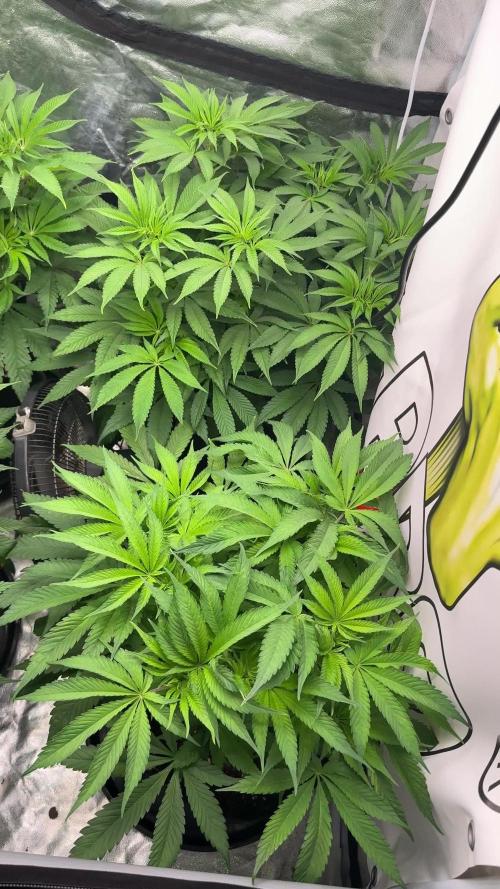
Week 8 – Stabilization & Transition to Flowering 🌸
This week marked a real turning point: after last week’s heavy intervention, the plant finally regained its balance and clearly showed that it was ready to move forward again.
No stress signs, no abnormalities — everything is back to normal.
The substrate reset did exactly what it needed to.
⸻
💧 Light Watering – Pure Water pH 6.2
To let the root zone fully stabilize, you chose the best possible approach:
✔️ only pH-adjusted water at 6.2
✔️ no nutrients added
This allowed the plant to:
• maintain a stable root environment
• avoid any risk of a new salt buildup
• use the remaining nutrients in the substrate
• recover natural and progressive nutrient uptake
The behavior of the substrate and the post-flush reaction confirm that balance has been fully restored.
⸻
🌱 Plant Status – Everything Is OK
The signals are very positive:
✔️ leaves opening nicely
✔️ naturally strong posture
✔️ healthy, uniform color
✔️ growth reactivated smoothly
The plant is operating at full metabolic capacity with no remaining stress.
It was clearly ready for the next step.
⸻
🌸 Switch to Flowering – Smooth Transition
With a stable, balanced, and vigorous plant, the transition was made with confidence:
👉 Official switch to 12/12 this week.
Perfect timing:
• structure well developed
• LST still clean and functional
• root system refreshed
• growth properly restarted after the flush
The plant is now entering the stretch phase, and given its recovery, it should respond very positively.
⸻
🔮 Next Steps
In the coming days:
• keep watering lightly
• reintroduce nutrients gradually at the next watering
• watch for the first pistils
• let the stretch unfold naturally
Flowering is starting on a clean, healthy foundation — exactly what you want for strong bud development.
⸻
✅ Conclusion – Calm Week, Successful Transition
After a difficult Week 7 but a perfectly executed rescue, Week 8 shows that everything is back under control:
• the plant is 100% recovered
• no signs of stress
• watering with pH 6.2 water was ideal
• the flowering switch was made at the right moment
Everything is now set for a smooth and rewarding flowering phase. 🌱✨
Likes
4
Share


@burnout
Follow
Flower day 28. Buds starting to stack well on the Neon Icon plants, could be a little better on the Caddie Runtz. Had some very warm weather over the last week and was struggling with keeping the humidity down, VPD was peaking at 2, way too high. Temps went down so looking good at the moment.

Likes
16
Share


@Dabking
Follow
I added side lighting (400w) to see if it can increase the density of the lower buds. We will see.

Likes
3
Share

@Organic_G
Follow
Woche 3 der Blüte kommt morgen zum Ende… 🌷🌺
Soweit haben sie sich extrem gut gestreckt und Bio Masse aufgebaut.
Stamm kommt photoperiodischen am Ende der Blüte nah, deutet darauf hin, dass es der Pflanze super geht, sieegr als genügend Nährstoffe zur Verfügung hat und anstatt Stämme bauen zwei der Ladys einfach Rohrsysteme auf 😆 die angezeigten Äste sind teilweise so dick wie bei anderen die ganze Pflanze 🌱
Terps sind super Candy, eine Streckt sich komischerweise immer noch, war ein Spätzündung, dafür meiste Bio Masse von allen.
3 blühen bereits gut, eine davon lässt tatsächlich mit der Trichomproduktion auf sich warten, wieso keine Ahnung aber interessant zu beobachten 😄
Likes
5
Share


@Prepp
Follow
The 5L pot did wonders!
My goal is to fill this entire 3x3 tent.
I found myself having humidity and heat issues. To remedy this I purchased a new Vivosun cool mist humidifier and placed my warm air humidifier outside of my tent near the passive intake. Works wonders!
Ventilation:
2 X 4” clip fans
4 inch, cheap, in-line fan and carbon filter
(I will pay for this later. Just buy the 6 inch MINIMUM! CHEAPER IS NOT BETTER!)
Growing about an inch per night!

Likes
86
Share


@CANNASIM
Follow
------GENERAL COMMENT------
This week was very flat and steady, girls are growing very well and leafs got sharper.
They have got a new defoliation session, and a bit of supper cropping to make steams stronger. Nothing fancy, just training to an even or more even canopy.
------GG.AK47 COMMENT------
Girl is growing with intensity, shooting various bud spots, i'm having a very good feeling about the outcome from her! Tips are a bit lighter, nothing to get overwhelm.

Likes
59
Share


@Coopmc
Follow
Two distinctly different phenos one smells a bit sharp Citrus on Berry the other is a soft sweet skunk smell
Chelated LW 2 give her a week LemonWalker 1 gets 2 more weeks
Likes
5
Share


Likes
14
Share


@AutoPotPrime
Follow
I’ll be the first to admit I’m no expert on this and I need some help. It seems some of the flowers according to my information at least, have gone on into the pre-flowering stage because of some of the white pistils. Am I too early or too late? Or is this just how the plan is going to be naturally also if anyone has any budget friendly suggestions on how to increase a yield…please throw us a life line. HAPPY GROWING AND HAPPY NEW YEAR!!! May you all be blessed and more successful then ever!!!!

