


Likes
Comments
Share


Likes
71
Share


@DogDoctorOfficial
Follow
Greetings, fellow cultivators! Week 6 has brought us to a pivotal moment in our Anesia adventure as we witness our green beauties reach new heights of vitality and vigor. Join me as we delve into the latest developments in our thriving veg garden!
Our Anesia girls continue to impress with their robust growth and lush foliage, each plant a testament to the care and dedication poured into their cultivation. From the graceful Future#1 to the energetic Zoomiez, it's a sight to behold and a joy to witness their journey towards maturity.
But the excitement doesn't end there! As we enter the final stretch of veg, anticipation is building for the transition to flower and the promise of bountiful blooms to come. With each passing day, our plants grow stronger and more resilient, ready to face the challenges of the flowering phase head-on.
And speaking of excitement, I'm thrilled to announce that Episode 1 of "Welcome to the Green Oasis" is now available on YouTube! Join me as we embark on this journey of growth and discovery, exploring the wonders of our green sanctuary and celebrating the beauty of nature in all its glory.
So be sure to check out the link in my bio and join us on this epic adventure. Don't forget to like, comment, and subscribe for more green goodness, and stay tuned for the next chapter in our Anesia saga. Until then, happy growing!
https://www.youtube.com/watch?v=8l_e2Jc2Q0E Welcome to the Green Oasis: Episode 1 - Tent Transformation! Direct link with full explanation of whats happening as the video is to big file to upload here
Genetics Red Banana Pudding = RBP
Apricot Oreoz = AO
Zoomiez = Z
Future#1 = F
https://anesiaseeds.com/
Plant nutrition - Aptus Holland - https://aptus-holland.com
LED Photons - Future of Grow - https://www.thefuturofgrow.com/
Controls - Trol Master - https://www.trolmaster.eu/
Watering - Autopot - https://autopot.co.uk/
Tent - Mars Hydro - https://marshydro.eu/
Love and attention - Me, myself and i
As always thank you all for stopping by, for the love and for it all , this journey of mine wold just not be the same without you guys, the love and support is very much appreciated and i fell honored and blessed with you all in my life, With true love comes happiness. Always believe in your self and always do things expecting nothing and with an open heart , be a giver and the universe will give back to you in ways you could not even imagine so
More info, the ocasional give-away and exclusive updates from all my adventures can be found - links in the profile description
Friendly reminder all you see here is pure research and for educational purposes only
Growers Love To you All 💚

Likes
17
Share


@EGPharouh
Follow
The harvest wasn't the biggest. But high quality. I will increase the light density by adding CFL to the grow room. And test the nest grow how much I can push the yeild.

Likes
27
Share


@RDWCGrowing
Follow
3/18/2023
Week 5- Day 1 of Veg (Day 45 overall)
First day of Week 5 Water change day.
36 Gallons in
Mammoth Silica = .5Mil/Gal = 18Mil
CalMag = .5Mil/Gal =18Mil
Root Drip = 1Mil/Gal =36Mil
FLoraMicro = 4.8Mil/Gal = 173Mil
FLoraGro = 4.0Mil/Gal = 144Mil
FLoraBLoom = 3.8Mil/Gal = 137Mil
ORCA = .5Mil/Gal =18Mil
PH = 5.85
PPM = 576
I adjusted the lights to final position for grow the lights are now 45" from the top of the plants.
PPFD= 450
Tent Temp = 78.3
Water Temp = 73.2
3/19/2023
Week 5- Day 2 of Veg (Day 46 overall)
Not much to report.. Did some defoliation and some topping. The humidifier was not cutting it by itself to keep the humidity around 60 so I added a bigger humidifier today on a second InkBird Controller. Lets see if it can help control the environment a little better and keep me from having to refill 3 times a day.
3/20/2023
Week 5- Day 3 of Veg (Day 47 overall)
Just let them be today. We all took the day off and just grew!!
3/21/2023
Week 5- Day 4 of Veg (Day 48 overall)
Nothing much to report they continue to do good.. I topped a little I fim'ed a little and I defoliated a little.
Everything seems to be on point still...
3/22/2023
Week 5- Day 5 of Veg (Day 49 overall)
Did a little bit of daily maintenance by adding 6mil of PH Up to bring my PH from 5.80 to 5.89, I refilled my humidifier. I topped a little, I FIMed one and I defoliated a little bit.
3/23/2022
Week 5- Day 6 of Veg (Day 50 overall)
Regular maintenance conducted. The PH was down to 5.80 so I added 8mil of PH UP bringing the PH to 5.91. I topped where it was needed, I also defoliated some to allow light to hit lower nodes as well as allow a good air flow.
3/24/2023
Week 5- Day 7 of Veg (Day 51 overall)
Last Day of the week time for measurements:
#3 = 1 foot
#2 = 11 and 1/2 Inches
Tomorrow I will try to just add a SILICA top off to my Res.. I hope it doesn't call any gumming and me to drain and restart my Res.. this will be my first time topping off SILICA.

Likes
7
Share


@Aleks555
Follow
Dutch Passion - Melonads Runtz Harvest
We’ve completed this amazing grow, and I must say, we truly enjoyed it! The plant grew easily and initially had a bush-like shape, but later, it transformed into a Christmas tree look. The aroma is incredibly delicious, and the yield is impressive. The buds are dense and covered in resin; while trimming, our fingers were coated in such a thick layer of sticky resin that the scissors wouldn’t cut the leaves anymore.
We want to extend our gratitude to Dutch Passion for such an amazing strain—we absolutely loved growing it. We also want to give a huge thanks to Xpert Nutrients for the outstanding fertilizer that has helped us grow such beautiful and powerful plants year after year. Without your products, it would have been much harder to achieve these results. The nutrients are easy to use and of exceptional quality!
Why I Choose Xpert Nutrients:
When it comes to growing strong, healthy plants, choosing the right fertilizer is key. After several years of experience in indoor cultivation, I can confidently say that Xpert Nutrients stands out from the rest, and here’s why:
1. Unmatched Quality: From the very first use, it’s clear that Xpert Nutrients is made from premium, high-quality ingredients. Every bottle is consistent, and the nutrients are perfectly balanced for each stage of the plant’s growth cycle. This attention to detail has allowed me to grow incredibly healthy plants with powerful roots, lush foliage, and dense, resin-packed buds.
2. Easy to Use: No complicated mixing instructions or guessing games. Xpert Nutrients provides clear guidelines, and I never have to worry about whether I’m giving too much or too little. The nutrients dissolve perfectly in water, leaving no residue or sediment in my system, making feeding a breeze.
3. Consistent Results Every Time: I’ve used Xpert Nutrients across multiple grows, and the results are consistently impressive. My plants grow faster, are more robust, and yield more, whether I’m growing autoflowers or photoperiod plants. Each time, the buds come out dense, sticky, and packed with potency.
4. Boosts Potency and Flavor: One thing I’ve noticed is that Xpert Nutrients doesn’t just help with growth; it also boosts the aroma and flavor of the final product. My plants consistently produce some of the most aromatic and flavorful buds I’ve ever grown, making each harvest a true sensory experience.
5. Optimal Performance with Every Strain: Whether I’m growing strains from Dutch Passion, Anesia Seeds, or Humboldt, Xpert Nutrients works wonders with all of them. I can rely on it to provide the essential nutrients my plants need to thrive, no matter the strain or growing conditions.
6. Support and Trust: The customer service and support from the Xpert Nutrients team have been incredible. They genuinely care about their customers' success and are always ready to provide advice and guidance. Knowing I have such a supportive company behind me is invaluable.
After years of growing, I’ve tried a lot of different fertilizers, but Xpert Nutrients has consistently delivered the best results. It’s a product I trust, and it never lets me down. If you’re serious about growing the best plants possible, Xpert Nutrients is a game-changer you can’t afford to miss.


Likes
17
Share


@OKushoma
Follow
Stomp my feet for this one but I did not weigh it. Nope, I smoked it. My bad. I started out only smoking a small bud and then one led to another and I got busy, yadda yadda LoL Go to plant #2 for better details.


Likes
92
Share


@biggreens420
Follow
This girl is doing well nice side branches before fiming but find her any way hitting her with the Shogun line up put a vid up of e.c and pH of feed i don't check often as it's always the same roughly just in flower i switch the calmag and silicon for a boost and a pk she's healthy and happy not much to say as she's all good thanks for reading happy growing guys


Likes
11
Share


@CanabisLoverHobbyGrower
Follow
Little bit of defoliation today just to allow light to hit as much as possible,.. day 21 from breaking soil, all look healthy, started a proper nutrient feed today also, still toying with the idea of topping or just some lst, not sure yet, will see how they look next week,.. stay tuned 😀

Likes
20
Share


@adam_pawloski87
Follow
We are in Flush !! Was giving them GH Flora series + rapid start + cal mag
Likes
7
Share


@Zuppler
Follow
Week 10 - Fifth Week of Flower
The Donutz tent is stepping into its fifth week of flower with some exciting developments and a few surprises. The plants are thriving, and the vibes remain immaculate as the grow progresses.
Key Updates:
Purple Phenos: 3-4 of the plants are starting to show stunning purple hues in their buds and sugar leaves. The color shift adds a beautiful contrast to the tent and hints at the unique expressions within the Donutz genetics.
Different Phenotypes: While most of the plants are stacking up nicely, 1-2 phenos are a bit on the thinner side with less bud density. It’s a reminder of the natural variability in genetics, but there’s still time for them to fill out in the coming weeks.
Environment & Care:
Stable Conditions: Temperature, watering (reverse osmosis), and overall care are dialed in perfectly. The plants are enjoying a consistent, stress-free environment with plenty of love.
Healthy Growth: The rest of the tent is looking strong, with vibrant buds and trichome development continuing to ramp up.
Observations:
The purple phenos are a standout feature this week, bringing extra visual appeal to the tent.
Even the thinner phenos are showing healthy structure and potential to develop further before harvest.
Trichome production is increasing, and the tent is starting to radiate that sweet, sticky aroma.
Next Steps:
Continue monitoring the thinner phenos to ensure they’re getting enough light and nutrients.
Maintain stable environmental conditions and nutrient levels to support bud development.
Keep a close eye on trichomes as they mature, watching for any signs of ripening as the grow approaches the final stretch.
The Donutz are flourishing, and the tent is alive with color, aroma, and promise. The Florida Gang grind is paying off big time — the finish line is in sight!

Likes
10
Share


@woolygrower8280
Follow
On day 2 of the week I turned both lights settings on (there are 3 options; growth: on flower: off / growth: off flower: on / growth: on flower: on)
I set them both on because I read the more light the more bud and I was sure that the plant had started the transition and was flowering
like stated in the previous week, the main stem got way to close to the light, (4in from ) and not having more room in the tent I bought a cheap garden net and distributed the plant so the light was as even as possible using a cheap little instrument with light sensor I bent the main stem pretty violently but it recovered well and is doing well
tried dropping the temperature a bit by keeping my window open but I didn't drop it too much due too the fact that I live and sleep in the room
just realized today that I should have changed the nutrient mix dosage at the begging of flower as recommended on the bottle to help the transition but I guess it turned out alright
watering 2 -3 times a week 3L at a time

Likes
14
Share


@DarBGrowDiaries
Follow
What a crazy auto, she is by far the biggest I grew in this tent, taking over the whole space with only LST.
Super uniform and smelling very sweet.
Can only reccomend giving this strain a try, big pots and lots of water
Likes
Comments
Share

@HOME_GROWBOOK
Follow
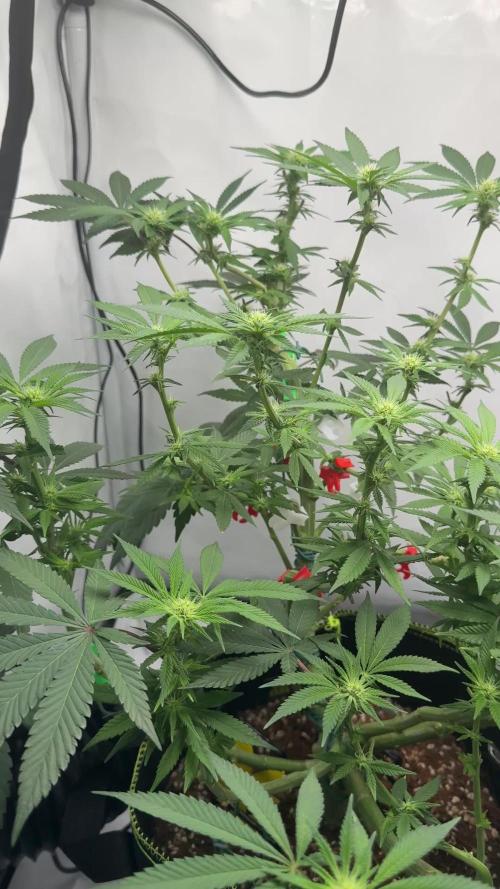
Der Stretch ist offiziell vorbei! Beide Sorten – 24K Gold und Gelato 33 – haben ihre Endhöhe erreicht und konzentrieren sich nun voll auf die Blütenproduktion.
Das Blätterdach steht dicht und gleichmäßig, alle Spitzen sind auf einer Ebene und perfekt im Lichtfeld.
24K Gold zeigt jetzt kräftige Blütenansätze an allen Haupt- und Seitentrieben. Ihre Tops sind bereits mit einem feinen weißen Flaum bedeckt, die Blütenstruktur wirkt kompakt und gleichmäßig.
Sie duftet bereits leicht süßlich mit einem typischen Kush-Unterton.
Gelato 33 präsentiert sich etwas buschiger mit engen Internodien. Ihre Blütenstände sind kleiner, aber sehr zahlreich – viele kleine Tops, die sich gleichmäßig entlang der Triebe bilden.
Das Blätterwerk bleibt sattgrün und gesund, keinerlei Anzeichen von Stress oder Nährstoffmangel.
Nach dem Entfernen des Netzes stehen die Pflanzen frei und stabil.
Eine gezielte Entlaubung wurde abgeschlossen, um Licht und Luft optimal zu verteilen.
Düngung & Setup:
• 💧 Canna Coco A + B → 6 ml/l
• 📈 EC 1.6 | pH 5.8
• 🌡️ 25–26 °C Tag / 21 °C Nacht
• 💧 Luftfeuchtigkeit 50 %
• 💨 Starke Umluft & stabile Tropfbewässerung
Der Übergang in die Hauptblüte verläuft absolut stressfrei – die Pflanzen sind gesund, vital und bereit, Masse aufzubauen.
Ab nächster Woche folgt der Fokus auf Blütendichte und Harzbildung – das spannendste Stadium beginnt jetzt!

Likes
6
Share

@DeepRootsGrowTrees
Follow
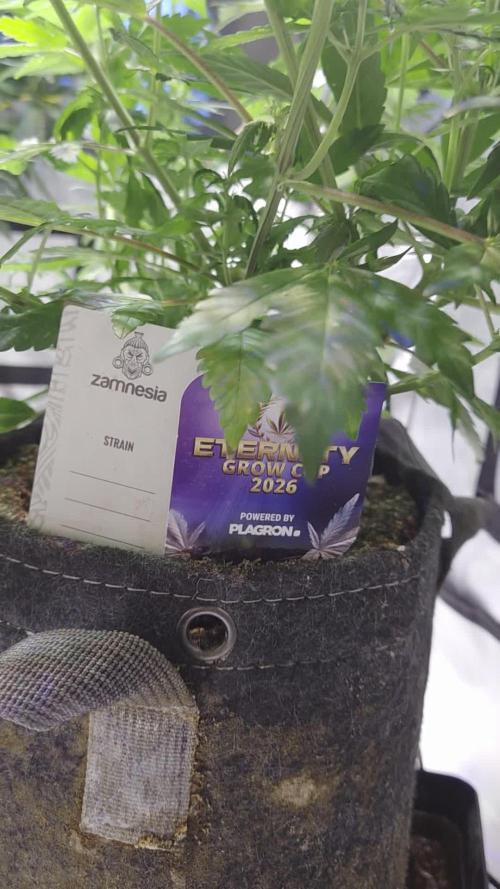
STICKY BROCCOLI 🥦 / ZAMNESIA & PLAGRON
WEEK #8 OVERALL
WEEK #2 FLOWER
She's doing great 👍 age hasn't had any issues she's about a foot tall and a foot wide, she's got multiple tops and her color is amazing!! STAY GROWING MY FRIENDS 🧡!!!
THANK YOU 😊!! FOR TAKING A 👀 IT'S ALWAYS APPRECIATED!!
THANK YOU ZAMNESIA AND PLAGRON😊!!!
STICKY BROCCOLI 🥦 / ZAMNESIA SEEDS

Likes
15
Share


@northern_rookie
Follow
Less is more. Lesson learned. Without training these plants, having the fifth plant has really cramped the tent. Because I have limited space for the tent, access into the sides isn't possible. I have only the front entrance. Next time I think I will stick yo maybe three strains that have been positive and try and find the time to train more.
The WOS-Northern/Skunk has grown out so nicely into a Xmas tree type of posture. She is making her really good friends with her neighbours, perhaps to their detriment.
Seedsman Blueberry continues to be solid and unphased by anything. This is the first time I have smelled a plant that has such a fruity aroma. It really took me aback in surprise. Very cool.
HiFi 4G needs support. Did a McGyver solution for the time being. Doesn't appear to have bulked up much this week.
Jack is about the same. A bit of bulk up but not expecting this one to be a big yielder. Appears healthy overall so I'm happy.
CBD+ bulked up for sure on the main cola's. I'm skeptical she will be done at 60 days at this point....but have to trust what Dinafem are telling me.
Be safe folks.


Likes
7
Share


@SamDo
Follow
Week 19 of Vegetative Growth
(Transition Week – Pre-Flower Move)**
This week marks an important milestone for the Pineapple Upside Down Cake: she was finally moved into the tent where she’ll spend her entire flowering phase.
She’s not flipping yet — this stage is all about controlled acclimation before the real show begins.
Up until now, she was growing under a 5000K blue-leaning veg light at low wattage, which kept her compact and focused on structural development.
Inside the flowering tent, the lighting is completely different: a full-spectrum 3500K panel, warmer, broader, and naturally more stimulating.
A spectrum switch like this can easily stress a plant, especially in late veg, so the intensity was intentionally reduced to 300 PPFD to give her a soft landing.
Temperature conditions also shifted: about 21°C during the day and 17°C at night, with the light set to 25% power.
It’s a cool, stable environment — ideal for a plant adjusting to a brighter and wider spectrum.
The second key topic of the week was training strategy.
Her growth was accelerating fast, and the debate was wide open:
Should she be topped?
Should we go for a scrog?
Should we prune more aggressively?
In the end, the most coherent choice was a clean LST session.
Her main branches — roughly ten apexes — were gently bent and opened to create a wider, flatter canopy.
This approach keeps stress minimal while giving her a solid architecture to handle the upcoming stretch.
Over the next few days, she’ll naturally stand back up, and once she does, her true structure will become clearer.
At that moment, we’ll be able to judge whether she needs extra shaping: a light defoliation, selective pruning, or even a late top if it really makes sense.
For now, the plan is simple and strategic:
• monitor her adaptation to the new spectrum,
• watch how she reacts to the LST,
• keep the environment stable,
• and only move to flowering once she shows full vigor again.
Summary for Week 19 (Vegetative Growth):
– Successful transition into the flowering tent
– Spectrum shift managed smoothly with 300 PPFD
– Cooler environment helping with acclimation
– Clean LST performed on about ten apexes
– No visible stress, good potential for a controlled stretch
– Next step: wait for full adaptation before flipping
See you next week for the follow-up — the pre-flower phase is getting close.
Likes
25
Share


@m0use
Follow
Weeks been chill, plants are not drinking as much as I thought they would be. Still annoying to water them separately with PH'd shit, some days I just give them tap and say fuck it.
Can't say they are doing the best they could be doing. Been to busy with other things to give them the full attention they need for a first time liquid feed grow. Really should have done this indoors but I hate running a tent in the summer when the sun and heat are free. Granted the tomatoes are blocking some of their sun, have to move them aorund. been meaning to do that but no where to put them where they won't block out some other plants.
Been having some fun making the little videos each week, been using open shot video editor to mash it all together and it works quite nice. Few crashes here and there as this laptop is garbage. It has so many features that I am not fully utilizing like cuts and effects but I've kept it stupid simple.
Bugger one of the videos did not upload into the diary. Annoying AF these things take forever to "resize/convert"
I like how the dead Blue Cindy plant looks like a biophage, sifi like alien thing.