


Likes
Comments
Share


@MT_Farmer
Follow
Still only watering ph'd water. The plants are actually quite different, the one in the front seems to expand out towards the sides much more the the one in the back. Also the colors of teh leaves are different

Likes
47
Share


@KA_LE
Follow
- Really happy with her recovery this week from the topping and defoliation, she's starting to show some explosive growth. I think I might up the nutrients to full strength next week, does anyone think this might be a bit much of an increase?
- Continued with some slight training, just making sure the main branches don't pop back up and that they are pulled down as much as possible to save on height.
- Did some minor training of the new shoots towards the end of the week, just trying to pull them into the empty space and even out the canopy a bit.
- She also seemed a bit more thirsty this week , up until now iv only been watering one litre once a week, this week I gave her a total of about 3 litres spread over two occasions.
Likes
1
Share

@HoneyBlunt42
Follow
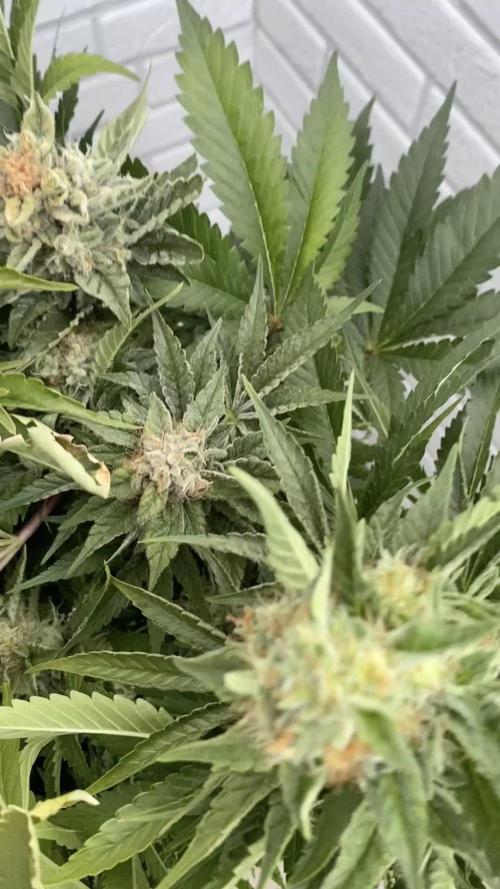
На третий день промывки понял, что более готовыми уже не будут. Харвест, обстриг крупные лопухи. на 10 дней в темный вентилируемый бокс с угольным фильтром. Затем взвешу сухой вес и уберу на неделю-другую в стеклянные банки пролечиваться

Likes
87
Share


@JKent19
Follow
Pretty good week overall! Day 80, I am posting a little early to coincide with my expected harvest in 2 weeks, and because today I officially started the flush! At this point I am anticipating the harvest between 5 and 14 days from now, depending on how quickly the buds finish ripening up. I am guessing the taller plant has about 75% red hairs and over 50% cloudy trichomes at this point. The shorter plant is slightly behind with maybe 40% of her hairs being red and maybe a third of the trichomes are cloudy. They have made a lot of progress over the past week, so🤞 they will continue that trend. Did a pretty decent defoliation on the shorter plant, due to some fan leaves that were blocking light from the lower canopy turning yellow. I have decided to try molasses with my flush water, hopefully that will improve my final product. One final note is the smell.... it is considerably stronger this time than either of my first 2 grows. Typically I do not bother with a carbon filter, but the smell was so strong it leaked in from my garage and permeated my entire house! So I added filter (and a very strong candle) and it seems to have helped the problem. Super excited for the harvest, will definitely keep everyone posted!


Likes
27
Share


@Oetelando
Follow
We have day1 of Week 7 and i think in 2 Week is Harvest Day.
They look all very good and perform strong.
Only disapointment is that the Gorilla Fast need 8-9Weeks and not 6. but the Quality is strong.
Wir haben Tag 1 von Woche 7 der Blüte.
Alles läuft wie es soll schade das die Gorilla fast nicht in 6 Wochen fertig wird aber die Qualität passt und ist perfekt.
In 1-2 Werden alle geerntet.
Letzte Woche in der gedüngt wird und die allerletzte Woche wird mit Ph reguliertem Wasser gegossen aber wenig und 1 Tag später als normal.


Likes
3
Share


@Farmerbry71
Follow
Starting to get close to the end the tall buds are packing on the weight very large plant very frosty will have a great yield from this plant
Likes
10
Share


@DeltaEye
Follow
I put the plants into an NFT system couple weeks ago. I could have waited a bit longer for the plants to develop a stronger root system before placing the rockwool cubes into NFT but I was being impatient because of the slow start and wanted to get the plants under proper light. Now two weeks later they are growing well with good root development.
I switched the lights to flowering cycle about a week ago so they should start stretching soon. No preflowers yet.
Likes
8
Share


@ezgrows4anoob
Follow
~Week 6/ 36-42 days from sprout
~Overall:
~VPD: Given up but keeping it decent. Growing in cold basement so having high humidity in the room is a no-no
~Plants DLI increased closer to 45 for these last few weeks of veg. Will close out around 50 next week, and then drop before flower.
~First top-dress end of next week
~Watering as needed, about every 5-6 days. Plants should be watered on the 18th. That will be 5 days since last watering. Might push it to the 19th though because with drop of temps means plants metabolism slows and they use less water.
Day 36 notes: Looking great. Soil still very moist. Looking to water on day 39. Also increased the DLI closer to 45, and I want to push it to 50 closer to the flip to flower. Other than that training continues. Did some more super cropping and leaf tucking. Also my clones are not looking good. This is understandable as the temp and humidity has dropped considerably. Will watch them the next couple days and if none of them shoot roots then they will be outta here. I have a small tent specifically for clones coming the 20th, in 4 days.
Day 37 notes: Did a lot of training today. My hope is to fill out most of the tent, if I have to have empty space I want it to be less than 8x8 inches. Grow is going well otherwise. Will be feeding on the 19th if all goes as planned. Some more red on the stems and petioles but it is still minor. Quite a bit of super cropping today. Also temps are all around and VPD is kind of screwed over right now. Also the plants smell really fruity now and smell a bit gassy. Smell really coming on strong. Also, even though they are not yet flowering, my hands were sticky today after handling them for LST, super cropping, and leaf tucking. Temp has been all over the place the past few days. Need to get it under control. Would prefer the conditions to stay at around 80F 60RH or 85F and 70RH. Not possible with my current setup though. 2-4 days until next watering. Soil was still quite moist today.
Day 38 notes: Looking good today. Did not do anything but peek my head into the tent and take some pictures. Temps are doing well, and I tried to get humidity up. Currently at 80F/39RH. I would prefer 80F/60RH. Will water tomorrow or the day after depending on what I see when I go check them tomorrow. Still no roots on the clones, but there are some very small what looks like the start of roots. I am going to let the clones sit in the cloner until they die or I need to clean the cloner for my real clones.
Day 39 notes: Maybe one of the most expected days so far. Expected to water the plants day 40, but they desperately needed water today. My blueberry plant also started peeling away from the main stem at 2 nodes. I am guessing my training was a bit too tight. The training was initially fine, but after the plants grew a bit more the ties were no longer at the tip, this caused the point of pressure to change and essentially ripped the plant apart at the seams. I need to keep this in mind next time. I did reattach the branch that had fallen off, but I do not know if it will live. If not, then I will actually use that branch for clones. Speaking of clones, all of mine are dead lol. Basically my high-ass forgot to turn the cloner back on after checking for roots. It was off for 24 whole hours. Came back today and clones are dead. Anyways its cool. I am going to throw these clones out, set up my new cloning tent, and after cleaning my cloner I will start a new batch of clones. The Blue Cheese in the front of the tent smells like straight dead skunk dumped in the tent lol. No matter what Ill be keeping some clones of that plant, at least for the smell alone. Not much to add otherwise. Next time I have to water I will readjust the LST ties.
Day 40 notes: Great day today. All of the plants have recovered well from lack of water. Will be watering them in 3-4 days again. At this point, the plants are big enough to switch to flower, but I want to try to wait another 20 days. In 2 weeks I am going to defoliate and take off any of the lower growth. It is at this time that I will go ahead and take some new clones. I disposed of the dead clones today after checking for roots. 4/14 ended up rooting. That's actually pretty nice given the fact that they were in hellish conditions. Clones would like 80F/60-80%RH. These clones were at 80F/30RH. I could have technically saved the 4 that rooted, but they would not have had the vigor that they should have. Also temps have been kind of way off again. Today it was in the opposite direction. Earlier was too hot and not humid enough. Today, the tent was too cold and too humid lol. I'll keep watching it but the plants are mainly very healthy. My cloning tent also arrived today and I got it setup and installed a light in there.
Day 41 notes: All good today. These plants are growing like a weed lol. The smell is intense now. Smells like a tent in flower. VPD was pretty good yesterday at 77F and 60RH and its the same way today. Will be taking clones in 12 days, and flipping to flower in 19 days. I am pretty excited because these plants are looking great so far.
Day 42 notes: Did not do much today. A bit of leaf tucking, but that's it. Will be watering either tomorrow, or the day after. Soil is still pretty moist about an inch down. Also taped the injured branch on the blueberry, and removed all of the ties from it. I will be doing some more training in a couple of days when I water. Plants have a very strong smell overall. I am definitely excited to flip these babies into flower and start weaving them through the trellis net about 1 week after I flip them.
End of week summary: Overall was a great week. There were a couple of interesting things I ran into this week but nothing wrong with the plants. These plants are gonna be beasts by the time I flip to flower. Also fimming on the Blue Cheese in the front definitely did not work. I have heard that it is not always successful.
Misc. comments: DLI meter malfunctioning. Will just eyeball it from now on. If plants seem stressed then I will lessen the intensity. Want to run a batch of 5 Blue cheese clones next time. Could also do the blueberry which has responded great to training. Need to get a couple of clip on fans to improve my air circulation. Investing in a better trellis net would also be wise. Going to wait to do all that until I start my raised bed cannabis garden next year in my 4x4 and 3x3 tents. I will likely also purchase either a 4x4, or a 5x5 specifically for drying plants. I would also then need to get a filter, intake and outtake, and a couple of clip on fans. Humidifier and dehumidifier I pretty much already have. I would also like my grow area to be built in a way that I can very easily maintain proper VPD.
Likes
23
Share


@DeepRootsGrowTrees
Follow
MATARO BLUE by KANNABIA
Week #18 overall
Week #4 Flower
She's doing great this week looking good and her buds are starting to dense up she's getting nice trichome coverage as well. Stay Growing!!
Kannabia.com
MATARO BLUE


Likes
8
Share


@Lazuli
Follow
What a huge dense flowers she has now
Smells a bit lemony i think 2-3 weeks left

Likes
15
Share


@Taskot_Joe
Follow
Huge signs of progress this week! The smell has come in strong as well as the nice fat crystal flowers starting to plump up, Definitely a tall growing strain but all signs are pointing towards the yield being of a good quality! Have ordered a USB loupe that will be arriving tomorrow as the current is too hard for photos!
Likes
8
Share


@Herbman420
Follow
Hi everybody week 1 into vegetation stage started feeding expert nutrients the whole line for the grow stage I use 0.3 ml to 1L of everything witch gives me a nice 320 PPM I have found perfect for their first feed. Can't wait how to see she goes and thank you for looking at the diary there will be updates every week and always remember it's 420 somewhere 👍🌱


Likes
15
Share


@RDWCGrowing
Follow
2/1/2024- Pre-Germination Activities Day 1
I have 21 weeks until final photo is do.. I took 3 seeds out of cold storage and will let them get to room temp for the next 48 hours before I go with Glass of water for germination. I have 3 beans because I will start from the very beginning helping ensure I present the best Pheno. This is going to be a fun one.. I am a few days away from being able to clear my tent out for this run.. I have a breeding run in right now and the Seeds are a few days away from being mature enough for me to take down the girls.
Once I get them down I will need to get my tent cleaned up and turned over right away. This is going to be close, I will have to time them to the water and into the tray at the right time.. because I will need to get lighting on them right away.. I have my 2X2 and my light ready incase I need to hold them in the cloning machine if the others are not done in the next few days.. Glad I have options that can stretch me out for a week or 2 to give me a little more time.
2/2/2024- Pre-Germination Activities Day 2
I checked on my breeding run to see how close the seeds are and if the tent is ready for me to clear and clean but alas I am still going to need a few days. I setup the emergency 2X2 and that should give me 2-3 weeks. The plan is to still wait one more day to allow the beans to warm up to room temp and then drop them in Water sometime tomorrow.
Form my Emergency 2X2 I have the following:
4" inline fan and carbon filter
Fan
VS-2000 light
2/3/2024- Germination Activities Day 0 - Dropped the Beans in.. Today is 0 day.. Go.. Go .. Go..
2/4/2024- Germination Activities Day 0-1 - Checked in on them this morning and no tap roots yet.. covered them back up and back in to the closet they went. I setup the Root Riots and the Seed tray for them. I Ensured my water that I was soaking the root riots in was PHed to 5.8 and I used RO water.
Afternoon Update: Checked on my Breeders and they are done. I started to harvest them, I took down the one I had reversed with STS and I took down the Black African Magic- All but one bud, I wanted to get some pics of that one today.
I was only able to get 2lbs into the Cannatrol because I had to be very careful to keep the bud from the plant that was treated with the STS separated from the other seeded bud that was pollenated from the plant I reversed.
Cannatrol could have held an additional 2oz of wet but not today. Ideally I need 1 more Cannatrol so I can take an entire Tent, but will figure that out. I put an additional 1.5lbs into the freezer to wait it's turn into the Cannatrol, I would have left it on the plant and taken it in 4 days when the dry cycle gets done but wasn't sure how much 2.2 lbs was equivalent to chopped and wet trimmed.
2/5/2024- Germination Activities Day 0-2 - Checked in on them this morning and 2 of them have very small tap roots out.. one still doesn't going to give them some more time. I will check in on them this evening and see if they are more open if so I will transfer the ones that are ready to their medium and seed tray.
2/6/2024- Planting Day TRUE Germination Day 0- Checked in on them this morning and all 3 of them have tap roots out. I broke the bottom of the tap root for #1 which was the biggest.. pretty sad.. I hope she survives.. I tried to be careful it just snapped off when I was trying to get it in the root riot right. Other than that all three are now in their in-between home in the 2X2 while if finish clearing and cleaning out their forever homes.
2/7/2024- Germination Day 1- Checked in on them and no surprise no sprouts yet. Sprayed the dome to moist it and light spray to the tops of the Root Riots.
2/8/2024- Germination Day 2- #3 is popped and it looks like #2 will be popped by this evening.. I got my second Cannatrol today so now I can take down the rest of the tent and get it into the dry/cure.
2/9/2024- Germination Day 3- #2 is popped as well.. so I have #2 and #3 up and still waiting to see on #1 but that might be a loss since I accidently broke off some of the Tap root when transplanting.
2/10/2024- Germination Day 4- #1 has Popped... We have ignition on all 3.. YAY!! I finished clean up and install of RDWC system, this time was unique the back left buckets 3 inch pipe wasn't seated correctly so I had to clean up about 12 gallons of water all of the floor. I also had two leaks coming from one of the Waterfall return junctions, this is why I do a full pressure test before I put anything in. I will continue to monitor it through tomorrow to ensure that I am good to go and then I will finish setting up the baskets and prepping the water to be ready for the ladies planting day!!!
2/11/2024- Germination Day 5- #1 Of course is going to be my trouble plant.. No matter what If she lives through planting in the system and making it, I think I might not cull her at all regardless, she has been such a problem, makes me wonder if she will be super worth it towards the end.. We will see as we go through this grow, but #1 has a piece of the shell on the leaves,
Other than that I set up a new thing I have been doing since last grow converting my Baskets into Sure plants so I can see exactly where the water is when I plant them and ensure I have the water up high enough that they are able to access it and grow but not too high were they are drowning.
2/12/2024- Germination Day 6- Everything seems to be going good.. will just keep them moist and let the roots grow for a few more days before I transplant to forever home.
2/13/2024 - Germination Day 7- Just keeping them Moist.
2/14/2024 - Germination Day 8 - Planting day.. they are now in the system.. :-)I had to fill the water to the bottom of the basket where I could see water on the bottom rocks and just coming up where I had created my whole/ sure plant.
2/15/2024 - Germination Day 9- Top fed just a little to keep them moist and encourage root growth towards the water. I ensured the PH is right at 5.98-6.02 range.
2/16/2024 - Germination Day 10- Top fed just a little to keep them moist and encourage root growth towards the water.
Likes
3
Share

@Jessi576
Follow
👉 Week 7 Bloom👈
👉18.04.2026 - 24.04.2026👈
👉 Days bloom: 43-49👈
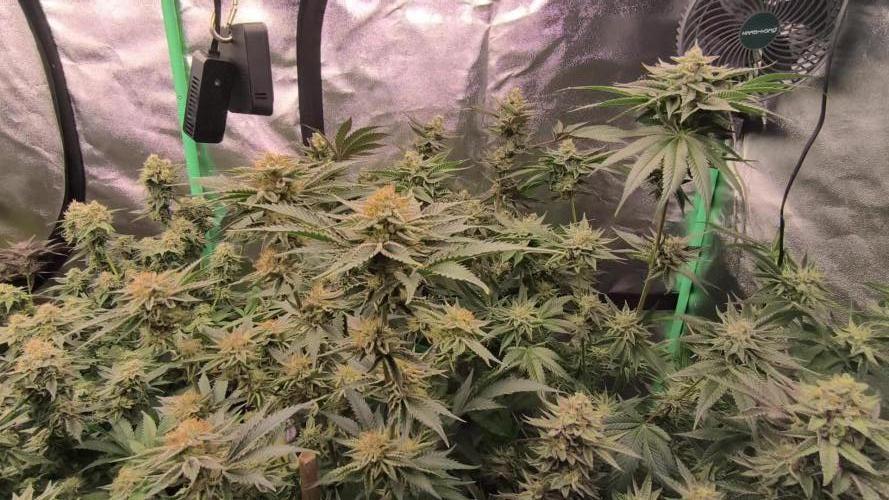
The plants have gotten defoliated on bloom day 43 (usually around 40-43).
Two third of the Cherrytinis needed to be tied to a help in form of a staff in combination with velcro band, because this particular cultivar tends to grow all branches extremely long and therefore relatively thin, even tho he got enough silicat.
The ripper seeds strain is doing what this cultivar usually does:
It is growing small branches with a few nodies.
The buds are really growing thick, which is quite beautiful. This cultivar would perfectly fit a sog, but is sadly growing so tiny, that it would take too long until the mother could produce enough cutrings a time, to start a SOG.


Likes
10
Share


@Dreadnug
Follow
Plant has been getting straight pH balanced water this last week and minimal nutes.
It is showing some slight nute burn so I let off a bit and raised the light canopy about 6”. I discovered that what I thought was a calcium or potassium deficiency was actually a rookie grower error by me. I have an RO system that I use to water all my strains in the grow room including this one, but when adding nutes to the water, it takes too long so I had been filling them up with well water. When I had originally tested the well water, I must had used a faulty testing agent as after testing it this last week, I was showing a pH of 7.5 vs. my RO of 6.2. Thus, every time I was adding nutes (multiple times a week) I was significantly fluctuating the pH between regular feedings and nutrient additions. To make matters worse, when I originally thought it was nute burn, I flushed each plant with well water and likely caused additional stress.
Anyway, I have since learned that the well water needs to be treated, I only utilize RO water the last few days and plan to do so over this next week.
Also, I have turned off the CO2 system as I was starting to see signs of heat stress on a couple of the strains (not this one). The literature I have reviewed suggested that these strains might be able to handle heat closer to 90F but it was also causing issues with high humidity so when I added a dehumidifier, it pushed the day temp to between 90-92F and the overnight temps were not getting low enough (maybe 85F or so). Maybe I could leave out the dehumidifier, but I was getting rH of 70% and didn’t want to risk any bud rot or mildew growth. So for now, I have turned off the CO2 and am getting high temps of 81F with 60% humidity and overnight temps of 74F and 50% humidity.
The Future #1 has shown the least signs of stress and is fattening up its buds very nicely. Over the next few weeks I will start monitoring the trichomes for a nice milky color for harvesting.

Likes
10
Share


@cjaygrows
Follow
Broke a Top while trying to LST woke up and it was snapped.
All three plants are showing different types of growth
Plant 1 is Showing Sative Traits
PLant 2 is showing Indica.Satava Traits
Plant 3 is Short and stubby showing is hard Indica traits


Likes
5
Share


@alafmalaf
Follow
The plants are stressed AF and after more research from being here I'm seeing the problems. I got another fan and put it on the intake duct so that air was being actively pushed in rather than passively from the other fan which only takes air out. And then I got a photometer app called photone. So I fixed it until it read 100 on the PAR meter which the guys at the grow place told me was good. Now with this hygrometer I can pay attention to this and maybe set up alerts for when the VPD exceeds a certain range.