The Grow Awards 2026 🏆
Likes
5
Share
@keiffie97
Follow
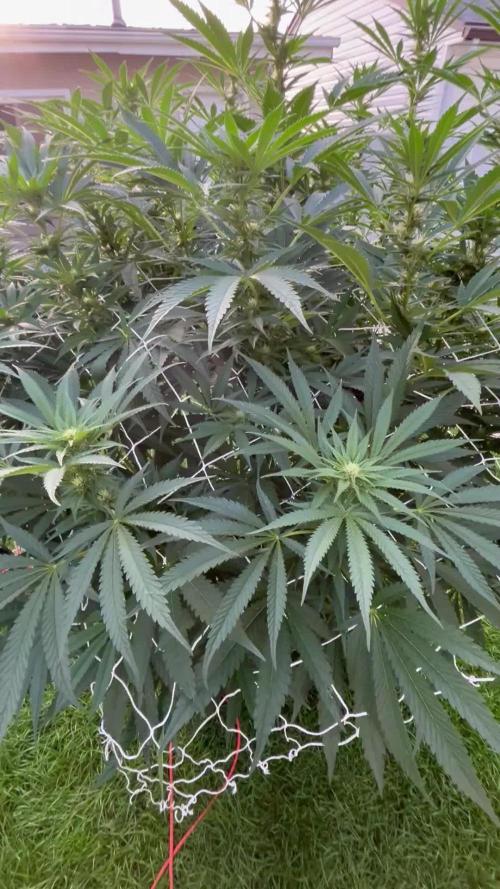
Sorry for late upload this is closer to end of week 5 beginning of week 6. Theyre huge. Both have grown and doubled cola size and the smell is very pungent. Its like a dookie, lime pepper smell and the bigger plant is very sticky. I see some color changing in leaves to like a rusty orange. I've raised lights to the max I can lift them on the provided hooks. I've been adding sturdy stalk and cal mag past few water cycles to add to ppm and they love it.
Likes
74
Share
@AsNoriu
Follow
Day 64. All is good, but .. Had some pH issues, that results in some leaves... Recalibrated meter. Have thrips again !!!! So bought 25000 Amblyseius swirskii. Should be done deal in a week !!! One fan broke, while installing new one, broke nice cola .... Think it was Orange. RealGorillaSeeds - Whitey Freeze Auto is the strain to quickly top up stash, I chop both of them this week. Doubt I'll push them more. Last Lemonade OG is flowering !!! But this grow is so over all time, some strains will be smoked, while others will finish ;))) Happy Growing !!!
Processing
Likes
Comments
Share
So basically for some reason I wasn't able to add my next week which caused me to start this "duplicate first grow diary". Then I decided trying to split my diary into four separate ones to better catalogue my grow, and I'm just having a lot of issues getting everything straight. SO! I decided to continue posting full scope pictures of the whole setup, all four plant sets included. Will try to update more on everything tomorrow!
Likes
31
Share
Hello growers and tokers! 👋 👩‍🌾 🧑‍🌾.🔥💨 As you can see these ladies are growing nicely. They're both at the same height 59cm but one is wider than the other. Quite nice so far. That's 12cm in one week same as the Royal Gorilla. Evenly spread canopy, the one that had better shape from the start now has longer colas. Both are stacking nodes nice and tight. They have a nice green color to them but you can't really appreciate that in the pictures. I'm still trying to get a hand of this new phone, I might just go back to the camera. 🤔 Starting to get a little shine to them, I think this strain will be the first in forming trichomes. They give off a nice smell but I can't put my finger on it yet. Feeding 1,5L each, every other day. Will be increasing as they ask for more. How do they ask for more? When feeding if the soil is drier than normal I give a 150-200ml increment of water. I do that until they stop feeding so much then i just maintain that amount. I start reducing if it takes longer to dry. That works good for me. The old finger in the dirt trick. 👍 Nothing like knowing exactly what your ladies need first hand. **Info and pictures were taken at day 12 of flower.** Hope you enjoyed this week's update. Stay tuned for next week. 😃 If you like this check out the other diaries of the strains in the tent. 😄 Take care and stay safe! One love!✌️🏽
Likes
233
Share
🐶 🐕 🐶 🐕 🐶 🐕 🐶 🐕 🐶 So this diary is dedicated to my Big Boy Midnite 🐶 Due to his age and trouble with his hips , he needs a little help so I will be making him special CBD and CBG Treats .... So keep in mind that I will be doing a Bubble Hash Water Extraction with the SDR and CBG once that's done and dried I will be Decarbing it by then placing it on a sheet of parchment paper and placing in over at 220 degrees F for 20 to 25 min to fully decarb it . Get ready for a paw-some treat that your furry friend will go nuts for! These peanut butter CBD or CBG treats are made with wholesome ingredients like flour, rolled oats, and natural peanut butter. Perfect for a special treat or a relaxing snack, your pet will love these bite-sized delights! Ingredients: • 2 cups of flour • 1 cup of rolled oats • 1/2 cup of natural peanut butter • 1/4 cup of water or beef and or chicken broth • 2 teaspoons of decarbed CBD or CBG Instructions: • Preheat your oven to 350°F. • In a large mixing bowl, mix together the flour, rolled oats, and natural peanut butter. • Add in the water and or broth and the CBD or CBG, and continue to mix until well combined. • Roll out the mixture to about 1/2 to 5/8 inch thickness on a lightly floured surface. • Cut the mixture into bite-sized treats using a cookie cutter. • Place the treats on a baking sheet lined with parchment paper. • Bake for 20 minutes, or until lightly golden brown. Allow the treats to cool completely before serving to your pet. Who says bacon is just for humans? These CBD or CBG treats are made with a yummy mix of flour, rolled oats, and cooked bacon. Your pet will love the taste and the benefits of CBD or CBG in each bite. Ingredients: • 2 cups of flour • 1 cup of rolled oats • 1/2 cup of cooked bacon • 1/4 cup of water or Chicken and Beef Broth • 2 teaspoons of decarbed CBD or CBG  Instructions: • Preheat your oven to 350°F. • In a large mixing bowl, mix together the flour, rolled oats, and cooked bacon be sure to grind up the bacon. • Add in the water and or broth as well as the CBD or CBG, and continue to mix until well combined. • Roll out the mixture to about 1/2 or 5/8 inch thickness on a lightly floured surface. • Cut the mixture into bite-sized treats using a cookie cutter. • Place the treats on a baking sheet lined with parchment paper. • Bake for 20 minutes, or until lightly golden brown. Allow the treats to cool completely before serving to your pet. Happy Growing And Happy Smoking and for all the Puppies out there Happy Snacking 😊 Side Note , I will be adding future pictures and video of the process of making the cookies as well as letting everyone know how it helped Midnite 🐶 Plus I will also give it a go and give my thoughts on the terps and the effects ... 👉Soil Provided by ProMix.ca 👉Nutrients Provided by Agrogardens 👉Lighting Provided by MarsHydro.ca 👉Seeds Provided by Kannabia Seeds ...
Processing
Likes
13
Share
This plant has a solid stench of pure ripe lemons. So much aroma and color in every bud, purples, to dark green, to lime green, to solid frost. This one definitely a fun strain to watch grow and tend too for the last few months. She’s definitely a hungry girl, seemed to be the only strain out of the three that accepted and thrived with full feed nutrients. Would definitely recommend this Strain to someone For a nice uplifting day smoke, also seems to do me good for some pain and stress relief.
Likes
25
Share
ANTHOCYANIN production is primarily controlled by the Cryptochrome (CR1) Photoreceptor ( !! UV and Blue Spectrums are primary drivers in the production of the pigment that replaces chlorophyll, isn't that awesome! 1. Diverse photoreceptors in plants Many civilizations, including the sun god of ancient Egypt, thought that the blessings of sunlight were the source of life. In fact, the survival of all life, including humans, is supported by the photosynthesis of plants that capture solar energy. Plants that perform photosynthesis have no means of transportation except for some algae. Therefore, it is necessary to monitor various changes in the external environment and respond appropriately to the place to survive. Among various environmental information, light is especially important information for plants that perform photosynthesis. In the process of evolution, plants acquired phytochrome, which mainly receives light in the red light region, and multiple blue light receptors, including his hytropin and phototropin, in order to sense the light environment. .. In addition to these, an ultraviolet light receptor named UVR8 was recently discovered. The latest image of the molecular structure and function of these various plant photoreceptors (Fig. 1), focusing on phytochrome and phototropin. Figure 1 Ultraviolet-visible absorption spectra of phytochrome, cryptochrome, phototropin, and UVR8. The dashed line represents each bioactive absorption spectrum. 2. Phytochrome; red-far red photoreversible molecular switch What is phytochrome? Phytochrome is a photochromic photoreceptor, and has two absorption types, a red light absorption type Pr (absorption maximum wavelength of about 665 nm) and a far-red light absorption type Pfr (730 nm). Reversible light conversion between the two by red light and far-red light, respectively(Fig. 1A, solid line and broken line). In general, Pfr is the active form that causes a physiological response. With some exceptions, phytochrome can be said to function as a photoreversible molecular switch. The background of the discovery is as follows. There are some types of plants that require light for germination (light seed germination). From that study, it was found that germination was induced by red light, the effect was inhibited by subsequent far-red light irradiation, and this could be repeated, and the existence of photoreceptors that reversibly photoconvert was predicted. In 1959, its existence was confirmed by the absorption spectrum measurement of the yellow sprout tissue, and it was named phytochrome. Why does the plant have a sensor to distinguish between such red light and far-red light? There is no big difference between the red and far-red light regions in the open-field spectrum of sunlight, but the proportion of red light is greatly reduced due to the absorption of chloroplasts in the shade of plants. Similar changes in light quality occur in the evening sunlight. Plants perceive this difference in light quality as the ratio of Pr and Pfr, recognize the light environment, and respond to it. Subsequent studies have revealed that it is responsible for various photomorphogenic reactions such as photoperiodic flowering induction, shade repellent, and deyellowing (greening). Furthermore, with the introduction of the model plant Arabidopsis thaliana (At) and the development of molecular biological analysis methods, research has progressed dramatically, and his five types of phytochromes (phyA-E) are present in Arabidopsis thaliana. all right. With the progress of the genome project, Fi’s tochrome-like photoreceptors were found in cyanobacteria, a photosynthetic prokaryotes other than plants. Furthermore, in non-photosynthetic bacteria, a homologue molecule called bacteriophytochrome photoreceptor (BphP) was found in Pseudomonas aeruginosa (Pa) and radiation-resistant bacteria (Deinococcus radiodurans, Dr). Domain structure of phytochrome molecule Phytochrome molecule can be roughly divided into N-terminal side and C-terminal side region. PAS (Per / Arndt / Sim: blue), GAF (cGMP phosphodiesterase / adenylyl cyclase / FhlA: green), PHY (phyto-chrome: purple) 3 in the N-terminal region of plant phytochrome (Fig. 2A) There are two domains and an N-terminal extension region (NTE: dark blue), and phytochromobilin (PΦB), which is one of the ring-opening tetrapyrroles, is thioether-bonded to the system stored in GAF as a chromophore. ing. PAS is a domain involved in the interaction between signal transduction-related proteins, and PHY is a phytochrome-specific domain. There are two PASs and her histidine kinase-related (HKR) domain (red) in the C-terminal region, but the histidine essential for kinase activity is not conserved. 3. Phototropin; photosynthetic efficiency optimized blue light receptor What is phototropin? Charles Darwin, who is famous for his theory of evolution, wrote in his book “The power of move-ment in plants” published in 1882 that plants bend toward blue light. Approximately 100 years later, the protein nph1 (nonphoto-tropic hypocotyl 1) encoded by one of the causative genes of Arabidopsis mutants causing phototropic abnormalities was identified as a blue photoreceptor. Later, another isotype npl1 was found and renamed phototropin 1 (phot1) and 2 (phot2), respectively. In addition to phototropism, phototropin is damaged by chloroplast photolocalization (chloroplasts move through the epidermal cells of the leaves and gather on the cell surface under appropriate light intensity for photosynthesis. As a photoreceptor for reactions such as escaping to the side of cells under dangerous strong light) and stomata (reactions that open stomata to optimize the uptake of carbon dioxide, which is the rate-determining process of photosynthetic reactions). It became clear that it worked. In this way, phototropin can be said to be a blue light receptor responsible for optimizing photosynthetic efficiency. Domain structure and LOV photoreaction of phototropin molecule Phototropin molecule has two photoreceptive domains (LOV1 and LOV2) called LOV (Light-Oxygen-Voltage sensing) on the N-terminal side, and serine / on the C-terminal side. It is a protein kinase that forms threonine kinase (STK) (Fig. 4Aa) and whose activity is regulated by light. LOV is one molecule as a chromophore, he binds FMN (flavin mononucleotide) non-covalently. The LOV forms an α/βfold, and the FMN is located on a β-sheet consisting of five antiparallel β-strands (Fig. 4B). The FMN in the ground state LOV shows the absorption spectrum of a typical oxidized flavin protein with a triplet oscillation structure and an absorption maximum wavelength of 450 nm, and is called D450 (Fig. 1C and Fig. 4E). After being excited to the singlet excited state by blue light, the FMN shifts to the triplet excited state (L660t *) due to intersystem crossing, and then the C4 (Fig. 4C) of the isoaroxazine ring of the FMN is conserved in the vicinity. It forms a transient accretionary prism with the tain (red part in Fig. 4B Eα) (S390I). When this cysteine is replaced with alanine (C / A substitution), the addition reaction does not occur. The effect of adduct formation propagates to the protein moiety, causing kinase activation (S390II). After that, the formed cysteine-flavin adduct spontaneously dissociates and returns to the original D450 (Fig. 4E, dark regression reaction). Phototropin kinase activity control mechanism by LOV2 Why does phototropin have two LOVs? Atphot1 was found as a protein that is rapidly autophosphorylated when irradiated with blue light. The effect of the above C / A substitution on this self-phosphorylation reaction and phototropism was investigated, and LOV2 is the main photomolecular switch in both self-phosphorylation and phototropism. It turns out that it functions as. After that, from experiments using artificial substrates, STK has a constitutive activity, LOV2 functions as an inhibitory domain of this activity, and the inhibition is eliminated by photoreaction, while LOV1 is kinase light. It was shown to modify the photosensitivity of the activation reaction. In addition to this, LOV1 was found to act as a dimerization site from the crystal structure and his SAXS. What kind of molecular mechanism does LOV2 use to photoregulate kinase activity? The following two modules play important roles in this intramolecular signal transduction. Figure 4 (A) Domain structure of LOV photoreceptors. a: Phototropin b: Neochrome c: FKF1 family protein d: Aureochrome (B) Crystal structure of auto barley phot1 LOV2. (C) Structure of FMN isoaroxazine ring. (D) Schematic diagram of the functional domain and module of Arabidopsis thaliana phot1. L, A’α, and Jα represent linker, A’α helix, and Jα helix, respectively. (E) LOV photoreaction. (F) Molecular structure model (mesh) of the LOV2-STK sample (black line) containing A’α of phot2 obtained based on SAXS under dark (top) and under bright (bottom). The yellow, red, and green space-filled models represent the crystal structures of LOV2-Jα, protein kinase A N-lobe, and C-robe, respectively, and black represents FMN. See the text for details. 1) Jα. LOV2 C of oat phot1-to α immediately after the terminus Rix (Jα) is present (Fig. 4D), which interacts with the β-sheet (Fig. 4B) that forms the FMN-bound scaffold of LOV2 in the dark, but unfolds and dissociates from the β-sheet with photoreaction. It was shown by NMR that it does. According to the crystal structure of LOV2-Jα, this Jα is located on the back surface of the β sheet and mainly has a hydrophobic interaction. The formation of S390II causes twisting of the isoaroxazine ring and protonation of N5 (Fig. 4C). As a result, the glutamine side chain present on his Iβ strand (Fig. 4B) in the β-sheet rotates to form a hydrogen bond with this protonated N5. Jα interacts with this his Iβ strand, and these changes are thought to cause the unfold-ing of Jα and dissociation from the β-sheet described above. Experiments such as amino acid substitution of Iβ strands revealed that kinases exhibit constitutive activity when this interaction is eliminated, and that Jα plays an important role in photoactivation of kinases. 2) A’α / Aβ gap. Recently, several results have been reported showing the involvement of amino acids near the A’α helix (Fig. 4D) located upstream of the N-terminal of LOV2 in kinase photoactivation. Therefore, he investigated the role of this A’α and its neighboring amino acids in kinase photoactivation, photoreaction, and Jα structural change for Atphot1. The LOV2-STK polypeptide (Fig. 4D, underlined in black) was used as a photocontrollable kinase for kinase activity analysis. As a result, it was found that the photoactivation of the kinase was abolished when amino acid substitution was introduced into the A’α / Aβ gap between A’α and Aβ of the LOV2 core. Interestingly, he had no effect on the structural changes in Jα examined on the peptide map due to the photoreaction of LOV2 or trypsin degradation. Therefore, the A’α / Aβ gap is considered to play an important role in intramolecular signal transduction after Jα. Structural changes detected by SAXS Structural changes of Jα have been detected by various biophysical methods other than NMR, but structural information on samples including up to STK is reported only by his results to his SAXS. Not. The SAXS measurement of the Atphot2 LOV2-STK polypeptide showed that the radius of inertia increased from 32.4 Å to 34.8 Å, and the molecular model (Fig. 4F) obtained by the ab initio modeling software GASBOR is that of LOV2 and STK. It was shown that the N lobes and C lobes lined up in tandem, and the relative position of LOV2 with respect to STK shifted by about 13 Å under light irradiation. The difference in the molecular model between the two is considered to reflect the structural changes that occur in the Jα and A’α / Aβ gaps mentioned above. Two phototropins with different photosensitivity In the phototropic reaction of Arabidopsis Arabidopsis, Arabidopsis responds to a very wide range of light intensities from 10–4 to 102 μmol photon / sec / m2. At that time, phot1 functions as an optical sensor in a wide range from low light to strong light, while phot2 reacts with light stronger than 1 μmol photon / sec / m2. What is the origin of these differences? As is well known, animal photoreceptors have a high photosensitivity due to the abundance of rhodopsin and the presence of biochemical amplification mechanisms. The exact abundance of phot1 and phot2 in vivo is unknown, but interesting results have been obtained in terms of amplification. The light intensity dependence of the photoactivation of the LOV2-STK polypeptide used in the above kinase analysis was investigated. It was found that phot1 was about 10 times more photosensitive than phot2. On the other hand, when the photochemical reactions of both were examined, it was found that the rate of the dark return reaction of phot1 was about 10 times slower than that of phot2. This result indicates that the longer the lifetime of S390II, which is in the kinase-activated state, the higher the photosensitivity of kinase activation. This correlation was further confirmed by extending the lifespan of her S390II with amino acid substitutions. This alone cannot explain the widespread differences in photosensitivity between phot1 and phot2, but it may explain some of them. Furthermore, it is necessary to investigate in detail protein modifications such as phosphorylation and the effects of phot interacting factors on photosensitivity. Other LOV photoreceptors Among fern plants and green algae, phytochrome ɾphotosensory module (PSM) on the N-terminal side and chimera photoreceptor with full-length phototropin on the C-terminal side, neochrome (Fig. There are types with 4Ab). It has been reported that some neochromes play a role in chloroplast photolocalization as a red light receiver. It is considered that fern plants have such a chimera photoreceptor in order to survive in a habitat such as undergrowth in a jungle where only red light reaches. In addition to this, plants have only one LOV domain, and three proteins involved in the degradation of photomorphogenesis-related proteins, FKF1 (Flavin-binding, Kelch repeat, F-box 1, ZTL (ZEITLUPE)), LKP2 ( There are LOV Kelch Protein2) (Fig. 4Ac) and aureochrome (Fig. 4Ad), which has a bZip domain on the N-terminal side of LOV and functions as a gene transcription factor. 4. Cryptochrome and UVR8 Cryptochrome is one of the blue photoreceptors and forms a superfamily with the DNA photoreceptor photolyase. It has FAD (flavin adenine dinucle-otide) as a chromophore and tetrahydrofolic acid, which is a condensing pigment. The ground state of FAD is considered to be the oxidized type, and the radical type (broken line in Fig. 1B) generated by blue light irradiation is considered to be the signaling state. The radical type also absorbs in the green to orange light region, and may widen the wavelength region of the plant morphogenesis reaction spectrum. Cryptochrome uses blue light to control physiological functions similar to phytochrome. It was identified as a photoreceptor from one of the causative genes of UVR8 Arabidopsis thaliana, and the chromophore is absorbed in the UVB region by a Trp triad consisting of three tryptophans (Fig. 1D). It is involved in the biosynthesis of flavonoids and anthocyanins that function as UV scavengers in plants. Conclusion It is thought that plants have acquired various photoreceptors necessary for their survival during a long evolutionary process. The photoreceptors that cover the existing far-red light to UVB mentioned here are considered to be some of them. More and more diverse photoreceptor genes are conserved in cyanobacteria and marine plankton. By examining these, it is thought that the understanding of plant photoreceptors will be further deepened.
Likes
124
Share
Hello growmies, we made it, here's the weed, woohoooo! 🍪 💜 Loved this grow, there were no issues whatsoever! ✌️ Thanks @Green_Buzz_Nutrients for sponsoring my grow, those products really do their job! 💚 If you want to give them a try, there's a generous discount code in my setup description. ⬇️ Thanks @SensiSeeds for the opportunity, let's do this!! 🚀 💚 🖤 _______________________________________________________________________________________ Purple Cookie Kush Feminized Seeds [Girl Scout Cookies x Purple Kush] Purple Cookie Kush Feminized seeds come from two well-known strains, Girl Scout Cookies and Purple Kush. The 60% indica / 40% sativa heritage leads to a well-balanced hybrid flower. Flavours range from grapes to sandalwood, and the terpene profile is a concoction of many complimentary aromas. Purple Cookie Kush Feminized is a short plant with good yields. Bud formation is dense, similar to many Kush strains. About Purple Cookie Kush Feminized Purple Cookie Kush Feminized takes the hottest GSC genetics and mashes them with a Purple Kush cultivar that was hand chosen for this project. No corners were cut in creating and selecting the right breeding stock for this fantastic strain. The result is a well-balanced hybrid that retains key qualities from its lineage. The Purple Kush parent of Purple Cookie Kush Feminized has a lot to contribute, as evidenced by the plant morphology. The compact nature and sturdy branching can be attributed to those indica-dominant genetics. Another area that the indica influence is evident is in the terpene profile, which includes scents of spicy hashish and earthiness. GSC contributes selected indica traits to Purple Cookie Kush Feminized, but the sativa side of the genes also had an impact. Complex, fruity expressions are detectable in both the mouth and nose of this strain. Before harvesting, during the last few weeks of flowering, growers will notice pleasant scents with floral notes lingering in the garden area. Growth pattern of Purple Cookie Kush Feminized Purple Cookie Kush Feminized seeds grow into a plant that represents in appearance both sativa and indica inheritance. Because this is a feminized strain, growers will not need to sex the plants at the early stages of flower and can accurately anticipate yields knowing that all plants will be flower-producing. Purple Cookie Kush Feminized has sturdy branches, similar to its GSC parent. The strong branches can support the weight of flower growth through harvest. The plant itself is stocky with a compact stature. This is attributed more to the Purple Kush influence. Due to the lower profile and many branches, defoliation is beneficial at various stages of growth. Indoor growers with a controlled climate report final heights in the 120 - 140 cm range. Purple Cookie Kush Feminized finishes flowering in a quick 50-60 day window, which is a distinctly indica quality. Outdoor growers in temperate / Mediterranean climates have seen plants reach over 160 cm with ideal weather. The bud formation of Purple Cookie Kush Feminized is similar to the popular Kush structure. Flowers are dense and compact. The buds are a mixture of swollen, trichome-covered bracts with dark forest-green foliage below. During the last weeks of flowering, the GSC influence adds purple hues to the vegetation. Purple Cookie Kush Feminized is a solid-performing, easy-to-maintain plant with good yields. It is not difficult to achieve the optimal indoor climate, and yields of 425 - 475 grams per m² are possible in these conditions. The ideal outdoor environment will have moderately warm weather and a small percentage of rain within the growing season. Growers in those regions have reported yields reaching 550 grams per plant, sometimes even more! Common plant training techniques are not crucial to the success of this robust, sturdy plant, but some growers looking to maximize yields will use them. Techniques that have been used with great success in canopy control include SOG, SCROG, Supercropping, and Lollipopping. Purple Cookie Kush Feminized handles them all without skipping a beat. Effects, taste and smell of Purple Cookie Kush Feminized The effects of Purple Cookie Kush Feminized usher in a more relaxed and easy-going day than most. It has the benefit of merging both indica and sativa attributes. Euphoric and uplifting effects are associated with sativa cultivars, and these effects are precisely how the Purple Cookie Kush Feminized experience begins. Blissfully distracted from the fast-paced world, thoughts shift to creative endeavours and inspirational goals. As these feelings are front and centre, a mild buzz begins radiating from the inner core. Soon, the indica-leaning effects are felt. Effects turn towards the loosening of tense muscles, the easing of minor aches, and an embracing full-body stone. The flavour profile of Purple Cookie Kush Feminized is almost like a full-course meal. The pairing of flavours is unique and somehow works perfectly. The taste of fresh peeled grapes sits well with the coffee and caramel elements. The indica genetics once again show their dominance with undertones of earthiness and spicy sandalwood to complete the flavour profile. Purple Cookie Kush Feminized has an unmistakably loud grape smell. This trait is not commonly seen in cannabis, but it is fully displayed with this strain. The remainder of the terpene profile is what many would consider the finer aromatic qualities of the GSC strain. Scents of spicy hashish float through the air, complementing the grape aroma whenever the jar is opened. Background notes of earth and sandalwood add another enjoyable layer to the terpene profile. https://sensiseeds.com/en/research/purple-cookie-kush-feminized?sqr=purple%20cookie _______________________________________________________________________________________ Setup: 140x70x200 cm Spiderfarmer tent 2x Monkey 16W fans (not oscillating) 1x Secret Jardin 30W 1x box fan 50W oscillating (on lowest level) LED Full Spectrum 320W AGLEX AGL-320W-MA 5,6 kg foldable, dimmable 864 pieces Samsung LH301H 864umol/s 2,7umol/J full spectrum white + RED 660nm + IR 740nm wavelength range 380-780nm covering 3x4ft Green Buzz Nutrients https://greenbuzzliquids.com/ ❗ Use code GD42025 for generous 25% discount (for orders of minimum 75€) Biobizz Lightmix + coco + wormcastings + perlite Carbon Active Granulate Filter 125/360 cm³/h PrimaKlima exhaust EC 125-400/240 cm³/h
Likes
36
Share
Hey everyone :-). This will only be a short initial update 👍. Today the seed was placed between two fruit cloths and placed in a dark place. I suspect the seed will be ready to be planted in the next 3-5 days :-). The diary starts next week with the planting of the seed :-). I'm really looking forward to the start and until then I wish you all the best 👍. Stay healthy and let it grow 🍀🙏🏻 You can buy this Strain at : https://originalsensible.com/original-sensible-seeds-zkittlez~20503 Type: Zkittlez ☝️🏼 Genetics: Afghan Kush Indica x Grandaddy Purple x Grapefruit hybrid 👍 Vega lamp: 2 x Todogrow Led Quantum Board 100 W 💡 Bloom Lamp : 2 x Todogrow Led Cxb 3590 COB 3500 K 205W 💡💡☝️🏼 Soil : Canna Coco Professional + ☝️🏼 Fertilizer: Green House Powder Feeding ☝️🏼🌱 Water: Osmosis water mixed with normal water (24 hours stale that the chlorine evaporates) to 0.2 EC. Add Cal / Mag to 0.4 Ec Ph with Organic Ph - to 5.5 - 5.8 .
Likes
6
Share
¡Primera semana y seguimos con buena positividad! Las plántulas ya empiezan a crecer y a abrirse, se ven fuertes y ojalá sigan así. Todavía están dentro del propagador para mantener una buena humedad, ya que en esta etapa las raíces apenas están formándose. La mayor parte del agua la absorben por las hojas, así que no se necesita tanto riego, sino más bien mantener alta la humedad en estas primeras semanas.
Likes
72
Share
@BodyByVio
Follow
Day 65 : officially 1st day of flush . Changed the reservoir with fresh water and 1.2g/5 gallons of Yucca extract and 5ml/gallon of Cleanex from Botanicare . Day 68- I did some defoliate. Few more days until harvest.
Likes
5
Share
Signs of flower is becoming more noticeable on mental rainbow F1 have noticed more bud site development and more clusters of stigmas on the tops of main side branches as well as other setts of smaller side branches streaching upwards
Likes
89
Share
@Gunnen
Follow
So another week and some more thickening and ripening. The smell is like blueberry on one and the others are sweet as well. Slightly different smell to each. Watering when dry still at pH 6-6.6 and monitoring overall plant trichomes. At this point it's autopilot to the end. No more feeding with slow release and will slowly flush the remaining food out next few weeks. I like my trichomes to have some amber, not too much but mostly cloudy with some amber. Seems like most will be dense, except one plant I've called corona virus. It has smaller buds but are really resinous and smelly. Cheers and happy growing!
Likes
9
Share
@Mr_Maes
Follow
This is one of my favorite strains. For sure one that i will always have in my own personal seed bank.
Likes
75
Share
Week 6: Nurturing the Monstrous Beauty of Panty Punch Auto As we embark on Week 6 of our cultivation journey with Panty Punch Auto, it's time to reflect on the remarkable evolution of this botanical marvel, from a tiny seed to the towering giant adorned with lush foliage and bountiful buds. In this report, we delve deep into the intricate fixings, sticks, and bendings that have shaped her growth, alongside an exploration of the revolutionary TrolMaster technology, with a special focus on the unveiling of the Tent-X controller. From the earliest days of her life, Panty Punch Auto has been a testament to resilience and determination. Through meticulous care and strategic interventions, we've guided her growth, ensuring she thrives in our grow space. Fixings sticks have been instrumental in supporting her weighty branches, while gentle bendings have encouraged optimal light exposure and airflow, resulting in a robust plant with an abundance of branches and buds. At the heart of our environmental control strategy lies the TrolMaster system, a game-changer in precision cultivation. This week, we're thrilled to introduce the Tent-X controller, a cutting-edge addition to our arsenal of tools. In an unboxing video, we'll unveil the Tent-X controller and explore its myriad features, including its integration with the Lumatek Zeus using the LMA-14 interface. The Tent-X controller represents a paradigm shift in grow environment management, offering unparalleled control and flexibility. With its advanced capabilities, we can fine-tune every aspect of our grow space, from temperature and humidity to lighting schedules and CO2 levels. The LMA-14 interface acts as a bridge between the Tent-X controller and the Lumatek Zeus, enabling seamless communication and synchronization for optimal plant growth and development. But the innovation doesn't stop there. The Tent-X controller comes equipped with a 3-in-1 sensor, providing real-time monitoring of temperature, humidity, and light intensity. This invaluable tool allows us to maintain the ideal growing conditions for Panty Punch Auto, ensuring she thrives in her environment. As we marvel at the extraordinary progress of Panty Punch Auto, it's essential to express our gratitude to those who have made this journey possible. A heartfelt thank you to TrolMaster for providing the revolutionary Tent-X controller, to Aptus Holland for their unwavering support and exceptional nutrients, to Grow Diaries for the platform that connects us with fellow growers, and to the vibrant community for their endless encouragement and inspiration. In conclusion, Week 6 marks another milestone in the cultivation of Panty Punch Auto, a testament to the power of innovation, dedication, and community. As we continue to nurture her growth, let us anticipate the wonders yet to come and celebrate the beauty of this monstrous plant. Stay tuned for more updates as we witness the ongoing evolution of Panty Punch Auto and explore the boundless possibilities of modern cultivation techniques. Together, we'll continue to push the boundaries of what's possible and cultivate excellence in every leaf and bud. #PantyPunchAutoAdventure #RootsAndFruits #TrolMasterControl #GrowDiariesCommunity #CultivationExcellence Genetics - Panty Punch Auto - https://seedstockers.com/ Plant nutrition - Aptus Holland - https://aptus-holland.com LED Photons - Lumatek - https://lumatek-lighting.com Controls - Trol Master - https://www.trolmaster.eu/ Watering - myself Love and attention - Me, myself and i As always thank you all for stopping by, for the love and for it all , this journey of mine wold just not be the same without you guys, the love and support is very much appreciated and i fell honored and blessed with you all in my life, With true love comes happiness. Always believe in your self and always do things expecting nothing and with an open heart , be a giver and the universe will give back to you in ways you could not even imagine so More info, the ocasional give-away and exclusive updates from all my adventures can be found - links in the profile description Friendly reminder all you see here is pure research and for educational purposes only Growers Love To you All 💚 💚 💚
Processing
Likes
3
Share
@999cows
Follow
Had some ph issues which resulted in some yellowing of the leaves also started low stress training ! Investing in a Ppm meter this week
Likes
7
Share
Week 4 - Sometimes You Got To Lose To Gain Phase 2 - I took off the fan leaves so that the plant would redirect its energy into the stem and branches rather than the leaves. I also cut of the top heads so that the energy would go into the development of the 2 heads below.
Processing
Likes
8
Share
Nothing to start. No real attention needed yet
Likes
19
Share
@Mattyice
Follow
This is my first grow. I just started super duper light nutes. Like 4 ml per half gallon. Cal mag and grow big. Upgrading light tomorrow. Can't wait especially with the progress I've made with approx 215 watts of less. Upgrading to 1200W. Update: i got my light. Viparspectra 1200w