


Likes
Comments
Share


@Earthsower
Follow
She looks much better than a few weeks ago as she suffered too much of a drought but she is steady recovering. The double kush cake continues to grow with short nodal spacing. She is receiving around 500 ml of water every other day, stands at 25cm from the soi

Likes
8
Share

@Chubbs
Follow
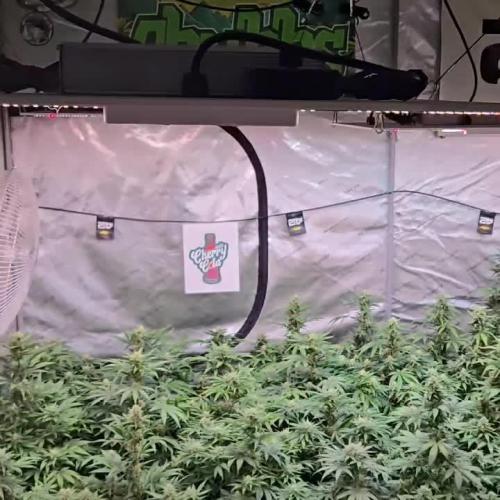
Weekly update on this amazing strain. They're getting close to being finished. I'll get into the tent today and double check some trichs. All in all Happy Growing

Likes
10
Share

@Ruthlez
Follow
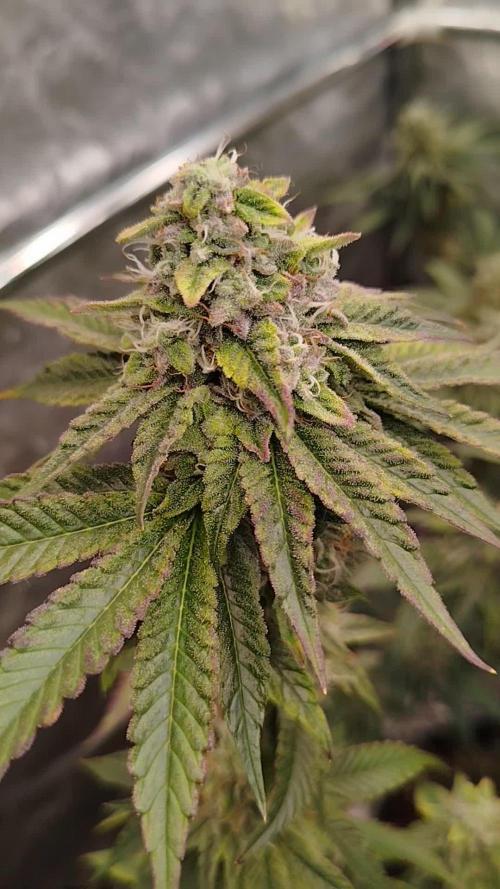
Start der Blütewoche 6 🌱
Diese Woche gibt es nicht viel zu berichten.
Alle 4 Pflanzen legen ordentlich an Masse zu und werden von Tag zu Tag Giftiger 🤩
Auf der Geruch hat extrem zugenommen.
Ich musste bei jeder Pflanze die zu Äste zusätzlich am Hauptstamm fixieren, da das Gewicht der Knollen ordentlich nach unten drückt.
Diese Woche bekommen sie noch Nährstoffe nach Plan, ab nächster Woche beginnt der flush.
Likes
15
Share


@crystal_garden_0
Follow
Great week. Plants are ready to be harvested. Really nice plant . Great smell nice structure. Very frosty , really sticky very dense buds. Fast strain to grow, very enjoyable. Thanks everyone
Processing
Likes
15
Share


@AK1210
Follow
The tricombe production on this strain is ridiculous! It looks amazing under my microscope. The heads are mostly milky coloured so this may be finishing sooner than expected.
The space in the tent is getting a bit tight so I'll be glad to have more room when this lady has done her thing.
Likes
11
Share


@Greenfingers666
Follow
Into week two all cuttings have taken 8 have been topped, spacers have been deployed to train branches 3cm spacers I will increase the size of spacers once the branches develop a little more.
about every 3 days Is required depending on how the strain performs.
this is a more creative method of growing with the final picture of your media in mind {peecock effect}.
once the media has starched I will snap on the spacers to create the scrog for a level canopy, holding the outer plants left and right further out to the left and right for more light exposure to develop my flowers to there full potential.
middle of week 2 I put the spacers together to make the scrog mainly two train the left and right rows of plants outwards for more space in the middle of my canopy.


Processing
Likes
13
Share


@GrowGuy97
Follow
Got everything moved around & the new carbon filter, fans & lights so hopefully I got better coverage with less power👍🏼 Topped 1 of the Gelato OGs today was getting way taller than the rest we will see how she bounces back! Everything else seems to be going great!
Day 22 topped & trimmed them up a bit
Day 23 started LST on a few
Day 24 started mainline on one of the GZ
Day 25 trimmed them a little more today


Likes
19
Share


@The_Lonely_Farmer
Follow
Hey growers I hope your all well ✌️
SHOULD I FLIP???
These girls are nearly 50cm and the one girl is around 35cm, I'm going too continue veg for 1-2 weeks longer and scrog in the meantime too gold back the 2 taller girl.
These girls are plodding into week 7 now so they are ready too flip but will see how my grow question goes before switching too 12/12 👌
They are happy and healthy and doing well under the shogun nutrients!
I have defoliate the odd top fan leaf too allow better air circulation.
We have very high heat atm but hopefully they uptake more 😉😅
Happy growing 🌱💚
Likes
15
Share


@Taskot_Joe
Follow
The stretch is definitely in effect! The pistols are pistoling and the bud sites are popping up and flourishing with the help of a bit of lst, All signs are looking good to a successful grow / yield hopefully, Not drinking as much as I thought she would but I’m sure that’ll come, Root ball size is starting to fill out the fabric pot, Week by week now 🤤😴🤤
Likes
17
Share

@Chubbs
Follow
What up fam, weekly update on these lovely ladies. They're getting close to being finished so I'd say where in the home stretch. The flowers are swelling amazing and definitely smelling even better. All in all its been HappyGrowing.
Likes
4
Share

@CheeRz
Follow
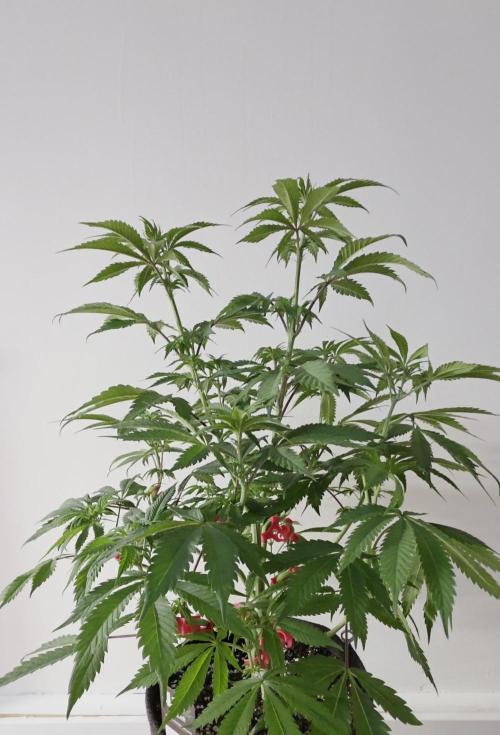
The ladies are doing great and growing well. I'm really happy with the progress so far. They have now reached 60 cm. I plan to install the Scrog net within the next few days to allow them to grow wider.
Likes
7
Share


@LACREME
Follow
Primeira semana de planta, por enquanto um broto.
Germinei no papel toalha + ziplock, e depois passei para o cultilene.
Assim que a raíz cresceu, como mostra no vídeo, passei para o Kokostec.
Na primeira rega utilizei ppm 340 e pH 6 e os produtos listados acima.
A ideia nesse ciclo é fazer um cultivo em coco, misturando a linha FloraSeries da GH com ferts KNF caseiros.
Qualquer critica e/ou sugestão, fico a disposição. Siga-me no Instagram, @LACREME710
Likes
6
Share

@DogDoctorOfficial
Follow
💙 Project Blue Tent – Week 11
💙 Blue Waffle F1 – Pheno B
🌸 Same Room. Same Conditions. Another Beautiful Expression.
Hello everyone, and welcome back to another chapter inside Project Blue Tent! 💙🌱
And once again...
I'm looking at these girls and thinking:
How can four plants look this similar?
😂💙
If you've been following Project Blue Tent, you'll know that we're documenting four individual plants from seed to harvest, each with her own dedicated diary.
All four share the same tent.
The same lighting.
The same irrigation.
The same reservoir.
The same nutrition.
The same environmental conditions.
The same cultivation philosophy.
And yet...
each one gets her own chapter.
Today it's time to give the spotlight to Blue Waffle F1 – Pheno B.
And honestly?
She's looking absolutely beautiful.
🌿 PHENO B – LET HER SHINE
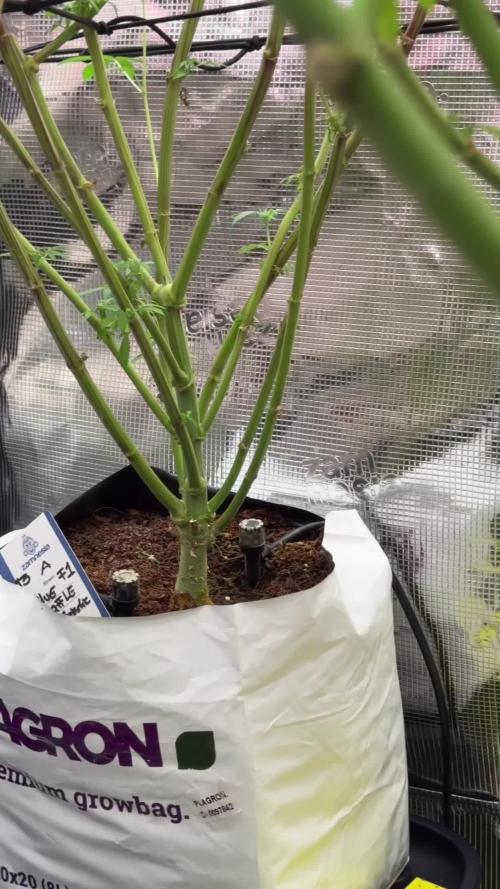
Pheno B has reached approximately 145 cm and has developed a fantastic flowering structure.
At this stage, there isn't really a lot I want to change.
And that's actually a good thing.
The big work has already been done.
The long vegetative period gave us the structure.
The topping and training shaped the plant.
The first SCROG organized the canopy.
The aggressive flowering stretch forced us to rethink the vertical space.
The major defoliation opened the plant.
The second SCROG gave the flowering branches additional support.
The ventilation system was moved outside the tent.
The LEDs were raised.
The airflow was improved.
And now...
we're watching all of those decisions come together.
The plant is doing exactly what we wanted her to do.
Grow.
Flower.
Develop.
And increasingly...
FROST.
😂💙🌸
🌸 THE FROST IS GETTING SERIOUS
I have to say this because the photographs really don't need much explanation.
The frost levels are beautiful.
The flowers are becoming increasingly covered in trichomes, and every week the close-up photographs seem to reveal more.
This is the part of the grow where you start looking at the plants differently.
Earlier, we were looking at structure.
Now we're looking at flowers.
And those flowers are beginning to tell us their own story.
The density.
The development.
The resin production.
The structure.
The way the flowers are forming along the branches.
Everything is becoming much more interesting.
And Pheno B is absolutely shining.
💙🌸
🌿 THE TOPPING AND STRUCTURE – LOOK AT THAT OPENING
Another thing I'm really happy with this week is the structure created by the topping and training.
When you look closely at Pheno B, you can really see how the plant opened up.
The main structure divided beautifully.
The branches spread through the available space.
And the flowering sites are now positioned throughout that structure rather than all trying to occupy the exact same vertical point.
This is one of those things that can be difficult to appreciate when you're doing the training weeks earlier.
At the time, you're making cuts.
Moving branches.
Supporting growth.
Trying to imagine what the plant will eventually become.
Then several weeks later...
you look at the flowering plant and suddenly understand why you did it.
And that's exactly what I'm seeing now.
The structure is there.
The opening is there.
The flowering sites are there.
And the plant is filling that framework beautifully.
🕸️ THE X-CROSS – KEEPING THE STRUCTURE WORKING
The support system is also doing exactly what we wanted.
The second SCROG remains in place, helping organize and support the upper flowering structure.
And with the way we've arranged the support through the canopy, we've created that X-cross structure that helps distribute and organize the flowering branches.
The idea isn't to keep forcing the plant into a new shape.
That stage is behind us.
Now the structure simply needs to support what the plant has already built.
And looking at Pheno B...
I'd say it's doing a damn good job.
😂💙
The branches are supported.
The flowers have room.
The canopy is organized.
And we can actually see through the plant.
That's exactly where I want to be at this stage.
💡 UNDER-CANOPY LIGHTING – NOW PART OF THE SYSTEM
The LumiFlora under-canopy lighting is also now fully integrated into the room.
We're using the 150W full-spectrum LumiFlora fixtures underneath the canopy to provide supplemental light to the lower flowering structure.
The main LEDs continue doing the primary work from above.
The LumiFlora units are simply giving the lower portions of these very tall plants another source of light.
And with plants reaching approximately 145 cm, this makes a lot of sense to me.
The canopy is no longer a flat surface.
It's a three-dimensional structure.
There are upper flowers.
Middle flowers.
Lower flowers.
Interior branches.
And naturally, not all of those areas receive the same amount of light from above.
So instead of constantly removing more foliage to chase light penetration...
we're experimenting with bringing light into the lower part of the plant.
And now?
We watch.
That's the fun part.
😂💡🌸
🌿 TWO LIGHT SOURCES. ONE VERY LARGE CANOPY.
The interesting thing about this setup is that we're effectively looking at the plant from both directions.
The main fixtures illuminate from above.
The LumiFlora fixtures supplement from below.
And the plant sits right between those two lighting environments.
I'm particularly interested in seeing how the lower flowering sites continue developing as we move deeper into flowering.
We're not making any promises about what the additional lighting will achieve.
We're documenting it.
We're watching.
We're comparing.
And we're letting the plants tell us what happens.
That's the whole point of Project Blue Tent.
🔬 SAME ROOM – SAME CONDITIONS – DIFFERENT DIARY
And this brings me to something I've been thinking about a lot during this project.
People often use the word "genetics" when talking about individual plants.
And obviously, genetics are involved in every plant.
But I personally like using the word:
"Cultivar."
Why?
Because we're looking at cultivated plant varieties.
We're not simply talking about an abstract collection of genes.
We're talking about plants that have been selected, developed and cultivated as a particular variety.
And here we're working with Blue Waffle F1 cultivars.
So throughout these diaries, when I talk about Pheno A, Pheno B and the other girls as individual cultivars, that's what I'm referring to.
And honestly...
the uniformity we're seeing makes this distinction particularly interesting.
Because look at them.
😂💙
Same environment.
Same reservoir.
Same feeding.
Same irrigation.
Same lighting.
Same training philosophy.
And yet we're getting remarkably similar expressions.
That's one of the things that makes these F1 plants so fascinating to observe.
And if you already know all of this...
beautiful.
You know.
😂
If you didn't...
hopefully you learned something today.
And that's never a bad thing.
I love learning.
So I don't think there's ever too much useful information.
🌸 F1 UNIFORMITY – THEY REALLY DO LOOK LIKE SISTERS
This is probably one of the most impressive things about this whole project.
The plants are beginning to look almost like copies of one another.
Different individual plants.
Different diaries.
But under the same conditions...
the similarities are incredible.
Similar height.
Similar flowering structure.
Similar development.
Similar response to the training.
Similar response to the defoliation.
And now...
similar frost.
😂💙🌸
Of course, we're still documenting them individually because the subtle differences are exactly what become interesting over time.
Maybe those differences will become more obvious as flowering progresses.
Maybe one will develop a slightly different structure.
Maybe one will finish earlier.
Maybe one will produce a different flower shape.
Maybe the differences will become much more obvious closer to harvest.
Or maybe...
they'll continue looking like sisters all the way to the end.
That's what we're here to discover.
🌬️ AIRFLOW – THE SYSTEM IS WORKING
The airflow arrangement remains unchanged.
We've got movement above and below the canopy, keeping the air circulating throughout this large flowering structure.
And that's particularly important now that the canopy is so developed.
The previous defoliation opened the plant.
The additional airflow helps take advantage of that space.
The lower portion of the plant isn't being ignored.
And the under-canopy lighting is working inside that same environment.
Everything has a role.
Light.
Air.
Structure.
Irrigation.
Nutrition.
And observation.
Nothing needs to be dramatic.
It simply needs to work.
💧 THEY'RE DRINKING BEAUTIFULLY
Another thing I'm very happy with is how these girls are drinking.
They're consuming well.
The irrigation is keeping up.
And the plants are showing us that they're comfortable with the current setup.
The reservoir remains shared.
The feeding remains shared.
The irrigation remains shared.
And yet Pheno B continues developing beautifully.
This is exactly why having a consistent system is so valuable for this experiment.
When all four plants receive the same inputs, we get a much more interesting opportunity to observe how the individual cultivars respond.
⚗️ SAME RESERVOIR – SAME NUTRITION
The nutrition remains unchanged.
We're continuing with:
PLAGRON Hydro A — 2.2 ml/L
PLAGRON Hydro B — 2.2 ml/L
PLAGRON Hydro Roots — 1 ml/L
PLAGRON Power Buds — 1 ml/L
pH adjustment as required
No need to start changing things simply because another week has arrived.
The plants are happy.
They're drinking.
They're flowering.
They're producing frost.
So we continue.
Consistency is part of the experiment too.
And honestly...
when the plants look this good, I'm not interested in fixing something that isn't broken.
😂💙
🌸 THE PREVIOUS DEFOILATION IS NOW A DISTANT MEMORY
It's also interesting to look at Pheno B now and remember what she looked like immediately after the major defoliation.
At the time, there was a dramatic difference.
A lot of foliage had been removed.
The structure became much more open.
And then we had to wait.
That's the difficult part.
You make the decision.
You do the work.
And then...
you leave the plant alone.
Now we're seeing the result.
The plant has continued growing.
The flowers have developed.
The structure has filled out.
And the flowering sites are clearly visible.
The plant didn't need us to keep interfering.
She simply needed time.
🌿 SOMETIMES DOING NOTHING IS DOING SOMETHING
This is probably one of the biggest lessons from this stage of Project Blue Tent.
There's a temptation in cultivation to constantly do something.
Adjust something.
Move something.
Change something.
Feed something.
Cut something.
Measure something.
😂
But sometimes...
the plants don't need another intervention.
They need stability.
They need time.
They need the environment to remain consistent.
And they need us to have enough discipline to leave them alone.
That's where we are now.
The structure is built.
The support is installed.
The lighting is established.
The airflow is working.
The irrigation is working.
The nutrition is stable.
So...
let her do her thing.
🌸 CURRENT GROW CONDITIONS
🌸 Flowering: Week 11
📏 Height: approximately 145 cm
💡 Light schedule: 12/12
☀️ Day temperature: 28°C
🌙 Night temperature: 27°C
💧 Relative humidity: 63%
⚗️ pH: 6.01
⚡ EC: approximately 2.24 mS/cm
🌡️ Solution temperature: 24.9°C
🌱 Substrate temperature: 24°C
🌬️ CO₂: approximately 666 ppm
💦 Watering: approximately 1.6 L per plant / 24h
? Pot size: 8 L
NUTRIENT RECIPE
PLAGRON Hydro A — 2.2 ml/L
PLAGRON Hydro B — 2.2 ml/L
PLAGRON Hydro Roots — 1 ml/L
PLAGRON Power Buds — 1 ml/L
PLAGRON pH Plus — 0.03 ml/L
PLAGRON pH Minus — 0.03 ml/L
💡 UNDER-CANOPY LIGHTING
2 × LumiFlora 150W Full Spectrum
🌸 THE FLOWERS ARE TAKING OVER
This is where the story becomes really exciting.
For weeks, we were talking about the plant.
Now we're talking about the flowers.
And Pheno B is giving us plenty to talk about.
The flowering sites are developing beautifully throughout the structure.
The branches are carrying them well.
The frost is becoming increasingly obvious.
And the entire plant has that unmistakable look of a flowering plant entering a very interesting stage.
The close-up photographs really show it.
The trichomes are becoming more visible.
The flowers are becoming more defined.
And the whole plant is starting to sparkle.
💙🌸
🔭 WHAT I'M WATCHING NOW
At this point, my list is actually pretty simple.
I'm watching the flowers.
I'm watching the frost.
I'm watching the lower canopy under the LumiFlora lighting.
I'm watching the structure.
I'm watching how the second SCROG continues supporting the branches.
I'm watching how much the plants continue to drink.
And I'm watching the four cultivars develop under exactly the same conditions.
That's it.
No major intervention.
No unnecessary changes.
Just observation.
Because right now...
the plants are doing exactly what we want.
🌿 WHAT WILL THE FUTURE BRING?
And this is the part where I honestly don't know.
We have a beautiful flowering structure.
We have impressive uniformity.
We have increasing frost.
We have healthy development.
We have stable environmental conditions.
And we have four incredibly interesting F1 cultivars sharing the same environment.
But what happens next?
That's the exciting part.
Will the flowers continue stacking at this rate?
Will the frost become even heavier?
Will the subtle differences between the cultivars become more obvious?
Will the lower flowering sites respond noticeably to the supplemental lighting?
And what will Pheno B look like when she reaches maturity?
I have no idea.
😂💙
And I absolutely love that.
Because if we already knew the ending...
what would be the fun of documenting the journey?
💙 FINAL THOUGHTS – SAME ROOM, BEAUTIFUL RESULT
So...
Week 11.
Same tent.
Same room.
Same reservoir.
Same irrigation.
Same nutrition.
Same lighting from above.
Same environmental conditions.
And yet...
another beautiful individual story.
Blue Waffle F1 Pheno B is looking fantastic.
She's approximately 145 cm tall.
Her structure is beautifully opened from the topping and training.
The flowering branches are supported by the second SCROG.
The canopy is receiving airflow from above and below.
The LumiFlora under-canopy lighting is now helping illuminate the lower flowering structure.
She's drinking beautifully.
She's flowering beautifully.
And the frost...
Oh my God.
😂💙🌸
The frost is becoming ridiculous.
And that's exactly the kind of problem I like having.
😂
The most interesting part for me, though, is seeing how similar these F1 cultivars are behaving.
Four individual plants.
One controlled environment.
And remarkably consistent results.
That doesn't mean every plant will finish identically.
It doesn't mean there aren't individual differences.
That's exactly why we're documenting them separately.
But right now...
they're giving us a fascinating look at just how uniform these plants can be under consistent conditions.
And that's something I want to keep watching.
We're not going to force the story.
We're not going to chase numbers.
We're not going to keep changing things just so we have something to write about.
We're going to let the plants write the next chapter.
And Pheno B?
She's writing a beautiful one.
💙🌸🌿
The structure is ready.
The support is ready.
The lighting is ready.
The airflow is ready.
The irrigation is ready.
The nutrition is ready.
Now...
we wait.
We watch.
We learn.
And we enjoy the show.
Let's see what the future has waiting for this beautiful girl.
Because if she keeps going like this...
I have a feeling we're going to have some very special flowers to photograph.
😂💙🌸
🙏 A HUGE THANK YOU
A huge thank you once again to Zamnesia for making Project Blue Tent possible and for giving us the opportunity to explore these beautiful Blue Waffle F1 cultivars individually.
Thank you to PLAGRON for the Hydro nutrient line supporting these girls throughout this vigorous flowering cycle.
A massive thank you to Mars Hydro for the irrigation and drainage system that continues keeping this entire ecosystem supplied and running beautifully.
Thank you to Zamnesia for the Phytonaut LED lighting, the curved scissors and the clip fans that have become such important parts of this project.
And a huge thank you to LumiFlora for the 150W full-spectrum under-canopy lighting that we're now using to explore supplemental lighting throughout this very large flowering structure.
And of course...
thank you to GrowDiaries for giving us the platform to document every part of this journey.
The good.
The unexpected.
The experiments.
The mistakes.
The lessons.
And now...
the frost.
😂💙🌸
Most importantly, thank you to everyone following Project Blue Tent.
Four individual cultivars.
One room.
One environment.
One reservoir.
One cultivation philosophy.
And four girls showing us just how beautifully consistent these F1 plants can be.
But we're not at the finish line yet.
There's still a lot of flower development ahead.
There's still a lot of frost to watch.
There's still a lot to learn.
And Pheno B has plenty more story left to tell.
Until next week...
Same room.
Same conditions.
Same beautiful girl.
More flowers.
More frost.
More observation.
And hopefully...
even more reasons to smile when we open that tent.
💙🌸🌿
Growers Love, happy growing, and take care everyone! 🌱💙


Likes
1023
Share


@Grow3rPT
Follow
Cultivo LED The Smith 150w 4000k (Samsung) - Não tem opção de colocar esta marca no diário.
Também estou a usar nutrientes, da kayasolucions mas também nao tem disponível para adicionar ao diario.
Quem quiser saber mais, pode pesquisar The Jungle e uma growshop :)

Likes
5
Share


@pzwags420
Follow
I had to top Cantaloupe haze and White widow as they were too close to the lights and I didn't want to loose any ppfd on my lowers. My GSC seems perfect for not topping. next time I would top those strains at least once. I have been flushing the CH and getting run off around 1200ppm which seems like the max she can take the others like it stronger so I have been flushing them every 2-3 days. CH is tough to keep happy but will continue to monitor. All plants are in week 4 of flower 12/12 from seed.

Likes
13
Share


@SkunkyDog
Follow
Hallo zusammen 🤙.
Sie wächst sehr schön und macht keine Sorgen.
Sie erhalten 25 Prozent Rabatt in unserem Shop
Mindestbestellwert beträgt 75 Euro
https://greenbuzzliquids.com/en/shop/
Code: GD42025
Sie bekommen 20 % Rabatt bei Zamnesia und der Code lautet GROWITGD.


Likes
17
Share


@Scarecrow
Follow
Well I definitely got my nighttime temps down and got some color and trich production going on this girl and the blueberry as well as the orange sherbet. I absolutely cannot wait to smoke this beast. The colas are massive and I've gone to the Overdrive in prep for the coming flush. Cruise control engaged...


