


Likes
5
Share


@CanarianGrow92
Follow
First week for our gorilla cookies from fastbuds 420
We are using the whole feeding schedule from Xpert Nutrients!! Lets see the results from this amazing nutrients!!!
We are using 7 liter pots and doing some defoliation and lollipop the next weeks
Likes
54
Share


@rhodes68
Follow
2/12 Week 7
Hairs beginning to show up more each day and the growth tips are transforming.
Continuing to encourage bushing by defoliating the top canopy every couple of days. Lots of bud sites in their future.
Lowering Nitrogen by putting them on all Bloom nuets , prob should have done that weeks ago.
29 inches high no sign of slowing. No problems unless we hit 40 inches. Then I gotta think 😣
Don't see any reason to worry stretch should end in a week to 10 days or less and there are a few things I got up my sleeve.
Actually these are the kinds of problems I signed up for and Ive nothing to complain about, this stuff is fun. 😁
Here's hoping for a big arsed harvest!
I was asked why I am letting the lower end of the plants get so over grown.
The idea is that this will slow down the upward growth and maybe get them to bush more later.
When the room exists in the flower tent that will be cleaned up.
Hitting them with the kangaroots again one last time in the morning to see if we can get those root balls expanded for bud building.
2/13 Pics
Starting to get some height differences(less than 2 inches) between the plants under the LED and those under the HPS so I have changed the HPS out for a MH light to slow down the height gains in the flowering tent. Their nodes could use some shortening.
Have other reasons but thats it for this grow.
Hung a small 2700K 30 watt LED directly over Aeryn out of the path of the main light to give her just a bit more red spectrum. Not much but something.
2/14
Rearranged the tent to give better access to the photos and allow better hanging of the small LED and give a bit more light from the MH.
Runoff tested on all plants and ranged from 550-600 ppm which just leaves us all kinds of room later for more nuets.
Heck this is perfect
2/17 Stepping down the nuets slightly
2/19 End week note:
Finally see some very slight nitrogen def on Aeryn so nuets back up, found the bottom end of of it.
Folding in PK at a low dose
Flipped week back to veg, only in flower the last day or so of the week

Likes
8
Share


@Islandboi340
Follow
Was extremely busy for the last two weeks but here’s my girls at 8 weeks goin try push dem to 9 weeks still a lot of white hairs
Likes
2
Share


@zenderman
Follow
15.10.26. day 36 from germination.The plant is developing beautifully despite the fact that there is little space left in the growbox.

Likes
3
Share


@High_Grade_Dadli
Follow
Moved dem girls into direct sunlight so they are getting more light coverage now....jus leave dem to do their

Processing
Likes
34
Share


@Birale91
Follow
Day 71. Start week 4 looking great by now.
Day 74. Starting to have a bit smell of fruit with citrus. Hope her taste will be good.
Lots of trichomes on early stage of bloom. :)
Video on day 75 and 77.
Likes
3
Share


Likes
7
Share


@InsideAz
Follow
Not much growin on this week just watering and letting them grow.
Smells like actual skittles
A lot of hidden bud sites because of plant structure (my bad, overtrained in previous weeks)
Increasing light to 80%
Nutrients in previous week and next week

Likes
2
Share


@Albanymedicinalgarden
Follow
Skywalker rounding the corner. Harvested 8/7 @ Day 76 from sprout
Blueberry bulking up.
Glueberry og done stretching and bulking up now


Likes
1
Share


@RanchPringle
Follow
Solid 4th week for the grow. She really bounced back after the stem breaks. Did more LST on day 22... And again on day 26. Feeding about 2000 ml per 24/ 30 hours. Showed signs of pre - flower on day 28.

Likes
48
Share


@CapybaraProbioticTeam
Follow
Esta fue la novena semana de flora. Para ser mas específicos, hoy 25/07/2020, es el día 126 desde la germinación y el día 60 desde que la planta mostró los pistilos blancos y comenzó a florar. Creo que no falta nada para cosecharla, probablemente en los próximos días, ya que todos los tricomas están blancos, y muy muy poquitos están color ámbar. Si bien la semana anterior dije que esperaría a tener el 20% de los tricomas ámbar, esta planta en particular mostró una maduración muy pareja, que no había visto nunca, asi que es muy probable que corte en lo próximos días, con un 5-10% de tricomas ámbar.
Esta semana solo regué con agua sin cloro y con un poco de melaza. Si bien para los fermentados que utilizo para alimentarlas no es necesario hacer lavado de raíces, creo que siempre viene bien sobre el final regar solo con agua y dejar que el suelo haga lo suyo.
Esto fue todo por hoy.
Saludos!!

Likes
63
Share


@Kitties_and_Colas
Follow
~_~_~_~_~_~_~_~_~_~_~_~_~_~_~_~_~_~_~_~_~_~_~_~_~_~_~_~_~_~_~_~_~_~_~_~_~_~_~_~_~_~_~_~_~_~_~_~_~_~_~_~_~_~_~_~_~_~_~_~_~_~_~_~_~_~_~_~_~_~_~_~_~_~_~_~_~_~_~_~_~_~_~_
9/10/21
😿 Not a harvest, just an end to this sorry, sorry dairy lol...the seedlings absolutely will not grow..things we've tried: giving them mild nutrients, mycorrhizal cultures, we've tried LED, HID, some time in the sun and even our old T5s lol...both seedlings are identical, genetic misfits.. we really won't have the space either after our next shipment so we've decided to give 1 seedling away to a (much more patient) friend with the caveat that these may be pollen bombs come flower and I fed the other seedling to my kitty George 😺.. ah well, you can't win them all..thank you so much the support anyway grow family, you're the absolute best!! ❤️💡🌱😽💨
~_~_~_~_~_~_~_~_~_~_~_~_~_~_~_~_~_~_~_~_~_~_~_~_~_~_~_~_~_~_~_~_~_~_~_~_~_~_~_~_~_~_~_~_~_~_~_~_~_~_~_~_~_~_~_~_~_~_~_~_~_~_~_~_~_~_~_~_~_~_~_~_~_~_~_~_~_~_~_~_~_~_~_


Processing
Likes
12
Share


@TupSkyWalker
Follow
Empezamos la segunda semana.
Ayer día 5 de Febrero se realizo un trasplante de las 9 plantas con mejor aspecto a tiestos de 6-7 L que tenia por casa que he decidido aprovechar. Son las 9 que quedan en el armario y con las que trabajare, de las 13 con las que empecé.
En cuanto a la iluminación la semana pasada la acabamos con 50W, para esta semana en adelante y durante todo el crecimiento la dejaremos en 100W. Ciclos de 18 horas de luz y 6 horas apagado.
Pocos riegos de momento solo con Rhizotonic ñ, 0,5 ml por litro. Empezaremos a añadir Plagron Alga Grow durante esta semana y pulverizaremos con Plagron Vita Race.
Las 4 plantas restantes han ido a exterior veremos como responden.
Disfruten y buenos humos.
Gracias por leer.
Tupskywalker
Likes
14
Share

@TrickzGrowz
Follow
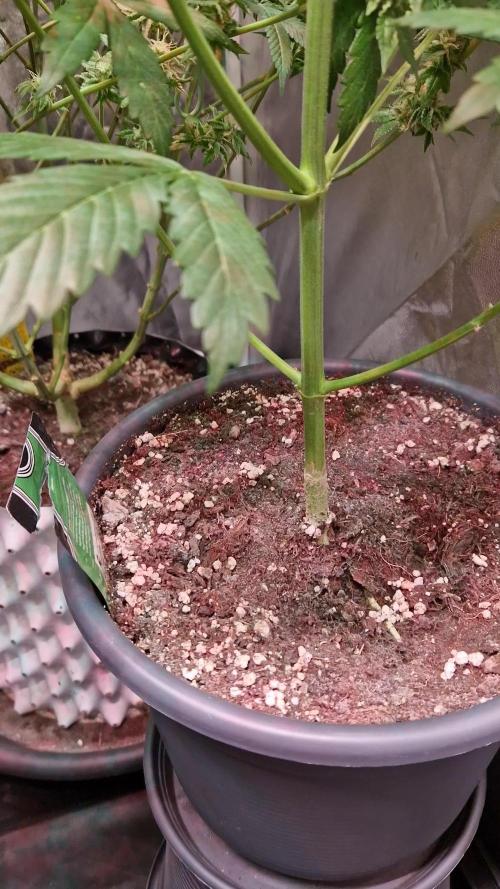
Bin sehr begeistert was an der GorillaZ noch alles dran gewachsen ist. Der Headbud ist super schwer und wenn man an ihr riecht, riecht es wie eine Skittlespackung die man frisch auf macht!
Processing
Likes
2
Share


@Valedor
Follow
semana de crecimiento de tricomas, ademas las flores presentan un crecimiento muy bueno, ya están madurando de verdad, el próximo cultivo lo documentaré con fotos mas claras, he aprendido mucho de tenerlas en hidroponia, me gusta y lo voy a seguir usando y explotando


Processing
Likes
20
Share


@DrGanj
Follow
budding up nicely now. One pheno looks to be growing different bud formations and is much more frosty. O stupidly didn't take a cut of this in veg so I've taken a flower cut to reveg and try monstercropping.

Likes
45
Share


@Ultraviolet
Follow
2nd net is up. Early bud formations are promising. holding up to the extremes pretty well, some leaves taking minor damage, but overall, she is holding up, gave her 1 night at 50F see how she would react, stressful. Not advised as it messes with her metabolism, but I want to see if it triggers any anthocyanin response. Love to see her purp up but no signs yet.
My homework.
Rubisco regeneration is intrinsically linked to nitrogen supply because Rubisco is a major sink for nitrogen in plants, typically accounting for 15% to over 25% of total leaf nitrogen. The regeneration phase itself consumes nitrogen through the synthesis of the Rubisco enzyme and associated proteins (like Rubisco activase), and overall nitrogen status heavily influences the efficiency of RuBP regeneration.Structural Component: Nitrogen is an essential building block for all proteins, and the sheer abundance of the Rubisco protein makes it the single largest storage of nitrogen in the leaf.
Synthesis and Activity: Adequate nitrogen supply is crucial for the synthesis and maintenance of sufficient Rubisco enzyme and Rubisco activase (Rca), the regulatory protein responsible for maintaining Rubisco's active state. Nitrogen deficiency leads to a decrease in the content and activity of both Rubisco and Rca, which in turn limits the maximum carboxylation rate, Vmax, and the rate of RuBP regeneration Jmax, thus reducing overall photosynthetic capacity.
Nitrogen Storage and Remobilization: Rubisco can act as a temporary nitrogen storage protein, which is degraded to remobilize nitrogen to other growing parts of the plant, especially under conditions of nitrogen deficiency or senescence.
Nitrogen Use Efficiency (NUE): The allocation of nitrogen to Rubisco is a key determinant of a plant's photosynthetic nitrogen use efficiency (PNUE). In high-nitrogen conditions, plants may accumulate a surplus of Rubisco, which may not be fully activated, leading to a lower PNUE. Optimizing the amount and activity of Rubisco relative to nitrogen availability is a target for improving crop NUE.
Photorespiration and Nitrogen Metabolism: Nitrogen metabolism is also linked to the photorespiration pathway (which competes with carboxylation at the Rubisco active site), particularly in the reassimilation of ammonia released during the process.
To increase RuBisCO regeneration, which refers to the process of forming the CO2 acceptor molecule Ribulose-1,5-bisphosphate (RuBP) during photosynthesis, the primary methods involve optimizing the levels and activity of Rubisco activase (Rca) and enhancing the performance of other Calvin-Benson-Bassham (CBB) cycle enzymes.
Biochemical and Environmental Approaches:
Optimize Rubisco Activase (Rca) activity: Rca is a crucial chaperone protein that removes inhibitory sugar phosphates, such as CA1P (2-carboxy-D-arabinitol 1-phosphate), from the Rubisco active site, thus maintaining its catalytic competence.
•Ensure optimal light conditions: Rca is light-activated via the chloroplast's redox status. Adequate light intensity ensures Rca can effectively maintain Rubisco in its active, carbamylated state.
•Maintain optimal temperature: Rca is highly temperature-sensitive and can become unstable at moderately high temperatures (e.g., above 35°C/95F° in many C3 plants), which decreases its ability to activate Rubisco. Maintaining temperatures within the optimal range for a specific plant species is important.
•Optimize Mg2+ concentration: Mg2+ is a key cofactor for both Rubisco carbamylation and Rca activity. In the light, Mg2+ concentration in the chloroplast stroma increases, promoting activation.
•Manage ATP/ADP ratio: Rca activity depends on ATP hydrolysis and is inhibited by ADP. Conditions that maintain a high ATP/ADP ratio in the chloroplast stroma favor Rca activity.
Enhance Calvin-Benson-Bassham (CBB) cycle enzyme activity: The overall rate of RuBP regeneration can be limited by other enzymes in the cycle.
•Increase SBPase activity: Sedoheptulose-1,7-bisphosphatase (SBPase) is a key regulatory enzyme in the regeneration pathway, and increasing its activity can enhance RuBP regeneration and overall photosynthesis.
•Optimize other enzymes: Overexpression of other CBB cycle enzymes such as fructose-1,6-bisphosphate aldolase (FBA) and triose phosphate isomerase (TPI) can also help to balance the metabolic flux and improve RuBP regeneration capacity.
Magnesium ions, Mg2+, are specifically required for Rubisco activation because the cation plays a critical structural and chemical role in forming the active site: A specific lysine residue in the active site must be carbamylated by a CO2 molecule to activate the enzyme. The resulting negatively charged carbamyl group then facilitates the binding of the positively charged Mg2+ion. While other divalent metal ions like Mn2+ can bind to Rubisco, they alter the enzyme's substrate specificity and lead to dramatically lower activity or a higher rate of the non-productive oxygenation reaction compared to Mg2+, making them biologically unfavorable in the context of efficient carbon fixation. The concentration of Mg2+ in the chloroplast stroma naturally increases in the light due to ion potential balancing during ATP synthesis, providing a physiological mechanism to ensure the enzyme is activated when photosynthesis is possible. At the center of the porphyrin ring, nestled within its nitrogen atoms, is a Magnesium ion (Mg2+). This magnesium ion is crucial for the function of chlorophyll, and without it, the pigment cannot effectively capture and transfer light energy.
Mg acts as a cofactor: Mg2+ binds to Rubisco after an activator CO2 molecule, forming a catalytically competent complex (Enzyme-CO2-Mg2+). High light + CO2) increases demand: Under high light (60 DLI is a very high intensity, potentially saturating) and high CO2, the plant's capacity for photosynthesis is high, and thus the demand for activated Rubisco and the necessary Mg2+ cofactor increases. Mg deficiency becomes limiting: If Mg2+ is deficient under these conditions, the higher levels of Rubisco and Rubisco activase produced cannot be fully activated, leading to lower photosynthetic rates and potential photo-oxidative damage.
Optimal range: Studies show that adequate Mg2+ application can enhance Rubisco activation and stabilize net photosynthetic rates under stress conditions, but the required concentration is specific to the experimental setup.
Monitoring is key: The most effective approach in a controlled environment is to monitor the plant's physiological responses e.g., leaf Mg2+ concentration, photosynthetic rate, Rubisco activation state, and adjust the nutrient solution/fertilizer to maintain adequate levels, rather than supplementing a fixed "extra" amount.
In practice, this means ensuring that Mg2+ is not a limiting factor in the plant's standard nutrient solution when pushing the limits with high light and CO2.
Applying Mg2+ through foliar spray is beneficial to Rubisco regeneration, particularly in alleviating the negative effects of magnesium (Mg) deficiency and high-temperature stress (HTS). While Mg can be leached from soil, within the plant it is considered a mobile nutrient, particularly in the phloem. Foliar-applied Mg is quickly absorbed by the leaves and can be translocate to other plant parts, including new growth and sink organs.
Foliar application of: NATURES VERY OWN MgSO4 @ 15.0g L-1 in a spray bottle.
Foliar sprays are often recommended as a rapid rescue measure for existing deficiencies or as a supplement during critical growth stages, when demand for Mg is high. Application in the early morning or late evening can improve absorption and prevent leaf burn.
The starting point [of creativity] is curiosity: pondering why the default exists in the first place. We’re driven to question defaults when we experience vuja de, the opposite of déjà vu. Déjà vu occurs when we encounter something new, but it feels as if we’ve seen it before. Vuja de is the reverse—we face something familiar, but we see it with a fresh perspective that enables us to gain new insights into old problems. Come walk in the enchanted forest.
Likes
5
Share


@Godsgrace
Follow
25 and 28 days from planting. A couple of days before, I started cutting off the large leaves.
Today I started doing LST. Perhaps I was a little hasty with this, but we'll see.
The temperature problem has been resolved.
Watering is carried out every 3 days. For the entire volume of the pot.
Likes
17
Share


@Kirsten
Follow
26.12.24:
I have noticed light stress on my plants. I had moved the lights further away and increased the light intensity to 70%. Unfortunately that created some issues. Namely severe palour of the leaves.
To try and rectify the situation, I've dimmed the lights to about 30%, staying at the same distance, about 30 inches away. I measured the par levels, after I did this. They should a reading of anywhere between 40 and 150, at the canopy of the plants. They are all different sizes. This seems to have improved the colouring on all plants.
After this evenings watering, I will monitor recovery and increase lighting intensity again slowly. I am also using the light cycle of 21/3, so the plants have many hours more light to absorb, than for example 12/12 or 18/6.
I am pleased with the progress, considering all of my mistakes!
29.12.24:
So I finally gave LST a shot, it's probably a bit too late, however I really want to get the most of the triploid pheno, and I went a little crazy and LST'd all plants except 2, as they're too small.
I did that late last night, this afternoon I was amazed to see the plants turn their leaves back to the light source. I'm glad I overcame my fear of trying it. I'm very excited to see them adapt and progress! 😁 there are videos above with before and after of my LST process.
Thanks for checking out my diary 🍃 ✌️