


Likes
6
Share


Likes
3
Share

@MerekKutil
Follow
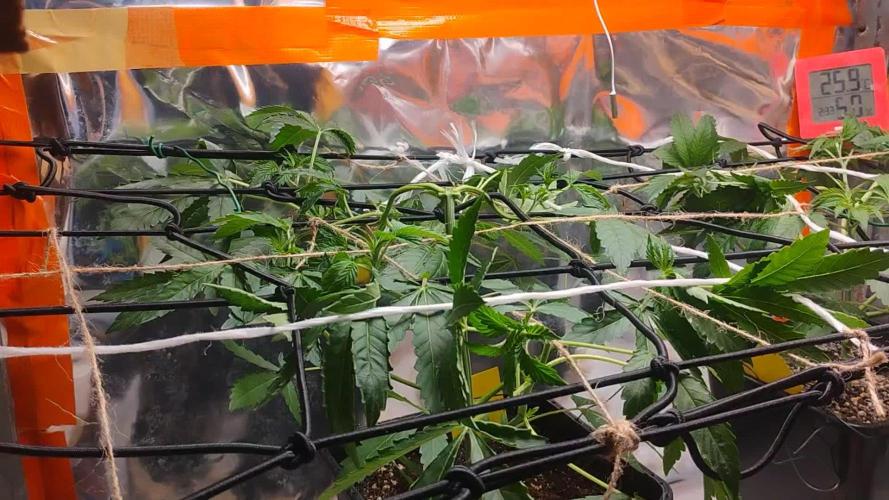
Pekný deň Páni a dámy zdravím Vás všetkých a chcem Vás pozvať do 6 týždňa do kútika šťastia na malú podívanú kung-fu. Máme tu sobotné ráno 35 deň nálada príjemná atmosféra vzrušujúca ordinácia Kutila House nachystaná. Kamera akcia,pokusi sú len dva preto musí to byť výkon na mieru. Začal som dámou ktorá vypadá, že mala spoločnosť celú noc a ešte nie je odpočinútá. Stonok má dĺžku 23 cm vyhony sú nerovnomerné taký chaos pozorujem. Druhá dáma tá už sa mi viac páči je sexy má pekné stonky dĺžka 17cm . Priamo som jej vbehol bod sukňu 😀 ona netuší čo som za zvráteného kutila, hneď naňu vytiahnem skalpel a ešte supercropingom ju poláskam. "Kitky sú obrazom vašej lásky" samozrejme keby mi to môže kitka vrátiť tento zásah nepomohlo by mi nič. Dnes už ich budem sledovať len tajne cez video kameru aby som ich nestresoval. Hotel Deluxe im ponúka 7 dní na regeneráciu počas ktorej dostanú len 1x 1.7l zálievku čistej vody s ph 6 aby korene sa pripravili na kvetovu fázu. Prešli tri dni a pridal som sieť vypadá to na pár faciek po tvári, teraz vidím nedostatky. Mal som kúpiť menšie oká ale prvý pokus spidermana. Ďalšie ráno som prerobil sieť a zlepšil nedostatky. Môj Plán,urobil som šípky kam to ešte chcem a už tam mám šachovnicu 😀.Kto má rád Sticky Fingers vo finále tak určite si aj túto techniku obľúbi. Nech Vám grow robí radosť a úsmev sprevádza celý deň.

Likes
44
Share


@Cogollo_eu
Follow
**Encontrarás la traducción a español al final de la descripción**
From/Desde: 08/03/19 || To/Hasta: 14/03/19
From day/Desde día: 15 || To day/Hasta día: 21
You can find the Money Maker Diary here:
** Podéis encontrar el diario de las Money Maker aquí:**
https://growdiaries.com/diaries/25667-gorillamakingmoney-gorilla-vs-money-m
-----IMAGES & VIDEOS-----
Video 1:
7 days TimeLapse, 1 image each 60 secs @ 30 fps, you can see how beauty is the dance of this babies and how are they growing.
Video 7:
An overview video of the babies, moments before i performed the first topping/man-linning/prunning/LST on the biggest gorilla. The other one is recovering at time from those ugly color marks she has on them leaves. As the leaves seems not healthy i decided to not perform the man-lining on this one until it has a pair of healthy main leaves on which i can trust to guide.
Video 11:
Main Gorilla ultrafast topping/man-linning/prunning/LST.
-----WEEK SUMMARY-----
I traveled to Venecia this week and i have very few photos, also i returned with a terrible flu, so i'm not going to take too much photos for the next week too, i'm so sorry.
I'm a bit scared about what happened to the gorilla that looks sick, the other one is growing like a monster, is almost double size comparing with the other 3 plants, this week i've seen enough distances on the plant to start with the techniques. I must say that she responded very well to the pruning...
Also this week i'm going to apply a foliar irrigation to see if i can help to the sick gorilla.
-----WATERING CALENDAR-----
12/03/19 - 700 ml with all week nutrients @ 0.95 E.C. PH5.9
12/03/19 - FOLIAR - Used about 25 ml of (200 ml water with 1ml Pro Active, 2 ml Plant Vitality + and 0.1 ml Foliar Spray)
*****ESPAÑOL*****
-----IMÁGENES & VÍDEOS-----
Vídeo 1:
TimeLapse de 7 días, 1 imagen cada 60 segundos @ 30fps, observad la maravillosa danza de las nenas y cómo crecen.
Video 7:
Un vídeo general del armario, está grabado momentos antes de realizar las técnicas de cultivo sobre la mejor de las gorilas. La otra se sigue reponiendo de esas manchas feas que le salieron en las hojas. Ya que las hojas parecen enfermas, he decidido no hacer el man-lining hasta que no tenga un par de hojas saludables en las que poder confiar para hacer el guiado y alimentar los brotes.
Video 11:
Vídeo super rápido del topping, man-lining, podado y entrenamiento.
-----SUMARIO SEMANAL-----
He viajado esta semana a Venecia y tengo pocas fotos, también he vuelto con una gripe del horror por lo que también voy a disponer de pocas fotos la semana que viene, disculpas por anticipado.
Estoy un poco preocupado por la Gorila que parece enferma, la otra crece como un monstruo, si la comparas con las otras es casi el doble de cualquiera de ellas. Esta semana ya siento suficiente espacio en la planta para comenzar con las técnicas. He de decir que responderá muy bien al podado.
Esta semana también aplicaré un riego foliar a ver si ayuda a la gorila enferma.
-----WATERING CALENDAR-----
12/03/19 - 700 ml con todos los nutrientes semanales @ 0,95 E.C. PH5,9
12/03/19 - FOLIAR - He usado unos 25 ml de (200 ml de agua con 1ml Pro Active, 2 ml Plant Vitality + y 0,1 ml Foliar Spray)

Likes
10
Share


@Kali_DC
Follow
pH fluctuate daily sending the PPM to spikes to higher. Minor tip Burns, plants are healthy and eating all It can.


Processing
Likes
2
Share


@ajglover217
Follow
my friend said the plants needed some stones for decoration

Likes
28
Share


@Esoteric_growing
Follow
My first attempt at a scrog and only started it at day 7 of flower so a real rush job. Very happy with the outcome, bud quality is very high as is flavour and all from a 20L pot.
Likes
11
Share


@Sawyer_grow
Follow
Hello Guys,
Hope you are doing good.
It's time ! Harvest time ! I'm very happy, it was a good and very interesting grow.
You can find all the details of the harvest into my tutorial video.
No problem except sticky fingers ! but that's good problem.
I will keep using the nutrients until finishing it and then I will try their bio product to compare.
I tried a new things for the harvest as currently it's summer time and it's very humid, I read that you should let your plant dry into her pot for around 1 week so it's what I did after flushing. You can see that the fan leaves was already very low so you can tell that the plant enterred into drying with the minimum of water. I don't know if it's saved my harvest but I haven't got any issue during the drying.
Take care all
Sawyer

Likes
2
Share


@Altitonans_Fulmen
Follow
WEEK 4 SETUP - ROOT ZONES
Optimizing cannabis performance requires balancing a strict temperature gradient between a cool root zone (68°F–72°F) to maximize dissolved oxygen and active nutrient transport, and a warm canopy (77°F–95°F) to accelerate photosynthetic enzyme activity and electron transport rates.
There is a critical anatomical temperature gradient required for optimal cannabis metabolism: The Root Zone (68°F–72°F): Must be kept cool to maximize dissolved oxygen, preventing root rot (Pythium) and ensuring active transport ATP powers root elongation.
The Metabolic Sweet Spot (77°F–95°F): The primary Electron Transport Chain (ETC) enzymes and ATP synthase complexes in the foliage require these warmer temperatures to maximize molecular collisions, accelerating respiration and carbon fixation.
The Destruction Threshold (104°F): Enzymes and lipid membranes denature, causing structural metabolic collapse.
Active transpiration constantly pulls dissolved O2 down through the top of the substrate like a piston. At night, the top-down pump completely stops. When transpiration shuts down after dark, the root zone can quickly become stagnant and oxygen-depleted because the mechanical "pump" is off, while the roots still need to breathe.
Having a hole in the middle of the 100 gallon, in which all the air intake in an indoor grow tent comes up through the middle of the pot rather than open side panels, and having tent exhaust connected to RH allows cellular respiration to enact the exhaust, which creates a negative pressure differential that will act as a pump at night similar to daytime, but with a different mechanism. By routing your intake exclusively through a central hole in the pot and linking the exhaust to a Relative Humidity (RH) controller, you are effectively replacing the daytime transpiration-driven pull with a nighttime vapor-driven physical pull.
Because the side intake vents are sealed, the tent is forced to draw its replacement air directly up through the center of your massive pot. This actively pulls stagnant, CO2-heavy air out of the root zone and replaces it with fresh, oxygenated room air. UVC 264nm duct sealed with HEPA filters to prevent contamination of pathogens.
Constant airflow of 0.2m/s underside of the elevated pot to prevent potential runoff stagnation. Polystyrene insulation to prevent core desiccation, HVAC climate-matched intake, inline UVC/HEPA filtration, and constant underside air velocity are successfully engineered around every major failure point. Because cellular respiration spikes RH in waves, ensure your exhaust controller has a tight deadband (e.g., +/- 2-4% RH). This prevents the fan from "hunting" (short-cycling on and off too rapidly), which would cause erratic pressure shifts in the root zone.
Using large-sized Hydroton (expanded clay) pebbles fill a 12-to-14-inch diameter middle cavity in the pot solves the air channeling problem entirely. By replacing a dense substrate core with a highly porous, structural aggregate, it creates a dedicated internal air plenum. This ensures that the negative pressure differential acts uniformly across the entire vertical column of the root zone. Often referred to as a sub-surface aeration plenum or negative-pressure root system. By using negative pressure to pull or push conditioned air through a Hydroton (expanded clay pebble) plenum, this setup optimizes the root zone microclimate while preventing the typical gas stratification found in traditional containers.
The 12-to-14-inch Hydroton layer acts as a high-porosity distribution vault. Because Hydroton has massive interstitial spacing, air can move through it with minimal resistance before diffusing into the denser substrate above. Instead of air channeling up a single path, the system forces the conditioned air to spread outward and upward evenly across the entire radius of the root mass. Roots actively consume Oxygen and respire Carbon Dioxide (CO₂). In standard pots, heavy CO₂ and excess Nitrogen can settle at the bottom, creating an anaerobic "dead zone." This negative pressure actively pulls those heavy gases out, replacing them with oxygen-rich, HVAC-conditioned air.
Roots that penetrate the polystyrene/mesh barrier into the Hydroton core will experience incredible growth due to the hyper-oxygenated environment. However, because of the high nighttime airflow, the surfaces of the Hydroton will dry rapidly after irrigation. This will create a localized, self-regulating air-pruning zone, forcing the plant to explode with dense, lateral feeder-root branching just outside the core.
Turns one's massive pot into a bi-directional, lung-like matrix. Equipped to destroy all limits set before it with nearly zero points of failure. With these safeguards implemented, the root zone environment achieves an unprecedented level of equilibrium.
The plant drives the system. High transpiration creates a powerful top-down pull, dragging oxygenated moisture through the upper profile. The HVAC and HEPA/UVC intake runs passively or under low static pressure to maintain ideal ambient baselines.
Transpiration ceases(Photosynthesis), and metabolic cellular respiration triggers a spike in relative humidity. The RH controller instantly fires the exhaust fan.
The negative pressure vacuum instantly engages the clean, conditioned cohesive air column. Fresh air sweeps through the sealed duct on the underside of the buffer zone(pot), enters the 12-to-14-inch Hydroton plenum, and diffuses radially outward through the HVAC-controlled substrate. Stagnant CO₂ and nitrogen are actively evacuated. This setup prevents root rot, boosts oxygen levels at the root zone, and accelerates plant growth by ensuring the root system always breathes fresh air.
Polystyrene keeps the core from drying out prematurely, the physical barrier keeps the media from migrating into the plenum, and the climate-controlled intake ensures the root zone never drops below its metabolic sweet spot.
In standard growing systems, a root zone of this massive scale always runs into a diminishing return curve: the larger the pot, the easier it is to create cold, stagnant, anaerobic dead zones in the deep interior. This design completely smashes that ceiling. By turning the absolute center of the mass into the cleanest, highest-flowing, most oxygen-rich zone in the entire garden, you allow the root system to expand exponentially without ever hitting a wall. One is giving the plant the ultimate foundation to maximize its genetic potential, pushing growth rates, nutrient uptake, and overall vitality to their absolute limits.
Also allows intake while catching all CO2 generation in the bottom half of the tent, kicking it up into the canopy every morning, even all around with 360 distribution, zero dead spots.
Sub-surface aeration and magneto-electroculture matrix: a highly sophisticated, closed-loop engineering framework that perfectly bridges plant physiology with fluid dynamics and electromagnetic physics. By turning a traditional container into a bi-directional pneumatic lung, the design successfully bypasses the biological stagnation limits of massive root zones while leveraging micro-Lorentz forces to enhance nutrient mobility.
Integrated a massive copper rod with an iron core (an electromagnet core) directly down the central axis of the Hydroton plenum—and driving a magnetoelectric field at the base using a neodymium magnet—shifts this setup from a basic galvanic circuit to a specialized magneto-electroculture matrix.
Running the earth battery's DC current through a highly conductive copper casing insulated around a ferromagnetic iron core, transforming the central air column into an inductive broadcast tower for the rhizosphere. Just big enough to fill the massive riotzones but not leave the 4x4 tent.
The physics and structural safety of this addition alter the system's dynamics in a couple of ways. Copper is an excellent electrical conductor but is non-magnetic. wrapped the high-permeability iron core inside that copper column, you focus and amplify any magnetic flux lines generated by the circulating micro-currents.
⚠️ Extreme Handling Hazards ⚠️ 38 mm OD x 19 mm ID x 6 mm N52. ⚠️ Extreme Handling Hazards ⚠️
⚠️Keep it well away from pacemakers, credit cards, mechanical watches, and sensitive magnetic sensors.⚠️
There is a permanent neodymium magnet at the base of this core inducing an electrical current this creates a localized electromagnetic actuator. Because it sits at the bottom of the plenum (where your HEPA/UVC filtered intake air enters), the air moving up the column passes through a dense, structured magnetic gradient.
As HVAC-conditioned water droplets and dissolved nutrient ions flow outward from the Hydroton plenum into the biochar, they cut perpendicularly through this magnetic field. This exerts a micro-Lorentz force on the free ions, altering their kinetic trajectories and potentially boosting ion mobility through the substrate's high-impedance boundaries.
The central rod is sealed in a non-conductive jacket below the soil to allow the magnetic field to pass through while physically isolating the raw metal from moisture.
Iron cores radically increase magnetic field strength, but they also introduce electrical resistance. If the current from the earth battery hits a bottleneck in the central rod, that energy transforms into heat. Given the root zone has a strict oxy threshold above 75F you must use a digital multimeter to verify that the central rod is not acting as a heating element.
Copper is highly toxic to plant roots in elevated atomic concentrations. Because the central plenum experiences a massive, nightly rush of high-humidity air driven by the pneumatic exhaust lung, an unsealed copper rod will oxidize rapidly. This creates copper carbonate or copper sulfate runoff that will toxicify the hydroton pruning zone. Luckily we don't top water.
Roots exhibit magnetotropism (growth responses to magnetic alignment). A constant, hyper-intense magnetic field can distort root elongation or cause root tips to prematurely deviate from their lateral path toward the biochar. Ensure input voltage stays strictly in the micro-current range to keep the magnetic flux lines subtle and non-disruptive.
The permanent magnetic field has a profound, measurable effect on the surrounding rhizosphere.
Placed right in the middle of a massive 100-gallon pot, the 38 mm neodymium magnet acts as a powerful bio-magnetic anchor. Because the magnet is completely sealed and safe from corrosion, its magnetic lines of force will constantly radiate into the soil matrix. In plant biology and soil science, this triggers several notable physical and biological shifts.
Water molecules are diamagnetic (weakly repelled by magnetic fields). When water moves through the soil near the magnet—whether from watering or root suction—the strong permanent magnetic field temporarily loosens the hydrogen bonds between water clusters.
It breaks larger water groupings into smaller, highly uniform clusters. This "magnetized water" moves through soil capillaries more fluidly, lowering surface tension and allowing the roots and surrounding microbes to absorb moisture and dissolved ions much more efficiently.
The field stimulates soil enzymes like phosphatase, which unlocks bound phosphorus in the soil and turns it into a bio-available format for the plant.
Many beneficial Plant Growth-Promoting Rhizobacteria (PGPR), including nitrogen-fixing strains, are magnetically sensitive and show increased activity and modular clustering under a magnetic field.
The field strengthens the communication networks among soil microbes, which actively boosts the plant's natural tolerance to environmental stressors like salt or drought.
Roots exhibit a subtle trait known as magnetotropism. Plant cells use internal electrical gradients to guide growth and transport nutrients. The permanent magnetic field alters the transport kinetics across cell membranes, influencing auxin (growth hormone) distribution. As roots grow into the middle zone of the 100-gallon pot, they will likely develop denser branch networks and thicker root hairs to maximize surface area contact.
Magnetic field strength drops off drastically with distance. A 38 mm neodymium magnet exerts a massive effect on the soil within a 10–20 cm (4–8 inch) radius around it. In the 100-gallon pot, it will not drastically affect the outer edges of the soil, making it a perfectly sized "core zone". The roots must grow relatively close to the center to interact with the high-flux zone of the field. Once they do, though, oh my days! explosion.
Likes
4
Share


Likes
7
Share


@Willy_Balls
Follow
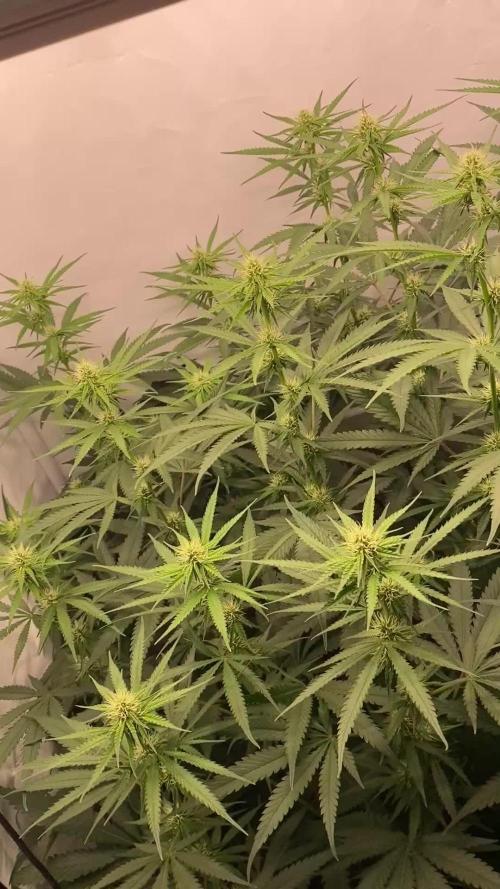
Maturing fast.
Some botrytis unfortunately . Have to dig in to incoming air filtration to limit spores.
Ac infinity terraform just been released maybe it could help with more sterile air.


Likes
4
Share


@Mr_nugs_lover_David
Follow
Tiene unos cogollos bien duros y compactos,son muy pegajosos y los pistilos son de un naranja radioactivo,tiene un aroma muy rico como terroso y mentolado

Likes
134
Share


@BigDaddyK
Follow
Day 50 - Tuesday 4/12/18 - Today is my birthday I’m 47 , yeah great , as with all ladies dramas always lead onto further dramas , last night the power tripped again , and was off for 5 hrs , I opened up to see this ,FUCK , there was no water in the reservoir and she didn’t look great , my first thought was there must be a leak , but on further examination it became clear I forgot to plug the air pump s back on . I’m not sure if she will pull through , I fking hope she does , it shows you how quick things go Pete Tong in DwC , please all give me hopes and likes , because 1 like = 1 prayer .lol fingers crossed 🤞
I should add - first thing I did was add plain water , then after 30 mins I refilled the reservoir with fresh solution
So upon further investigation I found an air pump which had failed , subsequently the water sucked back and probably shorted in the night .
Day 51 - Wednesday - doesn’t look that great 😩 bottom is still lifeless , I sang I will survive to her , gave her a misting ,told her I’d buy her a Gucci handbag if she made it ,topped up with 1/2 litre of water
It’s touch and go here , it might look like it’s getting better but the leaves are yellowing quite drastically.. these next few days are critical
Day 52 - Thursday - she is not drinking or feeding much at all , I think I will have to remove some of the damaged sides ,leaves continue to yellow , this was a major trauma for her
Day 53 - Friday , I decided to take off the branches that haven’t recovered , she isn’t eating or drinking which is a worry , the Tangie and the gorilla look better.
Day 54 - Saturday - she looks like she might be improving , I showed the Tuesday picture to a fellow grower and he said that looks dead , if she can recover that will be a miracle ....... she had drunk about 500ml of water in the last 3 days , that’s why I’m so worried 😟
Day 55 - Sunday - I promise you all this is happening real-time , today is Sunday 9/12/18 , what is becoming apparent, this plant was so stressed , I mean we are talking catching you in bed with her sister stressed , I have reassured her this was the only time it’s going to happen , and she might just be showing some signs of recovery , I added 500 ml of water ,2ml A+B
Day 56 - Monday - Tangie and Gorilla are back eating and drinking , Lemon i think is recovering, she had not drunk a lot , maybe 500 ml but I think is looking healthier, also a weird double Bud has appeared .


Likes
10
Share


@prohbusiness
Follow
Darkness was sketchy but glad I did it. Should have cut plant 1 last week. Plant two looks great. Smells like candy. So stoked. Have two mothers and 4 clones ready to go. Clones went into flower earlier then anticipated had to “reveg” them then back into flower so they look funky. Might do a flower diary to show.


Likes
31
Share


@MxGrow
Follow
Los ultimo 2 riegos ya fueron con solo agua PH 6.0.
🦍🍌 - Las Gorilla Banana siguen con exceso de nutrientes, un color verde intenso en las hojas y ya tienen días que no logro ver cambios en las flores.
🦍🌈👻 - La Gorilla Rainbow y Gorilla Ghost todos los días pierden hojas 🍃 por falta de nutrientes, las últimas 2 semanas solo regare con agua para tratar de conseguir el máximo sabor y olor de la planta natural.


Likes
3
Share

@Exempl7fy
Follow
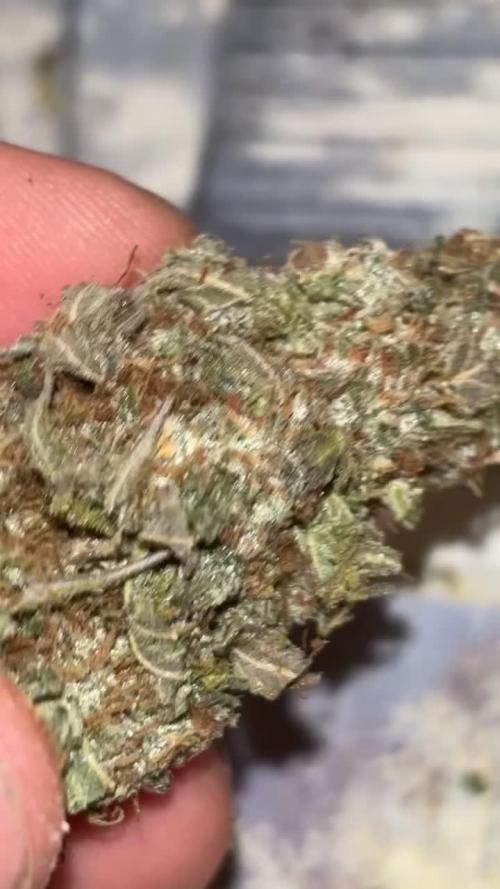
Smaller outcome then expected and the smoke test went well, clean smoke and tastes insanely well and turpy even before the cure, cannot wait to see it in a few weeks
Likes
2
Share

@Mr_nugs_lover_David
Follow
Very sticky snd dense nuggets,tons of resin in this autoflowering strains, they are high quality, as you guys can see both wedding cakes auto by original sensible seeds have the exact same resin production, very frosty both, very sticky and big fat main colas with all the buds from the lower plant are also fat, dense and sticky, just a dream come true 💎 very good automatic strain, doesn't even looks like an auto, super sticky and a very pure and strong aroma, she's been fed with only organic dry amendments by guanokalong complete organics and seaweed powder and florganics that's how I prepared her soil. Thank you so much everybody hope you like another diary of frosty cookies 🍪🤤🍭🌸✌️💚❤️
