




Likes
4
Share


@adam_pawloski87
Follow
@twenty20Mendocino R&DUpdate ~ Let’s Go day 49 for these girls an we are looking beautiful! This week we gave them another trim up a tied them down more a today they have bounced back like nothing happened, strong ones they gonna be an so nice an healthy!
The Sangria is looking really beautiful, she’s Been flowering for lil over 2 weeks now so we still got a good amount of weeks for her to build a little more but she is already looking amazing, can’t wait for her to be done, smelling delicious! Hope you all enjoy an have an amazing productive day as well as a great safe weekend! Peace love positive vibes to all y’all Cheers 😶🌫️💨💨💨💨🤙🏻

Likes
38
Share


@GODSGIFT_2005_JM
Follow
For LIQUIDS & NUTES ******GREEN BUZZ NUTRIENTS***** organic.
Also i’m using their LIVING SOIL CULTURE in powder form!
MARSHYDRO ⛺️ has large openings on the sides which is useful for mid section groom room work. 🤩
☀️ MARSHYDRO FC 3000 LED 300W
💨MARSHYDRO 6” in-line EXTRACTOR with speed-variation knob, comes complete with ducting and carbon filter.

Likes
68
Share


@Roberts
Follow
Auto Northern Dragon Fuel is progressing more into flowering. She is growing really well. She has been eating and drinking a good amount. She looks very promising in producing a good yield in a 1.5 gallon potter. Nothing more to report at the moment. Thank you Medic Grow, and Super Sativa Seed Club. 🤜🏻🤛🏻🌱🌱🌱
Thank you grow diaries community for the 👇likes👇, follows, comments, and subscriptions on my YouTube channel👇. ❄️🌱🍻
Happy Growing 🌱🌱🌱
https://youtube.com/channel/UCAhN7yRzWLpcaRHhMIQ7X4g

Likes
6
Share


@GutThatDank
Follow
End of week 12 - Day 90
Flower - Day 52
The girls continue to pack on bud weight.
I started to open up the buds to let light penetrate some of the side colas.
The buds are average 2 inches thick per cola and really packing on some resin.
Trichcomes are getting cloudy but no signs of amber yet.
Another week or so.
Likes
12
Share


@XperencdGmanXG
Follow
ive harvested the tops of these girls and left the bottom to mature more over another 2 weeks. I will update all the weights at the end. Will give them another bloom boost and some fulvic humic and microbes. should be able to quadruple the weight of the mid and bottom buds.
Likes
32
Share


@Belverde
Follow
Welcome growers
Week n°4 ended for this nice AYAHUASCA PURPLE 😈
In the past seven days she has started to grow in growth and is now no longer the smallest in the garden 🌱🌳
The color is a nice green and the vigor is also good 💪
Solid lower branches..
I hope to seeing purple everywhere 🔥🔥
Anyway..
A few days ago i have decided to modificated her grow doing the topping technique ✂️
I would to have the same heightnes for all my ten strains in the garden and so, i decided to do it for all my ladyes (except one)
I have also cut a couple of leafs off, not too much for now, just for increase the airflow and for a higher lights exposure of the lowers parts 🍃
For now she reacts pretty well..
For helping in this process, i have changed anothers things, like lights intensity and types of nutrients..
About the lights 💡
Doing that, i have increase the potency of my two Mars-Hydro SP3000, from 25% to 50% ⬆️
The two led panel are connected with a cable and i have only to adjuste the dimmer of one of them for change the intensity of each one, in just one move..
Pretty useful 💯
In the middle of the week i have switch from 18/6 on/off to 16/8 on/off..
Always tryed to mimic the natural cycle of the sun light, works good to me 👌
Anyway..
About nutrients 👇
In this week i have giving her always organic/veganic nutrients..
A little bit of silicium (Bionova) / Activator (Biomagno) / Crescita (Biomagno) / Activera (Biobizz) / Grow vegan (Bionova) / The Missing Link (Bionova) / X-Cell (Bionova) and a little bit of P-K 3-5 (Bionova) {This last one i have used in a foliar spray solution}
Like i usually do, a little bit of everything at any watering 💧
And that's it..
Stay tuned, we'll see you at the end of week n°5 📆
The beginning of flowering 🌻
Thank you so much for stopping by 😎👍
FC ✌️
🇮🇹

Likes
25
Share


@Kush_queen
Follow
Another amazing week with these beauties I am still feeding the same monkey nutrients couple seem to be burning through the feed quicker so I have upped the doses back to the full doses as I had dropped them slightly previously but they are so sticky 🙏🙏 so I am trying to ensure the air circulation stays constant and the humidity stays at around 42 with the increased temperatures we have had here in the UK I have turned my extraction fan up to near jet engine status 😂😂 thankfully its not really any louder than a fan so it's not been to bad and the carbon filter is doing a really good job at keeping the danky smell in the tent personally I love the smell not sure the neighbours would so much 🤣😳 in inlet fan and circulation fans are working hard but managing to keep temps from going above 29 there was one day I set Zues pro at 75% just to help temps drop
The buds are really starting to get heavy now and there is literally no room left for anymore the highest tips are probably 4f 8 the tent is only 6ft 6 so the Zues pro 600 is as high as it can go now so thank goodness the home stretch is not that far away now.
So I am really talking to them lots giving them lots of love and attention and preying these beauties continue to do there thing and grow there buds nice and fat with no issues 🙏👌
Thank you for reading stay blessed 💚


Likes
11
Share

@SecretHerb-Sanctuary
Follow
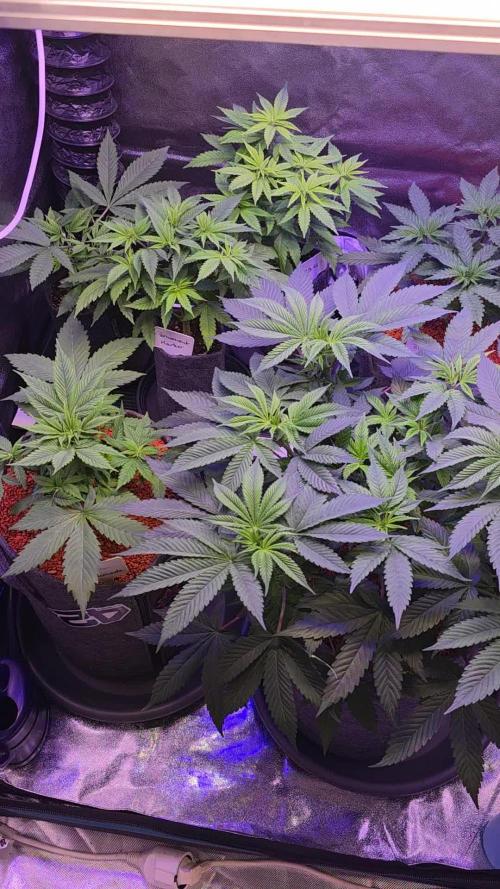
In der 6. BW zeigen die drei Amnesia Haze von @GanjaFarmerSeeds eine beeindruckende Reife, während sie sich jetzt so richtig auf die Ausbildung der Blütenendstände konzentrieren. Die Buds gewinnen massiv an Volumen und Festigkeit, was man an den vitalen, im Licht stehenden Blättern gut erkennen kann. Es ist eine wahre Freude, die Genetik dieser Pflanzen bei jedem Blick ins Zelt zu genießen, wie sich das Harz intensiviert und die Pflanzen ihre Energie in die Trichombildung stecken. Die Blütenbildung hat einen deutlichen Schub gemacht und wir bereiten uns jetzt auf die Endphase der Blüte vor, wobei die Nährstoffaufnahme absolut stabil läuft.

Processing
Likes
43
Share


@Hilkes_Herbs
Follow
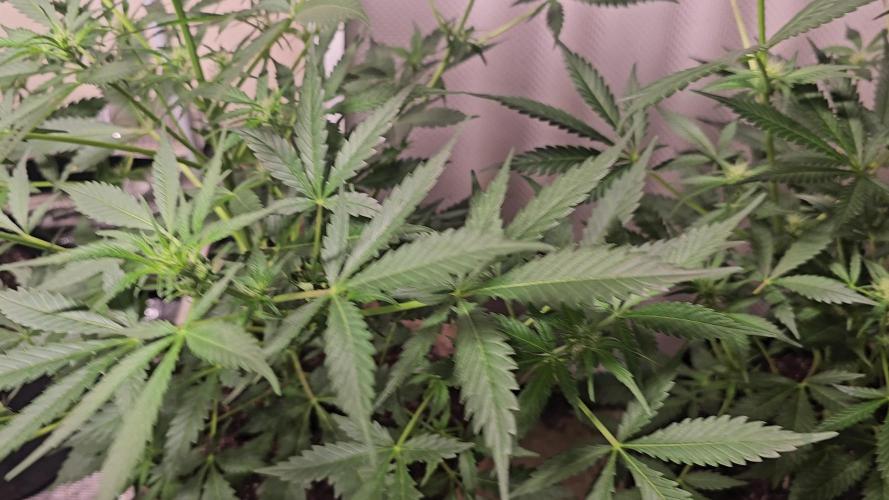
There we go, it‘s week #10 with Skunk #1 and these beautiful pictures. The EC is at 2.0 and the ph at 5.8... let’s see them still growing in the last 2 weeks. Njoy!
Day 64: New pictures online! EC is going up every day just like ph. Problem today is the heat! The water in the tank has exceeded 25°C and the temperature is not going to be cooler in the next week. That is why I added Purolyt. To prevent the water in the tank from getting algae and other sh*t. 😎
Day 65: Maybe it was too much Purolyt yesterday or the plants just give away all the leafes that are not in the light. Have to check tomorrow with lights off if something went wrong. Put 10liter pure water into the tank and ph'ed down.
Day 66: I know the water in the tank is too warm with 26° C. I will have to solve this problem. (I think I will use icecubes or something like that) But the flowers look pretty good. They stand the heat better than we do.(35° C outside in the city!)
Day 67: Still problems with the water temperature in the tank. Put an ice pack inside to get the temp down. Won't be helping long but for a moment.
Day 69: Still problems with the hot summer. Heat is up to 31,2° C but the plants seem to like it. Water temp went down to 24.4° C after refilling 10l pure water. After that I checked the EC which is at 1.86 and ph'ed down to 5.6
Planning to harvest soon, maybe in one week, what do you guys think? The white spots in the blossoms are burned blossoms that contains no thc or cbd. It looks like an albino flower to me. 😌 I can't avoid them because the tent is too low.

Likes
4
Share

@Samsationalseeds
Follow
Most of the autos are being moved into my dad's garden or the backyard.
Likes
2
Share


@High_Grade_Dadli
Follow
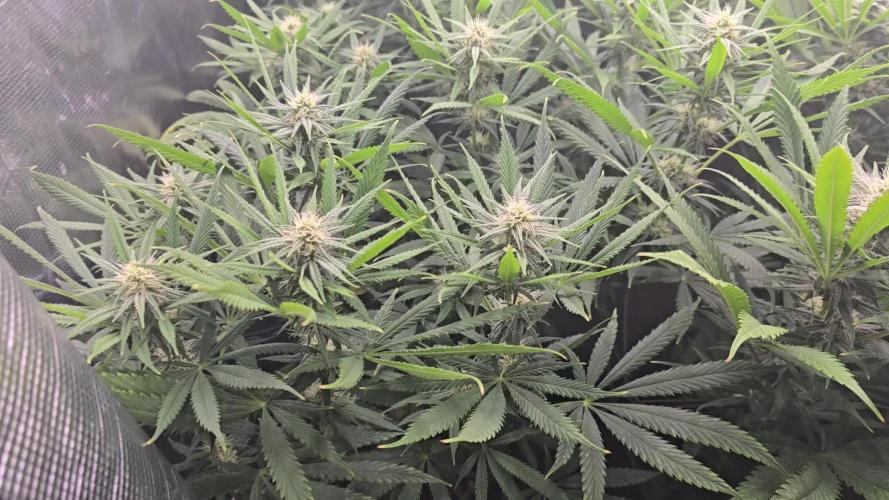
Week went smoothly cant complain....cutting are doing well also took 4 cutting of seed(think it's from applelicious) they already rooted n transplanted going to veg for a lil n send to flower to see if it's worth
Likes
Comments
Share


Likes
77
Share


@cheetah844
Follow
Still waiting for trichomes to amber up⏳
This is a very enjoyable grow using LST. Much more time consuming but I enjoy gardening so it's great for me.
I'm excited to see harvest amounts with LST💚🤗
I've moved both Gelato & Younger Zkittlez into a colder dimly lit room to hopefully enrich their colors. I will be harvesting them in the next day or two.
I've moved the two remaining mother plants into the smaller grow tent to finish flowering & I moved the clones to the larger grow space finally!

Likes
16
Share


@DaddyPrime2
Follow
6/17/24 she's winding down to the end(still a couple weeks) she's throwing out purple on the fan leaves. Thinking she may fade out nicely.
6/21 seeing some yellowing on the purple fading. Niiiice 👍

Likes
10
Share


@TiRobotProds
Follow
🔥🔥🔥🔥 en attente de l'explosion florale. Leq branche commence a ce givré d'une couverture de trichome fantastique.

Likes
8
Share


@Southofheaven
Follow
Just doing its thing.
Ive topped the main stem twice and 1st nodes once. Showing asymmetrical signs which il have to adjust to. The plan is to allow a decent veg, im not in a hurry. Also want to play with some grafting, wont learn if i dont try. Cheers fellas, enjoy

Processing
Likes
3
Share


@Kushizlez
Follow
Day 19-26 (May 10th - May 17th)
(Day 21) Stretch is almost over and the plants still look like they’re in veg. I’m seeing almost zero trichomes and when compared to my other room it’s laughable. At least the sites are starting to fill in a little. One plant is super leggy and stretchy. I’m guessing it’s Jack Herer but won’t know until late flower or harvest. The plant in the far left corner has great structure and thick pistil clumps. I’m guessing it’s either blueberry or the white og. Blueberry has a pretty distinct smell so differentiating all the strains won’t be that hard actually.
(Day 24) I’ve been rearranging the plants once in a while just to get all sides exposed to some decent light. I never realized how much I value my LED until this run. The only way I would ever use another hps for flower is if it was one of those 1000w DE lights that all the commercial grows use.
Sites are starting to fill in quite a bit now. Trichomes are still non existent though. Even on the archive genetics which is really surprising.
(Day 25) Pots somewhat dried out finally. Tomorrow I’m going to leach everything with another 2 liters each and top dress with 15ml of nature’s pride bloom, 10ml of Destiny launch and 5ml of kelp meal. I’m starting to see minor N tox on some of the plants so I will probably give them a full gallon. This tent is largely experimental so I’m going to fuck with these plants pretty heavy to iron out some theories and try some new techniques.
(Day 26) When I was watering today I noticed that slurricane, Puro loco and guava cake all hermed. The archives just got too stressed out in early veg I think. When I dug up both plants they were still being choked out by the sponge aerogarden plugs. Puro Loco was leading by far in the trichome department too. The guava cake was from a hermed bagseed so it’s not surprising at all but that kind of pisses me off about the “elite” Archive genetics, especially if you paid 200$ for a 10 pack. Then again, it was still my error and not their genetics. Luckily I didn’t pay a dime for them. Running those was a complete waste of time and space. With proper environment and no seedling stress I’m sure I could have grown some amazing looking stuff. All the European and Canadian genes look fine though. I’m sure they would have filled out a lot more if they weren’t being choked out by hermies. No signs of bananas anywhere else. Hopefully the 4 slurricanes I have outdoor this year will pull through without herming.

Likes
8
Share


@legolas40
Follow
The plants are maturing extremly fast, the amber thricomes are apearing so fast and the flushing started to prevent to get much CBN. The BIG DAY is soon!
