The Grow Awards 2026 ๐Ÿ†
Likes
Comments
Share
@RakonGrow
Follow
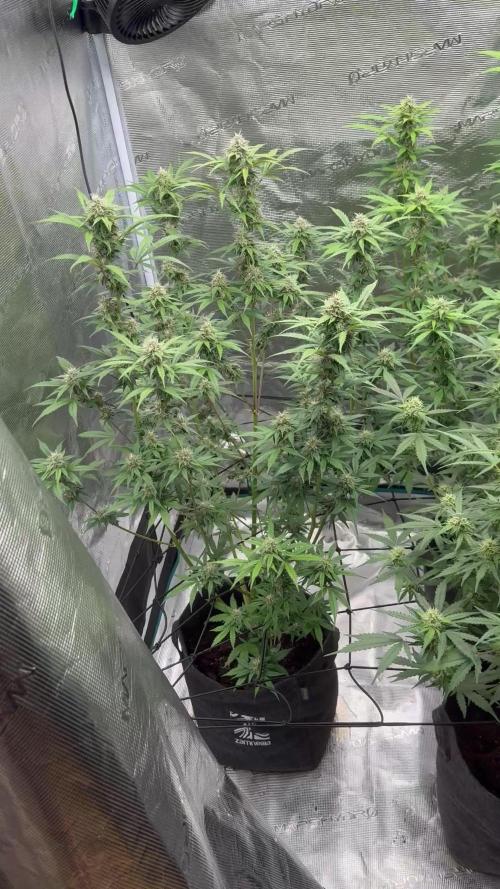
Note : + jegliches Zubehรถr wird in der GermniationsWoche aufgelistet . Zeitraffer Videos folgen immer nachtrรคglich. + videos werden so geschnitten das nur ein geschlossenes Zelt erscheint , ergo Fehlen paar reale Minuten (ca 1 Std) . Day 57: + 2.0 Liter Flaschenwasser + + Dรผnger fรผr Blรผhte + + + Canna Terrar Flores (Achtung wirkt wie PH-) + + + Canna Boost + + + Cannazym + + + Canna PH+ + + PH 5.91 Da es heute heiss ist , wird wie Gestern laufen . Bis 19:00 Uhr wird das Licht reduziert und dann DLI nachgeholt. Day 58: Da es immer noch heiss ist , wird wie Gestern laufen . Bis 19:00 Uhr wird das Licht reduziert und dann DLI nachgeholt. Day 59: + 2.0 Liter Flaschenwasser + + Dรผnger fรผr Blรผhte + + + Canna Terrar Flores (Achtung wirkt wie PH-) + + + Canna Boost + + + Cannazym + + + Canna Rhizotonic + + + Canna PH+ + + PH 5.91 16h jetzt mit 1000 PPFD und jeweils 1 Stunde Sonnenaufgang und Sonnenuntergang. Day 60: Mal ein bissel GrรถรŸenvergleiche gemacht .Das Clipper Feuerzeug ist 7.5 cm hoch . Day 61: + 1.75 Liter Flaschenwasser + + Dรผnger fรผr Blรผhte + + + Canna Terrar Flores (Achtung wirkt wie PH-) + + + Canna Boost + + + Cannazym + + + Canna Rhizotonic + + + Canna PH+ + + PH 6.01 Day 62: Das Wetter bleibt stabil, damit bleiben die Growwerte auch stabil. Bisher Lรคuft das 1000 PPFD Spitze und 750 PPFD Sekundรคtriebe ganz gut . Ihre Freundin die leider ein Wasserschaden erlitten hat (tja da war wohl irgendwas im Wasser was ein Regenbogenfilm erzeugt hat , im schlimmsten Fall Waschmittel) nimmt der einen Seite zwar licht, aber geht halt nicht anderes bei nur einer Lichtquelle . Ich fahr halt gleich ein doppel Experiement mit dem Licht. Bisher aber holt sie ganz gut nach mit 900-1000 PPFD auf die ziemlich gleich hohe Krone . Day 63: + 1.75 Liter Flaschenwasser + + Dรผnger fรผr Blรผhte + + + Canna Terrar Flores (Achtung wirkt wie PH-) + + + Canna Boost + + + Cannazym + + + Canna Rhizotonic + + + Greenhouse Feeding BioEnhancer + + + Canna PH+ + + PH 6.01
Likes
11
Share
@Chubbs
Follow
420 Fastbuds Amnesia Haze Auto Week 4 This week has been exciting for sure. Since the mild defoliation I did a week ago, they bounced back like I never took any leaves off to begin with. I still have only watered 2 liters of straight well water daily and they seem to be absolutely fine. All in all Happy Growing Everyone.
Likes
33
Share
@Rollex420
Follow
Impressive how this plant managed to grow despite the few hours of light .. I guess what it could do with a better season than this year (there has been a lot of rains) and in a place where it grows with constant light.. anyway I am very happy with her, I would also say proud of how the growth went. In the last few weeks, as you can see, the plant has suffered an attack by caterpillars that have eaten some of its leaves in a short time, the plant has remained very strong anyway. I tried to remove them manually until they disappeared completely Before proceeding with the cut, I put the plant in the dark for 48 hours, further stressing it by shocking the roots with ice cubes. I've never used these two methods, but I've heard a lot about them. some say it is useless while others say that these methods work to increase the production of trichomes and terpenes. We'll see, I'll share my experience with you as always. Also follow me on Instagram for daily updates! Keep growing fam! Much love ๐Ÿ’š
Likes
12
Share
Que pasa familia, volvemos el viernes con las power plant xL del banco Zambezaseeds, la verdad que estoy sorprendido con el Aroma que desprenden estos ejemplares, es muy dulce y fuerte. Han crecido bastante a diferencia del resto, sacaron brazos largos y llenos de flores. Conseguimos bajar la humedad y eso se agradece por la etapa que afrontamos de floraciรณn. Estรกs tรบ ultimas semana sin aรฑadiremos PK en polvo. Hemos tutorado las power plant xL debido a la altura y el peso de la flor en si, ahorramos problemas futuros estรกs semanas y las centramos al engorde.
Likes
5
Share
06/09: increased light from 50 to 55% 07/09: Gave her a litre of water with biogrow, rootjuice & bio-heaven 08/09: Measured her at 41cm tall today! 09/09: increased light from 60% tot 65% 10/09: Watered 1L with no added nutrients & increased her light to 75%. She has little pistol hairs so I assume its preflowering!!? I am so excited, its beautiful. 12/09: watered with 1L with rootjuice, bioheaven, biogrow, activera and calmag
Likes
12
Share
Likes
99
Share
@Natrona
Follow
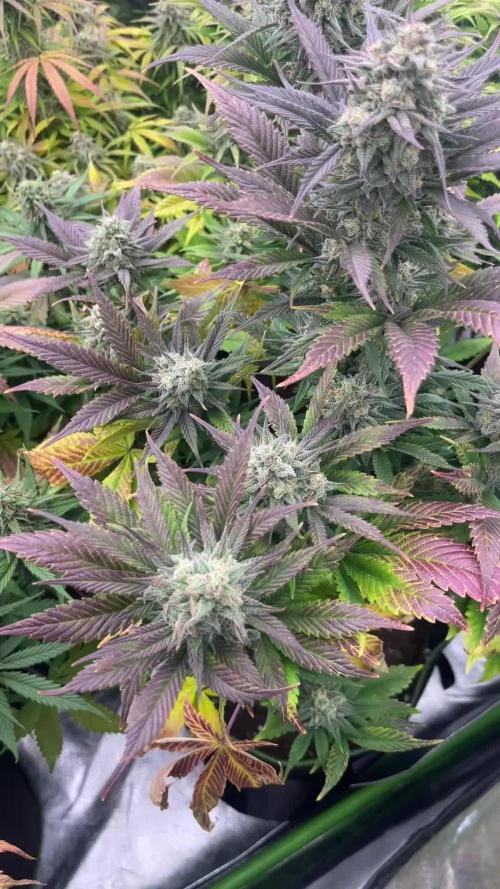
2025 Plagron / Zamnesia Eternity Grow Runtz Auto Week 11 Flower 7 Runtz Automatic is in her last week; March 17 had her wet trim and was put in the dark for 2 days before getting the chop on March 20. Runtz fade and nutrient usage apparent in the leaves combined with a check of her trichomes were an indication of readiness. The older pistils are turning orange brown and water consumption is slowing down. Many leaves were fully yellow and fell off when I touched them. Her leaves look pretty with lime greens, pinky purples in the bud formation. The buds are dense and covered in trichomes supported nicely with her stems. Through the microscope, the trichomes are mostly milky with some amber as well. She was harvested on day 74 from germination. As part of the flushing process, I topped the pot with ice, then watered with ph 6.5-6.7 water for 3 days. Then I put Runtz Auto in the dark for 2 days still in her pot. She will hang to dry in a darkened room. Temps are 71-72and 50% humidity. This week the gals were fed on March 17 & 19. Pics were taken on the 17th. Bloom Juice 120 ml Royal Rush 0 ml Power bud 15 ml Green sensation 15ml Cal Mag 20ml Recharge 5ml Ppm ranged from 676-777 Ph 6.5 Temp 68 Your likes and comments are appreciated. Thanks for stopping by. Growers love ๐Ÿ’š๐ŸŒฟ ๐Ÿ’ซNatrona๐Ÿ’ซ
Processing
Likes
15
Share
Likes
24
Share
What is up you sexy displays of humanness? It's week something lol.. 9 I think. I always forget if a week is passed then counted or vice versa lol. The plants look waaaaay better from the first time I flowered. I think the environmental controls like the AC and the light distance are finally all getting locked in. I could be messing up nutrients but based on what I see I'm not burning or underfeeding to my knowledge. I'm praying for that last fattening week for these things to bulk up because I'm pretty sure they have maybeeeeee 2 weeks then a 3-day flush. Yall are the experts though so feel free to weigh in. Especially with the plants looking all over the place. Ill bust out the electronic microscope for some trichome pics next week closer towards harvest time. I keep reading it's a long flower and they still have a lot of white pistons. Plants are hella icier though compared to the first run, they look stickier, and overall I'm feeling more accomplished. I can't tell if I'm leagues away from pulling 1 lb per plant. Now the right light...... ugh.. idk why but I was trying to get my damn BN link dual timer programmed bc I have the closet in there still vegging and once I plugged everything in that right light had half the board go out again. This happened a while back and after I've checked all the connections it just randomly came back on one day and I have not questioned it over the months. Kinda pissed I cant have 1 smooth day but that's life I guess haha. oh weird question but my rooms are completely sealed. they don't really have ducting or new air pumping in. Could the plants be suffocating themselves getting that big and flowering in a closed room? I've heard the air you breathe is more than enough most time and I don't want to burn unnecessary money but If they are logically just not getting enough Co2 to transpire then.. ya.. you get my point lol. Oh and I scratched the pk 13/14 bc i felt like I was pushing my luck with it only recommended for 1 week and also it's about the end of my knowledge so I figured cutting something extra was the safe bet. the leaves are all dark too
Likes
16
Share
This plant was the smallest of the 3 I am growing, she is now second biggest and by next week will be the tallest. Only using dry amendments and she is loving life. Going to be a good one.
Likes
12
Share
day 49 just pure water phed down. it is day 51, morning before lights on, I might chop today. I use a zero water filter pitcher got off walmart. My humidifier is only a sonic wave. If you use regular tap water it will get gunky in a sonic humidifier. If you have a heat humidifier that boils the water the mist should be clean. These are the 2 types of water humidifiers. Researching best water filters this "zero water" also comes with a free ppm meter! yay! Other water pitcher brands; the water still has ppm. So water misted will still have ppm contamination. You can easily used distilled water only, and reverse osmosis. I just fill a 4gal office water jug with the pitcher and fill my humidifier when needed. I do not use a humidifier in my entire grow up to this point when I chop, I need the perfect rh or this whole effort can fail. growing up to this point only requires 20% effort, chopping now for the 2 weeks dry is this 80% of crucial determination, succeed. A lot of tasks are required today for a clean chop. I feel confident, observed my cross seeds with pink paradise and one with a slightly open caylex looks dark enough for successful germination. I figured 8-16 seeds may be created, 3-4 buds were potentially pollinated. Many growers don't understand when creating genetics with female/female there is a slight chance of herm. You lose 50% of your genetic function. Just water last 2 days, no humic no folvic, 1st time entire grow ha! There is a lot of cleaning to do, remove the trees, clean the entire tent and environment with bleach water, hacksaw. I am very proud of my grow. I have sampled 3 of the strains, dr. thunder legit made my lips numb but it could have just been the terps removing my skin cells from the sticky filter, no lie. This is my best grow to date. I did this for you, and to document hype or not under the best conditions I could give my plants, full max potential, although I wish I had more lights, I am not looking for industrial lol, this is how I grow. Learn a lot on youtube and podcasts there is many good content and I may dab into it. You can have a room full of growers and you have 1 seed in your hand, they will all tell you that their way is correct ;) and the best way. Oreo is stinky AF, Bridal is just amazing glad its massive, just not into sativa but the test seemed slight sativa with majority indica, pink untested, dr, thunder just a lip numming plant aha, its very nice, all 4 amazing appeal like advertised, and excited for next run. Either crosses from this or other copycat genetics. I will give you beautiful glamout shots today, the sizes of the plants, My guesstimate bridal 1lb, thunder 1lb, pink, 0.4lb, bridal 0.5, I am ambitious off 640w lm301h, and 4x 20w blurples daisy chained. day 51 4 chopped see you in a few weeks :D
Likes
25
Share
@KivzBudz
Follow
In the end Iโ€™m very happy how this first Grow went. Tomorrow Iโ€™m gonna finish the other half and update some pictures. Curing begins now, canโ€™t wait to smell and taste the full cured terpens! ๐Ÿ˜‹๐ŸŒฑ
Likes
19
Share
@Mikado
Follow
Adding week 4, as I had it in "germination" in the diary a week too long. Brings it in line with it's size/maturity. Messed up my lighting for 48ish hours, left on 24hrs a day, due to flip flopping on going to flower.
Likes
19
Share
Strain was a great producer. shake: 41.5grams 77.5grams 2.0 grams Total= 121grams FLower: 116.6 112 60.1 57.3 63.7 44 26.1 Total: 479.9grams TOTAL Trim and Flower = 121 + 479.8 = 600.8grams = 21.25oz
Likes
57
Share
1/4: Moved a few other plants out of the closet, now they've got a little elbow room. Both Zenzations are fattening and frosting up very nicely. The Gorilla Girls have finally stopped stretching and are budding up nicely now. Their lowers are as all as the tops. The Black Jacks look great, too. 1/7: Fed today and gave them all a sniff test...killer stink from the Zenzations.๐Ÿ˜ต I added a dose of endoboost in their feed today...kinda worried about the monstrous size of my plants considering that they are only in 3 gallon pots..
Likes
45
Share
7/11 It's pouring. We got like 2 in of rain. I compared the flowering with that of the mendo breath I grew in a previous journal and they are real close. Tjat was DONE DONE in September. Judging by the small preflowers they are going to be ready approximately around the same time. I think I'm going to have a middle September harvest with some and some will go to October. Realistically, I should've changed this to flower. I like to call it "the stretch" though. Plants are stretching like a mother fucker. Seems like the less I fuck with them the better they do! No nutes yet. I'm going on vacation for a week and I think I won't feed before I leave either. Plants don't look like they are lacking in anything. Just because I have tons of nutes doesn't mean I need to use them. Still need to put up the secondary supports for flower. Went over after a break in the rain. Went through each plant one by one. Most had leaves that were either turning yellow or yellow at the bottom interior. I only removed leaves that were dead or dieing. I should probably have degoliated more but I'm doing the KISS method this year. Things seem to be doing good that way. Some minor pests. I found a slug but put out slug bait for those and earwigs. Noticed a few white flies and multi color flies (probably fungus knats but they are up at the top, not down by the soil. I'm going to think about it and do some research. Damage is so MINIMAL and pests are MINIMAL that im holding off spraying. I mat start nutes tomorrow though. I'm uncertain on a lot of things. I need to meditate on it. Just because those interior leaves died the plants are still a LUSH dark green so I think they're alright. It's going really good but I'm going to be on vacation for a week. I can still monitor daily with my camera's and my family that is watching them will FaceTime me every morning and show me what's going on. They know what they're doing and if something arises I have BASICALLY a growers union in my town. All family. We look after each other. That's the only reason I considered even going. However, the event horizons, sherb pie, toasted toffy and AT LEAST 1 GMO "LOOK" like they will be flowering early. Like I said they look similar to a mendo breath pheno on another diary that finished in September. We shall see. I'm excited that's for sure! 7/12 So far no rain! Super hot and muggy. Killed a jpn beetle and a moth larvae this morning and another beetle this afternoon. I'm seeing SOME pest damage which makes me want to spray before some of these plants take off flowering. There isn't much damage and tje birds sit on the top just WAITING for a chance to swoop in and grab something. I've seen tons of wasps tjis year. I killed a snail yesterday and put out slug bait around my pallets. I'm leaving early tomorrow. I'm CONSIDERING doing an application of Cap'n Jack's before I leave. I'm not sure. I made little DIY videos for dad and I hope he follows them. If not I'll have another grower come help. With all the rain I noticed some white flies when I shook a couple plants. I don't have time to really deal with it right now. There were only a few and I think spinosad would kill those too. Either way it will be fine. I can monitor via camera. I can even hit an alarm that goes to four different people. Still. I don't like leaving my girls. Especially in this heat. 7/13 Left early for a short vacation. Just got a picture saying it's sunny there and my plants are doing good. I'm lucky to havecthe crew that I do. I'm sure if I asked they'd put up yellow sticky traps. That's something I may consider. 7/14 Dad said it Rained last night and driving down here it was just PURE SHEET RAIN. He sent me pics I uploaded and everything looks GREAT! gonna get sun after all that rain and wind. They are gonna explode! 7/15 Still on Vacation. Dad showed me the plants and said they looked a little dry so I had him use the 4 GALLONS OF WATER I HAD PREMIXED FOR HIM TO WATER THE GARDEN. This way each plant gets a half gallon. It's supposed to be in the 90's with no rain tonight. Rains euppised to come tomorrow but I've seen how fast a bag can dry out in ONE day with super hot weather and high winds. The wind blows through the bag drying the medium out. Dad's right. Things do look amazing. I'm having fun but it will be nice to get back and see if I was right and those few plants are trying to flower. Looks just like those two mendo phenomes that flowered early. 7/16 still on vacation. Got a nice rain for the plants. Not much though. 7/17 Had DAD WATER FOUR GALLONS ON THE GARDEN. ANOTHER HEAT ADVISORY IN EFFECT. I really miss my girls. I'm ready to get going and start doing the things that need to be done. Few more days and I'll be home with my pretty ladies. Last time I came back to nice little flowers. They looked about in the same stage when I left. I love early finishers. They're stretching thsts for sure.
Likes
28
Share
Beginning of week.. I raised the lights a little.. They are at 50% power at 18" (roughly) from the plants. The ladies are getting from 420 to 500 PPFD. Went ahead and fed them some extra FloraMicro this week.. I'm guessing they are just very hungry girls.. And I'm thinking the pH in the rootzone issue is not clearing up at all.. BUT.. It seems like no matter what pH I water them with.. The runoff ALWAYS comes out at 5.8 or 5.9 with the Mandarin Cookies and 5.8 or 5.7 with the ETHOS Cookies.. So if you want to reuse your coco coir.. Make sure to remove ALL the roots. The girls dont look too bad at all.. And that's why I'm guessing they just needed more nutes in the mix.. We shall see how this week goes! Mid week.. They are looking alot better! Mandarin Cookies is exploding woth growth.. ETHOS Cookies is growing slow but she is growing for sure.. I think I may need to remove a node or 2 on the ETHOS Cookies.. I could just leave it.. But the very top 2 are covering alot of tops.. I could make some clones from it.. Hmm.. All-in-all.. I'm happy with how these girls are growing for now tho.. This rootzone issue isnt going away.. But I think I found a way to make it work out.. I've been watering a little differently.. Here is a bit of an example: Day 1: Feed at 6.5 Day 3: Water at 6.4 Day 5: Feed at 6.3 Day 7: Water at 6.2 Day 9: Feed at 6.5 Day 11: Water at 6.4 Day 13: Feed at 6.3 Day 15: Water at 6.2 Etc... The runoff is staying above 5.5 each time.. But as I lower the pH, the runoff pH lowers as well (obviously).. So I think watering this way has helped keep these gorgeous ladies happy.. And theyare also very hungry.. I may have to start watering one plant every other day.. Water plant 1 tomo.. Water plant 2 the next day.. Then plant 1 the next day and then plant 2 the next day etc... 1 reason I want to start doing it that way is because I think the ETHOS Cookies isn't needing as much nutes as the Mandarin Cookies.. But they are looking great. Very happy and so are they! The heat has been insane lately.. So at the hottest part of the day I try to just turn the light down to 25% for 4 hours or so.. I hate having to do that.. But it's all I can do for now.. Or maybe change the light/dark hours.. Blah.. Whatever, they are happy! End of week.. I supercropped 2 branches.. They pretty much healed up and are already back to normal.. Like it didnt bring them down any lower at all lol.. It straightened back up and its as if nothing happened.. Just a big ass (MOOSE) knuckle lol.. But I stopped using the Kushie Kush and was just using the normal Gen Hydro FloraBloom in the mix. Will be upping the FloraGro next week! Wow.. Such hungry ladies! It's been so long since I've grown a bigger photo period.. I forgot how much they can take!.. On to the next!...
Likes
34
Share
Yellow butterfly came to see me the other day; that was nice. Starting to show signs of stress on the odd leaf, localized isolated blips, blemishes, who said growing up was going to be easy! Smaller leaves have less surface area for stomata to occupy, so the stomata are packed more densely to maintain adequate gas exchange. Smaller leaves might have higher stomatal density to compensate for their smaller size, potentially maximizing carbon uptake and minimizing water loss. Environmental conditions like light intensity and water availability can influence stomatal density, and these factors can affect leaf size as well. Leaf development involves cell division and expansion, and stomatal differentiation is sensitive to these processes. In essence, the smaller leaf size can lead to a higher stomatal density due to the constraints of available space and the need to optimize gas exchange for photosynthesis and transpiration. In the long term, UV-B radiation can lead to more complex changes in stomatal morphology, including effects on both stomatal density and size, potentially impacting carbon sequestration and water use. In essence, UV-B can be a double-edged sword for stomata: It can induce stomatal closure and potentially reduce stomatal size, but it may also trigger an increase in stomatal density as a compensatory mechanism. It is generally more efficient for gas exchange to have smaller leaves with a higher stomatal density, rather than large leaves with lower stomatal density. This is because smaller stomata can facilitate faster gas exchange due to shorter diffusion pathways, even though they may have the same total pore area as fewer, larger stomata. Leaf size tends to decrease in colder climates to reduce heat loss, while larger leaves are more common in warmer, humid environments. Plants in arid regions often develop smaller leaves with a thicker cuticle and/or hairs to minimize water loss through transpiration. Conversely, plants in wet environments may have larger leaves and drip tips to facilitate water runoff. Leaf size and shape can vary based on light availability. For example, leaves in shaded areas may be larger and thinner to maximize light absorption. Leaf mass per area (LMA) can be higher in stressful environments with limited nutrients, indicating a greater investment in structural components for protection and critical resource conservation. Wind speed, humidity, and soil conditions can also influence leaf morphology, leading to variations in leaf shape, size, and surface characteristics. Small leaves: Reduce water loss in arid or cold climates. Environmental conditions significantly affect gene expression in plants. Plants are sessile organisms, meaning they cannot move to escape unfavorable conditions, so they rely on gene expression to adapt to their surroundings. Environmental factors like light, temperature, water, and nutrient availability can trigger changes in gene expression, allowing plants to respond to and survive in diverse environments. Depending on the environment a young seedling encounters, the developmental program following seed germination could be skotomorphogenesis in the dark or photomorphogenesis in the light. Light signals are interpreted by a repertoire of photoreceptors followed by sophisticated gene expression networks, eventually resulting in developmental changes. The expression and functions of photoreceptors and key signaling molecules are highly coordinated and regulated at multiple levels of the central dogma in molecular biology. Light activates gene expression through the actions of positive transcriptional regulators and the relaxation of chromatin by histone acetylation. Small regulatory RNAs help attenuate the expression of light-responsive genes. Alternative splicing, protein phosphorylation/dephosphorylation, the formation of diverse transcriptional complexes, and selective protein degradation all contribute to proteome diversity and change the functions of individual proteins. Photomorphogenesis, the light-driven developmental changes in plants, significantly impacts gene expression. It involves a cascade of events where light signals, perceived by photoreceptors, trigger changes in gene expression patterns, ultimately leading to the development of a plant in response to its light environment. Genes are expressed, not dictated! While having the potential to encode proteins, genes are not automatically and constantly active. Instead, their expression (the process of turning them into proteins) is carefully regulated by the cell, responding to internal and external signals. This means that genes can be "turned on" or "turned off," and the level of expression can be adjusted, depending on the cell's needs and the surrounding environment. In plants, genes are not simply "on" or "off" but rather their expression is carefully regulated based on various factors, including the cell type, developmental stage, and environmental conditions. This means that while all cells in a plant contain the same genetic information (the same genes), different cells will express different subsets of those genes at different times. This regulation is crucial for the proper functioning and development of the plant. When a green plant is exposed to red light, much of the red light is absorbed, but some is also reflected back. The reflected red light, along with any blue light reflected from other parts of the plant, can be perceived by our eyes as purple. Carotenoids absorb light in blue-green region of the visible spectrum, complementing chlorophyll's absorption in the red region. They safeguard the photosynthetic machinery from excessive light by activating singlet oxygen, an oxidant formed during photosynthesis. Carotenoids also quench triplet chlorophyll, which can negatively affect photosynthesis, and scavenge reactive oxygen species (ROS) that can damage cellular proteins. Additionally, carotenoid derivatives signal plant development and responses to environmental cues. They serve as precursors for the biosynthesis of phytohormones such as abscisic acid () and strigolactones (SLs). These pigments are responsible for the orange, red, and yellow hues of fruits and vegetables, while acting as free scavengers to protect plants during photosynthesis. Singlet oxygen (ยนOโ‚‚) is an electronically excited state of molecular oxygen (Oโ‚‚). Singlet oxygen is produced as a byproduct during photosynthesis, primarily within the photosystem II (PSII) reaction center and light-harvesting antenna complex. This occurs when excess energy from excited chlorophyll molecules is transferred to molecular oxygen. While singlet oxygen can cause oxidative damage, plants have mechanisms to manage its production and mitigate its harmful effects. Singlet oxygen (ยนOโ‚‚) is considered a reactive oxygen species (ROS). It's a form of oxygen with higher energy and reactivity compared to the more common triplet oxygen found in its ground state. Singlet oxygen is generated both in biological systems, such as during photosynthesis in plants, and in cellular processes, and through chemical and photochemical reactions. While singlet oxygen is a ROS, it's important to note that it differs from other ROS like superoxide (Oโ‚‚โป), hydrogen peroxide (Hโ‚‚Oโ‚‚), and hydroxyl radicals (OH) in its formation, reactivity, and specific biological roles. Non-photochemical quenching (NPQ) protects plants from damage caused by reactive oxygen species (ROS) by dissipating excess light energy as heat. This process reduces the overexcitation of photosynthetic pigments, which can lead to the production of ROS, thus mitigating the potential for photodamage. Zeaxanthin, a carotenoid pigment, plays a crucial role in photoprotection in plants by both enhancing non-photochemical quenching (NPQ) and scavenging reactive oxygen species (ROS). In high-light conditions, zeaxanthin is synthesized from violaxanthin through the xanthophyll cycle, and this zeaxanthin then facilitates heat dissipation of excess light energy (NPQ) and quenches harmful ROS. The Issue of Singlet Oxygen!! ROS Formation: Blue light, with its higher energy photons, can promote the formation of reactive oxygen species (ROS), including singlet oxygen, within the plant. Potential Damage: High levels of ROS can damage cellular components, including proteins, lipids, and DNA, potentially impacting plant health and productivity. Balancing Act: A balanced spectrum of light, including both blue and red light, is crucial for mitigating the harmful effects of excessive blue light and promoting optimal plant growth and stress tolerance. The Importance of Red Light: Red light (especially far-red) can help to mitigate the negative effects of excessive blue light by: Balancing the Photoreceptor Response: Red light can influence the activity of photoreceptors like phytochrome, which are involved in regulating plant responses to different light wavelengths. Enhancing Antioxidant Production: Red and blue light can stimulate the production of antioxidants, which help to neutralize ROS and protect the plant from oxidative damage. Optimizing Photosynthesis: Red light is efficiently used in photosynthesis, and its combination with blue light can lead to increased photosynthetic efficiency and biomass production. In controlled environments like greenhouses and vertical farms, optimizing the ratio of blue and red light is a key strategy for promoting healthy plant growth and yield. Understanding the interplay between blue light signaling, ROS production, and antioxidant defense mechanisms can inform breeding programs and biotechnological interventions aimed at improving plant stress resistance. In summary, while blue light is essential for plant development and photosynthesis, it's crucial to balance it with other light wavelengths, particularly red light, to prevent excessive ROS formation and promote overall plant health. Oxidative damage in plants occurs when there's an imbalance between the production of reactive oxygen species (ROS) and the plant's ability to neutralize them, leading to cellular damage. This imbalance, known as oxidative stress, can result from various environmental stressors, affecting plant growth, development, and overall productivity. Causes of Oxidative Damage: Abiotic stresses: These include extreme temperatures (heat and cold), drought, salinity, heavy metal toxicity, and excessive light. Biotic stresses: Pathogen attacks and insect infestations can also trigger oxidative stress. Metabolic processes: Normal cellular activities, particularly in chloroplasts, mitochondria, and peroxisomes, can generate ROS as byproducts. Certain chlorophyll biosynthesis intermediates can produce singlet oxygen (1O2), a potent ROS, leading to oxidative damage. ROS can damage lipids (lipid peroxidation), proteins, carbohydrates, and nucleic acids (DNA). Oxidative stress can compromise the integrity of cell membranes, affecting their function and permeability. Oxidative damage can interfere with essential cellular functions, including photosynthesis, respiration, and signal transduction. In severe cases, oxidative stress can trigger programmed cell death (apoptosis). Oxidative damage can lead to stunted growth, reduced biomass, and lower crop yields. Plants have evolved intricate antioxidant defense systems to counteract oxidative stress. These include: Enzymes like superoxide dismutase (SOD), catalase (CAT), and various peroxidases scavenge ROS and neutralize their damaging effects. Antioxidant molecules like glutathione, ascorbic acid (vitamin C), C60 fullerene, and carotenoids directly neutralize ROS. Developing plant varieties with gene expression focused on enhanced antioxidant capacity and stress tolerance is crucial. Optimizing irrigation, fertilization, and other management practices can help minimize stress and oxidative damage. Applying antioxidant compounds or elicitors can help plants cope with oxidative stress. Introducing genes for enhanced antioxidant enzymes or stress-related proteins over generations. Phytohormones, also known as plant hormones, are a group of naturally occurring organic compounds that regulate plant growth, development, and various physiological processes. The five major classes of phytohormones are: auxins, gibberellins, cytokinins, ethylene, and abscisic acid. In addition to these, other phytohormones like brassinosteroids, jasmonates, and salicylates also play significant roles. Here's a breakdown of the key phytohormones: Auxins: Primarily involved in cell elongation, root initiation, and apical dominance. Gibberellins: Promote stem elongation, seed germination, and flowering. Cytokinins: Stimulate cell division and differentiation, and delay leaf senescence. Ethylene: Regulates fruit ripening, leaf abscission, and senescence. Abscisic acid (ABA): Plays a role in seed dormancy, stomatal closure, and stress responses. Brassinosteroids: Involved in cell elongation, division, and stress responses. Jasmonates: Regulate plant defense against pathogens and herbivores, as well as other processes. Salicylic acid: Plays a role in plant defense against pathogens. 1. Red and Far-Red Light (Phytochromes): Red light: Primarily activates the phytochrome system, converting it to its active form (Pfr), which promotes processes like stem elongation and flowering. Far-red light: Inhibits the phytochrome system by converting the active Pfr form back to the inactive Pr form. This can trigger shade avoidance responses and inhibit germination. Phytohormones: Red and far-red light regulate phytohormones like auxin and gibberellins, which are involved in stem elongation and other growth processes. 2. Blue Light (Cryptochromes and Phototropins): Blue light: Activates cryptochromes and phototropins, which are involved in various processes like stomatal opening, seedling de-etiolation, and phototropism (growth towards light). Phytohormones: Blue light affects auxin levels, influencing stem growth, and also impacts other phytohormones involved in these processes. Example: Blue light can promote vegetative growth and can interact with red light to promote flowering. 3. UV-B Light (UV-B Receptors): UV-B light: Perceived by UVR8 receptors, it can affect plant growth and development and has roles in stress responses, like UV protection. Phytohormones: UV-B light can influence phytohormones involved in stress responses, potentially affecting growth and development. 4. Other Colors: Green light: Plants are generally less sensitive to green light, as chlorophyll reflects it. Other wavelengths: While less studied, other wavelengths can also influence plant growth and development through interactions with different photoreceptors and phytohormones. Key Points: Cross-Signaling: Plants often experience a mix of light wavelengths, leading to complex interactions between different photoreceptors and phytohormones. Species Variability: The precise effects of light color on phytohormones can vary between different plant species. Hormonal Interactions: Phytohormones don't act in isolation; their interactions and interplay with other phytohormones and environmental signals are critical for plant responses. The spectral ratio of light (the composition of different colors of light) significantly influences a plant's hormonal balance. Different wavelengths of light are perceived by specific photoreceptors in plants, which in turn regulate the production and activity of various plant hormones (phytohormones). These hormones then control a wide range of developmental processes.
Likes
1
Share
Great newsโ€”my Banana Kush seed has popped and is standing tall! ๐ŸŽ‰ Tiny cotyledons are already showing a healthy green, and Iโ€™m excited to watch this girl take off over the next few days. Hereโ€™s to a strong start! #BananaKush #Seedling #GrowDiaries **Day 5 โ€“ Seedling Update** Great news: all three Banana Kush seedlings are settling into veg! ๐ŸŒฑ The cotyledons look bright and healthy, and each plant has its first true leaf set. They did stretch a touch at the start, but the lowered light and steady airflow should help them thicken up fast. --- ### Environment * **Temp / RH:** 25 ยฐC day โ€“ 21 ยฐC night / **75 % RH** * **Light:** LED at 35 %, now **20 cm** above the canopy, 18/6 schedule * **Airflow:** Two fans have been running unfortunatley only since yesterday to keep fresh air moving and strengthen the stems * **Medium:** Light mix with extra perlite in 0.5 L peat pots on a seed-heat mat ### Watering & Feed * Still giving only **plain Gerolsteiner Naturell** (pH โ‰ˆ 6.2 out of the bottle) โ€“ no nutrients yet; runoff looks clean. ### Observations * Stems are a little lanky from the earlier light distance, but colour is good and the new growth looks happy. * Roots should start circling the peat pots soon; a gentle tug already shows light resistance. ### Next Moves 1. **Up-pot in 3โ€“4 days** into 3 L Air-Pots and bury an extra couple of centimetres of stem to fix the stretch. 2. Keep RH around 70โ€“75 % for another week, then start lowering to ~60 % as they bulk up. 3. Gradually ramp the light to 40โ€“45 % once theyโ€™re settled in the new pots. So far, so sweetโ€”hereโ€™s hoping for chunky Banana Kush colas down the road! ๐ŸŒโœจ
Likes
45
Share
@yan420
Follow
FERMAKOR BARREL MIX โ€“ BASE IN USE (Testing on the Fantasy Feast girl we pulled out of another diary https://growdiaries.com/diaries/274722-grow-journal-by-yan402 ) (FERMAKOR BASE SYSTEM KOH VERSION diary https://growdiaries.com/diaries/278391-grow-journal-by-yan402) (Urea & Micros on the way โ€” first week running without them) ๐Ÿถ๐Ÿ’ง๐Ÿถ๐Ÿ’ง๐Ÿถ๐Ÿ’ง๐Ÿถ๐Ÿ’ง๐Ÿถ ๐Ÿ’ง 30 L Barrel โ€“ Current Working Mix ๐Ÿถ๐Ÿ’ง๐Ÿถ๐Ÿ’ง๐Ÿถ๐Ÿ’ง๐Ÿถ๐Ÿ’ง๐Ÿถ Step 1 โ€“ Calcium Nitrate (Part A) 7 L warm water (~35โ€“40 ยฐC) โ†’ added 45 g Calcinit, stirred until fully clear. Thatโ€™s the calcium + nitrogen backbone for the feed. Step 2 โ€“ FERMAKOR PK Base (Part B) 15 L water in the main barrel โ†’ added 30 ml FERMAKOR PK Concentrate, mixed well. This forms the main P + K part of the formula. Step 3 โ€“ Combine Solutions Slowly poured the Calcinit mix into the barrel while stirring โ€” no reaction, still crystal clear. That confirms the mix is stable and precipitation-free. ๐ŸŒฟ Step 4 โ€“ FPJ / FFJ Batch Added 30 ml homemade FPJ (fish + veg batch) โ‰ˆ 1 ml/L. Color shifted to a light-amber tone โ€” looks alive and active. ๐Ÿ‹ Step 5 โ€“ Citric Acid Balance Added 1 tsp citric acid after everything was blended to fine-tune pH and help chelate micros later on. ๐Ÿ“ฆ Step 6 โ€“ Top Up & Check Filled to the 30 L mark with plain water โ†’ pH tested with drops, showing yellow-green โ€” roughly 5.8 โ€“ 6.0 range. Nice clean look, stable smell, no residue. ๐Ÿ’ง Current Base Ingredients (Active Mix) Warm Water โ‰ˆ 22 L total Calcinit 45 g โ†’ N + Ca foundation FERMAKOR PK Base 30 ml โ†’ P + K support Citric Acid 1 tsp โ†’ Chelation + pH balance FPJ / Fish Emulsion 30 ml โ†’ Organic enzyme booster Result: clean amber mix, mild and balanced. Iโ€™ll let this version run for a week before adding anything. ๐Ÿ‘€๐Ÿ‘€๐Ÿ‘€๐Ÿ‘€๐Ÿ‘€๐Ÿ‘€ Observations and changes ๐Ÿ‘€๐Ÿ‘€๐Ÿ‘€๐Ÿ‘€๐Ÿ‘€๐Ÿ‘€ 27.10.25 VW27 noticed some min burnt tips so I decreased Calcium Nitrate 45 to โ†’ 40g, decided to add two more elements micros and Epsom salts just to make sure they got everything, Fetrilon Combi 1 (Micros): 0.5 g, Epsom salts: 8 g 28.10.25 VW27 she seems devoid of any deficiencies, seems ready for the flip to 12/12 02.11.25 VW27 girl is looking good so I decided to stop making daily videos and do a standard once a week update. 09.11.25 aVW28 7 days since flip,stretch in full swing, first pistils showing, leaf color deep and healthy. Slight tip burn early week โ†’ gone after pH stabilized. Feed stayed clear, no residue, roots clean and sweet-smelling, did what I hope is a last cleanup and pruning๐ŸŽฅ 10.11.25 VW29 added Phosphoric acid pH down to the schedule for flowering stage. 14.11.25 FW1 FERMAKOR PK Micros 40 โ†’ 50 ml 23.11.25 FW2 got some burnt tips, observe and act accordingly in case it worsens, diluted by 25% for this week. ๐ŸŒฑ๐Ÿ’ฆ๐ŸŒฑ๐Ÿ’ฆ๐ŸŒฑ๐Ÿ’ฆ๐ŸŒฑ๐Ÿ’ฆ๐ŸŒฑ๐Ÿ’ฆ๐ŸŒฑ ๐ŸŒฟDay to day tasks & actions ๐ŸŒฟ ๐ŸŒฑ๐Ÿ’ฆ๐ŸŒฑ๐Ÿ’ฆ๐ŸŒฑ๐Ÿ’ฆ๐ŸŒฑ๐Ÿ’ฆ๐ŸŒฑ๐Ÿ’ฆ๐ŸŒฑ 23.11.25 FW1 โ€“ Fed 3l of #1 โ†’ 1l runoff 24.11.25 FW2 โ€“ Fed 5l of #1 โ†’ 2l runoff 25.11.25 FW2 โ€“ Fed 5l of #1 โ†’ 2l runoff 26.11.25 FW2 โ€“ Fed 5l of #1 โ†’ 2l runoff 27.11.25 FW2 โ€“ Fed 5l of #1 โ†’ 2l runoff 28.11.25 FW2 โ€“ Fed 5l of #1 โ†’ 2l runoff 29.11.25 FW2 โ€“ Fed 5l of #1 โ†’ 2l runoff 30.11.25 FW2 โ€“ Fed 5l of #1 โ†’ 2l runoff ๐Ÿถ๐Ÿ’ง๐Ÿถ๐Ÿ’ง๐Ÿถ๐Ÿ’ง๐Ÿถ๐Ÿ’ง๐Ÿถ ๐Ÿ’ง Nutrients in 30 L #1 Veg โ€” FERMAKOR ๐Ÿถ๐Ÿ’ง๐Ÿถ๐Ÿ’ง๐Ÿถ๐Ÿ’ง๐Ÿถ๐Ÿ’ง๐Ÿถ ๐Ÿ’ง Calcium Nitrate (Calcinit / Nitcal): 45 g โ†’ 40 g โ†’ 35 g = 1.33 g/L โ†’ 207 ppm N + 253 ppm Ca = 1.17 g/L โ†’ 183 ppm N + 224 ppm Ca (current) ๐Ÿ’ง PK Concentrate (FERMAKOR Base): 30 ml โ†’ 40 ml โ†’ 50 ml = 1.00 โ†’ 1.33 โ†’ 1.66 ml/L โ†’ balanced 1:1 P:K + light micros (from extract) ๐Ÿ’ง Home-made FFJ/FPJ (Fish + Veg): 30 ml = 1.00 ml/L Epsom Salt (MgSOโ‚„ยท7Hโ‚‚O): 8 g = 0.27 g/L โ†’ 26 ppm Mg + 35 ppm S ๐Ÿ’ง Fetrilon Combi 1 (Micros): 0.5 g = 0.017 g/L โ†’ Fe 0.7 ppm โ€ข Mn 0.7 ppm โ€ข Zn 0.3 ppm โ€ข Cu 0.3 ppm โ€ข B 0.1 ppm โ€ข Mo 0.02 ppm Phosphoric Acid (pH down) + Citric Acid (chelation): โ†’ First set pH with phosphoric acid โ†’ Add a little citric only if extra chelation is needed ๐Ÿ’ง Target pH: 5.8 โ€“ 6.0 (drop test yellow-green) ๐Ÿ“ฆ TOTAL Inputs: 60 ml โ†’ 70 ml โ†’ 80 ml / 48.5 g per 30 L = 2.00 โ†’ 2.33 โ†’ 2.66 ml/L + 1.62 g/L (current) YouTube Link: https://youtube.com/-m8h?si=A7x4Zlr2kj-_ga31