


Likes
Comments
Share


@DrLaggis
Follow
🌱 Day 57 - Start of the Second-to-Last Flowering Week 🌱
Hello, Grow Friends!
Today marks the start of the second-to-last flowering week—Week 9 overall, and Week 5 of flowering. 🌿 I’m getting more and more excited as my first grow nears its end. As I approach harvest, I’ve decided, based on my research, to stop feeding nutrients and stick to just pH-adjusted water for the final two weeks. 💧⚖️
Watering Routine:
I’ll keep the same watering schedule—1 liter every two days, which is about 10% of the pot volume. 🌱💧 This should be enough to flush out the remaining nutrients, ensuring a clean finish for the plant.
Temperature & Humidity:
The temperature remains stable between 19-23°C, which I believe is ideal for this stage of the grow. 🌡️🍂 No more high temperatures to worry about! The humidity is fluctuating between 45-58%, and I’m keeping a close eye on it to stay below 60%. 💧🔍 Everything seems on track for now. 🌿
Plant Health & Growth:
The plant still looks very healthy overall. 🌱💪 However, I’ve noticed that in the past three days, there haven’t been any visible changes in the size of the buds. 🤔 It could just be that I’m not seeing the growth clearly, but the only noticeable change is the daily opening of new flower calyxes. 🌸
Harvest Preparation:
I’m already getting my equipment ready for drying after harvest. 🛠️ Once it’s time to cut, I’ll be hanging the plant to dry for the first 10 days. 🌿✂️ I want to make sure everything is set for a smooth drying process.
Stay tuned for more updates, and as always, daily photos of the plant will be posted! 📸🌱

Likes
33
Share

@valiotoro
Follow
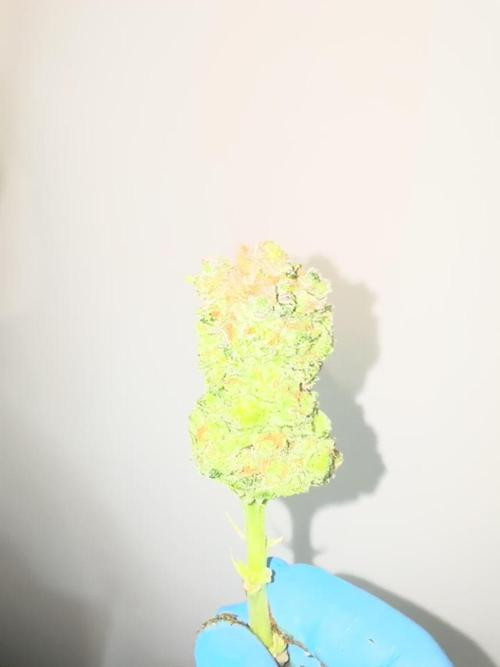
Rock-hard buds, insanely sticky, with a truly sublime aroma… couldn’t ask for more 🔥


Likes
16
Share


@GreenMunchkin
Follow
Week 7 let's go !
Day 152 - 04/11 : The plant symptoms have seemed to slow down. The soil is also starting to dry out a bit more which might have been a problem.
Day 155 - 07/11 : She was flushed in the morning with about 4L of water and 2L of a 30% strength microbial+trichoderma tea to innocculate the soil in case the microlife took a hit. The run off was 1L.
I also switched the 400W MH for a 400W HPS to finish off with a little extra boost of light + different spectrum and see if it makes any differences.
The light were moved up by approximately 20-30cm. They are now at about 70cm from the plant. I wondered if the light were maybe too close and caused all those strange symptoms. Let's see if there is any change in their behaviour.
Day 156 - 08/11 :
It seems the plant is a lot happier. It has only been a day but I feel like she is fattening up faster suddenly. Or it could be that she has recovered from the slight chock from a few days ago.
Day 158 - 10/11 :
Yep she is definitely happy again. I am convinced it was the light or at least it was part of the problem, I am seeing a lot of growth all of a sudden, on all plants and not just this one. Trichome are up, pistilles are up, calyxes swelling, everything is running smooth again. She is looking ready already, from a bud general appearance I could almost harvest now, but the trichomes are still mostly clear and I have a feeling she has a little more in her. I suspect the reason for such large amount of already brown trichomes might have been the light excess they went through.


Likes
16
Share


@Big_Rade_SCLA
Follow
Great week. I simply keep watering more. I'm going to start with the juices and more kelp meal sprinkles next week.
They're getting taller by the day and no sign of being waterlogged and no runoff either. Green, smelly, in pre-flowering or transition state, companion plants taking off also. Haven't spotted any males or male pollen sacks in the grow area after the removal of 6 identified males. No pollination from my grow, but the environment is wild for pollen around here--i get seeds every year--even if it's just 8 seeds from a whole pound of harvest--a bee lands on the flowers in mid-october and it's like 50/50 seed or not in that location--just saying that it's part of growing outdoors without a net.


Likes
15
Share


@lemonairlines
Follow
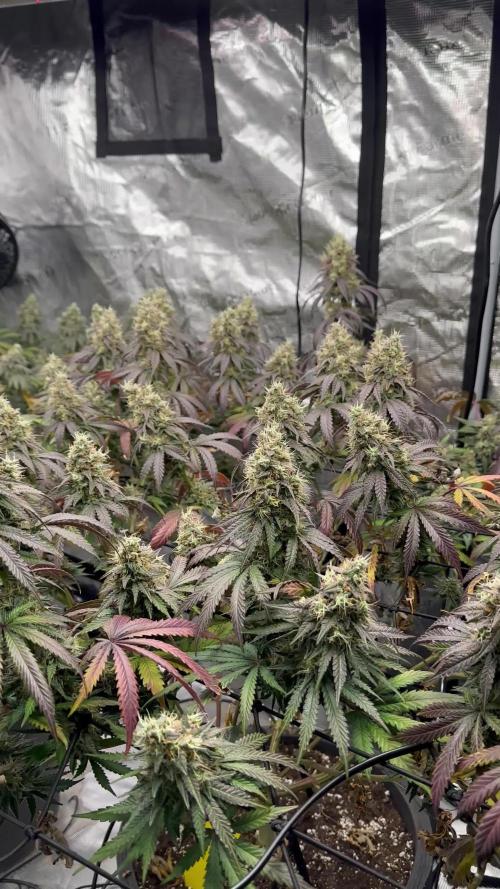
I came to the end of a period that lasted about 4 months. I got really bored on last weeks. It took 128 days , Finally, I kept it in the dark for 3 days. I really like this genetics, easy to grow and durable .It is also very successful in terms of smell and aroma. it would be much better if my pot size was a little bigger , lower buds could fat more but still pretty nice buds . Let's see how the numbers will be


Processing
Likes
5
Share


@Rushif90
Follow
Buds plumping up now the tallest of the 3 strains I’m running now but it’s also the least in diameter and canopy density but it’s good for the density it has I still have to defoliate but no where near as often as say the Alaskan purple witch I have to pull 5 to 8 leaves a day and no matter how many you pull the center of the plants like a jungle.


Likes
2
Share


@InsideAz
Follow
What an amazing plant, was really a pain for me because it had weak branches and my lack of knowledge on this plants structure showed throughout the grow.
Despite my shortcomings this plant did outstanding, I think it is the best Marijuana I’ve grown alongside the Lovers Moon and Nana plants
Dipping into the stash 1 month into cure and it tastes amazing. Not harsh at all, smells of a powerfully dank herbally pine with hints of pepper in the aftertaste. 1-2 months more of cure and this plant will be at its peak she’s only getting started. I’ll still be dipping into the stash whenever I please at this point.
Been putting alot of effort into my cure and keeping my jars fresh and below 58% rh
My goal is 50-55. Have tried higher humidities in the past and had complaints or problems with the smell short and long term. So far the 50’s humidity has been doing well and you can tell the closer to 50 they get the better they smell. With time.
I will try to upload edited pictures of the buds to make them closer to what I see with the naked eyee
If you read all that I really appreciate your interest and know that photos are hard to take of frosty bud (: 🌞
Likes
107
Share


@MrJones
Follow
Mr-Jones Strawberry Pie Auto by FastBuds
🍓╰⊰🍓´🍓⊱╮🍓╰⊰🍓´🍓⊱╮🍓╰⊰🍓´🍓⊱╮🍓╰⊰🍓´🍓⊱╮🍓
🌞Environment - Contenu to work on ensuring that the Humidity stays above 45%
💧 Feeding - Using "Super Coco" amended soil. compost teas, Dechlorinated H20 PH/6.5 Fish Fertilizer
🍃Training / None just keeping things defoliated.
🕷️ IPM - Will be using Green Cleaner" 1 OZ per Gallon, and CannControl from Mammoth alternating between product each month for Integrated Pest Management.
💡"960 Watts of LED's 4x8x8 Custom Grow Closet"💡
🍓╰⊰🍓´🍓⊱╮🍓╰⊰🍓´🍓⊱╮🍓╰⊰🍓´🍓⊱╮🍓╰⊰🍓´🍓⊱╮🍓
Rambling - Completing Week 10 here, and this girl continues to do much better, stacking on the bud weight.
🍓╰⊰🍓´🍓⊱╮🍓╰⊰🍓´🍓⊱╮🍓╰⊰🍓´🍓⊱╮🍓╰⊰🍓´🍓⊱╮🍓
▶️Monday 01.18.21 / Watered w/ Dechlorinated H20 PH 5.8 / 6.2
▶️Tuesday 01.19.21 / Watered w/ Dechlorinated H20 PH 5.8 / 6.2
▶️Wednesday 01.20.21 / Watered w/ Dechlorinated H20 PH 5.8 / 6.2
▶️Thursday 01.21.21 / Watered w/ Dechlorinated H20 PH 5.8 / 6.2
▶️Friday 01.22.21 / Watered w/ Dechlorinated H20 PH 5.8 / 6.2
▶️Saturday 01.23.21 / Watered w/ Dechlorinated H20 PH 5.8 / 6.2
▶️Sunday 01.24.21 / Watered w/ Dechlorinated H20 PH 5.8 / 6.2
🍓╰⊰🍓´🍓⊱╮🍓╰⊰🍓´🍓⊱╮🍓╰⊰🍓´🍓⊱╮🍓╰⊰🍓´🍓⊱╮🍓
SOIL MIX
COCO - 70/30% Tupur Royal Gold 30 GALLON
WORM CASTINGS 5 GALLON
LOBSTER COMPOST 5 GALLON
PERLITE 6 GALLON
INSECT FRASS 2 CUP
ORGANICALLY DONE GROW 5 CUPS
BUILD A SOIL COCO MINERAL MIX 6 CUPS
Likes
170
Share


@Master_weeda
Follow
Bonjour à tous les padawans et maîtres jedis
Quel plaisir mes amis tout y est dans ce diarie !
À par le rendement 😁 mais bon ce n'était vraiment pas le but car je me suis rendu la tâche encore plus difficile en tentant l'expérience solo cup challenge avec main-lining sur une autofloraison.
Merci pour tout vos compliment votre soutient et votre gentillesse.
Je me suis vraiment amusé et j'ai pris beaucoup de plaisir avec ce diarie, mais j'ai surtout beaucoup appris. Que la force soit avec vous 💪

Likes
45
Share


@chapadux420r
Follow
What’s up dudes?
Well, 4 weeks since 12/12 light schedule and it’s everything going very well.
As you can see I started noting some brownish tips in some leafs what got me a little bit worried but guess it was just a little overfert. Back to using only biobizz nutrients
Besides that, not much more to say. Just have to sit back, relax and wait for the lady’s to fat up 😂


Likes
25
Share


@AsNoriu
Follow
Day 85. First girl is down, she was always smallest, made herself extra bent in veg, but started to flower first and finished first.
Never will i leave seedling pot to grow through, girl had very weak root system.
She had smallest shock from moving indoors, furthest from light ... that only makes my point, i can't mix lights with my current setup, something happens with plants.
Day 86. Second girl is down, no space and too humid, better chop now, than part whats left from bud rot ;)))
Cure day. Girls both blackjacked me ;)))
Smallest plants in my history, 42 from one i would count as not so bad, an ounce was expected, but not from two plants total .....
They smell so fruity and sweet, thats pure joy ! Maybe only joy ;))))
Grow report will be filled soon, i will cry enough there ;)))


Likes
78
Share


@deFharo
Follow
Bienvenidos cultivadores de marihuana clandestinos, y también, a los que tienen la fortuna de no serlo! 🖐️👨🌾... todo por la causa!
Décima semana de floración, la gitana floreada se va! 💃😿 El paso del tiempo se lleva a mi gitana aunque yo no quiera, fantástica a sido su compañía estos meses, ella, discreta como siempre y conforme con su destino, presume hasta el último momento de sus bellas flores... pero la vida manda.
Llega el momento de la cosecha, de la despedida, del saqueo, de la tristeza infinita, mi gitana y yo hablamos...
Dad -¿Cómo estas mi gitanilla?
G - Bien Papi, en paz, satisfecha.
Dad -¿Qué necesitas, mi niña?
G -Riégame por última vez, con agua pura
Dad -Claro, te purificaré mi amor!
G -Sácame al calor del sol, como hacíamos cuando era joven...
Dad -Sí niña, al sol de verano!
G -Quiero estar despierta hasta el final
Dad -Te acompañaré...
G - ¿Me contarás historias Papi?
Dad -😿 Claro como cada noche, pero hoy, te cantaré una canción...
G - Te quiero ❤️
Feliz verano cultivadores!!
Hasta la cosecha...
SALUDOS A TODOS!!
=================================
Info de la cepa GYPSY KUSH: https://en.seedfinder.eu/strain-info/Gypsy_Kush/Kannabia_Seeds/
"una variedad única con un duende flamenco que no se puede aguantar y que solo puede venir del sur..." Kannabia Seeds
- Genética: Black Domina x Afghan x Ginger Ale
- Hibrido: Sativa 50% Indica 50%
- Tiempo de Floración: 58-62 días
- Rendimiento: 500 gr/m
- THC - Hasta 16%
==============

Likes
16
Share


@Magic_frequency
Follow
How i wish i didn’t topped these 2 plants. :( too high too high alert😂😂😂
Likes
79
Share


@Hou_Stone
Follow
Until now I lowered my Ph with the PH- from BIoBizz. It was working fine but this week I tried Plagron PH- and it works better, I need to add 2x less ph- solution to lower the ph of the same volume of water. I recommend it 😘
My instagram😉:
https://instagram.com/hou_stone420?utm_source=qr&igshid=NGExMmI2YTkyZg%3D%3D
