


Likes
Comments
Share


@803FireGrower
Follow
These ladies are huge. Buds are super dense and they are getting close. Starting flush 3 days ago. Had a little light. Stress but I think they Will be ok



Likes
6
Share


@SecretC8keSociety
Follow
2nd Week of flower. They looking so much happier much more room and much more space for them to grow up and out. Bottom space is for the 2 Gary Payton and 2 Lava Cake. I will update those dairies as well.


Likes
13
Share


@Skinnytalls420
Follow
Day 36-13/05/22 damn they looking good i think I’m going to raise the light today I will have to check!!!
Day 38-15/05/22 gave them a nice bit of water today they needed it!!!!
.
Day 40-17/05/22 all looking good so yellowing of lower leaves but think it’s because I watered them a bit to late the other day!!!
Likes
22
Share


@Trip614
Follow
So I'm flushing this week, Sunday I used Flawless Finish and watered heavy early, and did a 2nd plain ro flush 6 hours later, I did the same thing Monday. Tuesday I did not give any water at all, Wednesday I flushed the same way with Flawless finish, but water 2 times after that night, I let everything dry Thursday and Friday, It is Saturday, Today I have used only RO water, I am done adding anything. I think I could call it good, but I am going to keep things going after today, tomorrow/Sunday, and Monday, I will not water again, Tuesday the light will not even come on and I will give it a couple days of dark to finish. I could use some tips on how to get some better pics. I try, I really do, but I'm not getting the pics my eyes are seeing, so in the center of the area is all yellow and marooning leaves, and the buds have a pink tint in that area. The trics are getting there, but not yet, I figure by end of week they should be right... almost all cloudy now, a few clear left, but barely any, the few amber here and there, but I'm also not taking a piece to check from the top either, I gettin a look at a few small little buds, near the top, but not the top, I feel like I'm close... , So anxious had to phone a friend to tell me why to wait today... lol, I'll test my runoff ppm's tonight just to be sure, but the way the coco is taking the water makes me think its clean. I'm always ready at the end, Garden of Green seeds have ALWAYS made me look like a great grower. I'm excited, The smells, is very strong, it has a sweeter smell, next week I should have harvesting pics... Thanks for checkin it out

Likes
16
Share


@DOOBS_N_BREWS
Follow
Tight on space in the tent so she is definitely a little crammed. She's stacking nicely though =)
Day 64- NFTG feed/Mammoth P/Recharge @ 6.8 ph
Day 65-66 No Water
Day 67- Mammoth P/Recharge/ Cal-Mag/ Bloom Khaos feed @ 6.8
Day 68-70 no water

Likes
13
Share


@valiotoro
Follow
Week 8 for the Cherry coco🍒
One Green Pheno in the garden.
Green sensation next week
I can already see the harvest👀
Have a good one Take care😎
Likes
26
Share


@D33jW
Follow
📅 Week 10 – Day 69 / FLO35
🌞 Temp: 26–28°C
💦 RH: 60%
💥 PPFD: 720 µmol/m²/s
🌬️ VPD: ~1.3
Nothing major this week – the flowers are stacking up nicely considering the conditions we have during this summer run.
It's warm during the day and warm at night, so metabolism isn’t running at its best.
A lot depends on the weather now, so I'm keeping my fingers crossed for cooler nights to help things along.
Stay wild – and keep growing 🌱

Likes
15
Share


@masterofsmeagol
Follow
8/17 Watered everything but the 50. Found two leaves with sep markings on the pink kish in the 50. Definitely not using old soil again. I'm pretty sure THIS plant contracted it from the soil and not the way the others did with the lawn mower and birdseed hijinx. It's supposed to rain for the first time basically all summer. It's am 80% chance so I HELD OFF ON PLANT DOCTOR AND DID NOT APPLY as I'm supposed to have a clear day after. I'll apply the plant doctor in the morning. I'm hoping this rain will knock down a bunch of those thrips. They seem to be on a small branch on a plant or two. One or two leaves show damage and I'll pick them off. I figure I'll get them after I apply plant doctor. I'll use either citric acid or just my regular bt-k pillar treatment with Castille or liquid soap. That will kill them as well. I'm on really worried about it. I also might just buy a bunch of lady bugs and unleash them once things get further along.
EDIT: TOOK A QUICK VIDEO AND A COUPLE PICS. HOPEFULLY WE GET THIS RAIN. IF NOT IM GOING TO TREAT THE THRIPS THAT ARE ON TWO PLANTS NOW. I THINK IM GOING TO GO WITH BT-K FOR NY PILLARS AND HOPE THAT THE DISH SOAP IN THE MIX KILLS THE THRIPS. I HAVE LOTS OF DIFFERENT OPTIONS SO ILL FIGURE SOMETHING OUT. BUDS SEEM TO BE EXPLODING IN GROWTH. OH AND THANKS TO THE OUTDOOR GROWER THAT MESSAGED OFFERING TO HELP. I APPRECIATE THAT. THANKS.
8/18 We got the rain we were expecting. It was sheet rain for a few hourscand rained during the night. Everything was drenched and it was cold (50°F). I shook off the special kush that's way further in flower. I decided to use the leafblowrr despite the risk of spreading anything. I did it so that it wasn't ever blowing TOWARDS another plant but still. I was hoping it might blast off some thrips that might have survived that torrential rain. We've never had a dry summer like this. I'll moniter things. My water day is tomorrow so I assume that's when the girls will get their plant doctor dose. It's a great time of year for cannabis growers. We get to watch all the hard work we've put in literally pay off. It's very peaceful in the garden.
EDIT: Went over at about one to check things out and do some minor defoliation. I checked on the thrip situation and I dont know if I blasted them off with the leafblower or if the rain washed them away bit I doubt it. Ivecmade the decision to treat these little bastards. It's on one plant but it's started to spread to another branch on another plant. I probably just overlooked it but still. Seeing that it rained like he'll and I'm seeing like zero signs of septoria I'm going to treat everything. At least I think I am. I haven't decided what to use. I think I could just use bt and soap and I'd probably be alright. I'd feel better doing that as it's something I'm familiar with. Outdoor growing. It's always something.
8/19 In the 40's last night. Hopefully that will help with the thrips. I was hurried and since today tops at 72° I only watered the 10th planet big mk ultra and the chem dog with preventative plant doctor. I'm not seeing hardly any septoria and if I do itsca random leaf. I mixed up 3tsp of citric acid and some Dawn in a 2 quart hand sprayer and treated the 10th planet that I thought had heat stress and the Pink kush in the ten gal that has the damage. I also treated a branch on my good tenth planet. It was the only branch with markings so I think I've got it early enough. I'm just wondering the best way to tackle this. The pink kush I'm sure, could handle spinosad. That strain is much later flowering. I'll see how the citriccacid works and go from there. If the other girls need water they'll get it when I get home alongcwith plant doctor. I've got some work to do. I'll keep this updated. Opinions are always welcome.


Likes
58
Share


@PapaBlob
Follow
12/09 Ca y est, elle montre les premiers , vrai, signes de senescence. Impec , comme je part 18 jours, elle sera prête a couper à mon retour. 😁👍

Likes
199
Share


@PEAKYPLANTERS
Follow
WELL WELL WELL, FRIENDS!
NO PROBLEM WITH THE GERMINATION OF THIS BABY .... I CAN'T WAIT TO OBSERVE HER RED GEMS !!! ----------------------
-------------------
For those interested in buying this fantastic light
https://amzn.to/3ttb2j9

Likes
19
Share


@Dunk_Junk
Follow
She's doing her thing this week. I'm keeping her watered approx 50ml/day.

Likes
27
Share


@blackwidow
Follow
I changed the fertilizer from organic to inorganic. It was seen that the plant was needed nitrogen, the plant was rather weak in growth, and the color of the leaves was yellow. When i had return to mineral fertilizers the plant immediately restored.

Likes
11
Share


@horticulturale
Follow
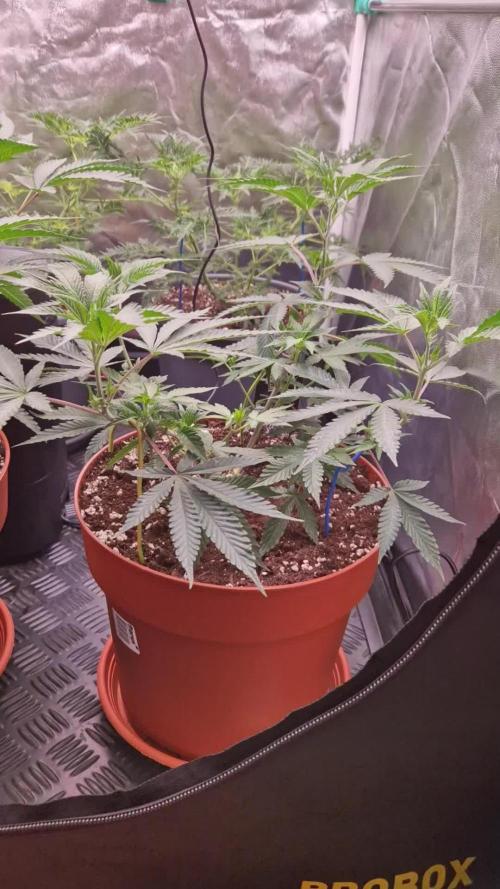
Hola.
Poca cosa que reseñar esta semana, crecen altas, más de lo que yo había previsto.


Likes
13
Share

@TrickzCutz
Follow
Servus Moin!
Die Super Double Cherry wächst ohne Probleme.
Leider habe ich bei den vorderen 3 Ladys irgendwelche Schädlinge entdeckt, die stark wie Thripse aussehen. Deswegen habe ich direkt Raubmilben bestellt. Diese will ich einsetzen bevor es in die Blüte geht.
Likes
5
Share


@Herbie
Follow
Mrs B aka Bruce Banner #3 from Original sensible seeds is a different plant for me, in a good way of course.
Beautiful thin sativa leaves and from the right angle looks like a picture of the tropics.
The Fat early leaves on their way out over shadowed by smaller leaves above working on the Bud sites.
A traditional super crop because she was starting to encroach on her girl scout cookie cousins space. Of course un fazed by the whole thing.
I was once worried about her leaves touching the £1 emergency blanket I use as light reflection in the grow cupboard but has never been an issue its way too thin to hold anyway near enough heat to ever be an issue so the shaping also come somewhat naturally.
shes under a selection of home standard LED bulbs around 10w, random blasts of UVB from a reptile light (I think helps growing with a slight slowing of the auto influence. My own thoughts from previous experiments only.) the other lights remain on 24 hours with a few 5 min breaks in the timer to cool the bulbs down a touch.
I of course talk to her/them on a regular basis which has some scientific backing somewhere showing benefit for both of us.


Likes
31
Share


@THCpapa
Follow
Week 18, and my buds are on a growth spree – they're growing and growing, reaching for the stars! But here's the funny part – I can actually smell them now when I open the tent. It's like a fragrant leafy surprise every time I peek inside.
As I watch my buds plump up and expand, I can't help but feel a sense of awe and wonder. It's like witnessing a tiny leafy miracle unfold before my eyes. Here's to Week 18 – a week of growth, fragrance, and the pure joy of watching nature at its best. Cheers to my amazing garden – may it continue to bloom and delight in the weeks to come! 🌿🌼
