


Likes
Comments
Share


@tsf_homegrow
Follow
Mykorrhizza zum umtopfen per Augenmaß direkt auf die Wurzeln gestreut.


Likes
4
Share


@civillianwalking420
Follow
Hella great strain , imma go head n start another 2 of these rite away , love the growth , love d buds d high ohmagahdd well done Royal Queen Seeds , will repeat wit yall cheers

Likes
89
Share


@JuanHaze_Arg
Follow
16/10 se riega 🚿 con 3 litros de agua de osmosis + cal mag hasta llegar a ec0.4 + agua del grifo + 2ml/L de solo tek bloom.
PH:6.1 EC:2.0
18/10 se riega 🚿 con 2 litros de agua de osmosis + cal mag hasta llegar a ec0.4 + agua del grifo
PH:6.1 EC:0.8

Likes
29
Share


@GrownwithLED
Follow
My ladies are developing AWESOME under the SANlight EVO4-120 LEDs inside my HOMEBOX growtent. All 12 have a healthy green color and grow more flowers every day now. New flowers appear every day, they look like little crowns on top of the plants. The supercropped plants have healed and are developing increased amounts of buds now as well. The nutrients from BIO NOVA have been increased to an EC-value of 1,5 now, so the plants can support their increased photosynthesis for flowering. Especially the adding of PK 13/13 brings added bud growth. Until now I LOVE how this round is going...😍


Likes
3
Share

@Islandboi340
Follow
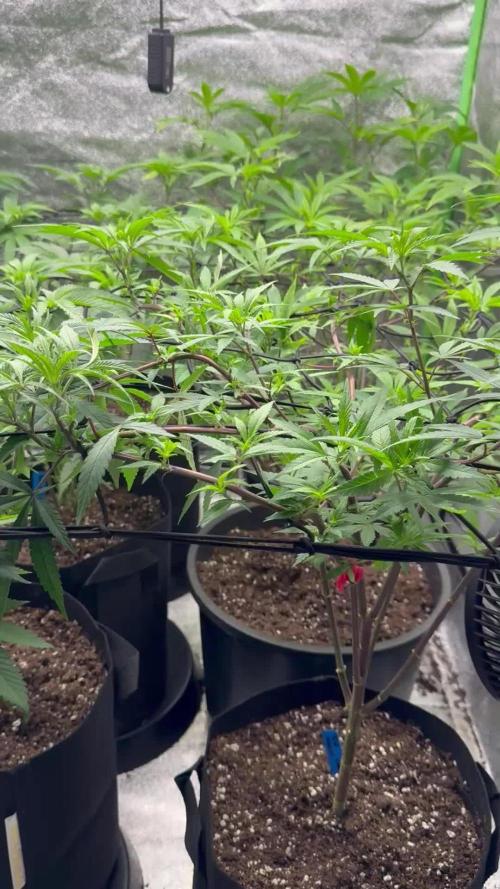
Trying something new I going run the trellis for two more weeks in veg den flip to flowers run gon definitely need two trellis
Likes
12
Share


@PedroAndHisPlants
Follow
My first grow has been a great learning experience, and I couldn’t be happier with the results. From the reliable BioBizz soil and nutrients to the impressive performance of the Spider Farmer SF 1000, everything worked well together. Each component contributed to a successful harvest, and I’m excited to continue experimenting and improving my setup with new gear and techniques.💚
Likes
11
Share


@pegonter
Follow
Beginning of week 7 plants faced a severe heat and dryness wave reaching 26°C and 35%hr however irrigation time (and volume) were fast adjusted and the problem was solved. Plants didn't got affected by that as seen.
One of 3 early skunks presenting yellowing on leaves and will be chopped soon. Other 2 might wait some more days.

Likes
9
Share


@SeseGrows
Follow
Do Si Dos 33 // Home Indoor 90x90 // Barneys Farm
⠀⠀⠀⠀⠀⠀⠀⠀⠀
Week 4
⠀⠀⠀⠀⠀⠀⠀⠀⠀
- Grotek Nutrients.
- Lumatek LEC 315w+💎.
LEC 315w --> 80%
Modo LST --> Activado ;)

Likes
42
Share


@Tropicannibis_Todd
Follow
👉Alrighty Then👈
👉Apple And Banana 👈 week 4 of flower
So we had some real nice growth this , had to do a little leaf management👈 flower mode activated......
Everything is looking good 👍I'm using well water which is hard so I'm having a few issue but I'm on it ....
So ive up'd the nutrients to accommodate pre flower .....
Soil by Promix
Nutrients by Cronks
Lights by MarsHydro.ca FC4800 X UR45 X Adlite Deep Red And Blue
Tent 4x4x6.5 & Equipment by MarsHydro.ca
High reflectivity inner mylar
Thick Oxford fabric
Smooth heavy duty zipper
Sturdy metal frame
Zipper blackout cloth
Good anti light leakage performance
The 6in Inline kicks ass moves alot of air
●Blue Light Effect:
Blue light shortens internodes, resulting in shorter, stronger plants, ideal for supporting fruit development later. During vegetative growth, blue light promotes lateral branch development effectively.
Well this should be fun 🙃
Thanks to all my growmies out there for stopping by its much appreciated 👈
👉Happy Growing👈
Well this should be fun 🙃
Thanks to all my growmies out there for stopping by its much appreciated 👈
👉Happy Growing👈
Likes
23
Share


@Horseluisweed
Follow
Básicamente lo mismo, aunque está semana pilló bastante más horas de luz(tuve que irme fuera de casa dos findes seguidos, en los cuales la dejé con la luz encendida full 24/7 en la caja)
Como experiencia utilicé café reposado 48h para "alimentarla" e intentar bajar el Ph de la tierra (coco ph6+hummus ph7+vermiculita ph8= ph total 7)
El otro experimento fue cubrir la tierra con coco para que el tallo eche raíces y aprovechar su espigamento!
Las horas de luz solía dejarla 8h en bombilla mientras duermo, y el día la pongo en la ventana a que tome el fresco, pero apenas tiene luz directa, me da la sensación que crece más rapido cuando vuelvo del finde, estoy replanteandome tenerla más tiempo en la caja con luz, porque la veo aún pequeña, y quizá ponerle un ventilador de pc o algo🤔..veremos, aún tengo el papel de aluminio al lado de la caja y ni se lo he puesto, con eso os lo digo todo☝️🎃

Likes
72
Share


@BodyByVio
Follow
It was a longer road until here. With all the reading I did I still made rookie mistakes. To much nutrients and to much light stunt my plant and created some deficiencies ( CaMg). Hopefully I will do ok from now on....
Lifted the light at 3 feet on 100% power and decreased the PPM’s to 600. Hopefully that will help and I did not create to much damage.
Wish me luck. I invested a lot of time and money on this grow but the experience is not there yet. I’m ok with what it is, I’ve learned a lot from this grow.
Likes
5
Share

@BlackForestGrower
Follow
Growing Apple & Bananas was a breeze. The plants showed impressive resistance throughout the entire grow, handling stress and minor fluctuations with ease. They responded especially well to lollipopping — that technique really brought out their best structure and boosted the final yield. Speaking of yield, it was definitely on the higher side, with dense, resinous buds that were a pleasure to trim.
In terms of potency, the effects sit comfortably in the mid-range. It’s not overwhelming, but still delivers a pleasant, balanced high that’s perfect for relaxed afternoons or casual social sessions. What really stands out, though, is the flavor. Apple & Bananas lives up to its name with a sweet, fruity profile that mixes apple-like freshness with tropical banana notes — smooth, tasty, and easy on the lungs.
Overall, this is a great strain for growers looking for reliability, high yields, and a deliciously sweet terpene profile. While it’s not the strongest hitter out there, its combination of flavor, simplicity, and resilience makes Apple & Bananas a solid choice for both beginners and experienced growers alike.

Likes
Comments
Share


Likes
11
Share


@Bread_n_Buds
Follow
Here we are again ready to start again, always under the sign of Zamnesia, we make our fantastic plants and we show you what we are capable of. We have 5 autoflowering strains and 5 photoperiodic ones and now we present them to you.
The fifth and last autoflowering for now of this round that we present to you is another classic of the classics always in the Zamnesia version. We have already grown it once and we sincerely hope to find the purple phenotype, Mythical mythological herb really in music and in everything, WE ARE TALKING
To explain my germination method which is a combination of experiences acquired in the field and readings of right advisors, I have chosen to divide it into phases so whoever wants can follow them and understand better step by step.
- Preparatory Phase ---- Check the average temperature in the room, humidity status to understand well whether it is the case to start or wait, I decided for the end of August because the temperatures start to drop towards the 22-25 degrees recommended for germination.
Then another thing more or less credible depending on the sensitivity is the control of the lunar phases. I believe in it a lot, it is a method that ancient farmers used to understand when it was best to plant depending on the attraction of the moon. To make my life easier I use a simple app that advises you on the right time to plant, harvest and put in a jar (depending on the lunar phases).
- Phase 1 --- Soaking in water. There are many authoritative friends who advise against this method due to the risk of drowning, but I have always been fine and I follow the rule if it opens in water almost certainly the seed is healthy and will come out of the ground 90% normally.
- Phase 2 --- Opening of the seed in water. As soon as the seed opens and the root comes out a little you have to be very very careful not to leave the seed in water open for too long. This is why there is a risk of drowning. So as soon as the root has come out it must be planted. Do not wait for it to stretch out too much, in the absorbent paper you can wait a little longer in water no.
- Phase 3 --- While I soaked the seeds I prepared my pots: I use small biodegradable pots (choose the ones with holes underneath for drainage). A few hours before working with the opened seeds I moistened the soil with water adjusted to the right pH (5.8 - 6.2) and Plagron Power Roots. The small root is now open and we can make a little hole with a toothpick, widen it and insert the seed. Not too deep with the root facing downwards. From Serious Seeds we learned the dome technique: if you put a small dome of soil on the seed the water will settle on the sides avoiding overwatering problems.
- Phase 4 --- The plant emerges from the soil. Up to now I have not put the light on, now I turn it on at minimum after half a day of soil to give direction to the seedlings. The first week the light will be gradually brought from 40% to 60% to go to 70% - 75% in the remaining weeks of veg. During the first week maximum, I keep the cycle of 24 hours to avoid stretching. Be careful not to exceed the first week at least with photoperiodic.
- Germination % --- In water 20/20 seeds have opened for good luck I'm waiting to talk when they come out of the ground but it seems that we are going towards an excellent percentage of germination..."Not too bad"...
- Soil and Food --- The soil used is entirely organic in every part and is the Plagron Promix that will be used with the 100% organic pack supplied by Zamnesia complete with all the main fertilizers for your plant buy it at the link --
https://www.zamnesia.io/it/11457-plagron-easy-pack-natural.html
// Strain Description // Have you ever wondered what Jimi played in 1967? With Purple Haze Automatic, it has never been easier to experience the magic of Purple Haze firsthand. In just 65 days, this compact autoflowering will reward you with top-quality sativa buds that will take you on a long creative journey. -
- Get a seed of this fantastic strain --- https://www.zamnesia.io/
- Soil and Fertilizers entirely organic --- https://plagron.com/en
- Growbox --- https://www.secretjardin.com/
- Music and sound --- I made my girls listen to 432hz frequencies and music from www.radionula.com
- Z --- You can find these seeds, much more from the world of cannabis, mushrooms and an incredible series of accessories and gadgets on the reference site not only mine but of many growers ----
https://www.zamnesia.io
Likes
21
Share


@w33dhawk
Follow
Moin moin liebe growmies!
Diese Woche war anstrengend (nicht mit den Ladys) im allgemeinen ich hab für den Sommer ein paar zu viele Pflanzen angesetzt (Tomaten,paprikas und Zitronen) jetzt bin ich nur noch am pflegen und das ganze im Blick haben, das ich kaum noch Zeit für andere Dinge habe 😰 aber naja das Leben ist kein Kinder Spielplatz.....
So zur Woche am 07.05 und 08.05 stand nicht viel an nur zu gucken (ach ja die garten Lady ist in den garten gezogen, und bekommt einen Extra Bericht da sie länger laufen wird als die Ladys hier).
09.05.22 heute war lst angesagt um die Pflanzen in Form zu halten.
10.05.22 heute stand Gießen an es gab für alle 4 Ladys 2L Wasser mit nährlösung zusätzlich zu den microben von Bio bizz habe ich jetzt auch great white hinzu gefügt( 1tsp/8L wasser)
11.05 bis 13.05.22 beobachten und hier und da ein wenig lst um die Form zu behalten.
Das war es wieder für die Woche cu growmies und viel Erfolg bei euren Damen.

Likes
15
Share


@Jr104th_st
Follow
Got 3 weird looking ones and 9 clones I don't want and 3 plants good growing one it's penut butter breath don't know make or female got it from a seed of some bud I bought in Vegas @woodys_official_


Processing
Likes
22
Share


@Yiyis_Grow
Follow
He tenido unos problemas esta semana.
Una de las plantas no tiene orden jajaja. Al parecer sus ramas no están muy fuertes y se caen. Acá es donde me arrepiento de no haber usado scrog.
Otras dos plantas están presentando un poco de amarillo en las puntas de las hojas y una que otra un poco quemado justo en la punta color amarilla.
Por lo demás las veo bien, se hicieron un poco más gordas, pero no lo suficiente o lo que quisiera.
Necesito incorporar co2 y scrog en el próximo cultivo.
Espero resolver mis problemas y mejorarlas para la otra semana.
Buenos humos


Likes
202
Share


@CrazyHorse
Follow
Good afternoon everybody 😊
It's getting wild, really wild 😇 From last week everything start to be hmm... massive 🤔 😜
Update:
Day 38
Original Cinderella 108 cm
Bruce Banner 83 cm
Purple Lemonade 78 cm
Day 40
I have to provide a defoliation as girls start expanding wildly 😇
Original Cinderella 114 cm
Bruce Banner 86 cm
Purple Lemonade 79 cm
All the best, You Lovely Girls Growers 💪 💪 💪
Likes
2
Share


@Mr_nugs_lover_David
Follow
The nuggets are very sticky and compact, they are frosty as hell and the aroma is very strong already. I loved this strain. She's such an amazing autoflowering strain. Very powerful.
Likes
43
Share


@TheCannaProphet
Follow
~ FastBuds PAPAYA SHERBET Photoperiod~
Well here we go on another journey together through 'Canna-land' and this one's kinda special... forget that, it's VERY special because this is FastBuds newest surprise for the community, a FEMINIZED PHOTOPERIOD STRAIN!🤯
I was fortunate enough to score these seeds, of which only 1000 were available and can't wait to see what this strain can do! This Papaya Sherbet, according to FastBuds, is a hybrid with a 9-10 weeks flowering period. For a more detailed and accurate description of this strain the following from FastBuds says it best:
"Combining the massive stature of Papaya (Oni Selection) with the strength and resilience of one of our best keeper cuts (Sunset Sherbet), this strain develops into a big, expansive bush adorned with numerous bud sites that later transform into a generous harvest of medium-sized buds. Papaya Sherbet flowers deliver a signature flavor of premium cannabis with subtle citrus undertones that emerge upon inhaling. During growth, her aroma makes for a sweet yet pleasantly bitter fragrance, giving you an idea of what the smoke will taste like. Notably stress-resistant, Papaya Sherbet is a great choice for growers working in challenging environments. She is very forgiving and rebounds quickly from any adversity, allowing growers the freedom to experiment with confidence that she will take everything like a champion she is. This strain embodies resilience, flavor, and abundant yields in every grow cycle."
Sounds like an epic strain and I personally cannot wait for this lady to strut her stuff!😍
________________________________________________________________________________________________________________________________________________________________________________________________________________________________________________________________________________________________________________________
The Setup:
This is going to be an outdoor grow, but I have started the Papaya Sherbet photoperiod indoors as our weather is still a bit too chilly to put a newly sprouted seedling outside (nighttime temp's dipping regularly into the 40's℉).
The plan is simple... let her grow inside under a 19/5 light schedule until the nighttime temperatures are in the mid 50's℉, which shouldn't be long. After which, she'll be moved outside and transplanted into the soil which I have already setup and inoculated with beneficial microbes from BioTabs and slow release dry amendments from Gaia Green. Once she's established herself outside she'll be given periodic top dressings of Gaia Green 4-4-4 and 2-8-4 along with worm castings and Compost Tea's. Her grow area is approx. 5'x5' and I have posts and a trellis net set up already for when she gets bigger to aid in training her. Let the fun begin!🤪💚
________________________________________________________________________________________________________________________________________________________________________________________________________________________________________________________________________________________________________________________
Weekly Updates:
9/4- The 4th week of flower is here and the FastBuds Papaya Sherbet photoperiod is looking fantastic! She's loaded with flowers that are all beginning to get frosty!
9/6- My daily watering campaign continues with me giving the Papaya Sherbet approximately 5 gallons of well water from the garden hose.
The flowers on the Papaya Sherbet are stacking away and the frost continues to accumulate!
9/8- Today, before watering the Papaya Sherbet, I did some needed plant maintenance, removing a bunch of old dead leaves, along with a handful of shade leaves that were yellow.
9/10- Well with four weeks of flower behind her now, the Papaya Sherbet photo is almost halfway through with another 5-6 weeks to go. I only hope and pray🙏 that the weather cooperates and stays cool and dry!
Thank you for checking out my diary, your positive comments and support make it all worthwhile! 💚Growers Love!💚😎🙏