


Likes
Comments
Share


@takecua
Follow
Por fin llego su día, a sido todo un reto
Ahora estara secando entre unos 7 o 10 días mas o menos
Espero sacar calidad ya comentare .. saludos y mucho verde

Likes
15
Share


@eecc_photo
Follow
Hi...
So this is my first time taking things a bit more seriously.
Open for tips and advice.
usually looking fore flavor rather than production.
First week on 250w
Also, pics are taken with the mobile... better pics next week

Likes
36
Share


@nonick123
Follow
Día 9 (10/06) N/A
Día 10 (11/06) N/A
Día 11 (12/06) Llueve mucho. Humedad alta por aquí. Eso les favorece
Día 12 (13/06) Se empiezan a desarrollar las hojas verdaderas a una buena velocidad! Todo en marcha! 💨
Día 13 (14/06) Riego ligero 100 ml sólo H20 EC 0,5 en previsión del trasplante en el día 15 de la planta
Día 14 (15/06) Se nota que estamos en el día 14 desde germinación y la mayoría de las plántulas van viento en popa!
Día 15 (16/06) Hoy procedemos a trasplantar a las chicas a su maceta intermedia de 6,5 litros
Se prepara con 5,5 Litros (85%) de sustrato PRO-MIX HP BACILLUS+MYCORRHIZAE + 1 Litro de Insect Frass (15%) + 65 gramos de Earth Vibes Super Soil (10 g/L substrato)
Se llena la maceta de sustrato con las manos (limpias) y rompiendo los trozos más gruesos, para que el sustrato esté aireado y esponjoso, sin presionar
Se coloca una maceta vacía de 1L para que quede la forma perfecta de la maceta donde están las plántulas (ver fotos)
Se espolvorea la parte proporcional de la probeta de microorganismos sobre el agujero de trasplante
Se saca la plántula de su maceta actual (bonitas raíces 😍) y se coloca en la maceta final
Se riega muy lentamente hasta percolación profunda con H2O EC 0,5 pH 6,5
Se coloca mulch (acolchado) de paja para evitar traspiración excesiva y cuidar a los microorganismos del suelo
A ver como reacciona al trasplante!
💦Nutrients by Lurpe Solutions - www.lurpenaturalsolutions.com
🌱Substrate PRO-MIX HP BACILLUS + MYCORRHIZAE - www.pthorticulture.com/en/products/pro-mix-hp-biostimulant-plus-mycorrhizae

Likes
4
Share


@GeminiCQC
Follow
Can't wait for each of them to finish out. Giving them hopefully their full amount of water, less with the auto as it was stunted by the 12/12.

Likes
93
Share


@Natrona
Follow
FBA2502 Plants 1-6
Week 7 May 11– 17
FLOWER 3
Nutrients :
Micro 25 ml
Gro 10 ml
Bloom 30ml
CalMag 30 ml
Recharge 10ml
Green sensation 16.5ml
Power buds 7.5 ml
5/11 PH 6.56, PPM 1560, temp 69
2ltr each
5/12 PH 6.31, PPM 1120, temp 68
1 ltr each
5/14 PH 6.66, PPM 1280, temp 70 1 ltr each
5/15 PH 6.66, PPM 850, temp 72 1 ltr each
5/11 Defoliation, feed, pics & videos
I made 4 gallons, used 3 to water then poured the runoff back into the rest in the bucket. The next feeding, I added a gallon of tap water to residual and ph to 6,31 temp 69 & PPm 1120. Did the same on 5/14 and 15 using up the remainder of the feed solution.
I must monitor and control the tent environment manually. For the past month, the humidifier has been an issue putting out way too much humidity; often leaving water in the bottom of the tent. In addition, the temperatures are also out of control. I added an AC last week to keep the temperature below 80. I finally determined the exhaust vent is also broken and has been for some time.
I have been giving good reviews on the AC infinity system. However, during the time I’ve owned this tent (2 yrs), I had to replace the lights twice, fans, humidifier and now the vent twice also. Everything but the tent containment has been replaced. AC infinity does stand by their products, but they are in California, and it takes at least 2 weeks to receive the replacement. This is extremely frustrating at the critical transition to flower for my equipment to fail again. For the time being until a replacement arrives, I pulled the 4” exhaust vent from my 3x3 and hooked it up. I have the AC pushing air in and the exhaust pulling air out. This should create a neutral pressure tent environment-neither positive nor negative. I do have 3 circulating fans in the tent to move air around the plants.
It looks like growth spurts have slowed and plant height has been reached. Now is the time for buds to fatten and frost up. All of them (6) are short remaining less than 3 ft. They range from 15 to 31 inches. The tallest #4 &5 and #6 have very light leaves and appear nutrient deficient compared to the shorter phenotypes. Pictures taken later in the week show fading on a few the older leaves. All are receiving the same solution and are in the same soil blend. Moving the gals in and out of the tent for their glamor shots, I bent one limb and snapped another. The bent one I taped with a splint and the snapped one I medicated manuka honey and wired it back to the main stalk.
Leaves look like sativa leaning. I hope FBA2502-2 is a good daytime. I’m getting excited to see what develops in the next month or so. News Break: I’ve been informed that 2502 is FastBuds New Frostbanger and is indica for nighttime. I’m disappointed that I didn’t get a sativa to test because I really need a daytime strain. The 2 Blue Cheese plants I just grew are also nighttime.
Upon opening the tent, a faint odor was detected, and some stickiness was observed during the process of defoliation. Pictures of the puffy buds even show differences. #4 &5 buds hairs are different from the others being crinklier and the others are straighter. Some like #2 &5 are showing frost on the leaves. Wow at the beginning of flower to have that much frost. They are living up to the new strain’s name.
I’ve noticed that when I water, sometimes water shoots out of the side holes I the air pots. I will pack the soil firmly into the sides for future runs.
Measurements:
#1 15”
#2 20”
#3 17”
#4 30”
#5 31”
#6 24”
Your likes and comments are appreciated. Thanks for stopping by.
Growers love 💚🌿
💫Natrona💫


Likes
16
Share


@WerebackFlat
Follow
A memorable harvest. The buds are all very high quality and cleaning them was easy as the pruning I did did not produce any popcorn buds. The flavor is among the most intense I've ever tried and it's a plant that I would recommend to everyone.

Likes
12
Share

@Ribemarti
Follow
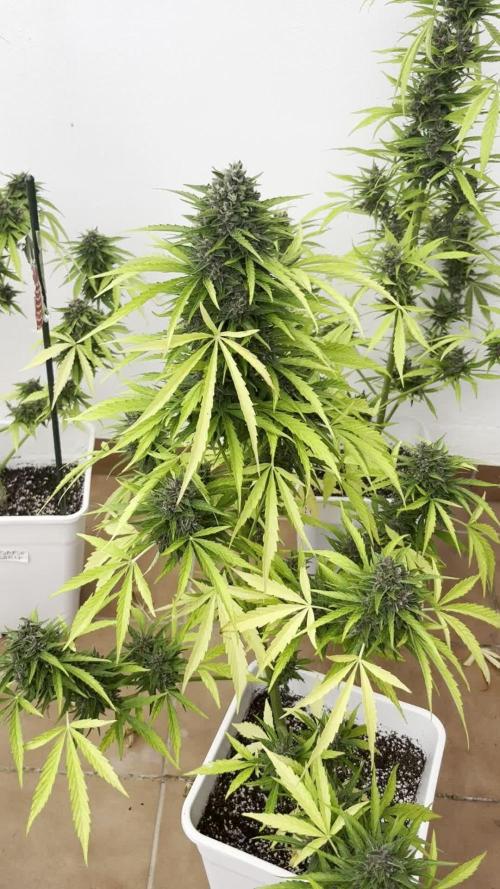
LAS PLANTAS TIENEN ECHO YA EL LAVADO DE RAÍZES, Y EN 2 DIAS EMPEZARE A CORTAR PLANTAS, YA CORTE 2 PLANTAS Y OLÍAN MUY RICO ESTAN EN EL SECADERO
COMO PODEIS VER LAS HOJAS AMARILLAS ES PORQUE ESTAN CONSUMIENDO TODOS LOS NUTRIENTES DE ELLA
MUY IMPORTANTE LAVAR LAS RAIZES Y DESPUES REGAR CON AGUA EC 900 DESPUES YA 400EC Y EN EL PH 6,5
Likes
99
Share


@TheFoxFarmer
Follow
Week 8 Flower
Flush flush flush 💦🚽💦🚽💦
It's extremely important to flush for at least 14 days when using synthetic nutes, or any bottled nutes in my opinion. The aim is to make her cannibalize (fade) as much as possible before she's chopped. By doing this, she's using up her stored nutrients, causing the leaves to eventually die. The better the flush the cleaner the smoke 👌💨 even when in an organic set up, the plant needs to be nicely faded before being harvested. Otherwise she's still full of nutrients. I still feel I'll be able to get an even better flush when I eventually make the switch to RO water, as my tap water holds a ppm value of approx 150. It's not too much, but 0 is always better.
She was taken down on Day 57 flower, after a 16 Day flush. I didn't want to take her any further as she was quite stressed being so close to the light. So to avoid getting seeds I waited until she had a beautiful fade before giving her the chop ✂️ I always take my girls down about 30mins before the light turns on so there is minimal chlorophyll production in the plant. This is to ensure the best smell, taste and overall burn after drying and curing.
A subtle but very sweet-ish tropical fruit skin kind of smell to her. Her buds are super dense and covered in trichomes. I trimmed off all fan leaves and then each branch was hung in my drying box and placed in a cool area. She was dry after 6 days and ready to be dry trimmed and jarred for curing. I'll post those pics with the harvest update!
Thanks for following and happy growing! 🐺
Likes
6
Share


@chupacabra80
Follow
этот сорт супер,он выдерживает все жару, холод, lst ,hst ,super cropping я делал все что мог,вывод такой что не трогайте авто сорта,пусть растут себе )))) 314 г
но ребята он без воды стоял больше суток в гидропонике в темноте,так что он за сутки немного подсох,так что я не могу сказать что было вчера на весах когда я я отключил гидропонику и оставил на сутки в темноте без воды, на фотке видно что листья уже упали,так что было больше! будем ждать когда высохнут 😉
ну вот ребята что вышло )) 62 сухих, вкус и запах соответствуют описанию,я не могу в точности передать вкус,но очень вкусный! это растение получило очень много стрессов,я всем советую!!!!
Likes
10
Share


@420pete
Follow
Chop day. Everything is looking and smelling incredible. The range of smells I've got so far are: floral, grape, blueberry, gas, burnt rubber, tangerine, funk. Everything appeared fully mature beside the Cambodian x Meat Breath and Pak Man so decided this was the best time to cut them down.


Likes
9
Share


@Skinnytalls420
Follow
Day 38- 18/01/22 and we are now in flowering everything is looking good I’m still cutting down the plants from my last grow Afghan kush and once I’m done with that I’ll be moving everything that isn’t chemdawg into the HPS tent!!! Day 41-21/01/22 plant is finally in the hps tent and doing well!!!

Likes
9
Share


@Sauce_XL
Follow
2.17.2024: Start of week 5, day 29 from seed, day 25 from sprout. Plant is healthy from what i can tell. Top of the plant's leaves all have slight white tips from what i'm assuming is light stress? Light is 16 inches from top of plant at 112 watts. I've let it pretty much do its thing so far. Branches are rather short making any sort of LST hard. Pistils are clearly visible so i'm assuming we're entering the flowering stage. Wouldn't be surprised to see the first signs of bud growth by the end of the week. Still no nutrients given. The fan leaves are large and blocking bud sites so perhaps i'll clip soon? Will upload pics today.
2.18.2024: Plant is responding well to the increase in light intensity. Still can't bring myself to take the large fan leaves off.
2.19.2024: Day 31 from seed. Plant is drinking more. Gave 64oz at 6.4ph. Run off ppm was 1450 at 6.6ph. Essentially 4 full weeks from seed before i need to start feeding. Next watering will contain nutrients.
2.20.2024: Humming along. Now firmly in the preflower/early flower stage. Growing 1/2 to 1 inch a day. If anyone is reading this, please tell me its ok to chop the big fan leaves blocking bud sites!
2.21.2024: Day 33 from seed, 29 from sprout. Picked up the pot this morning and it was very lite so i gave it another 64oz at 6.3ph. No run off this time which tells me they are starting to need more water or i need to up the frequency. Still no nutes in 33 days!
2.22.2024: Besides white tips on top growth, steady as she goes. I'll post a pic of the white tips. No idea how to solve. Plant is totally in flower but since we're almost at the end of week 5 from seed, i'll keep the diary in "flower." 14.5 inches from soil to top. Would love to see these get to 24 inches by the end.
2.23.2024: Upped water to 96oz at 6.4ph. About 2 cups of run off at 6.6ph and 1130ppm. Original soil still has nutes to offer at day 35 from seed.
Likes
3
Share

@Samsationalseeds
Follow
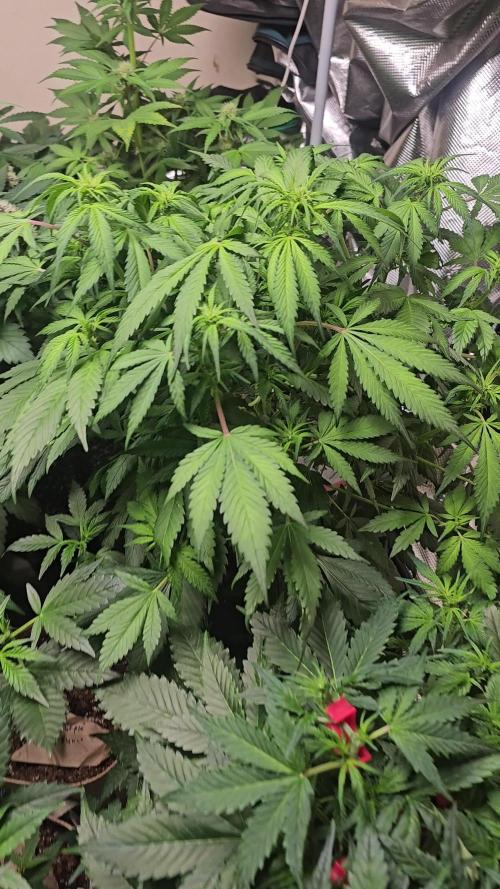
Day fifty, they're all looking pretty good.I'm doing a ph check every couple days
Likes
7
Share


Likes
38
Share

@Sadhus
Follow
**Semaine 7 : Septième Semaine de Floraison – Phase Bulking Avancé (1-7 avril 2026)**
**Note :** Mise à jour hebdomadaire. Tout reste RAS, les plantes continuent leur bulking de manière très propre et homogène. Données consolidées TrolMaster + GrowOps (semaine 7 / semaine 11 globale).
### Contexte et Objectifs de la Semaine
On est maintenant en **bulking avancé**. Les buds ont pris beaucoup de volume, les calices sont bien gonflés et la production de trichomes s’intensifie. Le stretch est terminé depuis longtemps, toute l’énergie est concentrée sur le remplissage floral, la densité et la résine.
Steering : **végétatif maintenu** (irrigations fréquentes, runoff 20-30 %, dryback nuit 8-12 %, VWC stable).
Objectifs : continuer le gonflement maximal des buds, booster la résine et les terpènes avec UV 90 min/jour, garder une stabilité parfaite des paramètres et éviter tout stress qui pourrait freiner la prise de poids finale.
**Petit point éducatif : Bulking avancé et rôle des boosters**
En semaine 7, la plante entre dans la phase où les buds « prennent du poids » rapidement. Le steering végétatif reste essentiel car il permet une absorption continue et élevée des nutriments sans stress hydrique excessif.
La combinaison actuelle (Cocos A+B + PK 13/14 + Sugar Royal + Green Sensation + Pure Zym + Silica Force + Cal-Mag Amino) est particulièrement adaptée :
- PK 13/14 et Sugar Royal alimentent directement la formation des fleurs et augmentent le poids sec.
- Green Sensation + Pure Zym stimulent le métabolisme et la santé racinaire en coco.
- Silica Force renforce les parois cellulaires (meilleure résistance et densité).
- Cal-Mag Amino prévient les carences classiques en flo (jaunissement bas ou pointe brûlée).
Maintenir EC autour de 2.6 et pH 5.8-6.0 évite les lockouts tout en permettant un uptake optimal. C’est le moment où on voit vraiment le retour sur investissement des boosters.
### Observations des Plantes
La plante dominante mesure toujours **150 cm** et domine clairement avec une structure massive, une canopée dense et une vigueur impressionnante. Le stretch est complètement stabilisé.
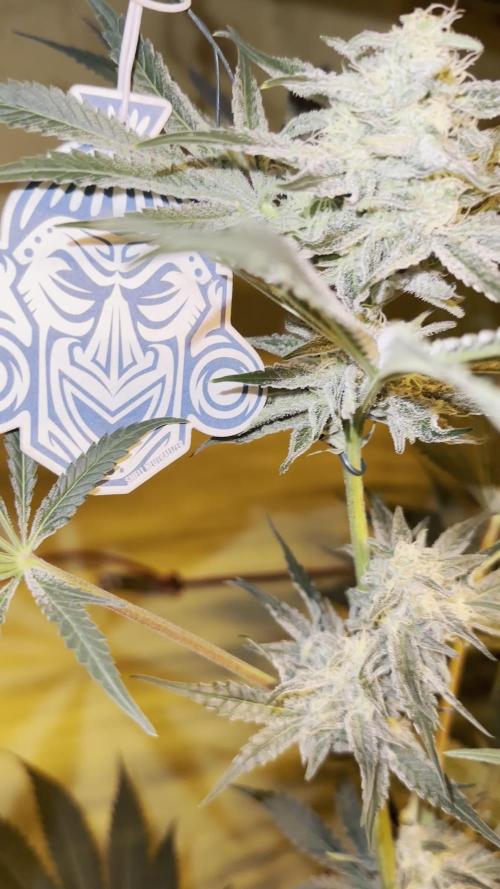
Les buds continuent de grossir de manière visible, les calices sont bien remplis et les trichomes se multiplient (brillance sucrée de plus en plus prononcée sur les sites supérieurs et moyens). Pistils commencent à changer de couleur et à s’enrouler.
Santé générale : excellente, feuillage vert profond, aucune feuille jaune ou nécrosée, zéro pest, zéro signe de stress ou carence. La plante secondaire suit correctement. Clones restent vigoureux. Les plantes sont pleinement concentrées sur le gonflement et la résine.
### Paramètres Environnementaux (TrolMaster + GrowOps – synthèse semaine 7)
- **Température jour** : 23-25 °C (moyenne live ~23.3 °C, cible 24 °C)
- **Température nuit** : 18-20 °C
- **Humidité jour** : 64-74 % (live ~58.9 %, cible 62 %)
- **Humidité nuit** : 49-59 %
- **VPD** : 0.8-1.2 kPa (live 0.94 kPa → idéal pour bulking)
- **PPFD moyen** : 750-777 (max ~814) → DLI 32 mol/m²/jour (optimal)
- **UV Light** : 90 min/jour (maintenu)
- **Far Red Light** : 30 min en fin de cycle
- **CO₂** : setpoint 900 ppm jour (enrichment actif)
- **EC solution** : 2.6 mS/cm (live 1.85-2.95 selon moments)
- **pH solution** : 5.8-6.0 (live 6.43, runoff 5.8-6.2)
- **Runoff EC** : 4-5 mS/cm
- **Irrigation** : Fréquente (4-5 cycles/jour)
- **Runoff % daily** : 20-30 %
- **Night dryback** : 8-12 %
- **Steering** : Végétatif confirmé
### Nutrition et Irrigation (Soupe actuelle)
**Nutriments utilisés cette semaine (doses par litre) :**
- Cocos A → 1 ml
- Cocos B → 1 ml
- CANNA PK 13/14 → 1 ml
- Green Sensation → 0.1 ml
- Pure Zym → 1 ml
- Sugar Royal → 1 ml
- Cal-Mag Amino → 1 ml
- Silica Force → 1 ml
- pH- → 0.5 ml (ajustement à 5.8-6.0)
Eau à ~20 °C, temp solution ~15-18 °C.
Irrigation fréquente avec dryback contrôlé → excellent équilibre pour maintenir le bulking sans excès ni carence.
### Problèmes et Ajustements
**RAS total.**
Aucune alerte GrowOps, aucune intervention nécessaire. Les paramètres restent très stables, le steering végétatif fonctionne à merveille et les plantes répondent parfaitement aux boosters. Aucun signe de fatigue ou de ralentissement.
### Plans pour la Semaine 8
- Maintenir steering végétatif + EC 2.6 (possible léger ajustement PK selon gonflement)
- UV rester à 90 min/jour
- Défoliation légère et ciblée (seulement les fan leaves qui bloquent vraiment la lumière sur les buds inférieurs)
- Photos rapprochées pour suivre l’évolution des trichomes et de la densité
- Commencer à réfléchir à la date de flush (généralement semaines 8-9 selon maturité des trichomes)
Ce journal sera mis à jour hebdomadairement.
#GrowLegendary #Zamnesia #Plagron #EternityGrowCup2
Les buds gonflent bien, les trichomes se développent et la plante dominante à 150 cm reste superbe. On approche du pic de résine, tout se passe idéalement ! 🌱✨


Likes
49
Share


@TheUndercoverGrower
Follow
I've discovered this week my timer that was powering the 600w LED had developed a fault and was turning on roughly an hour early, I thought the glueberry were taking a little while to kick in to full flower now I understand why. Has probably put the grown behind by about 10 days which is a bit annoying but these things happen.
I've taken the 600w led out and replaced it with 2 x 300w leds either side of the hps to spread light more evenly.


Likes
20
Share


@Excalibur
Follow
09 October 2018 -
Day 106
Flush run well, Buds have increased and thickened up nicely.
Day 107 -
No more burn and buds are growing.
Day 108 -
Conditions are good.
Day 109 -
Noticed heavy and healthy root growth.
Last day before trim
Day 110 -
Trimmed and Harvested.
** Tent was required **
Day 111 -
Colour and smell has become stronger
Day 112 -
Still drying
