The Grow Awards 2026 🏆
Likes
Comments
Share
Likes
33
Share
@Belverde
Follow
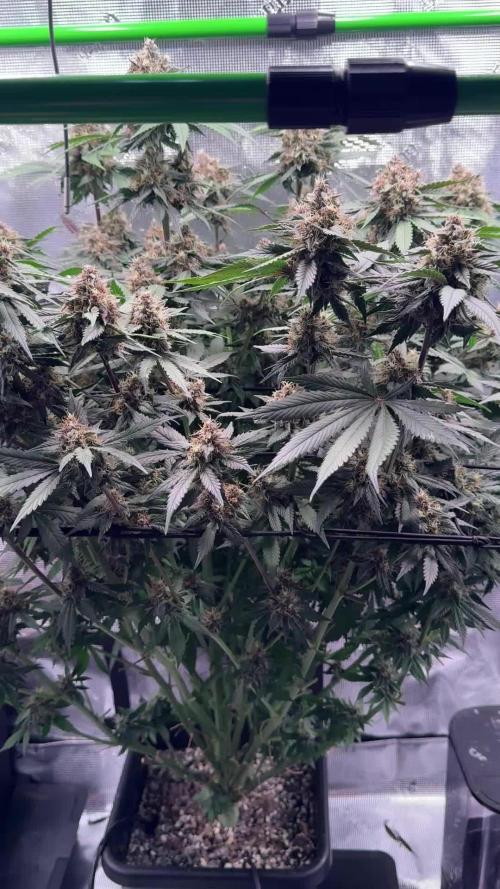
Welcome growers We are at the end of week n°3 in flowering for these two BLUEBERRY CHEESECAKE 🍰 The flowers are developing quite well on both and I can already perceive the classic blueberry notes of these varieties.. Even the trichomes are already quite evident 💯 The color of the leaves (the remaining ones) tends to be classic green, without blue-violet hues I still giving their always organic/veganic nutrients.. And yes... As seen in the video, the most evident thing these days was a massive defoliation ✂️✂️🍃🍃🍃🍃 Honestly, I never use such an aggressive technique.. This time I decided to practice it on all the plants I have in the garden (10 visible in the diaries + 8 regular all female) out of pure curiosity to see how each of them will react It's a bit of a controversial method, but it's trying and seeing what happens Let's hope so 🍀 I immediately start a more massive fertilization.. Next week we will see how they will be 😉 About nutrients 👇 I still giving their always organic/veganic nutrients.. A little bit of silicium (Bionova) / Crescita (Biomagno) / Activera (Biobizz) / Grow vegan (Bionova) / The Missing Link (Bionova) / X-Cell (Bionova) / Bioheaven (Biobizz) , a little bit of P-K 3-5 (Bionova) /Fioritura (Biomagno) / Bloom vegan (Bionova) and now i have introduced Biomassa (Biomagno) and Florastimo (Biomagno) Basically these nutrients contain primarily NPK in organic / vegan form + kelp extracts, humic and fulvic acids, amino acids, aloe vera, potassium silicate, beneficial bacteria and fungi Like i usually do with liquids nutrients, a little bit of everything at any watering 💧 See you at the end of the first month in bloom 🌻🌻 Thanks for stopping by 😎👍👍 FC ✌️ 🇮🇹
Likes
9
Share
@Tragic
Follow
For a neglected plant she was great i watered the last time 3 days ago and chopped her today should end up with about 2 oz depending on dry time and conditions.
Likes
16
Share
Day 19 I topped all 5 plants. Very fast growth everyday. Continuing to water every other day with organic kelp. Plants are loving everything I've thrown at them so far🤙 Link of me topping one of my plants: https://youtu.be/LsLsAdEvyzw
Likes
8
Share
She’s been a thirstier girl more recently...been drying out every 3-4 days, 5 max. Getting real full. I’ve been putting minimal effort in due to the organic soil I decided to use, but she’s responding to everything really well.
Likes
7
Share
Hiiigh friends 🙌 Welcome to week 8. 😍 Due to too much unwanted stress, flowering is delayed. The big lady was unable to withstand the training. Her neck is broken. But she is far from giving up and will fight to the end.. 😊 See you next week. 👋 Arturo for KannaKullektiv 🙏
Likes
18
Share
@Borberad
Follow
Hoffe nach den Überraschungen in der letzten Woche verlaüft diese wieder ruhiger. Habe den Leitwert des Drain bei beiden Pflanzen auf ph6 und 2000 microSiemens Ende letzter Wiche reduziert bekommen. Interessanter Weise waren die Leitwerte bei den Pflanzen trotz exakt gleicher Wasser/Düngergabe um den Faktor 2 auseinander. Der ph-wert lag bei beiden bei 4,8 [Warum auch immer]. Hab die Werte durch Spülen mit Leitungswasser und Osmosewassermix mit Leitwert 500 auf die oben beschrieben Werte gebracht und hoffe das die Damen es mir verzeihen und mich trotzdem in 3 Wochen mit reicher und vor allem leckerer Ernte belohnen werden. Gieße jetzt jeden 2Tag, so viel, dass genügend Drain entsteht um die Werte zu kontrollieren. Drain liegt bei Ph ca. 6,0 bei max 2,5mS andernfalls wird mit Osmose oder Leitungswasser (0,8mS und Ph7.2) gegegengehalten. Da sie in Stofftöpfen stehen, ist es hoffentlich nicht so dramatisch etwas zu viel Wasser zu bekommen.
Likes
9
Share
@NOLOGIK
Follow
hello guys, we really got to the limit I think! after 89 days, the first month of March was very cold and April not least !, I still managed to have a beautiful plant !!! and rich in trichomes, the smell is reminiscent of pine resin! and I can't wait to try. Sunday 9/6 cutting ... while in the indoor I'm growing the non-original seed born from a top, now I've passed it after 89 days of vegetative, in bloom it was full of primordial flowers! I think it will be a success !!!!, then I cut some branches I made 4 cuttings 1 of these is dead, the others continue on their way, for reasons of space they are already receiving even 12 hours of light .. .
Likes
19
Share
Week 1 Day 1 - 8/12/2023 1st Water change Day! Such a special time it is when you remove the little bit of Nutes that you gave them as an appetizer and you give them their first real meal. Added 39 Gallons of Water to my system SILICA= .5mil/Gal = 19.5 = 20mil Root Drip = 1mil/Gal = 39mil Cal Mag= .25mil/Gal = 9.75 = 10mil FLoraMicro= 3.0mil/Gal = 114mil FloraGro = 2.0mil/Gal = 78mil FloraBloom = 2.0mil/Gal =78mil ORCA= .5mil/Gal = 19.5 = 20mil Week 1 Day 2 - 8/13/2023 Everything is looking good the roots are making thier way to the water and the new grow is looking nice and green. Week 1 Day 3- 8/14/2023 Everything is right on track, they are looking beautiful and in the praying postition all leaves happily lifting towards the light. Week 1 Day 4- 8/15/2023 Looking beautiful today and looked like she could use her first haircut.. gave her a TOP off. Roots are laying in the water everything is looking right on track.. Week 1 Day 5- 8/16/2023 walked in and the humidity was under 60.... ohh noooooo.. So I added 2 humidifiers to the tent and attached them to my InkBird controller which is set to 62. She had roots nicely in the water.. this grow is on!!! Week 1 Day 6- 8/17/2023 Humidity was a little low this morning, so I refilled the humidifiers. Other than that, the temp looks great, the PH looks great, the PPM looks good the plant is in the praying position and all damage from the little drowning seems to have been fixed. Happy Happy. Week 1 Day 7- 8/18/2023 Yay.. week 1 in the books, roots in the water growth has started first hair cut given and both side nodes are growing. Everything is looking good and on track.. A lot better than week one of the last grow when I had them drowning week 1. Really excited on how this grow is going to come out.
Likes
57
Share
1/4: Moved a few other plants out of the closet, now they've got a little elbow room. Both Zenzations are fattening and frosting up very nicely. The Gorilla Girls have finally stopped stretching and are budding up nicely now. Their lowers are as all as the tops. The Black Jacks look great, too. 1/7: Fed today and gave them all a sniff test...killer stink from the Zenzations.😵 I added a dose of endoboost in their feed today...kinda worried about the monstrous size of my plants considering that they are only in 3 gallon pots..
Processing
Likes
9
Share
@Luv2Grow
Follow
Day 57 - Starting week 9 and man she is looking good with the dark purples. Just took her out for some pictures and see if she needed a drink. Will probably give her a feeding on Sunday. Got the new AGLEX COB LED hooked up so we’ll see over the next few days how she likes it. Day 58 - Nothing new happening with this girl today. So far so good with the new light. Soil is still sorta damp so plan in giving her some water tomorrow. Day 59 - Still chugging along and still not ready for any water and I don’t want to over do it so will hold off another day before giving her some. Day 60 - Still not ready for water, looks like tomorrow she should be ready and will give her a feeding of the foxfarm trio. Other than that, she’s chugging along and looking gorgeous. Day 62 - Looking great still and gave her a feeding of the foxfarm trio today. I went ahead and defoliated quite a bit today so hopefully she can focus on some more bud development. I’m gonna start really checking the trichs here in the next couple days. She might be getting close to the end but not sure yet. Day 63 - Ending week 9 today and almost all trichs are cloudy. Wanting to get about 30-40% amber before chopping plus she’s still got quite a few white pistils so I’ll wait until I stop see those popping up.
Likes
6
Share
Likes
4
Share
@Troxx
Follow
Clones are coming around they was shocked being up in Maine we had a light out for 3 days got too 40° in the cloner etcetc sooo trying to get them to root just gave them some clonex ✌️
Likes
6
Share
@Hommero75
Follow
End of the 2nd week and GG4 Sherbet FF is taking her sweet time to grow and develop. I been having some issues with her, but I'm optimistic and I know she is going to pull through.
Likes
20
Share
Variedad con una floración corta, entre 8/9 semanas. Procedente del original Exodus Clon (UK). Predominancia indica con un nivel de thc superior al 16% . Es muy fácil de cultivar y la alimentación la acepta muy bien en general . Cada etapa cumplió con mis expectativas y por ello aparte del sabor el colocon ... en cuanto a todas sus etapas le doy 9/10 . CEPA BRUTAL enserio.
Likes
55
Share
2nd net is up. Early bud formations are promising. holding up to the extremes pretty well, some leaves taking minor damage, but overall, she is holding up, gave her 1 night at 50F see how she would react, stressful. Not advised as it messes with her metabolism, but I want to see if it triggers any anthocyanin response. Love to see her purp up but no signs yet. Remember, For every molecule of glucose produced during photosynthesis, a plant needs to split six molecules of water. This process provides the hydrogen needed for synthesizing glucose and other organic compounds, while oxygen is released as a byproduct. Homework. If Rubisco activity is impaired and it cannot properly function or regenerate its substrate, the plant's leaves are likely to turn a pale green or lime green, a condition known as chlorosis. Essentially, Rubisco activity is highly regulated and susceptible to various environmental and metabolic factors that can cause it to become inhibited, leading to an apparent failure in RuBP regeneration due to a lack of consumption. Rubisco regeneration is intrinsically linked to nitrogen supply because Rubisco is a major sink for nitrogen in plants, typically accounting for 15% to over 25% of total leaf nitrogen. The regeneration phase itself consumes nitrogen through the synthesis of the Rubisco enzyme and associated proteins (like Rubisco activase), and overall nitrogen status heavily influences the efficiency of RuBP regeneration. RuBisCO is a very large enzyme that constitutes a significant proportion (up to 50%) of leaf soluble protein and requires large investments in nitrogen. Insufficient nitrogen supply limits the plant's ability to produce adequate amounts of RuBisCO, thereby limiting the overall capacity for photosynthesis and carbon fixation. Maintaining the optimal, slightly alkaline pH is crucial for the proper function and regeneration of Rubisco. Deviations in either direction (too high or too low) disrupt the enzyme's structure, activation state, and interaction with its substrates, leading to decreased activity and impaired RuBP regeneration. (Lime/yellowing) Structural Component: Nitrogen is an essential building block for all proteins, and the sheer abundance of the Rubisco protein makes it the single largest storage of nitrogen in the leaf. Synthesis and Activity: Adequate nitrogen supply is crucial for the synthesis and maintenance of sufficient Rubisco enzyme and Rubisco activase (Rca), the regulatory protein responsible for maintaining Rubisco's active state. Nitrogen deficiency leads to a decrease in the content and activity of both Rubisco and Rca, which in turn limits the maximum carboxylation rate, Vmax, and the rate of RuBP regeneration Jmax, thus reducing overall photosynthetic capacity. Nitrogen Storage and Remobilization: Rubisco can act as a temporary nitrogen storage protein, which is degraded to remobilize nitrogen to other growing parts of the plant, especially under conditions of nitrogen deficiency or senescence. Nitrogen Use Efficiency (NUE): The allocation of nitrogen to Rubisco is a key determinant of a plant's photosynthetic nitrogen use efficiency (PNUE). In high-nitrogen conditions, plants may accumulate a surplus of Rubisco, which may not be fully activated, leading to a lower PNUE. Optimizing the amount and activity of Rubisco relative to nitrogen availability is a target for improving crop NUE. Photorespiration and Nitrogen Metabolism: Nitrogen metabolism is also linked to the photorespiration pathway (which competes with carboxylation at the Rubisco active site), particularly in the reassimilation of ammonia released during the process. To increase RuBisCO regeneration, which refers to the process of forming the CO2 acceptor molecule Ribulose-1,5-bisphosphate (RuBP) during photosynthesis, the primary methods involve optimizing the levels and activity of Rubisco activase (Rca) and enhancing the performance of other Calvin-Benson-Bassham (CBB) cycle enzymes. Biochemical and Environmental Approaches: Optimize Rubisco Activase (Rca) activity: Rca is a crucial chaperone protein that removes inhibitory sugar phosphates, such as CA1P (2-carboxy-D-arabinitol 1-phosphate), from the Rubisco active site, thus maintaining its catalytic competence. •Ensure optimal light conditions: Rca is light-activated via the chloroplast's redox status. Adequate light intensity ensures Rca can effectively maintain Rubisco in its active, carbamylated state. •Maintain optimal temperature: Rca is highly temperature-sensitive and can become unstable at moderately high temperatures (e.g., above 35°C/95F° in many C3 plants), which decreases its ability to activate Rubisco. Maintaining temperatures within the optimal range for a specific plant species is important. •Optimize Mg2+ concentration: Mg2+ is a key cofactor for both Rubisco carbamylation and Rca activity. In the light, Mg2+ concentration in the chloroplast stroma increases, promoting activation. •Manage ATP/ADP ratio: Rca activity depends on ATP hydrolysis and is inhibited by ADP. Conditions that maintain a high ATP/ADP ratio in the chloroplast stroma favor Rca activity. Enhance Calvin-Benson-Bassham (CBB) cycle enzyme activity: The overall rate of RuBP regeneration can be limited by other enzymes in the cycle. •Increase SBPase activity: Sedoheptulose-1,7-bisphosphatase (SBPase) is a key regulatory enzyme in the regeneration pathway, and increasing its activity can enhance RuBP regeneration and overall photosynthesis. •Optimize other enzymes: Overexpression of other CBB cycle enzymes such as fructose-1,6-bisphosphate aldolase (FBA) and triose phosphate isomerase (TPI) can also help to balance the metabolic flux and improve RuBP regeneration capacity. Magnesium ions, Mg2+, are specifically required for Rubisco activation because the cation plays a critical structural and chemical role in forming the active site: A specific lysine residue in the active site must be carbamylated by a CO2 molecule to activate the enzyme. The resulting negatively charged carbamyl group then facilitates the binding of the positively charged Mg2+ion. While other divalent metal ions like Mn2+ can bind to Rubisco, they alter the enzyme's substrate specificity and lead to dramatically lower activity or a higher rate of the non-productive oxygenation reaction compared to Mg2+, making them biologically unfavorable in the context of efficient carbon fixation. The concentration of Mg2+ in the chloroplast stroma naturally increases in the light due to ion potential balancing during ATP synthesis, providing a physiological mechanism to ensure the enzyme is activated when photosynthesis is possible. At the center of the porphyrin ring, nestled within its nitrogen atoms, is a Magnesium ion (Mg2+). This magnesium ion is crucial for the function of chlorophyll, and without it, the pigment cannot effectively capture and transfer light energy. Mg acts as a cofactor: Mg2+ binds to Rubisco after an activator CO2 molecule, forming a catalytically competent complex (Enzyme-CO2-Mg2+). High light + CO2) increases demand: Under high light (60 DLI is a very high intensity, potentially saturating) and high CO2, the plant's capacity for photosynthesis is high, and thus the demand for activated Rubisco and the necessary Mg2+ cofactor increases. Mg deficiency becomes limiting: If Mg2+ is deficient under these conditions, the higher levels of Rubisco and Rubisco activase produced cannot be fully activated, leading to lower photosynthetic rates and potential photo-oxidative damage. Optimal range: Studies show that adequate Mg2+ application can enhance Rubisco activation and stabilize net photosynthetic rates under stress conditions, but the required concentration is specific to the experimental setup. Monitoring is key: The most effective approach in a controlled environment is to monitor the plant's physiological responses e.g., leaf Mg2+ concentration, photosynthetic rate, Rubisco activation state, and adjust the nutrient solution/fertilizer to maintain adequate levels, rather than supplementing a fixed "extra" amount. In practice, this means ensuring that Mg2+ is not a limiting factor in the plant's standard nutrient solution when pushing the limits with high light and CO2. Applying Mg2+ through foliar spray is beneficial to Rubisco regeneration, particularly in alleviating the negative effects of magnesium (Mg) deficiency and high-temperature stress (HTS). While Mg can be leached from soil, within the plant it is considered a mobile nutrient, particularly in the phloem. Foliar-applied Mg is quickly absorbed by the leaves and can be translocate to other plant parts, including new growth and sink organs. Foliar application of: NATURES VERY OWN MgSO4 @ 15.0g L-1 in a spray bottle. For those high-intensity workouts when 1 meal a day is just not enough! Foliar sprays are often recommended as a rapid rescue measure for existing deficiencies or as a supplement during critical growth stages, when demand for Mg is high. Application in the early morning or late evening can improve absorption and prevent leaf burn. The plant was getting a little limey yellow in the centre. Shortly thereafter, she was back in business, green mostly regenerated. The starting point [of creativity] is curiosity: pondering why the default exists in the first place. We’re driven to question defaults when we experience vuja de, the opposite of déjà vu. Déjà vu occurs when we encounter something new, but it feels as if we’ve seen it before. Vuja de is the reverse—we face something familiar, but we see it with a fresh perspective that enables us to gain new insights into old problems. Confidence is evidence... nothing more. You are confident because you have driven 10,000 times, you are confident because you have spoken 10,000 times. People think confidence is a feeling, but it's not. If you want more confidence, then you need to create evidence, take more shots, collect more data, build more experiences, take more risks; fail, confidence doesn't come first; it is the reward you get for doing the work. no one else wants to do.
Likes
4
Share
@Andres
Follow
She has 104 days and is ready ... but I'll leave her one more week. She looks with compact flowers and a good smell...and also fed with fishbowl water...
Likes
12
Share
@Bluemels
Follow
Tag 67: Ein entspannter Grow ist es mit der Fat Banana, erfordert aber auch mehr Geduld. Sie streckt sicht nicht alt zu sehr. Nächste Woche werde ich sie noch etwas ausdünnen.