


Likes
Comments
Share


@valiotoro
Follow
The trim was easy✂️
The smell is very nice with citrus,pine & Diesel🍋🌲⛽️
The buds are fat & sticky full of resin🤩


Processing
Likes
17
Share


@TheGanjaGrower
Follow
I don't think I'm going to grow autoflowers for a while. I think I have much more control over photos and they are much more potent.

Likes
2
Share


@MG2009
Follow
Good week at 26.75" tall, suspect it's male or a vigorous female.
08/04/2018
38 days old hope it's old enough,to flower cause days are getting shorter!...
If it's male i will cut down not looking for a new male breeder yet. Fingers crossed though🙏 it's a a girl🙏✌️
08/04/2018
Feeding Fox farms big bloom. The little boost for Pre flower.
08/05/2018
Just about 35 days in growth,not to bad. Should show sex soon as all the other plants are in Pre flower mode, and days are getting shorter.
08/06/2018
She is a he ..... What shall I do?.
I hate to risk loosing a good male but can't risk getting seed !
08/07/2018
Time of death 8:00am post mordom pic to follow at 8:05 after a brief moment of silence✌️


Likes
36
Share


@GYOweed
Follow
Well i broke a branch right off Bubba Cheese cake #2 stem by slightly trying to move a 3 gal pot lol ouchie
They will both need supports fyi.
Anywho, I either out did myself or these are the longest trichomes I've seen.
#2 is bigger n frostier.
#1 smells like freaken candy...and i mean the good colors you save for last lol.
#2 is more muted but creamier and maybe hopefully some cheese.
Increased exaust fan speed, Increased oscillating fan speed.
Reduced lights to 11/13.
Adjusted far red, adjusted morning to come on later at night and turned off the heat mat (yes i had a heat mat lol).
That should hopefully bring out any colors but it seems this one may stay green af.
Another grower is going to week 20 i think in flower and still no color change....in my experience that means this wont taste anything like earthy wood anthocyanins.

Likes
2
Share


@Fatbudz
Follow
Incredibly, they both gave almost the same, 70 grams each.
good quality but it was below expectations
I felt a difference compared to the autos in the first round.
maybe my fault or genetics 🤔😅🤪

Likes
23
Share


@DreamIT
Follow
Sponsored by:
⚖️HUMBOLDT SEESDS⚖️-💡VIPARSPECTRA💡-💐GREEN BUZZ LIQUIDS💐-🛠️WEDRYER🛠️
8/7 After several days of Growdiaries making it difficult for me to write and respond to comments, I found that I can still update the journals. I apologize to everyone for the non-replies but I have replaced the main email and the email to confirm the account never arrives, and Growdiaries' customer service seems to be non-existent.
10/7 everything is going well, nothing special to add🤘🦄
12/7 it grows very fast, within two weeks I hope it is ready to clone
__________________________________________
Personal advertising (contains affiliate links)
__________________________________________
🦄 Highly professional graphics and website, one-of-a-kind genetics, and a legendary story! Anonymous shipping!
✅https: //bit.ly/HumboldtSeedsCompany
__________________________________________
Did you know that Green Buzz Liquids fertilizers are 100% vegan? A complete line of products ready to give the best to each of your plants! Visit the site and see my journals to see how they work 🦄
🤯 And with the code "dreami t" you will immediately receive a 15% discount on your purchases
✅https: //bit.ly/GreenBuzzLiquidsPro
__________________________________________
👀 Are you looking for a good lamp to start with? 👀
🌞Viparspectra has something more than the others, take a look at their site.
⏩ Use "GDVIP" for an extra discount or "DREAMIT3" for an extra 5 %% discount
👀 Search for it on Amazon
✅Amazon USA: https://amzn.to/30xSTVq
✅Amazon Canada: https://amzn.to/38udUVe
✅Viparspectra UE: bit.ly/ViparspectraUE
✅Viparspectra USA: bit.ly/ViparspectraUS
______________________________________________
🌈 Tired of blowing on your weed hoping it dries quickly? Check out the Wedryer website! You will find a well-made accessory that will help your weed dry in just 8-10 days without the annoying risk of finding mold or other annoyances! (no affiliate links)
✅https: //bit.ly/Wedryer_
______________________________________________
📷🥇Follow the best photos on Instagram 🥇📷
https://www.instagram.com/dreamit420/
Backup
https://www.instagram.com/dreamit4200/
🔻🔻Leave a comment with your opinion if you pass by here🔻🔻
🤟🦄💚 Thank you and good growth 💚🦄🤟

Likes
17
Share


@Agrocann
Follow
After ~ 30 hours the small root emerged from the seed.
After 48 hours the small root become big and I managed to brake the tip of the root.
After 48 hours from seedling the new baby has emerged :)

Likes
14
Share


@Rangaku
Follow
Handled the transplant really well , she’s starting to branch out nicely. I’ll start some LST in the next week or so

Likes
16
Share


@SaintSativa
Follow
I burned them. I knew 2000 ppm was too much but I went with the NFTG chart anyways. The different charts worked great at 100% until now. The one in the back took it the worst. The front one only somewhat. I stopped feeding and have just been giving them tap water for the last week which is about 100ppm. They seem stable now, I guess.
These fuckers have gotten unruly. They are too big for their own good. I can barely get in there to do anything. When I started these I didnt look too much into the strain. I just figured i'd use up some free seeds and got to it without much of a plan. I was going to use 5 gallon pots but on transplant day I realized I only have 7 gallon pots so I went with it. They are 2 giant bushes for sure.
The buds on the back plant are getting massive. I got yoyo's everywhere. They smell great.
I took out a couple lights and started to simulate shade. Roughly 4 weeks left, give or take.




Likes
5
Share


@Granddaddy_Terp
Follow
Midnight is a seriously beautiful cultivar and unlike many other purple strains I’ve seen, grown and smoked, this one’s terps are actually rather impressive. Her aroma is a pungent mix of berries, citrus and gas. I love it.
She certainly isn’t the fastest auto. We’re at day 77 since sprout and it’s clear she still needs another 2-2.5 weeks. I expect her to be ready for harvest somewhere in the 90-95 day range.

Likes
18
Share

@valiotoro
Follow
Hello everyone week 5 of flower has passed for this Vanilla Latte auto 🍼
For the feeding schedule i stopped feeding Power Roots and Pure Zym and started feeding Green Sensation 0,5/l
Mars hydro FC-E6500 75%
have a great day and wish you all happy growing 😎👨🌾🏻
Likes
7
Share


@High_And_Hydro
Follow
- Ich hab die erste Woche des Biobizz Allmix Düngeschemas gestartet und gebe wie immer erstmal vorsichtige 100%, da meine Erde an sich durch den Kompost recht potent sein sollte.
- Außerdem hab ich mit meinem Calmag-Rechner mein Leitungswasser angepasst. Die Werte könnt ihr auf den Bildern sehen.
- Den PH-Wert passe ich ebenfalls auf 6,5 an.#
- Die Lampe bringt zur Zeit etwa einen PPFD-Wert von 350 - 360 µmol/s/m² bei 18 Stunden Beleuchtungszeit (DLI von 22 - 23 mol/d/m²). Sie wird aber nur eingesetzt bis es warm genug draußen bleibt. Tagsüber stehen sie jetzt schon draußen, sofern es nicht regnet oder stürmt.
Die Papaya Cookies macht sich hervorragend und sie ist sehr uniform mit den anderen Fastbuds Strains bis jetzt. Sieht gut aus finde ich 💪😁👍
Likes
6
Share


@DonPato
Follow
Increíblemente, hace unos días atrás, diez para ser exactos, incorpore de forma casera, cO2, con una mezcla de levadura fresca y azúcar, en orden de 1 burbuja por segundo, Los resultados obtenidos en las flores inferiores fue de una explosión de tricomas muy densa y de maravilloso olor y calidad, estoy muy contento con los resultados obtenidos, gracias a los consejos y practicas obtenidas en todos lados. agradecido 🙏
ENG.
Incredibly, a few days ago, ten to be exact, incorporate homemade, CO2, with a mixture of fresh yeast and sugar, in order of 1 bubble per second, The results obtained in the lower flowers was an explosion of trichomes very dense and wonderful smell and quality, I am very happy with the results obtained, thanks to the advices and practices obtained everywhere. grateful 🙏

Likes
2
Share


@polle
Follow
Now the pics are getting better cause its up to date. Its the last week for her in veggie, ill put her in flower tomorrow because i dont want her to explode my tent.
Also 5 skunks in a 60x60 tent is kinda scary but we wiiiill seee.
Have a good one guys.

Likes
26
Share


@pifflestikkz
Follow
Day 57
26/08/24 Monday
Feed today using de-chlorinated tap water pH 6. No plagron products as noticed burning again.
(I think I'll do a run using advanced. And Plagron. Just to see what's different. )
There all showing great progress!!
Divine seeds - auto Overdose, the main bud is so compact and dominant it looks great!
The rest are performing well, did a decent fanning of lower two fans that started to turn in colour.
Apart from that left them to it ✌️💚
Day 59
28/08/24 Wednesday
De-chlorinated tap water pH 6 only today, 400ml with little to no run off.
Day. 61
30/08/24 Friday
Another feed today using de-chlorinated tap water pH 6 with Plagron products.
Picture and videos coming tonight 🤯👀✌️💚
Day 63
01/09/24 Sunday
(End of week)
De-chlorinated tap water pH 6 today with calmag.
Notes on plant structures , bud structures, leaf density.
- Auto critical orange punch -
Xmas tree shape, main colar nice and thick. Side arms - doing with LST next time would provide more decent tops.
Strong structure, big fans, but bud to leaf ratio is high! Compact ball shaped buds so far.
- Orange Bud - she Climbs! Tall, Long structure, I would top this strain next time, with LST next time again she would provide alot more tops.
She has an even leaf to bud ratio, but the buds look fire already and there only just forming! Getting hues of blue on calyxes. Taller buds.
- Auto Melonade Runtz -
Another Xmas tree shape, ideal for LST, main colar bud is impressive, she just wants to stack.
Leaf to bud ratio is even again, bud the buds are forming tall, with pistils firing everywhere.
- Auto Overdose
Wow, compact short autoflower, with a powerful punch! She is dense!!
Fanse are even, thick, and balanced.
Leaf to bud, even.
Bud formations - dense boulders already, like mini hedgehogs. I would definitely do a SOG with these 🤩

Likes
Comments
Share

@ReallySavoy
Follow
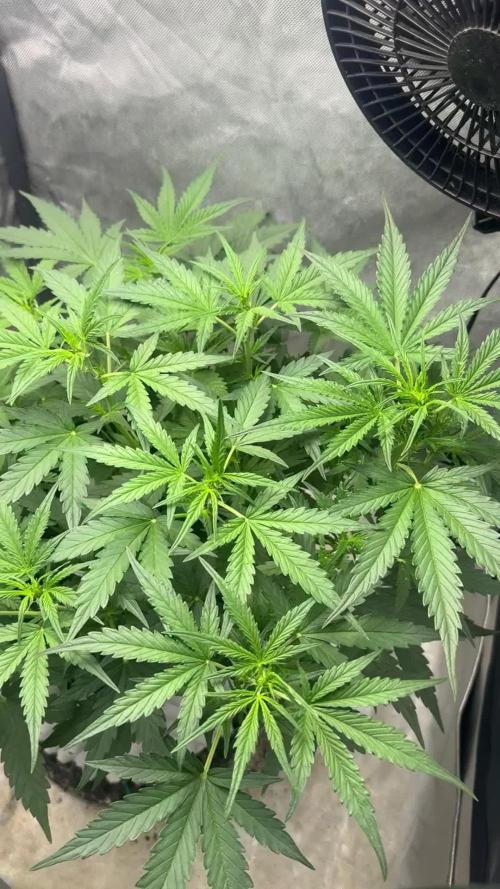
This week, the plant has entered pre-flowering, as can be seen in the video—it’s about to bloom.
The aroma has become very strong and pleasant.
The plant is drinking a lot of water, almost 3–4 liters per day, as I place it outside in the sun whenever possible while keeping it in the grow box.
Likes
17
Share


@halexxo
Follow
He empezado a darles forma con la mano con cuidado para aplicar lst a lo largo de esta semana. Continuo regando con 500mL por planta.
Likes
19
Share


@Teydoee
Follow
How do you control really huge fan leaves that are putting too much weight on lower leaves?
