


Likes
Comments
Share


@Bread_n_Buds
Follow
We have reached the second week of flowering for our beautiful photoperiod ladies of Zamnesia. Born 1 September now at day 45 amazing.
---- The general environmental conditions are good, there is always a little too much heat from next week we should have just for the resin a sharp drop in temperatures that could also give us beautiful foliage for this period.
--- Our 2 Karen Kush deserve a slightly different discussion. They had a bit of difficulty in the final vegetative phase, I saw them not being very good and here is where different decisions must be made for the two plants.
—— Plant 1 is still in vegetative stage in another growbox dedicated to emergencies and due to space problems. I topped the center x8 tops and I'm letting them grow. Under the center I cleaned everything except two lateral branches that I elegantly worked with a symmetrical LST that director Wes Anderson would really like. It's a plant that could easily be dedicated to Grand Budapest Hotel. Also these lateral tops were growing too much compared to the center. In fact, by taking the center's food first, whoever is at the internode below eats first, there is nothing to do and therefore these lateral underlying branches were becoming much taller and more powerful than the center. Solution? Repeated fimming to keep the lateral branches low, which are indeed widening and strengthening, but the center is reaching them to be better aligned. In my opinion it will be wonderful in the end.
—— Plant 2 was cleaned of many branches that would have given useless holes and we simply sent it into flowering straight like the others, we need to photograph the main cola of the plants and making them grow straight is more or less the only way.
--- Fertilization program - The fertilizers are always Plagron and I am following the table that I generated on the site depending on the chosen substrate. Create your own sheet and follow it, never be presumptuous my friend as I have been in the past, follow the sheet and look at the plants, not all need the same amount of fertilizer. We have reached the point of giving a good dose of iron in the first weeks of flowering on the advice of Plagron directly foliar and I am at the end of the second week of flowering. It had started a bit quietly but now it is proving to be among the best.
---- https://plagron.com/en
- Power Roots - 1 ml/l
- Alga Bloom - 4 ml/l
- Pure Zym - 1 ml/l
- Sugar Royal - 1 ml/l
- Vita Race - 5 ml/l
--- The Plagron 100% Organic pack is available on Zamnesia at: https://www.zamnesia.io/en/11457 -pla gron-easy-pack-natural.html
--- The dehumidifier now works between 50% and 55%
// Site Strain Description // Formidable genetics: These seeds contain the genes of Monster Bud Kush and White Widow. High THC content: With 24%, the effects are pronounced and intense. Fast flowering: This indica-dominant hybrid needs just 8–9 weeks to reach harvest. Excellent yield potential: This plant is very generous, if grown in the right way!
- Get a seed of this fantastic strain --- https://www.zamnesia.io/it/10780-zamnesia-seeds-karen-kush.html
- Soil and Fertilizers entirely organic --- https://plagron.com/en buy on www.zamnesia.io
- Growbox and air sistem --- https://www.secretjardin.com/
- Music and sound --- I made my girls listen to 432hz frequencies and music from www.radionula.com
- Light - P2000 - https://www.viparspectra.com
- Z --- You can find these seeds, much more from the world of cannabis, mushrooms and an incredible series of accessories and gadgets on the reference site not only mine but of many growers
---- https://www.zamnesia.com

Likes
28
Share


@hydroponicganja
Follow
Some buds are starting to show signs of maturing, they have a bit of a creeping stretch. I'm still moving buds away from the light and resting them outside the deflector as they reach it!!!!
The smell is very sweet and a hint of pine. Getting excited about the harvest 🤘😎

Likes
4
Share


@WulfBlud
Follow
Ph issues resolved end of Week 10 with multiple applications of lime and 2 flushes with PHd water at 7.5
Just waiting to chop the El Chemi Kiwi at this point which is very close and most likely can be chopped right now. My drying tent is currently in use as I wait the weather to turn around so I can harden them off and plant in the back yard.
The strawberry nuggets is likely 1.5 weeks away at least but it is really fattening up more than the chemkiwi.

Likes
19
Share


@GoldenWeedGrower
Follow
Legend
Timestamp: 📅
EC - pH: ⚗️
Temp - Hum: 🌡️
Water: 🌊
Food: 🍗
pH Correction: 💧
Actions: 💼
Thoughts: 🧠
Events: 🚀
Media: 🎬
D: DAY, G: GERMINATION, V: VEGETATIVE, B: BLOOMING, R: RIPENING, D: DRYING, C: CURING
________________________________
📅 D91/B29 - 14/02/24
⚗️ EC: 0.9 pH: 5.8
🌡️ T: 19-25 °C H: 50-70 %
🌊 6L
🍗 CalMag - Bloom A-B - B52 - Bud Candy - Big Bud
💧
💼 I filled up all available space in the pot, preparing all for 3 days out. I'll be back on Sunday the 18th of February
🧠
🚀 I'm preparing all for 3 days out
🎬 Added timelapse video and screenshots
________________________________
📅 D92/B30 - 15/02/24
⚗️
🌡️ T: 18-23 °C H: 50-80 %
🌊
🍗
💧
💼
🧠
🚀 First day out
🎬
________________________________
📅 D93/B31 - 16/02/24
⚗️
🌡️ T: 18-23 °C H: 50-80 %
🌊
🍗
💧
💼
🧠
🚀 Second day out
🎬
________________________________
📅 D94/B32 - 17/02/24
⚗️
🌡️ T: 19-23 °C H: 40-70 %
🌊
🍗
💧
💼
🧠
🚀 Third and last day out
🎬
________________________________
📅 D95/B33 - 18/02/24
⚗️ EC: 0.8 pH: 5.8
🌡️ T: 19-23 °C H: 40-70 %
🌊 1L
🍗 CalMag
💧
💼
🧠
🚀 I'm baaaackkkk !!! 😎😎😎
🎬 Big job on media. I edited the cumulated time lapse videos and splitted day by day. Also uploaded the screenshots from the TrolMaster App for each day out. Great!
________________________________
📅 D96/B34 - 19/02/24
⚗️ EC: 0.8 pH: 5.6
🌡️ T: 19-23 °C H: 40-70 %
🌊
🍗
💧
💼
🧠
🚀
🎬 3 pics and a video added. Added timelapse video
________________________________
📅 D97/B35 - 20/02/24
⚗️ EC: 0.8 pH: 5.3
🌡️ T: 20-24 °C H: 50-65 %
🌊 5L
🍗 CalMag - Bloom A-B - B52 - Bud Candy - Big Bud
💧
💼 Some defolation
🧠
🚀 First signs of ripening
🎬 Added timelapse and screenshjots. I also prepared a timelapse of the entire week with some music 🎵🎵🎵 and weekly rate of T-H and VPD 📈📈📈

Likes
2
Share


@Huckleberry39
Follow
Great grow. I experimented with topping and topped to earley which hurt my overall yield but after all was said and done I ended up with just over an ounce of really good top shelf pot!!!

Likes
158
Share


@Ezzjaybruh
Follow
Dog sitting earlier this week for good friend.. he’s got two pit mixes
Dukie got a new bone to keep him occupied for a bit..
He’s loving it.
Thanks for tuning in to the puppo show

Likes
10
Share


@TiRobotProds
Follow
🔥🔥🔥🔥 en attente de l'explosion florale. Leq branche commence a ce givré d'une couverture de trichome fantastique.

Likes
229
Share


@Crashoverite
Follow
Hi everyone 😁
I would like to thank you all fellow growers and breeders for such a great support on this journey. Thank you Grow Diaries and Green House Seeds. Without you all this wouldn't be possible. Love you all
First ever recorded diary so don't know where to even start 😅
I am returning to growing after many many years of break. This is my first ever experience with autoflowers, scrog, lst, led and such tiny grow space.
Choice of strain - Big Bang Auto from Green House Seeds. I have run so many strains from this seed bank in the past and I was always happy with the final outcome. Was looking for indica dominant strain, fast flowering cycle and very important heavy yields on small spaces. Again thank you GHSC in very happy of choosing this strain.
Little bit about my cabinet.
External dimensions:
64 x 50 x 114 cm (W x D x H)
Growing area:
55 x 47 cm cm (0.26 m2)
Panel based on SAMSUNG LM301B diodes
Spectrum:
Samsung LM301B – 5000 x72
Samsung LM301B – 3000k x136
Samsung LM301B – 660nm x9
Samsung LM301B – IR 760nm x1
Regulation in the range of 20W - 110W - Meanwell XLG 100-H-AB
PPF 300 umol/s
PPFD 890 mol/m2/s @30c
Total of 6 adjustable fans, 4 exhaust fans 4 modes - silent/drying, vegetation, flowering, full power
Active carbon mass in the filter 2kg
Absolutely love my grow cabinet. Thinking of next build already.
My grow
3 beautiful ladies - Nuna, Luna and Sweet Mary Jane.
This was a pleasure experience growing autos for the first time. All 3 ladies on the end developed perfectly.
Nuna, left corner lady- tall and beautiful. She had some problems to switch to flowering and was even considering removing her but very happy that I was patient enough and turned great.
Luna, right corner lady - have to say she is the queen. She has the most heavy buds from all, the most. colorful. Her wet weight was 420g, can't say how much of dry but guessing approx. 100g
Sweet Mary Jane, front seat lady. I think she was the most pleasant to grow of her location but due to no other spare space for drying I belive that I have harvested her at least a week to early. If keep longer I belive she could be the most yielder from all 3.
Thank you all for all the support, help, comments, likes, messeges.
Love you all 💚💚💚
Will update this diary in some time and when puff perfectly cured 😎
Peace and love ✌️💚


Likes
Comments
Share

@Germanator
Follow
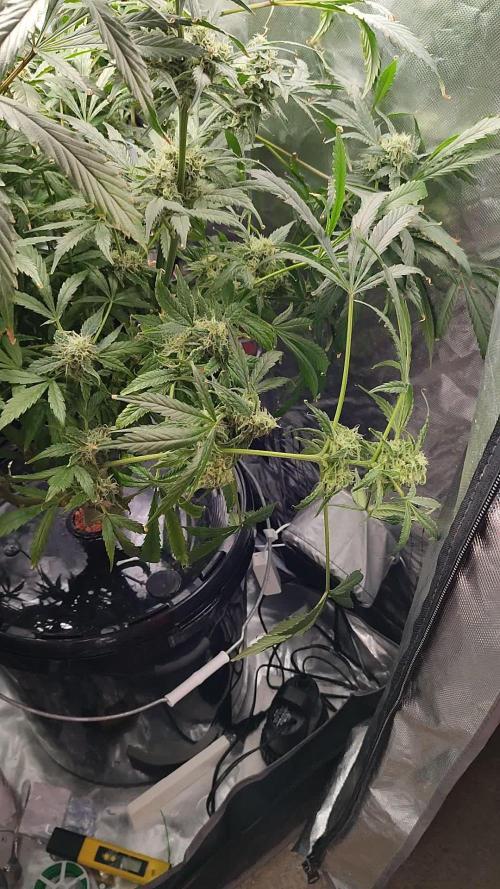
Some issues started to appear on the top leaves. I think this might be the CalMag problem everybody complains about sooner or later. Changed the water on the last day of this week and doubled the amount of CalMag supplement. Also I had to tie some of the lower branches up so they don't lean against the tent. Will definitely have to come up with something to keep the plants from falling over for the next run.

Likes
8
Share


@MrJazza
Follow
Começamos na semana 5, não tenho registos das semanas anteriores, espero quer gostem deste diário em português.
A Planta do meio é a NLA e as em volta as GGA.
Atualização com fotos todos os Sábados.
Resumo DIario:
- Dia 37 - 04/10 : Misturei 50g de guano de morcego (1-15-1) na superfície de cada vaso, reguei cada um deles com 1.5L de agua com Ph ajustado em 6.3, o desenvolvimento está bom, sem nada mais a apontar.
- Dia 38 - 05/10 : Notei um aumento significativo na intensidade do cheiro, estão a crescer bastante bem, não apresentam nenhum problema de nutrição, a NLA, naturalmente, está com a floração mais atrasada.
- Dia 39 - 6/10 : Fiz mais uma rega de 1.5L em cada vaso, o solo estava seco, como já havia fertilizado o solo á 2 dia com guano de morcego, coloquei apenas 3ml/L de CANNA Terra Flores e ajustei o Ph para 6.3. Elas estão a exigir muita agua, é bom sinal.
- Dia 40 - 7/10 : As meninas deram uma boa secada no solo, a intensidade do cheiro está realmente mais forte, estão a florir bem.
- Dia 41 - 8/10 : A terra estava praticamente seca, reparei que uma das GGA está a apresentar a ponta das folhas amarelada/queimada, principalmente nas folhas inferiores, poderá ser possível carência de Nitrogénio, pois é um nutriente móvel que a planta pode levar para as folhas superiores na falta do mesmo, adicionei 2ml/L de CANNA Terra Vega, que é um nutriente baseado em Nitrogénio e Ferro, á solução habitual, ajustei o Ph para 6.3 e reguei cada vaso com 1.5L, vou deixar a terra secar bem em 3/4 dias e acompanhar como reagem.

Likes
4
Share


@GroloCup
Follow
Keeping things simple again this week. Roots are already starting to come thru the starter pots drainage holes so I'd say the action below the surface has been what I was hoping for with this starter mix. I'll continue to provide a MegaCrop and Kelp Extract feedings to push her a little bit, I heard the term Synthganic the other day and it seems appropriate her, as I'm using organic and salt nutrients... I've got a little road trip planned so she may be coming down the shore with me over Thanksgiving.
Likes
50
Share


@00110001001001111O
Follow
Room setup rundown, examples of bud, et al in pictures...
Seedlings/Clones lights - Viparspectra XS1500.
Vege lights - Mars Hydro FC-4800
Flower Lights - 650w 3400K 1900umol/s PAR, (3) 226w DIY 2900K 630umol/s PAR (678w and 1890umol/s),
Substrate - 50/50 sphagnum peat moss and vermiculite in 5-gallon pots
Climate Control - Luckily, the lights, winter and normal furnace use all equate to a decent temperature, though a bit on colder side in in vege phase, sadly. Humidifier is needed early and later a dehumidifier is needed when canopy develops. I only grow in the winter months.
Irrigation - do not use the emitters in this diary. They suck a big fat dick to skip a line to suck a bigger dick. Use the pressure compensating type. https://growdiaries.com/diaries/232811-strawberry-cookies-og-r1-cherry-diesel-bbgs-ego-epg-ebg-grow-journal-by-001100010010011110/week/1366923 -- use something similar to those. They come in different shapes, too.
Basic process
The little light takes care of seedlings in 2.5" wide seedling pots until first up-pot. The 1-gallon pots fit well under the FC4800 in a 4x4 tent until day 21 after sprout. I plant 150% or more of what i need, so i can kill the weak without concern. The goal is for every plant that makes it to the 5-gallon up-pot being capable of producing a minimum of 160 grams with a maximum of a 35-40 day vegetative phase.
Third up-pot is into 5-gallon nursery pots and now under the 3 DIY lights and the 650W light in the big tent for a couple more weeks of vege. An irrigation system in the big tent saves a lot of time. One scrog for training and another for support, just in case. Reverting back to a more systematic approach to canopy composition moving forward. About 2.3 colas per sq ft and 8 primary colas per plant.
Yields were similar when over-crowding and being less systematic, but the proportion of less dense nugs is greater and trim time is needlessly elevated because of that fact. I was very controlling about this the first couple years but got away from it for far too long at this point.
Drying / Curing - Into mesh racks for 9 days. I wet trim and cut down to similarly sized buds for even drying. Temps are controlled around 68F and RH is set to 60%. Then into some 5-gallon buckets with gamma seal lids and (3) 2-way 67g boveda humidipaks (58% or 62%) in each bucket - 1 at bottom, 2 at top. Temp/RH probe confirms that they hold the RH steady at 60-63%.
Cost - 0.33 cents (USD) per gram produced. This includes an accelerated depreciation expense for all equipment used, fertilizer, water, electricity for all equipment used, new filters and other yearly purchases - bti, ph strips, sticky traps, etc. I'm a finance guy, so these numbers are comprehensively accurate and purposely err slightly on high side of cost. The only facet not included is the cost of my labor.




Likes
70
Share


@Insaniac_0
Follow
All feeds with nutes use either a whole ratio or combination of "Veg Mix" and "Bloom Mix"concentrates DILUTED in water until a total ppm of add in is reached using a (Total Dissolved Solids)TDS Meter measured in PPM (parts per million). The "Veg Mix" concentrate will eventually be added in smaller ratios and "Bloom Mix" concentrate what will eventually replace the "Veg Mix" concentrate entirely with the ppm and ratios listed when I feed. Veg mix recipe is on week 3. Bloom Mix recipe is on week 5.
Day 42
Morning check after defoliation. PH solution seems to be working!
Almost no new spread of the issue/deficiency (regardless of what it was)
Checked ppfd and got UL470, LL460, UR450, and LR440 over each of the colas. Temp/humidity steady still at 1.0 VPD 74F/63%RH/33% IL Vent
scraped a little soil off the top to see that it's still really moist so I likely wont be feeding until tomorrow morning.
Soil seems somewhat compacted, and ph readings were slightly lower, but still perfect in the safe zone
3 readings: 6.44,6.57, and 6.42 for avg 6.476
Day 43
Normal stats on VPD - same 74F/63%RH/33% IL Vent. ppfd over colas UL 490, LL 480, UR 470, LR 460
Still showing a slow progression of spots and yellowing on oldest leaves (like day 5 from initial occurrence, so very slow compared to past spread) I feel ph on a stressed plant was the biggest factor. Soil is still mostly damp to about an inch from the top but will be feeding tomorrow morning.
Day 44
Normal status with VPD 1.0 - 74F/63%RH/33%ILVent -- ppfd (after dunk) UL490, LL480, UR470, LR460
Calibrated meters and tested - prepared feed water- started with 3.5 gallons of 274ppm de-chlorinated tap- used 500ppm of 80/20 veg/bloom mix, pinch of epsom salt and squirt of h2o2.
Checked soil ph got 3 readings of 6.55, 6.65, 6.52 for avg of 6.573 so I ph balanced my feed to 6.3ish
Weighed pot for reference and saw 13lbs 10oz- dunked pot for 10 secs, lifted and hung over drain container - recorded the stream and drip videos when I then replaced and checked ppfd again.
Runoff showed 6.3ish ph and 2000 ppm (lower than my normal ppm of 2500 to 2600 my hypothesis is she's using them up so good time to feed)
rare side view of main-line base included with end of process pictures.
Did some LST with binds to train colas to position - I plan for 6 to be tied to ring and 2 in the center but at the same height by the time they grow past the support ring - I have them tied at the base of the first node and the pot - the center 2 colas are being trained too, but are tied off to the opposite side directly to the plant. looks like a hot mess for now - hopefully my vision will come through in a few days.
Day 45
Morning check after extensive LST yesterday - VPD is all stable 74F/63%RH/33%ILVent - not taking ppfd readings as she's still under the ring and I seen these readings yesterday and the day before - I plan on taking ph readings later today, but for now this is what I got.
Took ph readings - think I discovered hot spots of the woodash washing around the top - not detrimental since they are all with-in the range Im okay with (6 to 7) but worth note since I retested several times and got the same readings in these locations.
also did a little more LST with slightly adjusting for level
Day 46
vpd was normal 75F/64%RH/33%IL Vent - ppfd needed adjustment as the outside limbs were down to about 460 - so I moved the lights down to about 30 inches from 32 - and now the light measured 480 at lowest 490 around most limbs and the center is up to 530 - I will watch for light burn in that space
other than that all seems normal today, binds are still holding as placed and tops are turned/growing. the previous stress and nute issues seem to be in hindsight now.
Day 47
Soil ph was 6.54, 6.38, and 6.55 for an avg of 6.49 (last 2 readings were taken at yesterday's hot spot, seems to have cooled a bit now.)
VPD normal with temps/humidity about 74F/63%RH/33%ILVent --defoliated today so ppfds were taken after that, outer ring showed lowest at 470, and most at 480 with highest 490, and center colas 500 and 510
Defoliation of 16 oldest leaves at first node where my ties are bound. I left the growth tips for last.
the leaves showed what I hope to be the last of the ph issues scared on them... very much better than the last ones I took off
LST of the branches to ensure that ties are still under the first node and level the tops with the ring as much as possible - I feel the better I get this part the less there will be any need for LST or HST later
so, last thing - I topped again for 16 total colas - I might be reaching too far, but am also thinking ... 1st time gains experience that I can adjust later in future grows.
Also removed the growth tips from the first nodes.
So what's left?
a single branch into 2 into 4 into 8 into 16 with all of the tops cut at the first node except the last set of tops were taken at the 2nd node and first was at the 3rd node - there are no growth tips or fan leaves between the roots and the 16 colas (hopefully providing all resources to those points only from this point on)
fingers crossed it doesn't kill her and she recovers better than in past toppings.
Day 48
The tent is a little hotter than usual so I increased ILVent to 50% and reduced the heater by 2 degrees. So far there doesnt seem to be any issue showing on the plant but dont want it to become one either. So I will monitor the temps throughout the day as well.
ppfd was nearly same as yesterday with 470 as the lowest and mostly 480 to 490 around the ring with 510 and 520 in the center
no signs of stress so far from yesterdays barber visit but keeping a close eye on the burnt tips from before - I suspect that if there's any place for stress to show up, that would be where to look first.
Likes
2
Share


@Kali_DC
Follow
RO watering run off
Peach Sherbet OG - 2076 PPM
Peach Sherbet OG #2 - 1009 PPM
Mimosa x Orange Punch - 1035 PPM
Mimosa x Orange Punch #2 - 964 PPM
Permanent Marker Auto - 2020 PPM
Permanent Marker Auto #2 - 2520 PPM
Glookies Auto - 1031 PPM
Glookies Auto #2 - 3460 PPM


Likes
3
Share


@BlueTrees
Follow
The leaves on my plants are starting to fold up like a taco, some yellowing.. Not too sure what is going on. My friend suggested that it was a calcium or magnesium deficiency and it matches the description online but I usually give 3 or 4 ml per gallon damn near every time i water, is that enough or too much even? They are 5 weeks from seed today and all 3 are flowing very different and at a different pace..

Likes
7
Share

@Ziocannabis
Follow
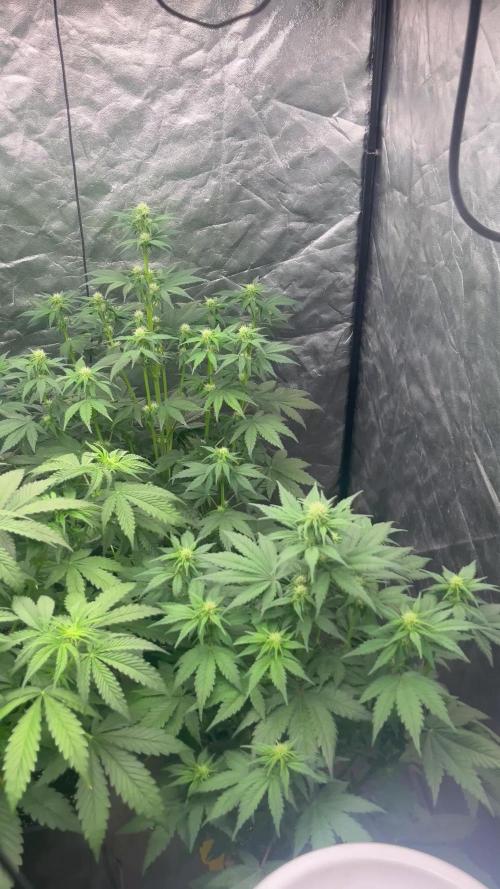
Prossima bagnata inizio ad usare Big bud , tasti terpeny linea Advance nutrients
Continuo con vitamina B52 Rino Skin e se noto qualche segnale dalla foglia Revive e Calmag sempre pronti🤭
Alterno sempre con solo acqua a ph 6,4 circa, il misuratore va troppo spesso tarato… meno male che non sto coltivando in idroponica , perché dovrei avere uno strumento migliore
Ragazzi buona crescita a tutti!
Spero di riuscire anche a continuare così e portare a termine il diario, perché viaggio molto e non sarebbe la prima volta che salto settimane ?