


shorts_status_processing


@cubansoldier
Follow
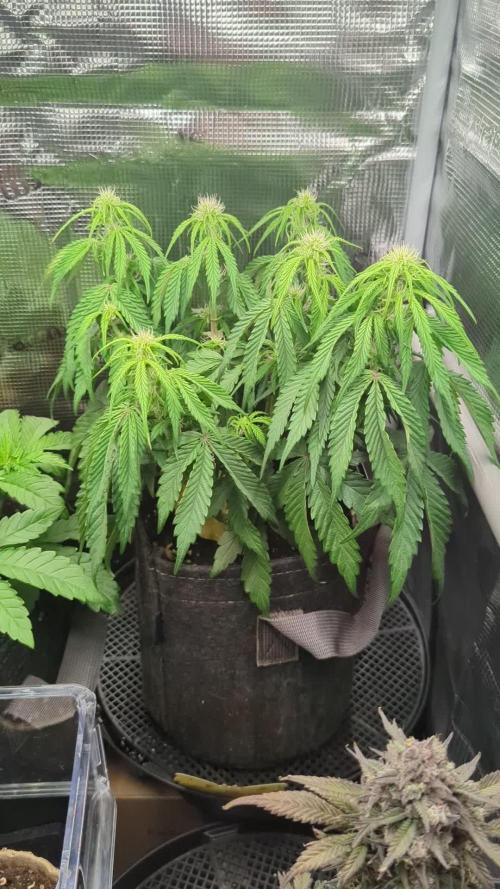
Gave the girls their first big feed yesterday and so far they seem to love it. One of the Bubba kush plants has a slight case of heat stress but it's not much n she's still growing. Happy growing my friends.. #CultivationsTheMotivation 🌱


@Reaper
Follow
Because these plants got put in flower “too early” they continued growing before actually flowering. right now they are legit in week 2 of flowering,
The strains are (see the picture of this week)
Top left: Critical - zamnesia
Top right: Critical super silver Haze
Bottom: Purple Haze
last video = end of this week


@Dunk_Junk
Follow
Been flushing for days now. I put 20L per day through her.
.
These pics are Day 132, She will be chopped tomorrow. I don't expect much weight TBH, the flowers are quite light and airy. Trichomes are milky/amber so it is time.
.
Upon doing more research on this strain and after speaking to somebody about bud shape/density brought me back to my thinking months back. After a very long (for an auto) veg period I suspected the genetics of this plant were not very strong with the Ruderalis genes. But I dismissed that because why would a seedbank put out a 'sub standard' product?............
I think I would have had better results with her if the lights were on 20/4, I may even grow all my autos from now on 20/4 just in case the Ruderalis genetics are not prominent enough.
.
You live and learn, but don't forget: Knowledge is power 😋
.
Harvest to follow............


@TheCannaProphet
Follow
~ FastBuds PAPAYA SHERBET Photoperiod~
Well here we go on another journey together through 'Canna-land' and this one's kinda special... forget that, it's VERY special because this is FastBuds newest surprise for the community, a FEMINIZED PHOTOPERIOD STRAIN!🤯
I was fortunate enough to score these seeds, of which only 1000 were available and can't wait to see what this strain can do! This Papaya Sherbet, according to FastBuds, is a hybrid with a 9-10 weeks flowering period. For a more detailed and accurate description of this strain the following from FastBuds says it best:
"Combining the massive stature of Papaya (Oni Selection) with the strength and resilience of one of our best keeper cuts (Sunset Sherbet), this strain develops into a big, expansive bush adorned with numerous bud sites that later transform into a generous harvest of medium-sized buds. Papaya Sherbet flowers deliver a signature flavor of premium cannabis with subtle citrus undertones that emerge upon inhaling. During growth, her aroma makes for a sweet yet pleasantly bitter fragrance, giving you an idea of what the smoke will taste like. Notably stress-resistant, Papaya Sherbet is a great choice for growers working in challenging environments. She is very forgiving and rebounds quickly from any adversity, allowing growers the freedom to experiment with confidence that she will take everything like a champion she is. This strain embodies resilience, flavor, and abundant yields in every grow cycle."
Sounds like an epic strain and I personally cannot wait for this lady to strut her stuff!😍
________________________________________________________________________________________________________________________________________________________________________________________________________________________________________________________________________________________________________________________
The Setup:
This is going to be an outdoor grow, but I have started the Papaya Sherbet photoperiod indoors as our weather is still a bit too chilly to put a newly sprouted seedling outside (nighttime temp's dipping regularly into the 40's℉).
The plan is simple... let her grow inside under a 19/5 light schedule until the nighttime temperatures are in the mid 50's℉, which shouldn't be long. After which, she'll be moved outside and transplanted into the soil which I have already setup and inoculated with beneficial microbes, and slow release dry amendments from Gaia Green. Once she's established herself outside she'll be given periodic top dressings of Gaia Green 4-4-4 and 2-8-4 along with worm castings and Compost Tea's. Her grow area is approx. 5'x5' and I have posts and a trellis net set up already for when she gets bigger to aid in training her. Let the fun begin!🤪💚
________________________________________________________________________________________________________________________________________________________________________________________________________________________________________________________________________________________________________________________
Weekly Updates:
5/7- Here we go with the new addition to the FastBuds family, Papaya Sherbert fem photo. I placed one seed in a glass of lukewarm tap water (non-chlorinated well water). Within 24hrs there was a root beginning to show coming out of the seed. I then placed the seed between two moistened paper towels that I then put in a vented plastic container. I put the container in a dresser drawer where it would be warm and dark.
5/9- When I checked on the seed yesterday, there was a substantial root about 1/2" long coming from the seed. I then planted the seed, root first with just the seed head exposed, in a 2" starter pot filled with peat that I pre-moistened with 6.5ph well water. I placed the starter pot in the bottom of a Solo Cup that I had cut in half. I then placed a clear Solo Cup over it to act as a humidome and placed it under the lights in the grow room. Today the little Papaya Sherbert showed her pretty little self and so begins this journey together with her!
5/12- Two days ago the Papaya Sherbet sprouted her first true leaves and today she's really showing some vigor and some impressive growth! Today I went ahead and transplanted her for the first time into a 2qt pot filled with pre-amended coco/perlite. Before placing the Papaya Sherbet into her new home I coated the hole with Xtreme Gardening MYCOS, then placed the Papaya Sherbet and watered her in.
5/15- One week from breaking ground and the FastBuds Papaya Sherbet feminized photoperiod is looking fantastic and doing great with a second set of leaves now out! She's liking her bigger pot and is really beginning to take off now. I should be able to do her final transplant, which will move her outside, next week as our weather is rapidly improving... I can't wait!
Thank you for checking out my diary, your positive comments and support make it all worthwhile! 💚Growers Love!💚😎🙏


@Mo_Powers
Follow
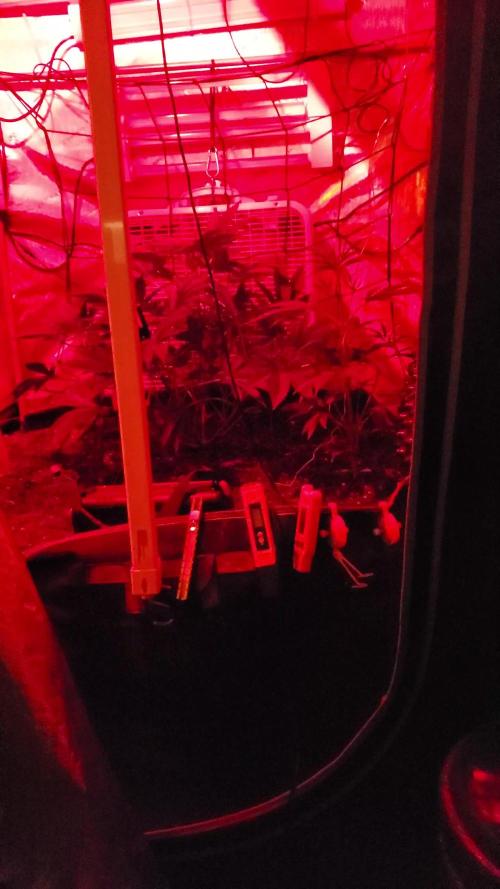
It’s had a big growth spurt. It’s more than doubled in size. The first buds are starting to appear. It’s already developing a faint scent. What I can definitely say is that it’s no longer a dwarf. I’m curious to see whether it’ll grow any taller or whether it’ll stay this size. In any case, I’m very happy with it and how it’s growing in the greenhouse.


@Ultraviolet
Follow
Removed autoflower and put her in her own pot outside the tent.
Foliars applied in strong blue 430nm with 4000Hz tone. 20-minute dose prior to application.
In essence, you're seeing a combination of the infrared light reflected by the plant, which the camera perceives as red, and any residual visible blue light the plant reflects, which results in a purple hue.
I was doing more stretching of the stems, adjusting weights, just a little too much, and it snapped almost clean. I got a little lucky in that it was still connected, wrapped her almost instantly while holding her in place with yoyo's. The core framework is now in place.
If your soil has a high pH, it's not ideal; you want a pH of 6.4, 6.5, or 6.6, which is ideal. If you are over a pH of 7, you have no hydrogen on the clay colloid. If you want your pH down, add Carbon. If you keep the pH below 7, you will unlock hydrogen, a whole host of new microbes become active and begin working, the plant will now be able to make more sugar because she has microbes giving off carbon dioxide, and the carbon you added hangs onto water. Everything has electricity in it. When you get the microbes eating carbon, breathing oxygen, giving off CO2, those aerobic soil microbes will carry about 0.5V of electricity that makes up the EC. The microorganisms will take a metal-based mineral and a non-metal-based mineral with about 1000 different combinations, and they will create an organic salt! That doesn't kill them, that the plant loves, that the plant enjoys. This creates an environment that is conducive to growing its own food.
Metal-based: Could include elements like iron, manganese, copper, or zinc, which are essential nutrients for plants but can exist in forms not readily accessible.
Non-metal-based: Examples like calcium carbonate, phosphate, or sulfur are also important for plant growth and potentially serve as building blocks for the organic salt.
Chelation in a plant medium is a chemical process where a chelating agent, a negatively charged organic compound, binds to positively charged metal ions, like iron, zinc, and manganese. This forms a stable, soluble complex that protects the micronutrient from becoming unavailable to the plant in the soil or solution. The chelate complex is then more easily absorbed by the plant's roots, preventing nutrient deficiency, improving nutrient uptake, and enhancing plant growth. Chelation is similar to how microorganisms create organic salts, as both involve using organic molecules to bind with metal ions, but chelation specifically forms ring-like structures, or chelates, while the "organic salts" of microorganisms primarily refer to metal-complexed low molecular weight organic acids like gluconic acid. Microorganisms use this process to solubilize soil phosphates by chelating cations such as iron (Fe) and calcium (Ca), increasing their availability.
Added sugars stimulate soil microbial activity, but directly applying sugar, especially in viscous form, can be tricky to dilute. Adding to the soil is generally not a beneficial practice for the plant itself and is not a substitute for fertilizer. While beneficial microbes can be encouraged by the sugar, harmful ones may also be stimulated, and the added sugar is a poor source of essential plant nutrients. Sugar in soil acts as a food source for microbes, but its effects on plants vary significantly with the sugar's form and concentration: simple sugars like glucose can quickly boost microbial activity and nutrient release. But scavenge A LOT of oxygen in the process, precious oxygen. Overly high concentrations of any sugar can attract pests, cause root rot by disrupting osmotic balance, and lead to detrimental fungal growth. If you are one who likes warm tropical high rh, dead already. Beneficial, absolutely, but only to those who don't run out of oxygen. Blackstrap is mostly glucose, iirc regular molasses is mostly sucrose. Sugars, especially sucrose, act as signaling molecules that interact with plant hormones and regulate gene expression, which are critical for triggering the floral transition. When sucrose is added to the growth medium significantly influences its effect on floral transition.
Probably wouldn't bother with blackstrap given its higher glucose content. Microbes in the soil consume the sugar and, in the process, draw nitrogen from the soil, which is the same nutrient the plant needs. Glucose is not an oxygen scavenger itself, but it acts as a substrate for the glucose oxidase (GOx) enzyme, effectively removing oxygen from a system. Regular molasses (powdered if you can), as soon as she flips to flower or a week before, the wrong form of sugar can delay flower, or worse. Wrong quantity, not great either. The timing of sucrose application is crucial. It was more complicated than I gave it credit for, that's for sure. When a medium's carbon-to-nitrogen (C:N) ratio reaches 24:1, it signifies an optimal balance for soil microbes to thrive, leading to efficient decomposition and nutrient cycling. At this ratio, soil microorganisms have enough nitrogen for their metabolic needs, allowing them to break down organic matter and release vital nutrients like phosphorus and zinc for plants. Exceeding this ratio results in slower decomposition and nitrogen immobilization, while a ratio below 24:1 leads to faster breakdown and excess nitrogen availability.
Carbon and nitrogen are two elements in soils and are required by most biology for energy. Carbon and nitrogen occur in the soil as both organic and inorganic forms. The inorganic carbon in the soil has minimal effect on soil biochemical activity, whereas the organic forms of carbon are essential for biological activity. Inorganic carbon in the soil is primarily present as carbonates, whereas organic carbon is present in many forms, including live and dead plant materials and microorganisms; some are more labile and therefore can be easily decomposed, such as sugars, amino acids, and root exudates, while others are more recalcitrant, such as lignin, humin, and humic acids. Soil nitrogen is mostly present in organic forms (usually more than 95 % of the total soil nitrogen), but also in inorganic forms, such as nitrate and ammonium. Soil biology prefers a certain ratio of carbon to nitrogen (C:N). Amino acids make up proteins and are one of the nitrogen-containing compounds in the soil that are essential for biological energy. The C:N ratio of soil microbes is about 10:1, whereas the preferred C:N ratio of their food is 24:1 (USDA Natural Resource Conservation Service 2011). Soil bacteria (3-10:1 C:N ratio) generally have a lower C:N ratio than soil fungi (4-18:1 C:N ratio) (Hoorman & Islam 2010; Zhang and Elser 2017). It is also important to mention that the ratio of carbon to other nutrients, such as sulfur (S) and phosphorous (P) also are relevant to determine net mineralization/immobilization. For example, plant material with C:S ratio smaller than 200:1 will promote mineralization of sulfate, while C:S ratio higher than 400:1 will promote immobilization (Scherer 2001).
In soil science and microbiology, the C:S ratio helps determine whether sulfur will be released (mineralized) or tied up (immobilized) by microorganisms.
A carbon-to-sulfur (C:S) ratio smaller than 200:1 promotes the mineralization of sulfate, when the C:S ratio is low, it indicates that the organic matter decomposing in the soil is rich in sulfur relative to carbon. Microorganisms require both carbon and sulfur for their metabolic processes. With an excess of sulfur, microbes take what they need and release the surplus sulfur into the soil as plant-available sulfate
A carbon-to-sulfur (C:S) ratio higher than 400:1 will promote the immobilization of sulfur from the soil. This occurs because when high-carbon, low-sulfur materials (like sawdust) are added to soil, microbes consume the carbon and pull sulfur from the soil to meet their nutritional needs, temporarily making it unavailable to plants.
200:1 C:S 400:1: In this range, both mineralization and immobilization can occur simultaneously, making the net availability of sulfur less predictable.
This dynamic is similar to how the carbon-to-nitrogen (C:N) ratio regulates the availability of nitrogen in soil. Just as microbes need a certain amount of nitrogen to process carbon, they also require a balanced amount of sulfur. Both mineralization and immobilization are driven by the metabolic needs of the soil's microbial population.
Sulfur is crucial for protein synthesis. A balanced ratio is particularly important in relation to nitrogen (N), as plants need adequate sulfur to efficiently use nitrogen. A severely imbalanced C:S ratio can hinder the efficient use of nitrogen, as seen in trials where adding nitrogen without balancing sulfur levels actually lowered crop yields.
Maintaining a balanced carbon-to-sulfur (C:S) ratio is highly beneficial for plant growth, but this happens indirectly by regulating soil microbial activity. Unlike the C:N ratio, which is widely discussed for its direct effect on nutrient availability, the C:S ratio determines whether sulfur in the soil's organic matter is released (mineralized) or temporarily locked up (immobilized).
Applied 3-day drought stress.
Glucose will hinder oxygenation more than sucrose in a solution because glucose is consumed faster and has a higher oxygen demand, leading to a more rapid decrease in oxygen levels. When cells respire, they use oxygen to break down glucose, and this process requires more oxygen for glucose than for sucrose because sucrose must first be broken down into glucose and fructose before it can be metabolized.
In a growth medium, glucose is a more immediate and universal signaling molecule for unicellular and multicellular organisms because it is directly used for energy and triggers a rapid gene expression response. In contrast, sucrose primarily acts as a signaling molecule in plants to regulate specific developmental processes by being transported or broken down, which can be a more complex and slower signaling process.
Critical stuff.
During wakefulness (DC electric current) life can not entangle electrons and protons. During the daytime, the light is sensed as multiple color frequencies in sunlight. Coherence requires monochromatic light. Therefore, at night, IR light dominates cell biology. This is another reason why the DC electric current disappears during the night. The coherence of water is maintained by using its density changes imparted by infrared light released from mitochondria in the absence of light. This density change can be examined by NMR analysis, and water is found to be in its icosahedral molecular form. This is the state that water should be in at night. This is when a light frequency is lowest and when the wave part of the photoelectric effect is in maximum use.
3600


@Kitties_and_Colas
Follow
~_~_~_~_~_~_~_~_~_~_~_~_~_~_~_~_~_~_~_~_~_~_~_~_~_~_~_~_~_~_~_~_~_~_~_~_~_~_~_~_~_~_~_~_~_~_~_~_~_~_~_~_~_~_~_~_~_~_~_~_~_~_~_~_~_~_~_~_~_~_~_~_~_~_~_~_~_~_~_~_~_~_~_
3/26/22
😻 First day of week 6!! These girls are starting to get REALLY frosty!! We dropped the MarsHydro 2inches this week, we're approximately 22" from the lowest and 18" from the highest part of the canopy..we're monitoring closely, we've burned plants close to this distance before.. the extra shot of N straightened their color out fast, they look great today..we removed all large fans just from cola tops so they receive as much direct light as possible for the next few weeks..its been an effortless run so far!! We'll upload again midweek. thanks for dropping by and happy harvests everyone!!
⚡Mars Hydro/SP-3000⚡ Specifications ⚙️:
Diodes: Samsung LM301B / Osram 660nm (960 total!)
Driver: Meanwell 300watt 🔌 (300W±5% @AC120V-277V)
PPF: 824umol/S ☢️
PPE: 2.8 µmol/j 〰️〰️
Lifespan: 50k+ hrs ⌛
Weight: 10.1 lbs (4.6kg)
Veg Coverage: 3 x 5 ft 🌱
Flowering Coverage: 2 x 4 ft 🌼
-The SP-3000 uses an aluminum heatsink (no fan) and the driver can be placed outside the tent 🌡️⬇️
-IP65 waterproof ratings, tolerant to high humidity grow environments 💦 ..
-Up to 15 can be daisy-chained together and all controlled from a single light! 💡~💡~💡~💡
~_~_~_~_~_~_~_~_~_~_~_~_~_~_~_~_~_~_~_~
Song: "I got a girl"
Artist: Philip Morris
~_~_~_~_~_~_~_~_~_~_~_~_~_~_~_~_~_~_~_~_~_~_~_~_~_~_~_~_~_~_~_~_~_~_~_~_~_~_~_~_~_~_~_~_~_~_~_~_~_~_~_~_~_~_~_~_~_~_~_~_~_~_~_~_~_~_~_~_~_~_~_~_~_~_~_~_~_~_~_~_~_~_~_


@Herbz_Unkraut
Follow
i went on holiday and installed an automatic watering pump...seems like it didn't activate as planed...when i got back after 7 days the pots were compleatly dry...
i removed alot of dead foliage from beneath...i would have removed it for better airflow soon anyways...so not much harm taken...
after a big watering they looked fine again
budgrowth didn't seem to be affected by the complete dryout...let's see where this goes...buds look perfectly fine so far


@moritz
Follow
Day 31 / 01.05. The Plants really have taken off with growth since I turned on the autopot system, even the Super Lemon Haze which seemed to be growing quite slow in the beginning. I filled the reservoir on day 28 with an EC of 1.7 mS/cm. Currently I am fighting a bit with the humidity as it tends to rise quite a bit.




@SkullRipper
Follow
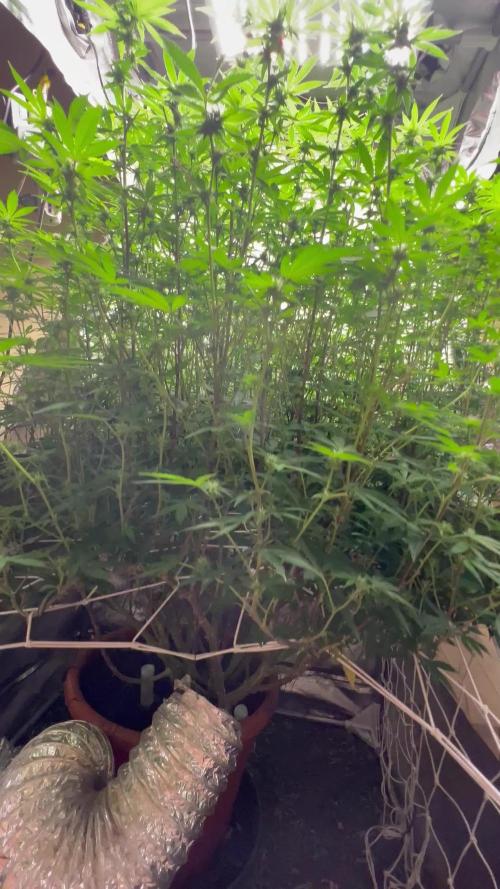
Day 25 of 4th week of Flowering Plants coming along nicely and seem happy with their environment.
The smell is still really low as the room is vented 24/7 and this strain doesn't stretch much making it ideal for indoor cultivation, Although the strain does prefer a "Mediterranean climate" Meaning I'm having to run a 1.5 kw heater!




@Gdawg
Follow
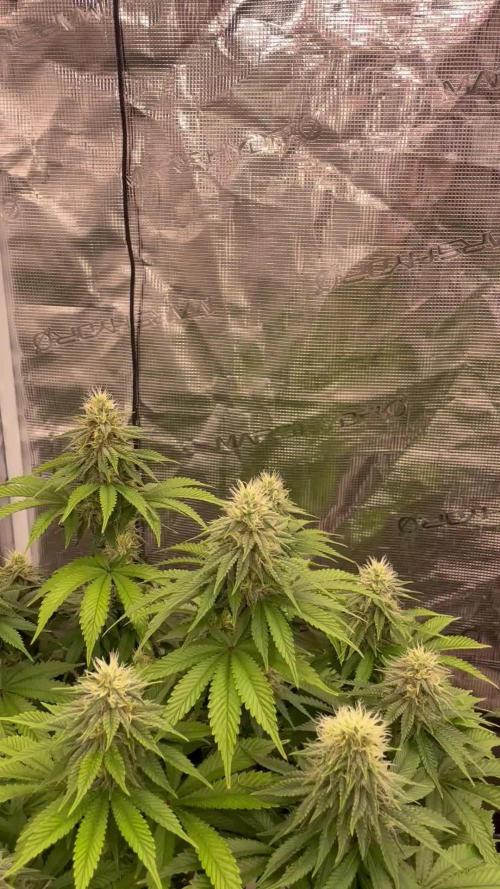
They are striving in there inviroment... sorry been ill for two weeks im impressed with the plants smell amazing and growing just as good


@sunshinegroww
Follow
Hello week 6 looking 🔥 2 yellow leafes i think underwater as pretty hot now ☀️☀️☀️?❤️


@Growcilla
Follow
Herzlich willkommen zur nächsten Woche, Freunde des gepflegten Grows. Eigentlich gibt es nicht viel zu berichten. Die Pflanzen sind schön kräftig gewachsen und der Wind weht. Beim nächsten Mal Gießen werde ich Dünger hinzufügen, dann gibt es auch Literangaben zu dem Wasser und dem Dünger. Der Wuchs ist bisher recht gleichmäßig, kleine Unterschiede gibt es immer. Ich bin gespannt, wie sich das weiterentwickelt. Ab nächster Woche wird es losgehen, dass ich eine der Pflanzen ein wenig trainiere und die andere in Ruhe lasse. Ich bin gespannt.
Bis nächste Woche und guck gerne in meine anderen Tagebücher.😊😊😊
Welcome to the next week, friends of the well-groomed Grows. Actually, there is not much to report. The plants have grown beautifully vigorously and the wind is blowing. Next time I will add fertilizer, then there will also be litres of water and fertilizer. The growth so far is quite uniform, there are always small differences. I'm curious to see how this develops. From next week, I will start training one of the plants a little and leaving the other alone. I'm excited.
See you next week and have a look at my other diaries. 😊😊😊


@PapaTerps
Follow
AlienZ Automatic - Greenhouse Seed Co.
Day 53 - watered with 2L of RO tap water, mixed with the defined nutrients and pH'd to 6.3. I wasn't sure how she was going to perform in such a small pot after the topping, but she has done so well!! She has six clear budsites that are well spaced out and even at canopy level 💪🏻 she is also starting to develop her bud sites so her aroma has started to fill the tent 🙌🏻 so far I'm really impressed with this one! She is showing signs of over watering, even though I have let her dry back to almost 5% moisture content of the soil, so I'm going to let her dry back to 2% and then only water her with 1L for her next watering in about 4 days time 🤞🏻