The Grow Awards 2026 🏆
Likes
Comments
Share
@cliv4ge
Follow
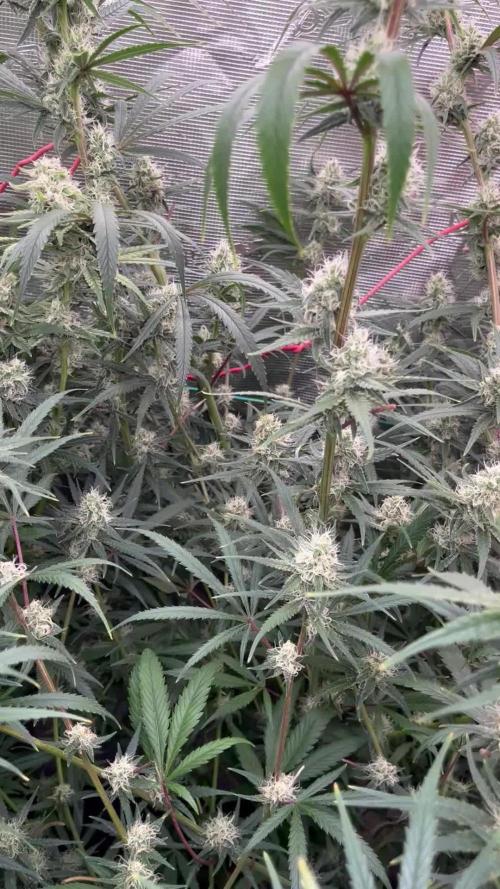
Hey gents! She is growing so well... Glad I started this hobby. Buds are filling out. I see many pistons turning brown. Maturity wise I think Im halfway done with flowering. My guess would be that 4 more weeks and this will be ready. Minor defoliation was done. (fan leaves that were shading bud sites). 90% of the community would have just trimmed the bud sites in the lower part of the canopy but I didn't wanna touch the plant more and just allow her to do her own thing. Thank you so much for stopping by. Enjoy your grows 🌷
Likes
21
Share
Another great week she is starting to look more finished. I've bumped down nutes this week and are still watering at 6.0+-0.2 ph. Next week i will start the flush and then it's harvest time 😁
Likes
7
Share
Howdy growfessors, thanks for stopping by. It's harvest time for Candy Kush. Dense, frosty buds, they foxtailed, which I did not expect under the FC3000 light. Still I'm super happy with the grow and I'm excited to see the dry weight in 7 days.
Likes
6
Share
@Roller
Follow
Semi Jealousy-Zamnesia, messi ieri nel bicchiere, si aspetta che germini, intanto sto preparando il box e la lampada, per quando saranno pronti per la vegetazione
Likes
8
Share
@Lykal
Follow
Germinação, após germinar foi colocado num vaso 11l com solo All-Mix Biobizz
Likes
12
Share
@RoyColt
Follow
Day137 4lt ro water -4ml cal mag extra, Total 200 ppm, ph6,4 Drain 900 ml, 360 ppm. Day139 18/04 start flush. 5lt ro water Total 15 ppm, ph 6,4 Drain 2500ml, 440 ppm. * 5lt ro water Total 15 ppm, ph 6,4 Drain 5000ml, 210 ppm.
Likes
26
Share
Like most beginners I am very impatient. Therefore the following question can I be satisfied with growth so far ? I haven't used any fertiliser so far because I put pre-fertilised soil in the pot when I repotted it. It hasn't received much water yet either, I drowned a plant before, so I have become cautious. I'm starting to think about training her, because I'm very limited in height. 5.5. 80ml 7.5. 100ml 11.5. 240m
Likes
55
Share
What's in the soil? What's not in the soil would be an easier question to answer. 16-18 DLI @ the minute. +++ as she grows. Probably not recommended, but to get to where it needs to be, I need to start now. Vegetative @1400ppm 0.8–1.2 kPa 80–86°F (26.7–30°C) 65–75%, LST Day 10, Fim'd Day 11 CEC (Cation Exchange Capacity): This is a measure of a soil's ability to hold and exchange positively charged nutrients, like calcium, magnesium, and potassium. Soils with high CEC (more clay and organic matter) have more negative charges that attract and hold these essential nutrients, preventing them from leaching away. Biochar is highly efficient at increasing cation exchange capacity (CEC) compared to many other amendments. Biochar's high CEC potential stems from its negatively charged functional groups, and studies show it can increase CEC by over 90%. Amendments like compost also increase CEC but are often more prone to rapid biodegradation, which can make biochar's effect more long-lasting. biochar acts as a long-lasting Cation Exchange Capacity (CEC) enhancer because its porous, carbon-rich structure provides sites for nutrients to bind to, effectively improving nutrient retention in soil without relying on the short-term benefits of fresh organic matter like compost or manure. Biochar's stability means these benefits last much longer than those from traditional organic amendments, making it a sustainable way to improve soil fertility, water retention, and structure over time. Needs to be charged first, similar to Coco, or it will immobilize cations, but at a much higher ratio. a high cation exchange capacity (CEC) results in a high buffer protection, meaning the soil can better resist changes in pH and nutrient availability. This is because a high CEC soil has more negatively charged sites to hold onto essential positively charged nutrients, like calcium and magnesium, and to buffer against acid ions, such as hydrogen. EC (Electrical Conductivity): This measures the amount of soluble salts in the soil. High EC levels indicate a high concentration of dissolved salts and can be a sign of potential salinity issues that can harm plants. The stored cations associated with a medium's cation exchange capacity (CEC) do not directly contribute to a real-time electrical conductivity (EC) reading. A real-time EC measurement reflects only the concentration of free, dissolved salt ions in the water solution within the medium. 98% of a plants nutrients comes directly from the water solution. 2% come directly from soil particles. CEC is a mediums storage capacity for cations. These stored cations do not contribute to a mediums EC directly. Electrical Conductivity (EC) does not measure salt ions adsorbed (stored) onto a Cation Exchange Capacity (CEC) site, as EC measures the conductivity of ions in solution within a soil or water sample, not those held on soil particles. A medium releases stored cations to water by ion exchange, where a new, more desirable ion from the water solution temporarily displaces the stored cation from the medium's surface, a process also seen in plants absorbing nutrients via mass flow. For example, in water softeners, sodium ions are released from resin beads to bond with the medium's surface, displacing calcium and magnesium ions which then enter the water. This same principle applies when plants take up nutrients from the soil solution: the cations are released from the soil particles into the water in response to a concentration equilibrium, and then moved to the root surface via mass flow. An example of ion exchange within the context of Cation Exchange Capacity (CEC) is a soil particle with a negative charge attracting and holding positively charged nutrient ions, like potassium (K+) or calcium (Ca2+), and then exchanging them for other positive ions present in the soil solution. For instance, a negatively charged clay particle in soil can hold a K+ ion and later release it to a plant's roots when a different cation, such as calcium (Ca2+), is abundant and replaces the potassium. This process of holding and swapping positively charged ions is fundamental to soil fertility, as it provides plants with essential nutrients. Negative charges on soil particles: Soil particles, particularly clay and organic matter, have negatively charged surfaces due to their chemical structure. Attraction of cations: These negative charges attract and hold positively charged ions, or cations, such as: Potassium (K+) Calcium (Ca2+) Magnesium (Mg2+) Sodium (Na+) Ammonium (NH4+) Plant roots excrete hydrogen ions (H+) through the action of proton pumps embedded in the root cell membranes, which use ATP (energy) to actively transport H+ ions from inside the root cell into the surrounding soil. This process lowers the pH of the soil, which helps to make certain mineral nutrients, such as iron, more available for uptake by the plant. Mechanism of H+ Excretion Proton Pumps: Root cells contain specialized proteins called proton pumps (H+-ATPases) in their cell membranes. Active Transport: These proton pumps use energy from ATP to actively move H+ ions from the cytoplasm of the root cell into the soil, against their concentration gradient. Role in pH Regulation: This active excretion of H+ is a major way plants regulate their internal cytoplasmic pH. Nutrient Availability: The resulting decrease in soil pH makes certain essential mineral nutrients, like iron, more soluble and available for the root cells to absorb. Ion Exchange: The H+ ions also displace positively charged mineral cations from the soil particles, making them available for uptake. Iron Uptake: In response to iron deficiency stress, plants enhance H+ excretion and reductant release to lower the pH and convert Fe3+ to the more available form Fe2+. The altered pH can influence the activity and composition of beneficial microbes in the soil. The H+ gradient created by the proton pumps can also be used for other vital cell functions, such as ATP synthesis and the transport of other solutes. The hydrogen ions (H+) excreted during photosynthesis come from the splitting of water molecules. This splitting, called photolysis, occurs in Photosystem II to replace the electrons used in the light-dependent reactions. The released hydrogen ions are then pumped into the thylakoid lumen, creating a proton gradient that drives ATP synthesis. Plants release hydrogen ions (H+) from their roots into the soil, a process that occurs in conjunction with nutrient uptake and photosynthesis. These H+ ions compete with mineral cations for the negatively charged sites on soil particles, a phenomenon known as cation exchange. By displacing beneficial mineral cations, the excreted H+ ions make these nutrients available for the plant to absorb, which can also lower the soil pH and indirectly affect its Cation Exchange Capacity (CEC) by altering the pool of exchangeable cations in the soil solution. Plants use proton (H+) exudation, driven by the H+-ATPase enzyme, to release H+ ions into the soil, creating a more acidic rhizosphere, which enhances nutrient availability and influences nutrient cycling processes. This acidification mobilizes insoluble nutrients like iron (Fe) by breaking them down, while also facilitating the activity of beneficial microbes involved in the nutrient cycle. Therefore, H+ exudation is a critical plant strategy for nutrient acquisition and management, allowing plants to improve their access to essential elements from the soil. A lack of water splitting during photosynthesis can affect iron uptake because the resulting energy imbalance disrupts the plant's ability to produce ATP and NADPH, which are crucial for overall photosynthetic energy conversion and can trigger a deficiency in iron homeostasis pathways. While photosynthesis uses hydrogen ions produced from water splitting for the Calvin cycle, not to create a hydrogen gas deficiency, the overall process is sensitive to nutrient availability, and iron is essential for chloroplast function. In photosynthesis, water is split to provide electrons to replace those lost in Photosystem II, which is triggered by light absorption. These electrons then travel along a transport chain to generate ATP (energy currency) and NADPH (reducing power). Carbon Fixation: The generated ATP and NADPH are then used to convert carbon dioxide into carbohydrates in the Calvin cycle. Impaired water splitting (via water in or out) breaks the chain reaction of photosynthesis. This leads to an imbalance in ATP and NADPH levels, which disrupts the Calvin cycle and overall energy production in the plant. Plants require a sufficient supply of essential mineral elements like iron for photosynthesis. Iron is vital for chlorophyll formation and plays a crucial role in electron transport within the chloroplasts. The complex relationship between nutrient status and photosynthesis is evident when iron deficiency can be reverted by depleting other micronutrients like manganese. This highlights how nutrient homeostasis influences photosynthetic function. A lack of adequate energy and reducing power from photosynthesis, which is directly linked to water splitting, can trigger complex adaptive responses in the plant's iron uptake and distribution systems. Plants possess receptors called transceptors that can directly detect specific nutrient concentrations in the soil or within the plant's tissues. These receptors trigger signaling pathways, sometimes involving calcium influx or changes in protein complex activity, that then influence nutrient uptake by the roots. Plants use this information to make long-term adjustments, such as Increasing root biomass to explore more soil for nutrients. Modifying metabolic pathways to make better use of available resources. Adjusting the rate of nutrient transport into the roots. That's why I keep a high EC. Abundance resonates Abundance.
Likes
38
Share
For LIQUIDS & NUTES ******GREEN BUZZ NUTRIENTS***** organic. Also i’m using their LIVING SOIL CULTURE in powder form! MARSHYDRO ⛺️ has large openings on the sides which is useful for mid section groom room work. 🤩 ☀️ MARSHYDRO FC 3000 LED 300W 💨MARSHYDRO 6” in-line EXTRACTOR with speed-variation knob, comes complete with ducting and carbon filter.
Likes
3
Share
Very dense flowers and heavy smells like cheese
Likes
81
Share
@m0use
Follow
SPONSORED DIARY===SPONSORED DIARY===SPONSORED DIARY TRANSPLANT #3 THIS WEEK!!!! Big week, did the last transplant of the grow before she enters flower. I decided to skip out on the 3gal and upgraded to a 4.97 or 5gal container. The plastic is cheep and looks like it was going to break but its all the grow store had in stock at the time. Was talking to them about going from a 2gal to 3gal and how it did not do much for the plant but stress it out. They also gave me a free sample of a bokashi fertilizer, I divided that in between the two plants. It looks identical to the regular non fertilizer branded bokashi, and I feel its the same but with a mist of NPK on it or something. Plants are doing well, Dynomyco had a slighter bigger root ball upon transplant and the plant its self is a tiny bit more robust. Given all the other soil boosters and microorganisms I have added into this, I don't feel I will see the true potential of just Dynomyco vs soil nothing else added. I just can't not add the others as it feel like a massive step backwards and end of day a big healthy plant is worth it. This diary may not have massive contrast in favour of Dynomyco but I will still use it none the less and I think its helps plus its not over just yet. Would love to hear what y'all think about this, hit me up in the comments and I'd try and get back to yea as fast as I can. I like how the dead Blue Cindy plant looks like a biophage, sifi like alien thing. SPONSORED DIARY===SPONSORED DIARY===SPONSORED DIARY This is my diary entry into the Dynomyco Show Us What You Got Contest! #DynomycoShowUsWhatYouGot! @DynomycoShowUsWhatYouGot! @Dynomyco Big Shoutout to @Dynomyco for picking me in their contest. Happy to be involved and as a user of Dynomyco I am curious to see this side by side with my own eyes. I will be honest I am a little skeptical it will show any major differences. but we will see what happens. Some disclaimers, I am still using LABS serum I made, This is also beneficial to the root mass however it's a bacteria based product and not fungal or mycorrhizae like Dynomyco. https://growdiaries.com/giveaways/DYNOMYCO_Show_Us_What_You_Got
Likes
42
Share
Bonjour à tous les padawans et maîtres jedis Tout d'abord merci à Tom de seedsman pour ses graines ainsi que greenhouse de me permettre de faire cette culture en m'offrant le feeding greenhouse Je rappelle que cultive simultanément 9 pots de 10 et 11 litres dans une box prévu pour 4 et que je n'utilise que le strict minimum du matériel nécessaire à une culture correcte au prix le plus bas possible MATÉRIEL CONFIGURATION Box 80×80×160 Lampe led Lampwin 300 watts ×2 Ventilateur à pince 15 watts Xiaomi Deerma humidificateurs 5L Hygrometre thermomètre Extracteur PROFAN 107 m3/h - 100 Prise programmable électronique ×2 1 pot carré noir 10 litres Green house feeding enhancer Green house feeding biobloom Green house feeding biogrow Substrat biobizz ligthmix Fil de fer et pince coupante Microscope Petite balance de précision CULTURE ÉTAPE PAR ÉTAPE J'ai tout dabord fais germé ma graine avec le easy start de Royal queen seed et je suis agréablement surpris car franchement le taux de réussite est très élevé (17 graines sur 19) simple d'utilisation et très efficace. Une fois la plantule sortie et d'une hauteur de 2 ou 3 centimètres je la prend délicatement et la place directement dans son pot définitif. Je préconise des pots allant entre 10 litres et 15 litres pour des autofloraisons cultivées en intérieur. Le pot aura été préalablement préparé (video dans diarie) avec 30 grammes d'engrais greenhouse feeding biobloom et 30 grammes de greenhouse feeding biogrow, soit l'équivalent de 3 grammes par litre de substrat. Je dépose donc la plantule dans son pot définitif je recouvre un peu de avec de la terre je tasse légèrement et j'arrose pour garder le substrat humide pas plus Je place ma lampe led 300watts à environ 90 centimètres de la plantule avec un cycle de lumière de 24/24 pendant une semaine. Au début de la semaine 2 le cycle de lumière passera en 20/4 grace a un programmateur car c'est pour moi le cycle de lumière qui offre le meilleur rendement pour une autofloraison. Jour1: léger arrosage Jour2: léger arrosage Jour3: la plantule commence à être plus vigoureuse mise en place de la ventilation pour augmenter sa masse racinaire et léger arrosage Jour4: arrosage avec un litre et demi d'eau ph6.3 à laquelle j'ai ajouté 0.9 gramme de greenhouse feeding enhancer (soit 0.6 gramme par litre d'eau) Jour5: aucune technique spéciale Jour6: aucune technique spéciale Semaine agréablement calme sans problème ni carence apparente Que la force soit avec vous !
Likes
3
Share
In questa settimana un colpo di vento forte ha fatto cadere il vaso e si è leggermente spezzato lo stelo alla base
Likes
4
Share
Start of week 7(May 3rd 2022). I’ve been using Lotus Grow every watering and so I decided to flush the pots with 7x their water holding capacity in the bathtub. I will be alternating between Lotus bloom/boost and a plant based “tea” from Dragonfly Earth Medicine called Fat Flowers. Lights were too close and caused marks on the leaves which look like deficiencies, I’ll keep a close eye until I can be sure. The petioles are purpling on the indoor plants as well(might be genetics though from the Strawberry Nuggets).
Likes
12
Share
The wheater was very bad. i hope for a good harvest but it is so hard. too much rain and wind.
Likes
61
Share
@Roberts
Follow
Sweet Bourbon Kush auto is doing great. She had a big growth spurt this last week. She is starting to develop her colas, and start stacking. I did lollipop her some and defoliated some of the bushier parts of the canopy. She is ready for another week of growing. Thank you Super Sativa Seed Club. 🤜🏻🤛🏻🌱🌱🌱 Thank you grow diaries community for the 👇likes👇, follows, comments, and subscriptions on my YouTube channel👇. ❄️🌱🍻 Happy Growing 🌱🌱🌱 https://youtube.com/channel/UCAhN7yRzWLpcaRHhMIQ7X4g
Likes
9
Share
And off we went, the adventure with Zamnesia's F1 Hybrids started off great, with a stunning 100% germination 8/8 born without any hesitation after a very short time in water and subsequently in soil. She is precisely at the 10th, she is the Pineapple Express, she grows well regularly and very similar to the little twin. One of the characteristics of the F1 Hybrids is stability and for now it has been thoroughly demonstrated since day 10. For the rest we have to say everything is going very well, the parameters are in order, the girls were born in a biodegradable jar which biodegraded a little earlier than expected and I proceeded with the potting, no repotting, be careful the seedling never came out of the jar biodegradable the roots pass it at a certain point of decomposition. So we are now in a comfortable 11 liter house that is perfect for autoflowering in my opinion. Unfortunately, the Zamnesia pots are about to arrive but I didn't have them in time, I preferred to repot them for the sake of the plants, we need to photograph them of course but first and foremost I'm a grower and I care about the health of my little girls. Something tells me we will be growing a lot of Zammi plants so we will use them in the Official Grower version next time. Zamnesia is the best online shop in the situation, you can find everything from seeds, to mushroom kits, through vaporizers and a thousand other things https://www.zamnesia.io Pineapple Express F1 seeds specifically https://www.zamnesia.com/10681-zamnesia-seeds-pineapple-express-f1-automatic.html Site Description ZAMNESIA SEEDS - PINEAPPLE EXPRESS F1 HYBRID AUTOMATIC: FRUITY FLAVORS AND ENERGETIC EFFECTS Combining Trainwreck with Hawaiian, Pineapple Express F1 Hybrid Automatic brings a beloved strain to new heights. This autoflowering F1 hybrid cultivar ensures exceptional uniformity, reliability, and stability, making it well-suited to growers of all experience levels. If you've not checked out Pineapple Express F1 hybrid Automatic for yourself just yet, now is the time. GROWING PINEAPPLE EXPRESS F1 HYBRID AUTOMATIC All it takes is 8–9 weeks from germination before Pineapple Express F1 hybrid Automatic is ready to harvest. Thankfully, very little effort is required throughout the growing process, aside from a bit of maintenance, to ensure ample, high-quality harvests. Thanks to its F1 genetics, Pineapple Express F1 Automatic offers superb resilience and uniformity, meaning all plants will have a similar height and appearance, and will churn out comparably large yields. Reaching heights of 50–70cm, Pineapple Express F1 Automatic is not an overbearing plant and can effortlessly slot into any setup. Once ready to yield, growers can see a return in the region of 400–550g/m² indoors and up to 200g/plant outdoors. AROMAS, FLAVORS, AND EFFECTS OF PINEAPPLE EXPRESS F1 HYBRID AUTOMATIC Just one hit of Pineapple Express F1 hybrid Automatic treats users to a rich assortment of flavors and aromas. This strain offers strong pineapple notes alongside moments of citrus, spice, and pine, making for a mouth-watering blend that's extremely moreish. Bolstered by 21% THC and an array of cannabinoids, Pineapple Express F1 Automatic showcases an energetic and uplifting high that will have you feeling chatty in no time. So if you've been looking for a strain to enjoy with friends, Pineapple Express F1 Automatic could be just the thing. As for fertilizers, I'm doing a small comparative experiment to finish off the fertilizers I had at home, it's not 100% indicative, it's only on two specimens but given the stable genetics I decided to try to compare the results of Plagron Vs Aptus, both excellent brands which they will certainly produce beautiful plants which are already of excellent stable genetics. In the next few weeks the comparison will be more evident now the seedlings are still very small and just potted. So seeds of all brands, in addition to these great F1 Hybrids and the entire Zamnesia line, fertilizers and everything related to the world of cannabis, you should buy them from the best online store in the sector www.zamnesia.io
Likes
13
Share
Fue como la semana anterior sigo alternando riegos con abono si abono no y esta semana uno de los días se me quedó la luz encendida y tuvieron 36 horas seguidas de luz, espero no les pase nada grave. Por lo demás todo bien
Likes
2
Share
both have responded well to defoiliation. Blueberryz stopped stretching after having to tie top down, Was getting dangerously close to hps light. Starting get some scent to
Likes
3
Share
@Mousse
Follow
Lampe 100% Ich habe sie entlaubt, und alles was unter dem ersten Netz war kam weg !! Ein zweites netzt habe ich dann ein paar Tage später eingebunden. Hab fast die komplette Fläche ausgefüllt also genau das was ich erreichen wollte!! :)
Likes
34
Share
Both of these Gorilla Punch and Cherry Cola were a pleasure to grow. Very easy and forgiven not finicky at all. Very dense tricome covered flowers. They cured absolutely amazing bag appeal and taste to match. I highly recommend. I'm late adding this last step to the dairy as I thought I was finished didn't know I had to ad this step.