Likes
Comments
Share
@Natrona
Follow
Fractal was harvested on Sept 12. Due to extended period of high temperatures and humidity with more rain expected every day following another hurricane. The other gals were showing disease. That was the determining factor to chop all outside girls down. Fractal hung in the dark for 2 days. Because her grow family experienced bud rot and wilt, she was examined carefully for any disease. She was disease free. Fractal had a long vegetative phase. Probably too long since I started my outside grow in April so they would be hardened off before I went on vacay in May. Three months of veg caused massive vegetative growth. The various breeder notes on photo period seeds indicate late September or October harvest. So that was in the back of my mind during this grow. 👉 Note for next year start seeds later in spring. 👉 Plan start date based on counting back from the vernal equinox. 👉 Based on such a long growing season, Autos may be preferable to finish quickly and not have extended vegetation phase before flower. Thank you @DivineSeeds for the opportunity to grow your exotic strains and participate in your contest. I will definitely grow fractal again.
Likes
6
Share
@Mishka420
Follow
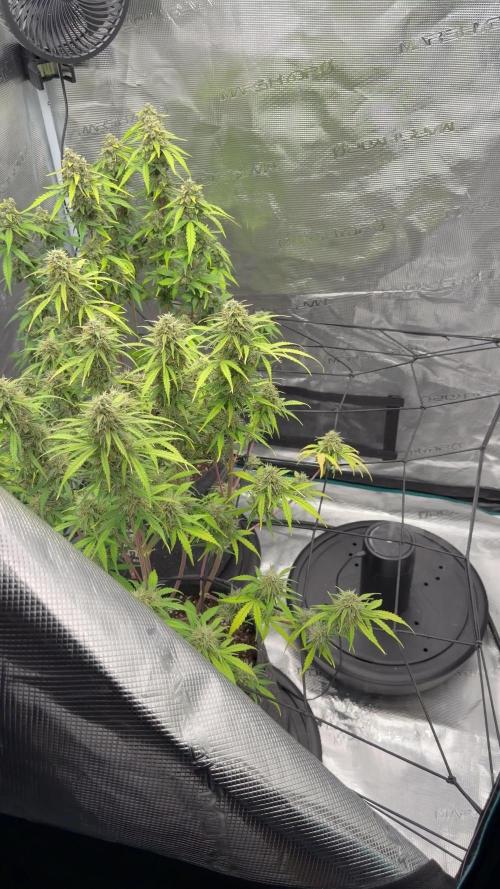
Flowering is now in its final ripening stage. Buds have reached impressive density and are heavily coated with trichomes, extending across the sugar leaves and giving the entire canopy an extremely frosty appearance. Calyxes continue to swell, with pistils slowly beginning to darken, indicating that harvest is approaching. Aroma intensity has increased significantly, with strong resin production dominating this stage. The plant remains healthy and stable, supported by the Athena Blended Line, including Bloom A & B, Balance, CaMg and Cleanse, with PK supplementation active since flower week 3 to maximize flower density and resin output. SCROG training has paid off with an even canopy and excellent light distribution across all bud sites. Focus is now fully on maintaining stable conditions and allowing the flowers to finish ripening naturally.
Likes
Comments
Share
So everything took off in flower, I was super harsh with the defoliating which initially I regretted, but was surprised with how they packed out during the following weeks. In general it's impressive how hardy these plants are. Even the outdoor grows yielded some quality. Add some more nuets (overdrive and carbo load), before flushing about 14 days before harvest, next time I'll do this earlier and really the Runtz could have gone another week but my drying needs to happen in the same space as my growing for now. Apologies for the quality of image, I'm just using my phone and some bits I have to document, I collect records too, so expect weird noises lol. Build a rotating plat from a lazt susan I found, has been the best piece of kit added this season.
Likes
19
Share
Vamos familia primera semana de floración de estás apollo black cherry de SeedStockers. Que ganas tengo de ver el progreso de esta variedad, las plantas están sanas, se ven con buen color. La cantidad de agua cada 48h entre riegos. Esta semana añadimos nutrientes de la gama Agrobeta. Ya puedo confirmar que elimine la plaga de tripa con aceite de nene jabón potásico e insecticida para ácaros. Las plantas están bastante bien ya llevan una semana en 12 horas de luz 12 oscuridad. Estas próximas semanas veremos como avanzan. Mars hydro: Code discount: EL420 https://www.mars-hydro.com/ Agrobeta: https://www.agrobeta.com/agrobetatiendaonline/36-abonos-canamo Hasta aquí todo, Buenos humos 💨💨.
Likes
25
Share
ANTHOCYANIN production is primarily controlled by the Cryptochrome (CR1) Photoreceptor ( !! UV and Blue Spectrums are primary drivers in the production of the pigment that replaces chlorophyll, isn't that awesome! 1. Diverse photoreceptors in plants Many civilizations, including the sun god of ancient Egypt, thought that the blessings of sunlight were the source of life. In fact, the survival of all life, including humans, is supported by the photosynthesis of plants that capture solar energy. Plants that perform photosynthesis have no means of transportation except for some algae. Therefore, it is necessary to monitor various changes in the external environment and respond appropriately to the place to survive. Among various environmental information, light is especially important information for plants that perform photosynthesis. In the process of evolution, plants acquired phytochrome, which mainly receives light in the red light region, and multiple blue light receptors, including his hytropin and phototropin, in order to sense the light environment. .. In addition to these, an ultraviolet light receptor named UVR8 was recently discovered. The latest image of the molecular structure and function of these various plant photoreceptors (Fig. 1), focusing on phytochrome and phototropin. Figure 1 Ultraviolet-visible absorption spectra of phytochrome, cryptochrome, phototropin, and UVR8. The dashed line represents each bioactive absorption spectrum. 2. Phytochrome; red-far red photoreversible molecular switch What is phytochrome? Phytochrome is a photochromic photoreceptor, and has two absorption types, a red light absorption type Pr (absorption maximum wavelength of about 665 nm) and a far-red light absorption type Pfr (730 nm). Reversible light conversion between the two by red light and far-red light, respectively(Fig. 1A, solid line and broken line). In general, Pfr is the active form that causes a physiological response. With some exceptions, phytochrome can be said to function as a photoreversible molecular switch. The background of the discovery is as follows. There are some types of plants that require light for germination (light seed germination). From that study, it was found that germination was induced by red light, the effect was inhibited by subsequent far-red light irradiation, and this could be repeated, and the existence of photoreceptors that reversibly photoconvert was predicted. In 1959, its existence was confirmed by the absorption spectrum measurement of the yellow sprout tissue, and it was named phytochrome. Why does the plant have a sensor to distinguish between such red light and far-red light? There is no big difference between the red and far-red light regions in the open-field spectrum of sunlight, but the proportion of red light is greatly reduced due to the absorption of chloroplasts in the shade of plants. Similar changes in light quality occur in the evening sunlight. Plants perceive this difference in light quality as the ratio of Pr and Pfr, recognize the light environment, and respond to it. Subsequent studies have revealed that it is responsible for various photomorphogenic reactions such as photoperiodic flowering induction, shade repellent, and deyellowing (greening). Furthermore, with the introduction of the model plant Arabidopsis thaliana (At) and the development of molecular biological analysis methods, research has progressed dramatically, and his five types of phytochromes (phyA-E) are present in Arabidopsis thaliana. all right. With the progress of the genome project, Fi’s tochrome-like photoreceptors were found in cyanobacteria, a photosynthetic prokaryotes other than plants. Furthermore, in non-photosynthetic bacteria, a homologue molecule called bacteriophytochrome photoreceptor (BphP) was found in Pseudomonas aeruginosa (Pa) and radiation-resistant bacteria (Deinococcus radiodurans, Dr). Domain structure of phytochrome molecule Phytochrome molecule can be roughly divided into N-terminal side and C-terminal side region. PAS (Per / Arndt / Sim: blue), GAF (cGMP phosphodiesterase / adenylyl cyclase / FhlA: green), PHY (phyto-chrome: purple) 3 in the N-terminal region of plant phytochrome (Fig. 2A) There are two domains and an N-terminal extension region (NTE: dark blue), and phytochromobilin (PΦB), which is one of the ring-opening tetrapyrroles, is thioether-bonded to the system stored in GAF as a chromophore. ing. PAS is a domain involved in the interaction between signal transduction-related proteins, and PHY is a phytochrome-specific domain. There are two PASs and her histidine kinase-related (HKR) domain (red) in the C-terminal region, but the histidine essential for kinase activity is not conserved. 3. Phototropin; photosynthetic efficiency optimized blue light receptor What is phototropin? Charles Darwin, who is famous for his theory of evolution, wrote in his book “The power of move-ment in plants” published in 1882 that plants bend toward blue light. Approximately 100 years later, the protein nph1 (nonphoto-tropic hypocotyl 1) encoded by one of the causative genes of Arabidopsis mutants causing phototropic abnormalities was identified as a blue photoreceptor. Later, another isotype npl1 was found and renamed phototropin 1 (phot1) and 2 (phot2), respectively. In addition to phototropism, phototropin is damaged by chloroplast photolocalization (chloroplasts move through the epidermal cells of the leaves and gather on the cell surface under appropriate light intensity for photosynthesis. As a photoreceptor for reactions such as escaping to the side of cells under dangerous strong light) and stomata (reactions that open stomata to optimize the uptake of carbon dioxide, which is the rate-determining process of photosynthetic reactions). It became clear that it worked. In this way, phototropin can be said to be a blue light receptor responsible for optimizing photosynthetic efficiency. Domain structure and LOV photoreaction of phototropin molecule Phototropin molecule has two photoreceptive domains (LOV1 and LOV2) called LOV (Light-Oxygen-Voltage sensing) on the N-terminal side, and serine / on the C-terminal side. It is a protein kinase that forms threonine kinase (STK) (Fig. 4Aa) and whose activity is regulated by light. LOV is one molecule as a chromophore, he binds FMN (flavin mononucleotide) non-covalently. The LOV forms an α/βfold, and the FMN is located on a β-sheet consisting of five antiparallel β-strands (Fig. 4B). The FMN in the ground state LOV shows the absorption spectrum of a typical oxidized flavin protein with a triplet oscillation structure and an absorption maximum wavelength of 450 nm, and is called D450 (Fig. 1C and Fig. 4E). After being excited to the singlet excited state by blue light, the FMN shifts to the triplet excited state (L660t *) due to intersystem crossing, and then the C4 (Fig. 4C) of the isoaroxazine ring of the FMN is conserved in the vicinity. It forms a transient accretionary prism with the tain (red part in Fig. 4B Eα) (S390I). When this cysteine is replaced with alanine (C / A substitution), the addition reaction does not occur. The effect of adduct formation propagates to the protein moiety, causing kinase activation (S390II). After that, the formed cysteine-flavin adduct spontaneously dissociates and returns to the original D450 (Fig. 4E, dark regression reaction). Phototropin kinase activity control mechanism by LOV2 Why does phototropin have two LOVs? Atphot1 was found as a protein that is rapidly autophosphorylated when irradiated with blue light. The effect of the above C / A substitution on this self-phosphorylation reaction and phototropism was investigated, and LOV2 is the main photomolecular switch in both self-phosphorylation and phototropism. It turns out that it functions as. After that, from experiments using artificial substrates, STK has a constitutive activity, LOV2 functions as an inhibitory domain of this activity, and the inhibition is eliminated by photoreaction, while LOV1 is kinase light. It was shown to modify the photosensitivity of the activation reaction. In addition to this, LOV1 was found to act as a dimerization site from the crystal structure and his SAXS. What kind of molecular mechanism does LOV2 use to photoregulate kinase activity? The following two modules play important roles in this intramolecular signal transduction. Figure 4 (A) Domain structure of LOV photoreceptors. a: Phototropin b: Neochrome c: FKF1 family protein d: Aureochrome (B) Crystal structure of auto barley phot1 LOV2. (C) Structure of FMN isoaroxazine ring. (D) Schematic diagram of the functional domain and module of Arabidopsis thaliana phot1. L, A’α, and Jα represent linker, A’α helix, and Jα helix, respectively. (E) LOV photoreaction. (F) Molecular structure model (mesh) of the LOV2-STK sample (black line) containing A’α of phot2 obtained based on SAXS under dark (top) and under bright (bottom). The yellow, red, and green space-filled models represent the crystal structures of LOV2-Jα, protein kinase A N-lobe, and C-robe, respectively, and black represents FMN. See the text for details. 1) Jα. LOV2 C of oat phot1-to α immediately after the terminus Rix (Jα) is present (Fig. 4D), which interacts with the β-sheet (Fig. 4B) that forms the FMN-bound scaffold of LOV2 in the dark, but unfolds and dissociates from the β-sheet with photoreaction. It was shown by NMR that it does. According to the crystal structure of LOV2-Jα, this Jα is located on the back surface of the β sheet and mainly has a hydrophobic interaction. The formation of S390II causes twisting of the isoaroxazine ring and protonation of N5 (Fig. 4C). As a result, the glutamine side chain present on his Iβ strand (Fig. 4B) in the β-sheet rotates to form a hydrogen bond with this protonated N5. Jα interacts with this his Iβ strand, and these changes are thought to cause the unfold-ing of Jα and dissociation from the β-sheet described above. Experiments such as amino acid substitution of Iβ strands revealed that kinases exhibit constitutive activity when this interaction is eliminated, and that Jα plays an important role in photoactivation of kinases. 2) A’α / Aβ gap. Recently, several results have been reported showing the involvement of amino acids near the A’α helix (Fig. 4D) located upstream of the N-terminal of LOV2 in kinase photoactivation. Therefore, he investigated the role of this A’α and its neighboring amino acids in kinase photoactivation, photoreaction, and Jα structural change for Atphot1. The LOV2-STK polypeptide (Fig. 4D, underlined in black) was used as a photocontrollable kinase for kinase activity analysis. As a result, it was found that the photoactivation of the kinase was abolished when amino acid substitution was introduced into the A’α / Aβ gap between A’α and Aβ of the LOV2 core. Interestingly, he had no effect on the structural changes in Jα examined on the peptide map due to the photoreaction of LOV2 or trypsin degradation. Therefore, the A’α / Aβ gap is considered to play an important role in intramolecular signal transduction after Jα. Structural changes detected by SAXS Structural changes of Jα have been detected by various biophysical methods other than NMR, but structural information on samples including up to STK is reported only by his results to his SAXS. Not. The SAXS measurement of the Atphot2 LOV2-STK polypeptide showed that the radius of inertia increased from 32.4 Å to 34.8 Å, and the molecular model (Fig. 4F) obtained by the ab initio modeling software GASBOR is that of LOV2 and STK. It was shown that the N lobes and C lobes lined up in tandem, and the relative position of LOV2 with respect to STK shifted by about 13 Å under light irradiation. The difference in the molecular model between the two is considered to reflect the structural changes that occur in the Jα and A’α / Aβ gaps mentioned above. Two phototropins with different photosensitivity In the phototropic reaction of Arabidopsis Arabidopsis, Arabidopsis responds to a very wide range of light intensities from 10–4 to 102 μmol photon / sec / m2. At that time, phot1 functions as an optical sensor in a wide range from low light to strong light, while phot2 reacts with light stronger than 1 μmol photon / sec / m2. What is the origin of these differences? As is well known, animal photoreceptors have a high photosensitivity due to the abundance of rhodopsin and the presence of biochemical amplification mechanisms. The exact abundance of phot1 and phot2 in vivo is unknown, but interesting results have been obtained in terms of amplification. The light intensity dependence of the photoactivation of the LOV2-STK polypeptide used in the above kinase analysis was investigated. It was found that phot1 was about 10 times more photosensitive than phot2. On the other hand, when the photochemical reactions of both were examined, it was found that the rate of the dark return reaction of phot1 was about 10 times slower than that of phot2. This result indicates that the longer the lifetime of S390II, which is in the kinase-activated state, the higher the photosensitivity of kinase activation. This correlation was further confirmed by extending the lifespan of her S390II with amino acid substitutions. This alone cannot explain the widespread differences in photosensitivity between phot1 and phot2, but it may explain some of them. Furthermore, it is necessary to investigate in detail protein modifications such as phosphorylation and the effects of phot interacting factors on photosensitivity. Other LOV photoreceptors Among fern plants and green algae, phytochrome ɾphotosensory module (PSM) on the N-terminal side and chimera photoreceptor with full-length phototropin on the C-terminal side, neochrome (Fig. There are types with 4Ab). It has been reported that some neochromes play a role in chloroplast photolocalization as a red light receiver. It is considered that fern plants have such a chimera photoreceptor in order to survive in a habitat such as undergrowth in a jungle where only red light reaches. In addition to this, plants have only one LOV domain, and three proteins involved in the degradation of photomorphogenesis-related proteins, FKF1 (Flavin-binding, Kelch repeat, F-box 1, ZTL (ZEITLUPE)), LKP2 ( There are LOV Kelch Protein2) (Fig. 4Ac) and aureochrome (Fig. 4Ad), which has a bZip domain on the N-terminal side of LOV and functions as a gene transcription factor. 4. Cryptochrome and UVR8 Cryptochrome is one of the blue photoreceptors and forms a superfamily with the DNA photoreceptor photolyase. It has FAD (flavin adenine dinucle-otide) as a chromophore and tetrahydrofolic acid, which is a condensing pigment. The ground state of FAD is considered to be the oxidized type, and the radical type (broken line in Fig. 1B) generated by blue light irradiation is considered to be the signaling state. The radical type also absorbs in the green to orange light region, and may widen the wavelength region of the plant morphogenesis reaction spectrum. Cryptochrome uses blue light to control physiological functions similar to phytochrome. It was identified as a photoreceptor from one of the causative genes of UVR8 Arabidopsis thaliana, and the chromophore is absorbed in the UVB region by a Trp triad consisting of three tryptophans (Fig. 1D). It is involved in the biosynthesis of flavonoids and anthocyanins that function as UV scavengers in plants. Conclusion It is thought that plants have acquired various photoreceptors necessary for their survival during a long evolutionary process. The photoreceptors that cover the existing far-red light to UVB mentioned here are considered to be some of them. More and more diverse photoreceptor genes are conserved in cyanobacteria and marine plankton. By examining these, it is thought that the understanding of plant photoreceptors will be further deepened.
Likes
8
Share
Week 7 Flowering / Everything is looking great! The plants are well developed and covered in trichomes. Last week or close to it: about 50% milky trichomes on the Critical Widow and Amnesia Lemon, with some still clear and a few amber. I’m thinking about harvesting either in the next few days or in about a week while continuing feeding. Aroma-wise: Critical Widow of the lower buds has a really unique profile — like a sweet candy Amnesia Lemon slightly salty, with a subtle background of peanut and a hint of lemon. 24 February start flo ≈ 69-70 days in 12/12 , harvest ≈ 9-10 weeks ✅ Flush plan 69-70 days in 12/12 FINAL FLUSH + HARVEST (2x16L SCROG) ≈ Apr 21: Drain 20L → 10L FlashClean✅ Apr 22-27 DRY-BACK (do nothing)✅ Apr 28: CUT whole plant d → hang dry 7-10 day🔨
Likes
20
Share
KRITIC AUTO BY KANNABIA Week #3 June 16th-23rd Week #1 Flower This week she started to flower at least she also stretched to about 13 inches tall and stated some side growth also. Hope she stretches not this week to make room for more bud growth. Stay Growing!! Kannabia.com KRITIC AUTO
Likes
2
Share
@pzwags420
Follow
Plants are growing well. set up veg tent with new ac infinity tent and fan.
Likes
16
Share
Water only from here 1L at a time 13/09 - Watered @ 10:43 - Health inspection 14/09 - Watered with 1l - Added extra Fan 15/09 - No water needed today. 16/09 - Watered till run down for flush 17/09 - No water today damp 18/09 - flushed 19/09 - Flushed
Likes
45
Share
@Robbaus
Follow
Ciao a tutti! Sono veramente senza parole per la quantità di terpeni e tricomi, mai avuti risultati simili. Devo dire che la linea advanced nutrients sta facendo tutto il suo dovere, non ho mai sentito un profumo così, si sente anche fuori di casa. Ho defogliato ancora tra una rete e l'altra andando a eliminare tutte le foglie che erano inutili, per evitare rischi muffa (visto anche l'umidificatore acceso) e per far sì che aria e luce non abbiano impedimenti a circolare liberamente. Penso che manchino 3 settimane, dalla prossima inizierò con l'overdrive per far sì che la pianta inizi a scaricare tutto quello che ha. Sono veramente soddisfatto, senza parole. La prossima volta metterò solo più due vasi e due strain, per ridurre il consumo di acqua e fertilizzanti, ho visto che ce la posso fare tranquillamente e più o meno nelle stesse tempistiche, visto l'eccessivo allungamento avuto questa volta. Una nota di merito allo strain, la barney's non delude mai ma la mimosa evo è veramente top, lo scorso anno ho fatto quella normale stavolta per orange punch e devo dire che è lo strain migliore che ho messo finora. Bene, continuerò a rifarmi gli occhi, a settimana prossima! 🤣 🍀😎💪🏼🔝
Likes
4
Share
11/10/2025 18:45 Everything good this week,full of Sunny days and temperature raised to 22°C during days and 12 °C during nights Plants are enjoying this climate even with cold nights,they will not be so big at the end but the quality Is on point #1 Coco Milk 84 days from seed This one has small buds pretty dense but glistering in resin ,the top nugs are greasy at the touch leaving the fingers sticky and smelly Didn't check the trichomes but they look like there Is some amber,the smell is super strong telling the finish Is near maybe earlier than i expected Brought a friend with me who has grown much more plants than me,also he tells the smell and the look are amazing,the flavour is fresh,deep,complex to describe I say it's like a good shampoo flavour when you enter in a barber shop not so pungent but creamy like a coconut milk exactly as the name says,AWESOME!!! There are some spider nets i think there will be some problems if this situation keeps going like this #2 and #3 Coco fresh 72 days from seed This plant keeps going fast even with cold climate,the buds are really fattening a lot and so dense Resin production Is not on point by now but It has to consider the late start of flowering,this plant Is blooming from only 30 days The smell Is now coming out,not strong but good fresh and flowery Leaves are starting to show some problems and the under sides are all purple with only a part of some leaves turning to a blue/deep purple colour Sorry for the bad quality of the last video,battery was running low and the final result Is pure lag😂 Next time i will bring an identifier and check,obviously Coco fresh will be the last one standing,if this keeps bumping maybe will end her life in november Edit: i added some pictures and better close up videos made with an iPhone 16 pro
Likes
44
Share
Thanks for checking out my grow! This is the 4th or 5th strain I’ve ran by 34 Street Seed Co. I have yet to be disappointed, great genetics for a fair price. This Pink Lemonade strain has tested in the 30% cannabinoid range with crazy terps, all from other Home Growers! This will be one of my submissions for the 2023- 34 Street Grow Cup, Can’t wait 🇨🇦👊❤️ I started as usual by soaking my seeds for about 6 hours in a glass of distilled water, then planted directly into the substrate about a 1/2 inch into the starter pot. I dialed my light back to about 100 watts from the wall, and raised it to about 40 inches above the pots. I covered the pots with domes, and set my humidifier to run non-stop. 30 hours later , they had all sprouted ❤️
Likes
14
Share
@nonick123
Follow
Día 15 (27/01) Ha reaccionado bien al trasplante. A ver como se desarrolla en los siguientes días! Día 16 (28/01) Muestra un buen desarrollo con las primeras ramas formándose Día 17 (29/01) Subo a DLI 40 Muestra un color verde estupendo 😍 Día 18 (30/01) Tras subir el DLI la temperatura en el indoor ha subido a de 22ºC a 26 ºC, de modo que va a acelerar las necesidades hídricas Se sigue desarrollando estupendamente 😁 Día 19 (31/01) Seguimos a buen ritmo Creo que debería haber regado este día... (Visto como estaba de seca al día siguiente...) Día 20 (01/02) Elimino las ramas más inferiores (1er nudo) que siempre suelen quedar débiles en el stretch Riego con 350 ml H2O RO Día 21 (02/02) Empieza a estirarse! 😍 Está sedienta! Riego con 350 ml H2O En una semana a floración! Khalifa Genetics - https://khalifagenetics.com/product/lemon-blanco-v3/ 💦 BioTabs 15% DISCOUNT code "GDBT420" biotabs.nl/en/shop/ @biotabs_official 🌱Substrate PRO-MIX HP BACILLUS + MYCORRHIZAE @promixmitch @promixgrowers_unfiltered 💡2 x Mars Hydro FC1500 EVO Led Grow Light (2024 NEW FC 1500-EVO Samsung LM301H 150W LED) - https://marshydro.eu/products/fc1500-evo-led-grow-lights/ - https://www.amazon.de/dp/B0CSSGN5D8?ref=myi_title_dp
Processing
Likes
9
Share
5th week of flower everything still looking good. Nugs getting bigger. 9/8 Middle of week 5 some of the buds are starting to flower and just thc everywhere. Will have plenty of trimmings for concentrates. Still wondering about the yield??? But see a little burn on edges of leaves. Probably go water only anyway cause still have organic toil soils working. Smells so good!! Last day of week 5 looks amazing so much THC everywhere. Looking forward to them fattening up in next week or two.
Likes
18
Share
@Xpie77
Follow
Planten groeien als kool. Wanneer de eerste bloemen vormen, dan ga ik ze ontbladeren. De planten krijgen melasse- en zeewiervoer en wat lavamolen. --------------------Durban----------------- Durban wietzaden komen oorspronkelijk uit Zuid-Afrika en zijn gekruist gedurende vele jaren in de jaren zeventig. Door al deze kruisingen heeft deze soort zich aangepast aan het Europese klimaat. De planten zijn bestand tegen wind, koude temperaturen en schimmels. Ze bestaat voornamelijk uit Sativa en heeft een bloeitijd van 8 tot 9 weken. Voor zowel de binnen- als de buitenkweek kun je een grote oogst met stevige toppen verwachten. Durban kan buiten een hoogte bereiken van 200-300 cm. Durban is een exclusieve Sativa-soort met een unieke, heerlijke geur. Deze soort staat bekend om zijn kruidige, wazige smaak met sporen van anijs, zoethout, citroen en kruidnagel. Dit heerlijke aroma is een van de redenen waarom zoveel kwekers keer op keer voor Durban kiezen. Eigenschappen van Durban wietzaden Hoog THC gehalte Exclusieve Sativa Hoge opbrengst Sterke soort Heerlijk aroma Informatie Durban wietzaden Bloeitijd: 8 – 9 weken Genetica: Durban x Original Thai 70% sativa, 30% indica Planthoogte buiten: 200 – 300 cm Oogstmaand buiten: van juni t/m oktober Opbrengst binnen: 450 – 650 gr/m² Opbrengst buiten: 200 – 700 gr/plant THC: 20% Link naar de shop: https://seedsgenetics.nl/product/durban-poison-gefeminiseerd/
Likes
13
Share
11/19: The remaining cheese sprout is kinda twisted looking 😐 11/20: Planted them and watered them in with a bunch of mycorrhizae.
Likes
14
Share
@Kagesan
Follow
Willkommen zur dritten Woche der Wachstumsphase.💚🌱 Hallo zusammen! Es ist großartig zu sehen, wie sich die Dinge entwickeln, und ich freue mich, euch auch diese Woche wieder ein Update geben zu können. Heute, an Tag 22, haben meine beiden Runtz-Ladies die Marke von 17–18 cm erreicht und sehen wirklich prächtig aus! Beide entwickeln sich nahezu gleichmäßig und wirken gesund und vital – genau das, was man sich in dieser Phase wünscht. Um den Fokus auf das obere Wachstum und die kräftigeren Triebe zu legen, habe ich die untersten beiden Nodiensätze entfernt, da ich die Erfahrung gemacht habe, dass diese ohnehin keine nennenswerten Ergebnisse liefern. In der letzten Woche habe ich beide Pflanzen zweimal mit jeweils ca. einem Liter destilliertem Wasser gegossen. Mit dem Düngen warte ich noch – damit werde ich erst beginnen, wenn die Damen in die Blütephase übergehen. Ich bin sehr zufrieden mit dem bisherigen Fortschritt und gespannt darauf, wie sich die nächste Woche entwickelt. Ich wünsche allen Teilnehmern weiterhin viel Erfolg und Freude bei diesem großartigen Wettbewerb! Bis bald 🌱👋💚
Likes
283
Share
FD43 - We're off into the seventh week of flower and we're in the homestretch. There's amber in the trichomes but I'm still seeing quite a bit clear so it will take a little while before the girls are done. FD45 - Pics FD47 - Pics FD49 - The end of another week and we're getting closer to chop.
Likes
5
Share
7/15/25 plant is giant. Been purpling since pretty early on. Fed her for the last time. 3tsp roots organics bloom booster, 2tsp microbe charge, 2 tsp uprising foundation