The Grow Awards 2026 🏆
Likes
Comments
Share
👉Alrighty Then👈 We are back this week and they are killing it 👏 😎 🙏 zero issues 😀 👉So we are now starting week 5 of Flowering and the stretch is finally , and the buds are pumping 🤪 👉I did a slight defolation and I've continue to emend my nutrients plan for full Flower ..... 👈 😳So I will be showcasing just 3 this round even thoe I am growing 7 plants 😳 👉Black Domina From Weedseedsexpress 👍 👉Permanent Marker From Weedseedsexpress 👍 👉Sleepy Joe OG From Weedseedsexpress 👍 The other 2 are repeats cause they are pure fire 👈 You can view these 2 in the 👉Summer Classic Diary 💪 Had issues with the Banana Biscotti germination, so it's way behind and also the extra seed I popped 👉Purple Oreoz From Seedsman 👍 👉Persian Pie From Greenhouseseeds 👍 👉Banana Biscotti From Seedsman 👍 👉Gorilla Cookies From FastBuds Soil by Promix Nutrients by Cronks Lights by MarsHydro & Vivosun Well this should be fun 🙃 Thanks to all my growmies out there for stopping by its much appreciated 👈 👉Happy Growing👈
Likes
16
Share
Seedling managing 93F 30%RH, around 20 DLI. Vpd is in the 3's. No I don't recommend. Signum Magnum. "A great sign appeared in the sky a woman clothed with the sun with the moon under her feet and on her head a crown of twelve stars. Sing ye to the Lord a new canticle: because He has done wonderful things. Glory to the Father, and to the Son, and to the Holy Spirit As it was in the beginning, and now, and ever shall be, world without end." The plant nutrient nitrogen exists in forms with both positive and negative charges. Ammonium (NH4+)(immobile in soil)(Cation) has a positive charge, while nitrate (NO3-) (highly mobile in soil)(Anion)has a negative charge. Nitrogen is unique among plant nutrients in that it can exist in both positively charged (ammonium, NH₄⁺) and negatively charged (nitrate, NO₃⁻) forms in the soil. This makes it a special nutrient. In that it is responsible for providing balance for reactionary trade offs when it comes to ph. Because ph itself in the medium will always slowly drift towards acidicity, such is nature. 80% of nitrogen should be nitrate and no more than 20% ammoniacal nitrogen. Ca, mg, and K are the big 3 cations related to soil composition, pH & base saturation. When nitrogen is in the form of ammonium, it can compete with calcium, magnesium, and potassium for absorption sites in the plant root. This competition can lead to a reduction in the uptake of these other essential nutrients. Nitrogen, particularly in its nitrate form (NO3-), can increase soil acidity, which can also affect the availability of calcium, magnesium, and potassium. The form of nitrogen applied (ammonium vs. nitrate) can influence its interactions with other nutrients. Ammonium nitrogen can have a more pronounced negative effect on the uptake of calcium, magnesium, and potassium compared to nitrate nitrogen. Common forms of ammonium nitrogen include ammonium ion (NH4+), urea, and ammonium compounds like ammonium nitrate, ammonium sulfate, and ammonium phosphate. Common forms of nitrate nitrogen include potassium nitrate (KNO3), sodium nitrate (NaNO3), calcium nitrate (Ca(NO3)2), and ammonium nitrate (NH4NO3). Phosphorus is an essential plant nutrient, and its availability in the soil is strongly linked to the presence of oxygen. Plants primarily absorb phosphorus as phosphate (PO4), and oxygen is a key component of this molecule. Furthermore, the availability of phosphorus in the soil can be impacted by factors like soil aeration and temperature, which in turn affect the oxygen supply to the roots. Phosphorus uptake in plants is most critical during the early stages of growth, particularly within the first few weeks of plant development. Young plants actively growing tissues have a high demand for phosphorus. They may absorb up to 75% of their total phosphorus requirements within the first few weeks of vegetative growth, with up to 51% of uptake happening overnight, primarily in the first few hours or early nightfall. ⑨Anaerobic root respiration, or respiration without oxygen, is detrimental to plants because it's less efficient and produces toxic byproducts, leading to reduced energy production, nutrient uptake issues, and ultimately, root damage and plant stress. ⑨Anaerobic respiration, unlike aerobic respiration, doesn't utilize oxygen as the final electron acceptor in the electron transport chain. This results in a significant drop in the amount of energy (ATP) produced, which is necessary for various plant functions, including growth, nutrient uptake, and maintenance of cellular processes. ⑨In the absence of oxygen, plants produce byproducts like ethanol and lactic acid during anaerobic fermentation. These byproducts can be toxic to the roots and inhibit their function, ⑨When oxygen is depleted in a medium, the pH tends to decrease (become more acidic) due to the production of metabolic byproducts. This is particularly relevant in biological systems where aerobic respiration relies on oxygen as the final electron acceptor. ⑨When oxygen is scarce, plants may switch to anaerobic respiration. This process produces carbon dioxide (CO2) as a byproduct. ⑨CO2 dissolves in water to form carbonic acid (H2CO3). This acid lowers the pH of the medium, making it more acidic. ⑨Anaerobic conditions can impair a plant's ability to regulate its internal pH, leading to a drop in cytoplasmic pH and potentially cellular acidosis. ⑨The change in pH can also affect the availability of certain nutrients to the plant, as pH influences the solubility of micronutrients like iron, manganese, zinc, copper, and boron. ⑨The lack of oxygen in the plant medium leads to a decrease in pH due to the production of carbon dioxide during anaerobic respiration and impaired pH regulation within the plant. In plant cells, cellular acidosis, a drop in the internal pH of the cytosol, is a significant stress response, particularly during conditions like flooding or hypoxia. This acidification can be triggered by a decrease in oxygen levels, leading to the production of metabolic byproducts like lactic acid and CO2. The plant's ability to tolerate and recover from these conditions depends on its cellular mechanisms to regulate pH and mitigate the effects of acidosis. When plants are subjected to low oxygen environments, such as those experienced during flooding, anaerobic metabolism, which produces lactic acid and ethanol, becomes the primary source of energy. This can lead to a build-up of these acidic metabolites in the cytosol, causing a drop in pH. OXYGEN Atomic oxygen (single oxygen atom, O) is the lightest form of oxygen, as it has the lowest mass of the oxygen molecules. Oxygen also exists as a diatomic molecule (O2) and an allotrope called ozone (O3), which have higher masses due to the number of oxygen atoms combined. Atomic Oxygen (O): This refers to a single oxygen atom, which is the most fundamental form of oxygen. Molecular Oxygen (O2): This is the common form of oxygen we breathe, consisting of two oxygen atoms bonded together. Ozone (O3): This is an allotrope of oxygen, meaning it's a different form of the same element, consisting of three oxygen atoms bonded together. Since atomic oxygen has the fewest oxygen atoms, it naturally has the lowest mass compared to O2 or O3. Ozone (O3) Lifespan: Ozone has a relatively long lifespan in the stratosphere, particularly at lower altitudes. For example, at 32 km in the middle latitudes during spring, ozone has a lifetime of about 2 months. Oxygen (O) Lifespan: Atomic oxygen, on the other hand, has a much shorter lifespan. At the same altitude, its lifetime is about 4/100ths of a second. Ozone-Oxygen Cycle: The ozone-oxygen cycle involves the rapid exchange between atomic oxygen (O) and ozone (O3). UV radiation can split molecular oxygen (O2) into atomic oxygen (O), which then reacts with O2 to form ozone (O3). Ozone can also be photolyzed by UV radiation, creating atomic oxygen again, which can then react with O3 to reform O2. Dominant Form: The partitioning of odd oxygen (Ox) between ozone and atomic oxygen favors ozone in the lower stratosphere. This means that a much larger proportion of odd oxygen exists as ozone than as atomic oxygen, especially in the lower stratosphere. Recombination: Atomic oxygen has a high energy and reactivity. When it encounters another oxygen atom, they can combine to form O2. This process releases energy, contributing to the heating of the atmosphere. Ozone Formation: Atomic oxygen can also react with molecular oxygen (O2) to form ozone (O3). Ozone plays a significant role in absorbing harmful UV radiation. Other Reactions: Atomic oxygen can react with various other molecules in the atmosphere, like nitrogen (N2), water (H2O), and carbon dioxide (CO2), forming different compounds. UV light below 240nm (peak 185nm) creates ozone (O₃) through a process called photolysis, where UV light breaks down dioxygen molecules (O₂) into single atomic oxygen atoms (O). These single oxygen atoms then react with other oxygen molecules to form ozone (O₃). Specifically, UV-C light with wavelengths shorter than 240 nm can cause this photolysis. UV light with wavelengths between 240-280 nm, (peak 254 nm) breaks down ozone (O₃) into dioxygen molecules (O₂) and atomic oxygen atoms (O). 280nm does not have the energy potential to break apart the stable bond of (O₂) into enough (O) to make (O₃) At ground level, atomic oxygen (single oxygen atoms) has a very short lifespan. This is because it's highly reactive and quickly combines with other molecules to form stable diatomic oxygen (O2) or other compounds. While the exact timeframe varies depending on the specific circumstances, its lifespan is typically measured in nanoseconds or picoseconds.
Likes
80
Share
~MERINGUE by DUTCH PASSION~ Well friends, here we go on another 'canna-venture' together! The grow room has had a complete remodel and some upgrades done to it including brand spanking new 4x8 and 4x4 tents and a Trolmaster Hydro X controller along with a new Control Panel. This strain by Dutch Passion is one of my all time favorite strains that I've cultivated previously with phenomenal results so I'm looking forward to seeing what this girl has to offer when she's grown to her full potential! I'm going to things a bit different this time around. I have a brand spanking new AC Infinity 4x4 tent and was just given one of HLG's newest lights for 2022, The Blackbird! I've got this 600w monster hooked up to my Trolmaster Hydro X Controller so I've got full control over timing, dimming and Sunrise/Sunset. This beauty is going to annihilate the 4x4 for sure! 😎👍 I'm going to grow her all by herself and veg her for around 70-90 days after witch I'll install a trellis net in the tent and spread her out. Once she's recovered from her 'net training' I'll flip her to 12/12 and hang on! 🤪 It's ALWAYS been a blast for me growing strains from Dutch Passion because their genetics are extremely stable which allow me to just concentrate on the essentials: Light, Environment, Water, Nutrients and possibly a bit of LST... not complicated, just basics like keeping a constant temperature and RH in the tent at a level that gives a good VPD, watering when almost dry and maintaining proper light levels according to their stage of growth and they REWARD you with some of the most EPIC cultivars you've ever grown! 👍👍👍 ____________________________________________________________________________________________________________________________________________________________________________________________________________________________________________________________________________________________________________________________________________________________________________________________________________________________________________________ ~STRAIN INFORMATION**~ ~Unique USA genetics~ ~Very sweet aroma and fruity flavors~ ~Compact buds with one of the highest THC levels~ ~Quality of the flowers is top-notch with an amazing bag appeal~ Meringue has a very sweet aroma and fruity flavor Meringue is a hybrid indica/sativa strain with a complex fruity aroma that leans to the tangy side of the spectrum but a bit sweeter. It smells like oranges, mango and honey with some earthy, sour hints. Her aroma profile is also very pungent. Meringue is a connoisseur’s delight Meringue is a high-quality strain. She might not be the biggest overall yielder but the level of quality is definitely a reason to keep growing her again and again. Expect solid yields of stunning looking buds. Although the flowers can be a bit smaller, they are rock-hard and thus will still put down some weight on the scale. When handled well she will deliver you some of the most beautiful looking nuggets on the planet. The dark hues in the flowers and leaves makes the white layer of resin really pop out for an eye-catching bag appeal. Meringue is grown by crossing Wedding Cake x Animal Cookies. Wedding Cake, also known as Pink Cookies, is a USA cross of the famous Girl Scout Cookies and Cherry Pie. These 2 strains make for the intense sweet tangy taste of the variety. It is also noted for its extremely high THC content. Animal Cookies is another popular USA variety which is a child of the legendary GSC line and Fire OG. She is a clone-only variety that flowers in about 9 week and grows very dense and compact buds that can show some dark coloration in the flowers. This strain has a sweet and sour aroma with a strong body-effect that will suit the more experienced smoker. -The genetics used to create Meringue ensure the following characteristics- ~A sweet tangy aroma from the Wedding Cake ~The dense, compact and colored buds from the Animal Cookies ~High potency levels thanks to both the Wedding Cake and Animal Cookies genetics Meringue is top-notch variety with a high cannabinoid profile and an intensely sweet, pungent aroma. ~Meringue Effects~ Meringue is a crossing of 2 popular hybrid USA strains. She leans a bit more to the Indica side which is shown in the shorter flowering time and bud structure. The effect of the variety is quite euphoric with a powerful sense of well being and relaxation. When you smoke more during a short period of time you will be rewarded with a deep body stone which could give a couch-lock experience. Meringue feminized seeds vs Lemon Meringue strain Any fans of the USA Lemon Meringue variety will love the Dutch Passion Meringue. Both varieties share a THC rich high and a connoisseur flavor profile. However feminized seeds of the Dutch Passion Meringue are thought to produce frostier plants and a superior vaping experience. -The growth and flowering time of Meringue- We recommend a veg period of about 4-6 weeks for these feminized seeds. Meringue can have a bit of a slow start while showing some stretch during the latter part of the grow period. On the other hand, she doesn’t stretch a lot during flowering, so she can be a bit challenging to understand. Meringue can have quite an unusual growth pattern with leaves that have elongated stems and which are pointed upwards with some distance to the main stem. This requires the use of certain growing techniques, like leaf tucking, to make sure she receives sufficient light from top to bottom. Meringue stays fairly compact and within 3-4 weeks there is already a lot of resin on the flowers. After 6 weeks of flowering the buds start to show orange pistils, they seem to ripen quite fast. Luckily all plants show amazing resin production, making them very appealing to the eye. The flowering time is about 8 weeks. In combination with the recommended veg phase, it will take around 12-14 weeks from cannabis seed to harvest. The yield of the Meringue Meringue produces XL harvests of top-notch quality cannabis; between 400 and 500 grams per m2 is possible. The buds are really frosty and dense. Our expert advice: Meringue is the perfect strain for professional home growers or licensed producers looking for a variety with the highest possible resin levels. Buds are literally coated in layers of resin. We would recommend to look out for the plants which show the most hybrid leaf and plant structure. These are generally the biggest and best yielding phenotypes. Consider using a UV light during the last few weeks of flowering and notice how the trichome production goes into overdrive. If you’re looking for something truly unique with an amazing bag appeal then please look no further, Meringue is the strain you need! ~More info about Meringue Meringue isn’t the most straightforward plant to grow so she can be a bit challenging to understand. The thing that stands out the most is the slightly unusual growth pattern, therefore more leaf picking is necessary, otherwise the lower buds will not receive enough light. Because of the slightly larger internodal distance, buds don’t have the tendency to become really big, which could make her a bit more interesting for growers with higher humidity levels. There should be enough fresh air around these flowers though, because they become rock-hard. Buds are covered in trichomes, lab results showed all phenotypes were close to and above 20% THC, suited for hardcore smokers. ** Credit to Dutch Passion ____________________________________________________________________________________________________________________________________________________________________________________________________________________________________________________________________________________________________________________________________________________________________________________________________________________________________________________ ~THE SETUP~ ~Initially seed was lightly scuffed, then soaked for 3 hours in 78℉ distilled water after which it was transferred to a moist paper towel laid out in a Jiffy Pellet plastic starter tray with lid. Underneath the tray was placed a Mars Hydro Heat Mat with Controller that was set to 78℉ where it stayed until a tap root emerged. ~Planted into Jiffy Peat Pellet that was hydrated with distilled water warmed to 78℉ with a 7.0 ph. ~Once roots emerged from the Jiffy Pellet she was transferred to a 1qt plastic pot. As she grows I'll be moving her into larger pots along the way up until she's in her 10g fabric pot. ~Grown in a 10g fabric pot filled with Mother Earth 70/30 Coco/Perlite medium and fed Dutch Pro nutrients throughout the entire grow with de-chlorinated water ph'd @ 6.2-6.8. ~19/5 light cycle for vegetation, then 12/12 to flower with supplemental UVA added during the last weeks of flower. Lights are controlled by a Trolmaster Hydro X controller set for a 15min Sunrise/Sunset simulation. ~ Supplemental co2 provided throughout vegetation and flower - monitored and controlled by an AutoPilot APC8200 co2 controller. ____________________________________________________________________________________________________________________________________________________________________________________________________________________________________________________________________________________________________________________________________________________________________________________________________________________________________________________ Weekly Updates: 12/1- I soaked the seed for 3 hours in 78℉ distilled water after which it was transferred to a moist paper towel laid out in a Jiffy Pellet plastic starter tray with lid. Underneath the tray was placed a Vivosun Heat Mat with Controller that was set to 78℉. After 30 hours she had not popped open yet so I soaked another seed for 3 hours and then into a paper towel and onto the heat mat it went. 12/3- This afternoon I checked and the seed had a root that was about 1/4 to 3/8" so at 5 pm I transferred it into a Jiffy Peat Pellet that was hydrated with distilled water warmed to 78℉ with a 7.0 ph using a tine off of a plastic fork as a 'mini trowel' to make a hole in the pellet and to gently cover the tap root, leaving only the seed head slightly exposed. This method accomplishes most of the initial work the seed has to do by eliminating having to orientate itself, push it's root down and head up. By the next morning she had her cotyledon leaves opened! 12/5- Well this is Day ONE for the Dutch Passion Meringue! I'll keep her in the covered/heated Jiffy tray until I see her roots beginning to emerge from the peat pellet, then I'll transfer her gently into her 2qt plastic starter pot to begin growing. 12/7- Today when I checked her, she had roots just starting to emerge from her pellet, so tomorrow I'll transfer her into her 'starter' pot. 😎💚 Thank you for checking out my passion in life! Please visit as often as you wish and I hope you enjoy this journey as much as I know I will! Grow Strong! 💪😎🤙
Processing
Likes
28
Share
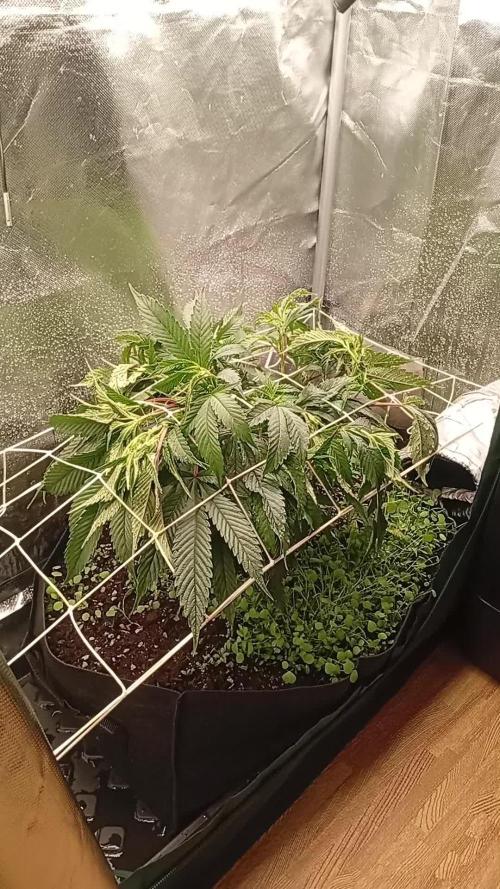
I'm watering both of these plants 1 gallon ever 2 days. They're starting to build up!! As an overview You can see from the pictures that both are dealing with a little bit of heat stress. They are in a tent where all other plans love it hot and the temperatures are in the low eighties. if you look at the top leaves you can see canoeing my guess is it's heat. Other than that they're doing great #1 has shot up she stands nearly 12" tall now. this is the plant that we are letting grow completely natural no topping, No training. #2 on the other hand stands almost 8" tall and is much bushier, thicker, and squatter. You can see clearly in the video that we topped her and also are employing some low stress training to tie down her lower branches. both plants are beautiful and doing great! I expect #1 will be transplanted this week sometime #1 is 15" from the light #2 is 25" from it. Day 30: quickly measured because it looked like they grew a bit since watering Thursday. Definitely have too! #2 has easy gone up an inch. #1 is close to the limit of her pot I think.they both have asymmetrical growth 🤨 each have a branch on one side much taller than the other sides so I have begun rotating them daily to help light penetration. Day 31: Today I transplanted #1 she was in a 1Gal nursery pot for 31 day and starting to show some issues. I moved her into a 10x10 square nursery pot. Approximately 3gals. From here she will go into a 10Gal for flower in about 6 weeks!(I'm letting them get some size)Very faint yellowing of the leaves and needing to be watered daily. Attached is a video, showcasing her roots. Idk why, but everytime I transplant they look like the video. Everyone else seems to have an insane amount of roots.🤷‍♂️ #1s roots are some of the thickest I've seen tho, a regular tree! I transplanted using real growers recharge. That's about for today hope u had a great 4th!!🇺🇸🇺🇸🇺🇸 Day 33: Just a quick update today. Check the video I say more in that than here. #2 has nutrient burn from the recharge. These are such easy plants!! They need and want nothing! Water them once every 48 hrs or so and that's it! Im obviously going to back off on the recharge tho for then next couple waterings.✌️💚🌱 Day 35: Finishing off the week with a transplant. We put #2 into a 10"x10" nursery pot. Works out to be 3 weeks in the small 3 weeks in the medium then she goes into a 12gal for flower. I used Azos and real growers recharge during transplant Soil: fox farm happy frog Light: ES300 LED 18/6 on/off 2x4 vivosun tent 6" oscillating fan, 8"tunnel fan 6" inline duct fan Watering this week: pH 6.5 1 watering of real growers recharge Maggie's 3-1 garden spray preventative
Likes
12
Share
Loving the growth on this Green Poison Auto by @sweetseeds ✌️🌱✌️
Likes
6
Share
These ladies are doing beautiful:) keep growing remember it’s 420 somewhere
Likes
2
Share
What’s up y’all!!?? Week 7 update is kinda bland. The bud sites are growing fuller which is exciting to see. A weak smell is apparent. Same feeding schedule as last week. I give a normal PH’d watering every few days in between the feedings just to get some of the nutrient build up out of the cocoa / perlite mix. I did a heavy defoliation in the beginning of the week. There are some lower bud sites which I’m hoping are getting more sunlight since I defoliated. Of course by the end of the week the leaves are back and big once again. I’ve been tucking them instead of putting the plant thru any further stress at this point. See y’all in week 8
Processing
Likes
18
Share
Se nos fue un poco de altura pero intentaremos arreglar el error farmers... al final quedo simplemente en podas apicales y de momento ramas muy finas. Iremos comentando el proceso Farmers!
Likes
20
Share
@Excalibur
Follow
09 October 2018 - Day 106 Flush run well, Buds have increased and thickened up nicely. Day 107 - No more burn and buds are growing. Day 108 - Conditions are good. Day 109 - Noticed heavy and healthy root growth. Last day before trim Day 110 - Trimmed and Harvested. ** Tent was required ** Day 111 - Colour and smell has become stronger Day 112 - Still drying
Likes
38
Share
For LIQUIDS & NUTES ******GREEN BUZZ NUTRIENTS***** organic. Also i’m using their LIVING SOIL CULTURE in powder form! MARSHYDRO ⛺️ has large openings on the sides which is useful for mid section groom room work. 🤩 ☀️ MARSHYDRO FC 3000 LED 300W 💨MARSHYDRO 6” in-line EXTRACTOR with speed-variation knob, comes complete with ducting and carbon filter.
Likes
9
Share
We start week 3 of bloom!! Goofiez 2 amor compound genetics it’s the champions!!
Likes
32
Share
@Fatnastyz
Follow
Week 8 10-14 Day 50 She looks, smells and grows well! Little studdered on drinking. What else but pics and videos! 10-16 Just water and pictures. Letting her do her thang! Around 500-700ml water a day. 10-19 Some burn, so I ran some runoff, yep burn! 1200 ppm now 400. 😱 Well 2 weeks from here 🤣 or so. 10-20 Nothing changed. .
Likes
8
Share
What a successful experiment! People said you couldn't grow and flower good weed in an Aerogarden so I had to prove them wrong. When I first started this grow experiment I would have been happy with a quality oz of bud. I never imagined pulling more than 2 oz's from 1 gallon of soil and only 45 Watts of light. That's 1.4 grams per watt! Already have a second Aerogarden going. This time it's Bud Bud Bling-Tingz✨ Give it a look!
Likes
10
Share
Currently in the drying room update to follow as soons as its dry
Likes
3
Share
Likes
9
Share
@Cannabot
Follow
Love this plant,beutiful uniform growing.The smell is amazing,super sweet smelling.Found her sweet spot nutes wise.Very happy thus far