


Likes
Comments
Share


@eldruida_lamota
Follow
Vamos familia novena semana floración de estás Pink Runtz de RoyalQueenSeeds.
La cantidad de agua cada 48h entre riegos.
Esta semana ya añadimos nutrientes de también acabaré cortando esta semana las plantas, aunque una no esté acabada se cortará igualmente temprana.
Las flores son bien densas y repletas de teicomas, ya veis que tonalidades más rojizas que esta sacando.
Estás semanas veremos como acaban.
Agrobeta:
https://www.agrobeta.com/agrobetatiendaonline/36-abonos-canamo
Hasta aquí todo, Buenos humos 💨💨💨


Likes
13
Share


@TightNugs
Follow
She's taken off a bit this week and got a bit taller.I moved the led 4 inches further away to stretch her out a bit ,seems to be doing the job.Loads of defolation gonna be needed here. 🍁😎

Likes
21
Share


@BLAZED
Follow
Week 14 (2-6 t/m 8-6)
2-6
Temperatuur: 27.1 graden (licht aan) 20.5 graden (licht uit)
Luchtvochtigheid: 55% (hoogste) 45% (laagste)
Het gaat aardig goed. En wat zijn de shots met de lamp uit en flitser op mobiel aan super mooi!
Ik ben ook verliefd geworden op haar geur, ze ruikt zo lekker zoet-zuur! 😍Ik kan niet wachten om haar te testen. Ookal ben ik bang dat ze net wat te veel THC heeft dan ik normaal rook haha, maar dat zien we nog wel.
Watergift: 1000 ml, met 0.2 ml Silica Power per liter, 0.3 ml CalMag per liter en 1 gr Calcium PowderFeeding per liter. EC: 0.6 PH: 6.3
3-6
Temperatuur: 28.8 graden (licht aan) 21.8 graden (licht uit)
Luchtvochtigheid: 56% (hoogste) 41% (laagste)
Watergift: 1000 ml, met 0.2 ml Silica Power per liter, 0.3 ml CalMag per liter en 1 gr Calcium PowderFeeding per liter. EC: 0.6 PH: 6.3
4-6
Temperatuur: 29.5 graden (licht aan) 22.7 graden (licht uit)
Luchtvochtigheid: 55% (hoogste) 42% (laagste)
Watergift: 1000 ml, met 0.2 ml Silica Power per liter, 0.3 ml CalMag per liter en 1 gr Calcium, 0.6 gr Hybrids en 0.4 gr PK+ PowderFeeding per liter. EC: 1.7 PH: 6.2
5-6
Temperatuur: 29.5 graden (licht aan) 22.4 graden (licht uit)
Luchtvochtigheid: 55% (hoogste) 44% (laagste)
Watergift: 1000 ml, met 0.2 ml Silica Power per liter, 0.3 ml CalMag per liter en 1 gr Calcium PowderFeeding per liter. EC: 0.6 PH: 6.2
6-6
Temperatuur: 29.4 graden (licht aan) 21.8 graden (licht uit)
Luchtvochtigheid: 55% (hoogste) 43% (laagste)
Ik ga vanaf nu om de dag wat PK+ meegeven aangezien ze dat nodig heeft in de bloei, 0.4gr per liter wordt er aangeraden op het schema maar ik doe voorzichtig en geef haar 0.2gr per liter.
Watergift: 1000 ml, met 0.2 ml Silica Power per liter, 0.3 ml CalMag per liter en 1 gr Calcium en 0.2 gr PK+ PowderFeeding per liter. EC: 0.7 PH: 6.3
7-6
Temperatuur: 30.1 graden (licht aan) 23.1 graden (licht uit)
Luchtvochtigheid: 56% (hoogste) 45% (laagste)
Watergift: 1000 ml, met 0.2 ml Silica Power per liter, 0.3 ml CalMag per liter en 1 gr Calcium PowderFeeding per liter. EC: 0.6 PH: 6.3
8-6
Temperatuur: 31 graden (licht aan) 23.5 graden (licht uit)
Luchtvochtigheid: 58% (hoogste) 45% (laagste)
De toppen beginnen voller te worden! Nu nog ongeveer 3 weekjes te gaan. 😁
Watergift: 1000 ml, met 0.2 ml Silica Power per liter, 0.3 ml CalMag per liter en 1 gr Calcium en 0.2 gr PK+ PowderFeeding per liter. EC: 0.7 PH: 6.2

Processing
Likes
17
Share


@Weedo_The_Hempstar
Follow
week 2 veg official lol we have arrived here safely and the babies are looking real good. No topping or any kind of defoliation will take place, we will only be taking off lower branches and leaves as the plants grow skywards trying to keep branching as close to the stem as possible. It's getting exciting lol
Likes
8
Share


@roxdan
Follow
They are maturing nicely! There are some brown patches on leaves which I think was caused by overfert, so I've lowered the dosages a little bit. I think that I was giving them too much calmag, since all other Biobizz products are below 50% recommended.
I'm hoping to harvest the BD and the SD in 2 weeks, let's see.
Likes
27
Share


@Mr_weed_pt
Follow
Another week they are looking good . My ak47 just got some mold on the top so I already loose one top but let’s keep forward.my gorilla is showing some nice purple buds..

Likes
23
Share


@adam_pawloski87
Follow
This week went very well! One will be getting cut an hung to dry while the rest finish up with one more week of flush ! These ladies are smelling so lovely I hope you all enjoy! Stay tuned for next week! Cheers 😤💨💨💨💨💨
Likes
52
Share


@GuerrillaNo_4
Follow
She's really starting to bush out. Still looking very healthy.
GENETICS:
-MSNL - Gorilla Glue Auto ~ my favorite strain, as you can tell by my username!
WATER:
-Condensed (Starting at 40ppm)
-Disinfected prior to adding nutrients etc. (Using COOSPIDER UVC - 253nm & 187nm bulb)
CLIMATE:
- Ambient Air Temp = 27/28'C ~ 26/27'C LST ~ Leaf to air temp variance of between 1-2'C
- Night Temp = 21/22'C ~ Day/Night temp differential 6-7'C
- Under Canopy Temp: 26'C (Day) ~ 21'C (Night)
- Relative Humidity = 50-60%RH (Avg. 55%RH)
- VPD = 1.30kPa (Avg.)
- Co2 ranges from 900ppm to 1500ppm (Avg. 1200ppm)
AIR PRESSURE:
- Ambient Air Pressure (outside tent) = up to 1010 mbars (101 Kilopascals)
- Actual Air Pressure (inside tent) = up to 1005 mbars (100.5 Kilopascals)
- Air Pressure Differential = up to 0.5 kPa range between inside & outside
LIGHT:
- Warm White 3000K/White 5000k/Far Red (660nm)/Infrared (730nm)/UV(260-400nm)
- At plant canopy = PPFD 900-1000umols/s/m2 ~ Lux 45,000-55,000 ~ Daily Light Integral 55-65
- Under canopy lighting ~ Blue (460nm)/ Red (630nm)
NUTRIENTS:
- Mostly Advanced Nutrients (For base nutrients and most additives, as only company I could find scientific data on)
- Canna (For Calmag Agent and Cannazym)
- Plant Success (Great White Mycorrhizae)
ADDITIONAL GROW TECHNIQUES:
- Mostly getting out of the plants way and letting nature take its course.
- Some LST. (i.e. tying down branches and tucking large leaves away)
- No HST or Defoliation.
INFECTION PREVENTION & CONTROL:
Infection control practices i.e
-PPE, Alcohol Hand wash
-Gray room outside tent,
-Carbon filter
-HEPA filter
-Plasma Ionizer
-Inline UV-C germicidal bulb
- Also using an additional higher powered COOSPIDER (UVC) 253nm & 187nm bulb, to disinfect the gray room outside of the tent once a week for 30 mins.
- Ozone (o3) gas that is produced using the COOSPIDER, is then directed into the tent to further control any unwanted pathogens.
- Ed Rosenthal (Zero Tolerance organic pesticide), sprayed once a week as preventative measure. On hand for heavier use (Once every 3 days before lights out for 15 days) in the case of an outbreak
(No outbreaks yet, due to aforementioned preventative measures)

Likes
4
Share


@AustinRon
Follow
OG 4Q24 Seedling Week 2
Orangegasm (Fem) [ IRIE Genetics ]
12/12 @ Bolt (Day 21)
Germination: 20 November 2024
#3A Earliest Harvest Date: 7 February 2025
#3B Latest Harvest Date: 17 February 2025
_________________________________________
Start of Week: [Mon Dec 2, 2024 CR2 4Q24 15:S:1:1]
End of Week: [Sun Dec 8, 2024 CR2 4Q24 21:S:1:7]
OrangeGasm Fertigation: Max EC: [ 2.4, mS]
_______________________________________
Week 2 Objectives
- Continue to root out Seedlings
- WHEN We’ve ROOTS AT THE BOTTOM - Up Plant to 1 GAL and Flip
- Restart EC Ramp (from 1.0 mS/cm2) WHEN ALL Seedlings are standing up STRAIGHT.
- Maintain Environment
Feed Schedule:
- RLA Hydro Chart, Max EC: 2.4
- RLA Foliar (Veg, No add’l PK)
- Weekly: Cytoplus or TM-7: [ 1.25, ml, gal] Through Bolt III
- Wetting Agents
- Dr Bronner’s Hemp Soap: [ 6, drops, gal]
- Quillaja 60: [ 1.25, ml, gal]
- Biology
- Photosynthesis Plus
- Mammoth-P
RLA Foliar through BOLT III
- Monday: Silica Skin, Solar Rain
- Wednesday: CalMag Fuel, Lush Green
- Friday: Solar Rain
Environment, Rooting Cuts, Week 0
- ECRange: [ 1.1, 1.7, mS]
- TempMax: [ 82, °F]
- RHMax: [ 69, %]
- VPD: [ 0.85, ±0.05, kPa]
- LightIntensityRange: [ 410, 530, µMol/m2/s]
- LightPeriod: [ 18/6] # Light Hours, Continuous Dark
Lighting Notes:
- @19.5” Canopy Distance, the dimmer shows 10% of the PPFD Delivered, i.e. 100% = 1000 µMol/m2/s, therefore we’ll maintain light distance (19.5”) and control Light Delivery from the Dimmer. Max will be 85% ( 850 µMol/m2/s)
__
Mon Dec 2, 2024
OG 4Q24 15:S:2:1
- Foliar: Silica Skin, Solar Rain
- TM-7: [ 1.25, ml, gal]


__
Tue Dec 3, 2024
OG 4Q24 16:S:2:2
- Let’s Resume EC Ramp: EC: [ 1.1, mS/cm]
- AM: Watered 50 ml/pot
- All seedlings have ‘Popped,’ Good turgidity, stems firming, big leaves . . .

Photosynthesis Plus: [ 3, ml]
Quillaja 60 Powder (Surfactant): [ 0.625, tsp]
TM-7 (BioAg, µNutrients): [ 0.625, tsp]
Starting with 9.4 EC, Diluted GH pHDown 50:1, and applied 4.2 ml. Reduced to 6.9pH. Took EC from 0.3 to 0.4. We DON’T need additional Phosphorous when phDown’g.
__
Wed Dec 4, 2024
OG 4Q24 17:S:2:3
- Foliar: CalMag Fuel, Lush Green
Ordered ph UP to address acidic Dehu Water.
Fertigation: 2024-12-04T09:32:20-0600: 50 ml/pot

Foliar:
- [X] CalMag Fuel: [ 2.5, ml, pt]
- [X] Lush Green: [ 0.625, ml, pt]
__
Thu Dec 5, 2024
OG 4Q24 18:S:2:4
EC: 1.3
After Foliar (CalMag Fuel/Lush Green), ‘mutant’ is filling in color.
We may have TWO ‘Jagged’ Girls - Serrated/Funky Leaves, TACO Leaves (Natural Fold)
Fertigation @ 1000, 50ml/pot


If so - This is Golden Goat Leaning, Frosty as Hell, Moderate Yielder

Per 0.5 gal feed water:
- [x] Primer A&B: [ 3.4, ml]
- [x] Silica Skin: [ 2.0, ml]
- [x] CalMag Fuel: [ 2.0, ml]
- [x] Lush Green: [ 1.4, ml]
- [x] Root Anchor [ 1.4, ml]
- EC: [ 1.3, mS]
__
Fri Dec 6, 2024
OG 4Q24 19:S:2:5
Foliar:
- CalMag Fuel: [ 2.5, ml]
- Lush Green: [ .0625, ml]
Fertigation:
- EC: [ 1.4, mS]
Per 0.5 gal feed water:
- [x] Silica Skin: [ 2.2, ml]
- [x] CalMag Fuel: [ 2.2, ml]
- [x] Lush Green: [ 1.5, ml]
- [x] Primer A&B: [ 3.7, ml]
- [x] Root Anchor [ 1.5, ml]
- [x] Photosynthesis Plus: [ 3, ml]

Wet Run Irrigation - 8 Emitters | Measure to assure relatively even delivery . . .
__
Sat Dec 7, 2024
OG 4Q24 20:S:2:6
- [ ] Assemble and Wet Run Irrigation
- [x] EC: 1.6

0.5 Gal Feed-water: EC: [1.5, mS]
- [x] Primer A&B: [ 4, ml]
- [x] Silica Skin: [ 2.5, ml]
- [x] CalMag Fuel: [ 2.5, ml]
- [x] Lush Green: [ 1.6, ml]
- [x] Root Anchor: [ 1.6, ml]
- [x] TM-7 (µNutrients): [ 1/8, tsp]
- [x] Photosynthesis Plus: [ 3, ml]
- [x] Quillaja 60 Powder: [ 0.125, tsp]
__
Sun Dec 8, 2024
OG 4Q24 21:S:2:7
440 x 4: 3520 ml/day (Less than 1 Gal)
EC: [ 1.6, mS/cm]

Likes
4
Share

@Growfather1
Follow
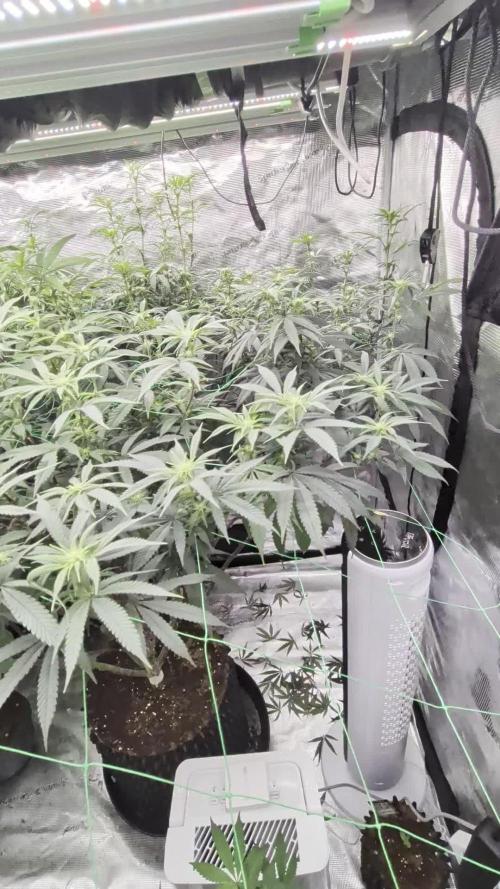
Hello everyone!
The MAC 1 F1 Hybrid is entering week three of flower and looking fantastic! She's stretching like she wants to high-five the ceiling LEDs.
The canopy is filling the space perfectly, and the 10liter pot is drying out daily. Even with the height management, everything is on schedule.
Temperatures are holding at 29 degrees Celsius. Humidity is rising at night to 60 percent, and during the day it sits at 52 percent—our humidity is playing peekaboo. I will defoliate her later this week.
That other MAC 1 F1 Hybrid plant in the other tent is sleeping right now. I will update her pictures and videos tonight when the lights are going on again.
Thank you for stopping by and have yourself a great day.
Best regards,
Growfather.

Likes
31
Share


@Dunk_Junk
Follow
Wow she's getting close to the end. Pistils have all but changed brown, trichomes under very close inspection are not milky so she will go on another week. Did I mention she's frosty?? 😍

Likes
5
Share


@alafmalaf
Follow
This week is getting closer but still not close to the size I want pre flower.
I turned down the lights and got some fertilizer to see if I can coax them to grow up. I think I've been light shocking them.
12/25
I hiked down the light and got the some fertilizer and you can see the diff in just one day of fertz and less light, more humidity
Likes
44
Share


@Roberts
Follow
Bubba Kush Mintz Autoflower is growing great. She got some selective defoliation, and gets kst as needed. She is showing her first pistils, and will very stretching a lot in next few weeks. She is looking great. Thank you Aeque Genetics, Spider Farmer, and Athena. 🤜🏻🤛🏻🌱🌱🌱
Thank you grow diaries community for the 👇likes👇, follows, comments, and subscriptions on my YouTube channel👇. ❄️🌱🍻
Happy Growing 🌱🌱🌱
https://youtube.com/channel/UCAhN7yRzWLpcaRHhMIQ7X4g
Likes
81
Share


@JuanHaze_Arg
Follow
Se empezaron a poner naranja la mayoría de los pistilos, esperaba que se enrosquen antes de que oxidaran pero no sucedió. De ahora en más solo le voy a dar agua para que valla comiendo todo lo que quedo en el sustrato. Voy a priorizar un mejor sabor en esta variedad antes que la cantidad.
03/05 se riega con 2,5 litros de agua + cal mag
PH:5.7 EC:0.9 drenaje PH:6.5 EC:2.5
08/05 Empieza el lavado de raices con abundante agua. aun tiene pelitos parados en las puntas. calculo que en 2 o 3 semanas la cosecho.
Likes
28
Share

@TrickzCutz
Follow
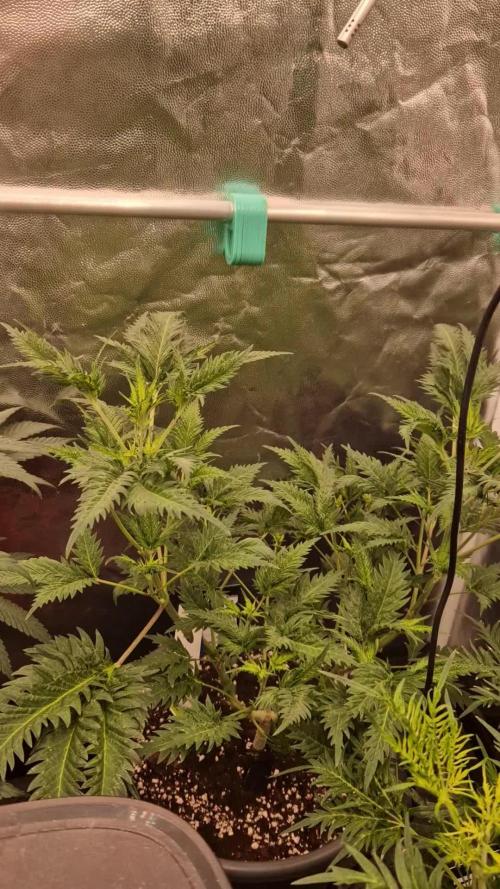
Servus Moin!
Die MDC #1 Raptor wächst vor sich hin. Ich habe hier und da ein paar große Fächerblätter entfernt.

Likes
20
Share


@Momgrowsthechronic
Follow
Welcome to the Week 10, Day 70 update for the Sweet Seeds Cream Mandarine XL Autoflowering grow. Not much to talk about this week as the last two plants remaining in the tent are on cruise control to harvest. I used fertilizer for the final time at the beginning of Week 10 and it’s flush time for these plants until the big chop! They are still being watered every 4th day and they are still drinking about 3.5 litres per plant per watering (0.875 of a litre per plant per day). These remaining two plants have virtually no Powdery Mildew so I am only defoliating as needed if the leaf is already dying. All of the pistols/hairs have turned orange and are receding back into the buds so I’m guessing that harvest will be in Week 11. I have included a brief video above with my photos showing pretty much everything used during this grow. I wanted to give people a quick look at how simple it really is to grow and harvest your own high quality cannabis. Hope you enjoy! I will post next time with my final harvest update- this might take a short while as I generally prefer to know the final dry bud weight as well as having some great photos of the dry, uncured product. Until then…
Likes
Comments
Share

@Dottgreenthumb
Follow
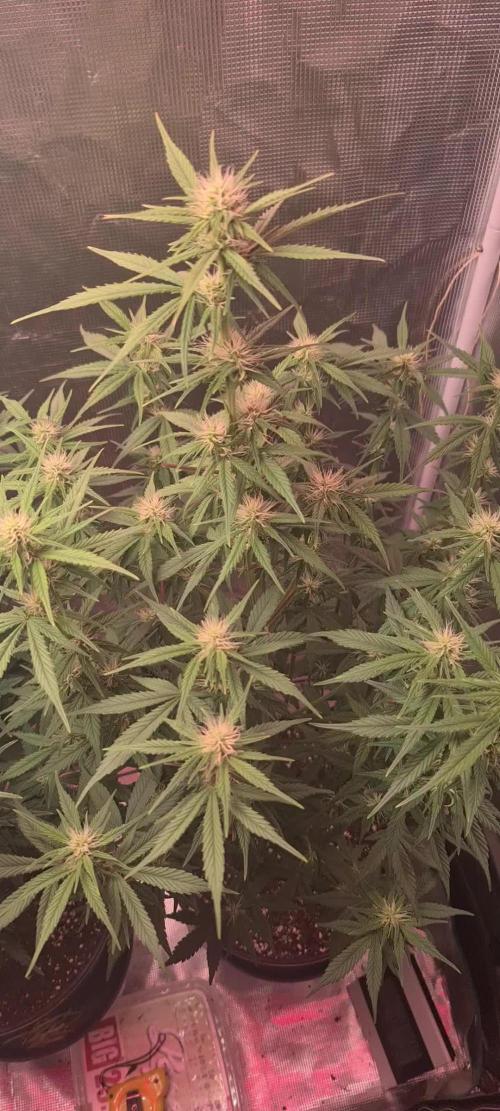
Sono passato dal 75% al 100 % di dimmer,
Marshydro depp red 18 ore ccese
Marshydro uv 10 minuti ogni ora per 18 ore
Likes
13
Share


@cookingwithninja
Follow
S2 beans are looking good. Will probably chop this weekend (so week 9 day 1-2) testers are good. Still feeding pk just slightly less so adding ph down again. I have stopped using ph down in flower as the soluble pk brings water down to 6.7 and beautiful. Nugs are pretty huge. Feels well above 30%.
Likes
76
Share


@Canna96
Follow
This week went well, She is growing well, and I am planning to transplant her in about a week and a half to her final home which will be a 5.2 gallon airpot. Very excited to get her into her final home, and let her roots stretch out, but still working on building a solid root mass. Thanks for stopping by, be safe, and Blaze on!
