Likes
Comments
Share


@Alejangrow
Follow
This is definitely an express strain. These girls are growing rapidly and seem very good for new growers based on their resilience. They are Very forgiving plants but hard to grow with other strains due to differing growth rates. I topped these once and have been doing some lst to try to let the kabul express catch up but it seems my efforts are of no use. 🤷♂️🏽🌿

Likes
18
Share


@Grower_Of_Persia
Follow
week intel:
its time for second pruning they grew up too fast and need second pruning as below :
first i remove big fan leaves and only leaves then let them rest for 1 day then the second part of pruning will get done that is removing branches based on these conditions:
1-if the branch is very low and never can make it to the top ,
2- if branch is in shade even after pruning fan leaves ,
3- if there are too many branches at the small space then non of them will get resources so if there is no space for branch then , they must get remove.
everything is perfect!
stresses :
pruning big fan leaves and lower branches + a little E.C stress around 1.7 once a week
feeding:
i feed them 3 times this week with this order :
day 1 : i feed them heavy with silicate +base nutrients(calcium & micros + Bloom) about 884 ppm - 1.7 e.c to cause a little stress.
day 3 : i feed them low dose of Feeding Booster + Karbo Boost around 325 ppm - 0.6 e.c to let them recover a little but not fully recover still a little stress will caused.
day 5 : i feed them with low dose of Top-Max + B-52 around 213 ppm - 0.4 e.c to let them recover the stresses to get ready for another stress next week.
guide of the week :
no more stresses from now on till the end and from next week i'll reduce the amount of nitrogen and calcium to below half to the end.

Likes
11
Share


@VividGreen
Follow
Lowered bloom nutrient to 16 mL per gallon and hydroplex to 4 mL per gallon.
EC now 2.3

Likes
51
Share


@DogDoctorOfficial
Follow
An in to soil she and her sister testers go, i know that for know everything looks the same , apart from the photos, but this will start changing with them growing. For now all of them are growing pretty much the same and now that they move in to soil and start feedings they will start showing the phenotype and genetic differences, but for now all looking great , healthy and strong af!!!
Haded a intro video from seed in to now, including how i transplant and what i use wen doing it so, and from here the moon is no limit for this babes i believe , so stay tuned as this testers they promise to be a interesting ride <3 <3 <3
They grew amazing for only a week fast and vigorous, all the testers for now look very the same <3 <3 <3
As always thank you all for stoping by and for supporting me on this journey, i am super passion about growing and fell blessed to have you all with me on this new journey <3 <3 <3
Genetics - Fast Buds Tester 08 09 10 11
Ligth - LUMATEK ZEUS 465 COMPACT PRO
Food - APTUS HOLLAND
#aptus #aptusplanttech #aptusgang #aptusfamily #aptustrueplantscience #inbalancewithnature #trueplantscience #fastbuds #dogdoctorofficial #growerslove
With true love comes happiness <3 <3 <3 Always believe in your self and always do things expecting nothing and with an open heart , be a giver and the universe will give back to you in ways you could not even imagine so <3 <3 <3
All info and full product details can be find in can find @
https://2fast4buds.com/ wen released
https://aptus-holland.com/
https://autopot.co.uk/
https://lumatek-lighting.com/
<3 <3 <3 Growers love to you all <3 <3 <3

Likes
2
Share


@DogDoctorOfficial
Follow
💜 Purple CousKush Auto by Zamnesia | Pheno B | Week 14 👑❄️
The Compact Queen Has Come Down — Small in Size, Massive in Character 💜🌸✨
Welcome back to another chapter of the 8×8 Adventure! 🌱💚
Well, my friends…
Our second Purple CousKush girl has officially come down.
👑💜✂️
And before anyone starts asking…
Yes, she's compact.
Yes, she's a smaller plant.
And yes, she's absolutely beautiful.
😂💜
Because let's be honest here: not every plant needs to take over the entire tent to deserve our attention.
Some plants are tall.
Some are wide.
Some stretch like they're trying to escape the room.
And then we have girls like Purple CousKush Pheno B.
Compact.
Dense.
Beautiful.
Full of character.
And carrying her own little piece of the 8×8 Adventure with her.
💜🌸❄️
I'm genuinely happy with this girl.
We've watched her develop, photographed her flowers, explored her macro details, and compared her expression with her sister.
And now, her time in the flowering tent is over.
We took her into the studio for some final photographs, and after that, she was hung upside down in the tent to dry.
Now?
We wait.
😂🌿
No rushing the next chapter.
No pretending the whole story is finished.
Her flowering journey has reached its end, but we still have the drying, trimming, final observations, and everything else that belongs to her harvest report ahead of us.
So let's give our compact Queen the spotlight she deserves.
Because she might not be the biggest girl in the room…
but she has absolutely earned her place in this adventure.
💜👑✨
────────────────────────
📢 FIRST, A QUICK EXPLANATION ABOUT THIS FLOWERING REPORT
Some of you might be wondering why we're publishing a flowering-week update when the plant has already been harvested.
Fair question!
💚🌱
As we've explained in the previous individual harvest reports, GrowDiaries has limitations on the number of photographs we can include in a single update.
And when we're reaching the end of a plant's flowering journey, there is simply too much to document properly in one report.
We have the final photographs from the tent.
We have the studio session.
We have the individual flower shots and macro details.
We have the harvest itself.
And then we have the drying, trimming, and final report to come.
Trying to squeeze all of that into one update would mean sacrificing photographs and details that deserve their own space.
So we're keeping the same approach we've used for the other girls.
🌸 **This flowering-week report:** Her final appearance, the studio photographs, and the end of her time in the tent.
✂️ **The harvest report:** The next stage of her journey, with the relevant harvest and trimming details.
That way, each stage gets its own space, and every phenotype keeps her own individual record.
Because this is not a general report about the entire room.
This is Purple CousKush Pheno B's diary.
Her journey.
Her photographs.
Her story.
💜📸
And even though several plants may reach harvest around the same time, I want each one to receive the attention she deserves.
No copy-and-paste endings.
No mixing sisters together.
No forgetting the smaller girls.
😂💜
Every plant gets her own chapter.
And this week, we're celebrating our compact Queen.
────────────────────────
🌱 A QUICK RECAP — HOW DID WE GET HERE?
For anyone joining this diary for the first time, let's quickly revisit the experiment.
The 8×8 Adventure has been running on a **12/12 light schedule from seed**.
That means the plants were grown under a twelve-hours-on, twelve-hours-off schedule from the beginning, rather than being given a separate extended vegetative period before switching the lights.
The idea was to document how different genetics and phenotypes would develop within the same general room environment under that shared schedule.
And what a journey it has been!
🌱 Different plants.
🌿 Different sizes.
🌸 Different structures.
💜 Different flowering expressions.
❄️ Different levels and appearances of frost.
And plenty of surprises along the way.
The room gave the plants a shared environment, but it didn't make them identical.
Some grew taller.
Some remained compact.
Some developed more open structures, while others built denser-looking flowers.
And Purple CousKush Pheno B?
She's been one of our compact girls throughout the journey.
She never needed to be the tallest plant in the room.
She never needed to compete with the giants.
She simply developed in her own way, giving us a beautiful individual expression to document.
And that's precisely why we separate the phenotypes into individual diaries.
Because the differences are the story.
💜🌱
────────────────────────
👑 THE COMPACT QUEEN — SMALL PLANT, BIG PERSONALITY
I want to make something clear this week.
I'm not disappointed that she's a smaller plant.
Not even a little bit.
😂💜
Would a larger plant have occupied more space in the tent?
Of course.
Would she have looked different in the overall canopy?
Absolutely.
But does that make her less interesting?
Not to me.
Purple CousKush Pheno B has her own identity.
She's compact.
She's dense.
She's beautiful.
And when you look at her photographs, you can appreciate the character she developed throughout the run.
There's something satisfying about following a plant from the early stages and seeing how she eventually presents herself at the end.
You remember the earlier updates.
You remember her development.
You remember the differences between her and her sister.
And then you arrive here…
with the plant harvested and the final photographs in front of you.
That's the full journey.
And I'm happy with what this girl has given us.
💜👑🌸
Not every plant needs to win a size competition.
Not every plant needs to dominate the canopy.
And not every plant needs to be judged by a single number.
The important thing is that we document what actually happened.
And this girl deserves to have her story told properly.
────────────────────────
💜 TWO SISTERS, TWO INDIVIDUAL STORIES
Of course, we can't talk about Pheno B without remembering her sister, Purple CousKush Pheno A.
Two plants from the same cultivar.
Two individual diaries.
Two different expressions to observe.
And both have now reached the harvest stage.
💜💜
Throughout the flowering weeks, we were able to appreciate their individual structures, compare their flowers, and explore their appearance through the camera.
We also had a little photographic confusion with some of the macro stacks earlier in the journey.
😂📸
That was a useful reminder that when you're photographing and processing lots of images from two sisters at the same time, proper labelling matters!
But the important thing is that both girls have received their own reports and their own space in the project.
We're not trying to pretend that they're identical.
We're not trying to force them into one combined story.
We're documenting what each one became.
And now, with Pheno B harvested, we can close her flowering chapter and move into the next stage.
Her sister has her story.
Our compact Queen has hers.
And both deserve to be remembered.
💜👑
────────────────────────
📸 ONE LAST STUDIO SESSION
Before saying goodbye to her time in the tent, we took Purple CousKush Pheno B into the studio for some final photographs.
And I'm very glad we did.
💜📸✨
There is something special about taking the time to photograph a plant at the end of her flowering journey.
During the grow, we're constantly looking at the bigger picture.
The tent.
The canopy.
The other plants.
The environment.
The overall development.
But in the studio, the focus changes.
It's just her.
Her structure.
Her flowers.
Her details.
Her individual expression.
And that's exactly what I wanted to preserve.
Because once the plant has been harvested, this particular moment is gone.
We can photograph the dried flowers later.
We can document the trimming.
We can explore the next stages.
But we cannot recreate this exact view of her standing at the end of her flowering journey.
So we took the photographs.
We gave her a little studio time.
And we let our compact Queen have her moment.
😂💜👑
Not every plant needs to be enormous to look beautiful in front of the camera.
Sometimes, all you need is a plant with character and a grower who enjoys documenting her.
And you know me by now…
I always have room for another photograph.
📸😂
────────────────────────
❄️ DENSE FLOWERS, BEAUTIFUL DETAILS
One of the things I enjoy about looking back at Purple CousKush Pheno B is how much there is to appreciate when we stop focusing on size.
The overall plant gives us one perspective.
The individual flowers give us another.
And the closer we look, the more details become visible.
💜🌸❄️
The flower structures.
The textures.
The trichomes.
The pistils.
The individual differences from one flower to another.
These are the details that make plant photography so enjoyable.
You can walk past a plant every day and become familiar with her appearance.
Then you take the time to photograph her properly, and suddenly you're looking at her again with fresh eyes.
That's what I love about documenting the 8×8 Adventure.
We're not just recording that a plant existed.
We're preserving a visual record of what she became.
And Pheno B has given us a beautiful collection of moments to look back on.
She's compact.
She's dense.
She's beautiful.
And she deserves to be remembered exactly as she is.
💜📸✨
────────────────────────
🌿 THE SAME ROOM — BUT NEVER THE SAME STORY
This is still the heart of the 8×8 Adventure.
One shared room.
One general environmental strategy.
One lighting ecosystem.
One overall approach to nutrition and care.
And individual plants expressing themselves in different ways.
The point was never to make every plant look identical.
If that had been the goal, there wouldn't be much of an experiment to document!
😂🌱
Instead, we've watched different genetics and phenotypes develop alongside each other and recorded their individual progress.
Purple CousKush Pheno B has been part of that experiment from the beginning.
Her compact structure is part of her story.
Her flowers are part of her story.
Her differences from Pheno A are part of her story.
And now, her harvest is another milestone in that record.
This is why the individual diaries matter.
When we look back later, we can follow the progression of one plant without losing her identity among all the others.
The room may be shared.
The story isn't.
💜🌿
────────────────────────
💡 THE LIGHTING JOURNEY — SAME PHOTONS, DIFFERENT EXPRESSIONS
The room has been running with the upgraded Future of Grow Black Series lighting setup, including the additional Black Series 600W fixtures that expanded our lighting capability.
LumiFlora has also been part of the lighting ecosystem, helping illuminate deeper areas of the canopy.
One of the interesting things throughout the adventure has been seeing how different plants developed within that shared environment.
The lighting system provided the same general opportunity across the room, but each plant still expressed her own structure and characteristics.
And that's the point.
The equipment helps create the environment.
The genetics contribute to the individual expression.
And the photographs help us document the result.
☀️🌿💜
A massive thank you to Future of Grow for supplying the additional fixtures and giving us the opportunity to explore the expanded setup throughout this run.
────────────────────────
🌬️ SHE'S NOW HANGING — AND THE WAIT BEGINS
After the studio session, Purple CousKush Pheno B was harvested and hung upside down in the tent.
And now…
we wait.
🌿⏳💜
This is where the diary moves into a different phase.
The flowering chapter is complete.
The plant is no longer standing in the canopy.
The studio photographs have been captured.
And now we give the drying stage the time and attention it needs.
There's no need to rush ahead in the story.
We'll document the next steps when it's time to do so.
For this report, I simply want to record where she is now: harvested, photographed, and hanging in the tent.
The next chapter will cover the relevant harvest and trimming details.
And after that, we'll continue building the record of her journey.
Because the end of flowering doesn't mean the end of the diary.
It means the story has moved forward.
💜🌱
────────────────────────
😂 THE GROWER'S JOB CHANGES AGAIN
Throughout a grow, there are different moments when the grower's role changes.
Early on, we're observing the young plants and documenting their development.
As they grow, we watch their structure and how the different phenotypes express themselves.
Later, the focus shifts towards the flowers and the final stages of the flowering journey.
And now, for Pheno B, that flowering chapter has reached its end.
The work changes.
The observations change.
The photographs change.
And the diary changes with it.
For now, she's hanging in the tent, and the next report will cover the following stage.
I'm not going to invent details about the final harvest result before we've documented them.
We'll share what we actually observe, just as we've done throughout this project.
That's the point of keeping a diary.
Real observations.
Real photographs.
One stage at a time.
💚🌿
────────────────────────
🔍 WHAT COMES NEXT?
Our compact Queen's story continues.
📸 **The final flowering photographs:** Captured before she left the tent.
🌬️ **The drying stage:** She's now hanging upside down in the tent.
✂️ **The harvest and trimming report:** Coming in the next chapter, with the details documented at that stage.
📚 **The individual diary:** Her journey remains separate from her sister's so we can follow her development properly.
And, of course, we'll continue sharing the experience with everyone following the 8×8 Adventure.
No need to rush the next chapter.
We'll get there when we get there.
😂💜
────────────────────────
💭 FINAL THOUGHTS — SMALL IN SIZE, BIG IN CHARACTER
Week 14.
Purple CousKush Auto by Zamnesia.
Pheno B.
Our compact Queen. 💜👑
She's been harvested.
She's had her final studio session.
She's now hanging upside down in the tent.
And I'm genuinely happy with her.
She's not a huge plant.
We know that.
But I don't think that should ever stop us from appreciating what she has given us.
She's compact.
She's dense.
She's beautiful.
And she's an individual phenotype with her own place in this adventure.
We grew her under the same 12/12-from-seed approach as the other plants in the room, documented her development week after week, and watched her express herself in her own way.
Now we have the final flowering photographs to look back on, and the next stage of her journey is waiting.
I'm not calling this an ending.
It's a transition.
The flowering chapter is finished.
The drying stage has begun.
The harvest and trimming report will come next.
And we'll keep documenting what happens along the way.
Because that's what this project is about.
Not just showing the biggest plants.
Not just celebrating the most dramatic results.
But giving every phenotype her own space, her own record, and her own moment in the spotlight.
And this girl?
She deserves every bit of it.
💜🌸❄️👑
Thank you, Purple CousKush Pheno B, for being part of this adventure.
You might be compact, but you've never been forgotten.
Now let's give you the spotlight one more time in this flowering chapter.
Let her shine.
💜✨
────────────────────────
🙏 THANK YOU
A huge thank you to GrowDiaries for giving us the space to document the individual journeys of the 8×8 Adventure and share them with growers around the world. 💚🌱
Thank you to Zamnesia for the Purple CousKush genetics and for giving us the opportunity to follow these two sisters throughout the run. 💜🌸
Thank you to Plagron for supporting the nutritional side of the adventure. 🌱
A massive thank you to Future of Grow for the Black Series lighting and especially for supplying the additional fixtures that expanded the lighting capabilities of the room. 💡☀️
Thank you to LumiFlora for helping illuminate the deeper areas of the canopy.
Thank you to TrolMaster for helping us manage and monitor the environment behind the scenes.
And, of course, thank you to everyone following the 8×8 Adventure.
Every comment.
Every question.
Every observation.
Every person who takes the time to follow these individual plant journeys.
It genuinely means a lot. 💚
And to Purple CousKush Pheno B…
thank you for giving us another beautiful story to document.
You have reached the end of your flowering chapter, but your journey isn't finished.
We'll see you again in the next report.
────────────────────────
🌿 COME JOIN OUR DISCORD COMMUNITY!
If you're not already part of the community, come and say hello!
💚 DogDoctorOfficial Discord:
https://discord.gg/dogdoctorofficial
Join us to discuss growing, equipment, photography, experiences, and all the things we learn along the way.
There are community conversations, shared experiences, discount codes, competitions, and giveaways to enjoy.
Whether you're experienced or just starting out, you're welcome to join the conversation.
Come share your journey, ask questions, and meet other growers.
We'd love to see you there! 🤝🌱💚
────────────────────────
💚 GROWERS LOVE, MY FRIENDS!
That's another flowering chapter completed in the 8×8 Adventure.
One more girl has come down.
One more individual story has reached a new milestone.
And one more collection of photographs has been added to the record.
💜👑📸
Our compact Queen is now hanging in the tent, and we'll let the next chapter arrive in its own time.
Thank you for following her journey.
Thank you for appreciating the smaller girls as much as the big ones.
And thank you for being part of this adventure.
Growers Love, my friends. 💚🌱
See you in the next chapter of the 8×8 jungle…
where the photographs keep coming, the individual stories keep unfolding, and every plant gets her chance to shine.
Purple CousKush Pheno B…
small in size, beautiful in her own way, and forever part of the adventure.
💜👑🌸✨
Let her shine.
Likes
16
Share


@OutdoorRebelGenetics
Follow
Well just checked on indoor grow and its a totally different phino type to the 2 I have in my greenhouse the gorilla grown frisan duck has bounced back the auto cheese are going to be a poor harvest I believe
utterly my fault put out to early ect
Last defol the dayof the ac 3 weeks flush see if these cherry buds cann burst out a bit 😀😄😜 well end of week 10 some pistons on autoflowering cheese are turning Amber so flushing her now few more weeks and I'll be smoking her lol 😆 any uk growers happen to have any hermie or male pollen give me a shout little video added show and tell haha


Likes
13
Share


@Yiyis_Grow
Follow
Aquí vamos en la tercera semana se floración 🤙
Mr Hide Seeds dice que las Kritical Red se cosechan a los 60 días y estamos en el día 47, no creo que estén totalmente desarrolladas y listas en 13 días.
Se agregó a la lista de nutrientes C4 de Mills, esto también a modo de prueba y acompañamiento del bioestimulante Everest que ya se venía usando.
La planta más grande y desarrollada está presentando al parecer deficiencia de potasio, seguramente está comiendo mucho. Ya lleva dos días con una cuota más alta y ya presenta mejoría.
Otra planta está muy oscura las hojas, la estamos dejando sin alimento 3 días para ver si corrije.
Las lluvias han parado y se ha estado usando agua del grifo directa sin reposar.
Buenos humos 🚬


Likes
1
Share


Likes
55
Share

@JaramnieJazz
Follow
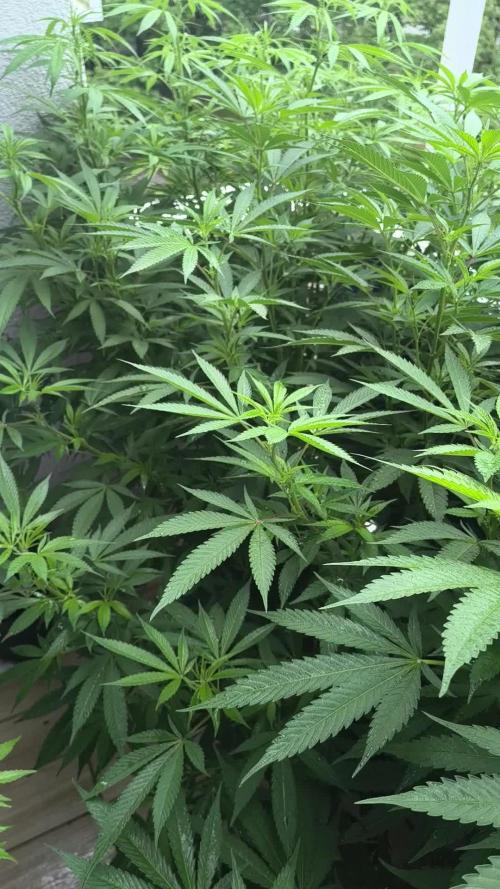
01.07.26 Ja weiter geht's sind richtige Monster geworden und so wie sie im Moment aussehen werde ich wohl nicht entblättern müssen das Licht dringt schön in die Pflanzen ein ich denke Apple Betty wird wohl am meisten Ertrag bringen zusammen mit Chocobang aber GDP braucht sich nicht verstecken wir werden sehen die Frage ist nur wann in Blüte entweder in 2 Wochen oder am 01.08.26 in 2 Wochen wäre wohl besser da ich paar Sorten diese Runde hab die bis zu 11 Wochen gehen dann wäre Anfang Oktober ende sonst ende Oktober und da ist das Wetter Mist mal schauen Daumen drücken für gutes Wetter Peace 🕊️
02.07.26 Sieht Bombe aus
03.07.26 Keine Ahnung ob es mir nur so vorkommt aber irgendwie bekommen die immer voll den Schub nach Regen sind deutlich größer geworden
04.07.26 Wetter ist schlecht keine Sonne nur Regen ich will sie bald in die Blüte schicken Daumen drücken dass das besser wird zumindest in der 2 Hälfte der Blühte .
Hab noch paar Triebe gefunden die nichts werden und entfernt. Größe ist jetzt 133cm die Chocobang ist ein Riese fuck mein Balkon ist ein Busch ich musste auf den Stuhl mich stellen um ein Überblick zu bekommen ich wünschte ich könnte die draußen anbauen damit sie sich voll entfalten können so klaut eine der anderen Licht eigentlich darf ich so 4stk machen 6 ist zuviel die können garnicht ihr volles Potenzial ausschöpfen
05.07.26 Weiter geht's es regnet am Stück hoffe das bleibt nicht so führs Wachstum ist das gut aber nicht die Blüte und die rückt näher .Der Favorit fürs bestäuben ist Black Lemon wegen dem FIZZZZ im Stemrub
06.07.26 Mehr Regen 😑 und kalt 14°C die Dünger Angaben von RQS ist eine Tablette auf 10L
07.07.26 Regen Regen Regen Größe ist 143cm


Likes
2
Share
@DogDoctorOfficial
Follow
🥒 14B – Pickled Lemon Haze F1 | Week 3
The Second Sister Takes the Crown
Welcome back to the Project Blue Tent, my little experiment where every plant receives individual attention from seed to harvest.
For anyone joining the journey for the first time, this project follows multiple Zamnesia Genetics grown side-by-side inside the same environment. Every phenotype gets its own diary so we can truly appreciate how genetics express themselves under identical conditions.
This week certainly wasn’t boring.
A malfunction in the irrigation system flooded the entire tent, leaving every growbag sitting in far more water than intended. Thankfully, the problem was caught quickly, the system was repaired, and every bag was allowed to drain naturally. Thanks to the incredible aeration of Plagron Cocos Premium, the roots never complained, oxygen remained available, and the plants simply carried on growing as if nothing had happened.
If anything, this little accident became another reminder that good substrates forgive our mistakes.
And this beautiful Pickled Lemon Haze F1 was no exception.
⸻
Week 3 Development
She has been an absolute pleasure to watch.
Although sharing the same genetics as her sister, she’s already showing her own personality. Her structure became incredibly symmetrical during the week, producing thick internodes, broad leaves and, most importantly, exceptionally vigorous lower branching.
Sometimes a plant tells you exactly what she wants.
This one practically asked to be topped.
Instead of growing vertically with a single dominant apex, she was already investing heavily into her side branches, making this the perfect candidate to redirect her energy and begin building a much wider canopy.
Looking underneath the plant was enough to make the decision.
Healthy secondary shoots were already racing upward, ready to become future main colas.
⸻
Why I Chose to Top This Plant
Many growers see topping as simply cutting the tip off.
It is actually much more than that.
The main growing tip naturally produces auxins that suppress the lower branches through what’s known as apical dominance. By removing that single growing tip, the plant redistributes hormones and allows the side branches to take over.
Instead of one dominant leader…
…we create several.
Since this Pickled Lemon Haze already had such impressive lower development, topping should allow those branches to explode with growth over the coming weeks, producing a much flatter, more even canopy.
For indoor cultivation, that means:
• Better light distribution
• More productive flowering sites
• Stronger structural balance
• Easier canopy management
Of course, topping is a high-stress technique, so timing matters.
I only perform it when the plant is completely healthy, actively growing, and has enough established nodes to recover immediately.
Judging by her response only days later, she barely noticed the haircut.
⸻
A Tiny Surgery
Using the Zamnesia trimming scissors, I carefully removed the apical shoot just above the selected node.
One of my favorite macro photographs this week captures the fresh cut perfectly.
Looking through the lens, it almost resembles a tiny green well filled with crystal-clear sap. It is fascinating how much beauty exists in details we rarely notice with the naked eye.
Nature never disappoints.
The removed growing tip itself was almost too pretty to throw away.
Sometimes I think photographers become sentimental about the strangest things.
⸻
Recovery
Recovery has been outstanding.
Within a very short time the remaining growth tips had already begun pointing upward, clearly responding to the hormonal redistribution.
There is no sign of stress, drooping or stalled development.
The stem continues thickening nicely, while the side branches seem eager to compete for dominance.
Exactly what I hoped to achieve.
⸻
Environment
The entire tent continues sharing the exact same environmental conditions.
🌡️ Day temperature: 27°C
🌙 Night temperature: 25°C
💧 Relative humidity: 67%
🌱 Root zone: 24°C
💡 Light schedule: 18/6
⚡ EC: 1.61
💧 pH: 5.8
? Pot size: 8 L Plagron Premium Growbag
💨 CO₂: Ambient (~450 ppm)
Everything remains stable, giving the plants every opportunity to recover from both the flooding incident and the topping session without unnecessary stress.
⸻
Feeding
As the plants continue accelerating their vegetative growth, I increased nutrition slightly.
Current feeding per litre:
• Plagron Hydro A — 1.6 ml/L
• Plagron Hydro B — 1.6 ml/L
• Plagron Hydro Roots — 1 ml/L
• pH adjusted to 5.8
The slight increase in EC is already being rewarded with faster growth and richer colour throughout the canopy.
The new growth remains bright lime green—a perfectly normal characteristic of rapidly dividing young tissue—while the older leaves continue holding a healthy medium green without burnt tips or nutrient deficiencies.
Everything points toward a happy, hungry plant.
⸻
Looking Ahead
Now comes the fun part.
Over the next several days I’ll simply let nature do its work.
The goal is to allow the two new dominant tops to establish themselves while the lower branches continue stretching upward.
Once the canopy begins filling evenly, gentle LST will likely follow to keep every future flowering site exposed to as much light as possible.
She has all the ingredients to become a beautifully balanced bush.
⸻
Thank you so much for stopping by and following another chapter of Project Blue Tent.
Every week these plants continue reminding me that growing isn’t just about producing flowers—it’s about observing, learning, adapting and appreciating how incredibly resilient these genetics can be.
I truly appreciate everyone who takes a few minutes to read, comment, share advice or simply enjoy the journey with me.
Happy growing, and I’ll see you all next week! 🌱💙
⸻
PS
A huge thank you to all the amazing companies making this project possible.
💙 Zamnesia for the outstanding genetics, the fantastic trimming scissors that made this topping effortless, and for believing in this adventure from day one.
? Plagron for providing the Premium Growbags, Cocos Premium substrate and the Hydro nutrient line that continues delivering healthy, vigorous growth week after week.
Your support allows this project to become the detailed educational diary I always dreamed of creating.
Growers Love and see you all in Week 4! 🌿💙
Likes
57
Share


@GERGrowDesigns
Follow
🥦Flowering Week 2 Stretch Control & Bud Site Activation
Eternity Grow Cup 2026 Sticky Broccoli Feminized
Stage:Flowering Phase Week 2
Day: ~16 since 12/12 switch
🌡️ Environmental Stability
The environment remained stable throughout the second flowering week, allowing uninterrupted progression through the stretch phase.
-Temperature: ~26°C
-Humidity: adjusted to support early flower development
-Light: running at full intensity (720W)
-Airflow: consistent, supporting dense canopy conditions
🌿 Plant Development & Stretch Progress
During this week, the plant continued its final stretch phase, showing strong vertical and lateral development.
-Uniform stretch across the canopy
-Strong upward movement of bud sites
-Noticeable development even in lower branches
-Well structured and evenly distributed canopy
✂️ Defoliation & Light Optimization
Two strategic defoliation sessions were performed during the week.
-Improve light penetration to all bud sites
-Increase airflow within the canopy
-Support uniform bud development
Following defoliation, the plant responded with enhanced growth activity, particularly in previously shaded areas.
🍭 Controlled Lollipopping
A light lollipopping session was carried out in the lower section of the plant.
-Only minimal removal to avoid excessive stress
-Combined carefully with defoliation
-Focus on redirecting energy toward productive bud sites
The majority of the lollipopping up to the SCROG level is planned for Flower Week 3, allowing a staged and controlled approach.
🍵 Irrigation & Feeding
The plant continues to show strong nutrient uptake and hydration balance, supporting ongoing stretch and bud formation
-Watering frequency: every 2 days
-Volume: ~9L per watering
-Nutrient program: Hy-Pro feeding schedule (excluding Spraymix this week)
🌱Strain Observation Sticky Broccoli
-Excellent stretch utilization
-Strong bud site activation across the canopy
-Good tolerance to combined defoliation and lollipopping
-Balanced growth structure under high light intensity
📸 Weekly Summary
Flowering Week 2 was a highly productive transition phase, where stretch was successfully managed and bud sites were activated across the entire canopy.
With strategic defoliation and controlled lollipopping, the plant is now well prepared to shift focus into bud stacking and density development.
The structure is set ,now the real flowering performance begins.
See you in Flower Week 3 🌸✨


Processing
Likes
6
Share


@dyrachok
Follow
Цвітіння йде повним ходом, з нетерпінням вже чекаю харвесту))) На квітах активно з'являються тріхоми, а їх розмір збільшується кожного дня. Ніяких проблем немає, видалив пожовкле листя.


Likes
18
Share


@Ultraviolet
Follow
High temperatures, high transpiration, high turgor pressure, and lots of cell elongation. Cannabis plants can sense and respond to their surroundings. They don't have brains like humans, but they have evolved sophisticated ways to perceive and react to various environmental cues, including light, gravity, touch, water, sound, and even the presence of other plants. This ability, known as plant perception, allows them to adjust their growth, defend themselves, and even communicate with each other.
Infrared light, particularly near-infrared (NIR), can influence plant growth and development by impacting various processes including initiation and elongation.
UVB radiation inhibits stem and hypocotyl elongation in plants.
Moderate UV-B exposure can cause a decrease in stem and leaf elongation, leading to a more compact plant architecture. Higher UV-B intensities, like 7.5 kJ·m−2, can lead to reduced elongation.
So it becomes a dance of initiating a stretch to seek to higher ppfd, then whenever you want the stretching to slow down,UVB inhibits the stretch by altering hormone balance,, coupled with the high-intensity dli once you get her to a height where you want. Being autos I don't have much time to play around. So we are playing fast and loose, get stretched, and then spread her open. You get the idea.
86F 30% RH with the lower side of optimal on ppfd, with a smudgering of infra-red to initiate response of making her stretch more so than normal.
Once she sprouts up in height, I drop metrics to 77F 55%RH% while upping the ppfd, giving her a dash of extra 430nm, giving the grow more of a 6000K. This encourages denser growth with less elongation. Higher side of optimal PPFD, with the auxin hormone balance changed, the side stems are starting to shoot up to the same canopy level as the apex (almost). Normally takes me 2 untrained toppings before a plant will flatten its canopy. I didn't take enough off the apex to do it in one chop, it was only day 10, so there really wasn't much to top from without creating unpredictable results using fim, opted just to keep it to a clean topping. Even predictability over the Chaos of the"Fim".
Brainfart:
Remember, the veg stage creates the skeleton that will stretch out into flowers. How dense you create the skeleton through light intensity will determine the density of your clusters as they form cola, as long as you can keep up with the demands. Increasing light intensity generally leads to plants having shorter internodal spacing, meaning the distance between nodes (where leaves grow) on a stem is reduced. This effect is particularly noticeable under LED grow lights, with great stress comes great dense clusters. Hello, temperature, my old friend! Goodbye, money on AC.
What did the flower decide to study in college?
STEM.


Likes
75
Share


@GODSGIFT_2005_JM
Follow
🍼Greenhouse Feeding BioGrow, Bio Enhancer & BioBloom
⛺️MARSHYDRO
The ⛺️ has a small door 🚪 on the sides which is useful for mid section groom room work. 🤩
☀️ MARSHYDRO FC 3000 LED 300W
☀️Also special thanks to VIPERSPECTRA P2000 (200W) & XS2000(240w) LED growlights
🌱GANJA FARMERS

Likes
35
Share


@Kellykush420
Follow
This week I found fungus gnats I added sticky boards and mosquito bits. A small amount of fading on oldest leaves. I did a small defoliation of the yellow fan leaves. I added bone meal to the top layer of soil and worked it in. Water at 6.5.
Likes
5
Share


@schmeirs
Follow
Happy plant, soon ready 😁
Today she took a shower 10 liters
Now i will give only water, don't forget to measure the ph 6,3
i can't wait 😋😋😋