


Likes
Comments
Share


@Itashish
Follow
Jour 76
Et commence à développer leur pistils
Les plantes sont saine et prennent beaucoup de hauteur je dois en palisser quelques une
J’ai fais un thé de compost oxygéné pour les booster pour la floraison
Recette :
5g cendre coque de ricin
25g biochar
5 gr levure de bière
4gr pollen d’abeille
7gr ortie micronisé
5gr spiruline
10gr tourteau de karanga
8gr Kelp
20gr zéolithe chabasit
5gr de consoude
3gr hydrolysât de Kelp
5gr vers de farine
12,5gr bactérie soluble
5gr levure saccharomyces cerevisae souche myco 6420
12,5gr de prêle sauvage sécher
125gr lombricompost
2gr big foot mycorhize gold
Mycorrhizae (400 propagules per gram)
Endomycorrhiza
Glomus aggregatum -100 propagules/gram
Glomus etunicatum – 100 prop/gram
Glomus intraradices – 100 prop/gram
Glomus mosseae – 100 prop/gram
Bacillus subtilis – 350,000,000 cfu/gram
Bacillus licheniformis – 200,000,000 cfu/gram
Bacillus megaterium – 200,000,000 cfu/gram
Bacillus simplex – 200,000,000 cfu/gram


Likes
19
Share


@TheCannaProphet
Follow
----------------------------------------------
~Sweet Seeds Sweet Zenzation (SWS84)~
----------------------------------------------
Zkittlez is one of the most famous and potent strains found on the west coast of the USA. Sweet Zenzation (SWS84) derives from a cross between an elite clone of Zkittlez combined with a specially selected Grape Ape clone, which is one of the strains used to develop the original Zkittlez.
The result is a predominantly Indica genetic hybrid. It produces a large amount of resin-soaked flowers. It is both relaxing and stress-relieving, yet it also stimulates the imagination and conversation, an effect that is normally associated with sativa strains.
The flowers have a high terpene content, an exquisite aroma and sweet taste, with hints of fruit-flavored candies, hardwood undertones, shades of lemon, cypress and subtle aromatic peppers.
Variety: Sweet Zenzation (SWS84)
Indica: 70%
Sativa: 30%
THC: 16-23%
CBD: 0.2%
Indoor Yield: 450-650 g/m²
Outdoor Yield: 400-700 g/plant
Effects: Creativity, Stimulating, Happiness, Relaxing
Taste: Spicy, Fruity, Citrus, Lemon, Candy, Cypress, Sweet
________________________________________________________________________________________________________________________________________________________________________________________________________________________________________________________________________________________________________________________________________________________________________________________________________________________________________________________
THE SETUP:
~Planted into Jiffy Peat Pellets that were hydrated with de-chlorinated water with SuperThrive added then ph'd to 6.0 @ 80℉
~Grown 100% organic in 10g fabric pots with Mother Earth 70/30 Coco/Perlite medium amended with 2tbs/g of Down To Earth 4-4-4 / 2 cups/g of Earthworm Castings / 1tbs/g of Dr. Earth Flower Girl 3-9-4, 1tbs/g of Dr. Earth Bat Guano, 3/4 cup of Down To Earth Azomite and 1 tsp/g Down To Earth Fish Bone Meal.
~24hr light cycle during Germination / 19/5 light cycle for Vegetation and 12/12 for Flower
~Straight water ph'd @ 6.2-6.8 when needed and weekly Compost Tea's.
__________________________________________________________________________________________________________________________________________________________________________________________________________________________________________________________________________________________________________________________________________________________________________________________________________________________________________________
Weekly Updates:
9/20- 💥BOOM!💥 Week Six of flower is here and my girl's in high gear, stacking her flowers and pumping out trichomes!
Today I watered her with 1.5g de-chlorinated water with 5ml/g of Botanicare CalMag+ added, then ph'd to 6.2 @ 72℉. I turned her pot and plucked a couple of yellow shade leaves...the basic daily maintenance.
9/22- I didn't water her yesterday as she looked great and was 'praying' hard. Today she was given 1.5g of de-chlorinated water which was ph'd to 6.2 @ 72℉ which I gave her through her drip pan (bottom chuggin) and I also gave her pot a turn.
I'm keeping an eye on what appears to be a few seeds developing. I'm hoping they're just fat calyx's that haven't matured yet however there's a strong possibility that, due to a temperature fluctuation that was excessive (20℉) may have caused her to stress and turn hermaphroditic... Fingers crossed! 🤔🤞
9/24- We're getting close to wrapping up Week Six of flower in a couple of days and she is right on track to be finishing up in the next 2-3 weeks.
I didn't water yesterday and today I went ahead and gave the last Top Dress of Dr. Earth Flower Girl 3-9-4, Dr. Earth Gold Premium 4-4-4, Down To Earth Bio-Fish, Down To Earth High Phosphorus Bat Guano and Worm Castings.
I watered in the Top Dress with 1.5g of de-chlorinated water which was ph'd to 6.2 @ 72℉ and let her enjoy her meal! 😜
9/26- After her heavy watering on the 24th I didn't water yesterday and when I checked her today at 'lights on' and she still had some weight to her pot and her leaves were praying hard so I held off on watering today and will hit her tomorrow with her usual 1.5g watering.
~Thanks for stopping in! Things should be getting a lot more interesting in the coming weeks...Stay lifted and be Blessed! 😎🙏~


Likes
18
Share


@VI_Cannabis
Follow
July 5 - The girls are still doing awesome. temps are between 21-26. Humidity is 40-50. Still feeding every 24-36 hours with 3L per plant.
July 6 - They are doing good. Showing lots of flower sites now. Unfortunately I did not get any pictures today.
July 7 - Tons of progress since last week. I don't see any signs of any problems, and still no pests! The smell is getting A lot stronger as it starts to flower more
July 8 - Still doing there thing, no problems, temps and humidity is fine. Have been feeding every 24 hours now as they seem to be really thirsty
July 9 - Super happy with how they are doing. No issues yet. Smell is heavier, and tons of bud sites showing up. Only issue is they are growing pretty uneven.
July 10 - Time to get a even canopy! First time doing some HST. I also did some defoliation. One of the stems split open a bit but it seems to be doing just fine. I did he HST and defoliation in the morning, i then took pictures of 12 hours later and everything seems just fine!
July 11 - Everything seems to be a lot more even and the broken stem doesn't seem to affect the growth.
Likes
7
Share


@Krissci
Follow
Haven't done much with this...
Shee look lovely..
All others done..just this strain left..
Onlyaugar water going forward


Likes
80
Share


@Ganjagrandaddy
Follow
Hi all. Welcome to this run withbthe Viparspectra XS1500 which i was kindly sent to try by their helpful rep Valerie. As I have a fairly good space to use for my main grow , it seemed an ideal time to explore a few options while I wait for space to appear following upcoming harvests. The opportunity hit at a good time and has now driven the future play time. lol
The light is a full spectrum 150W( at the socket) , Dimmable and very well made unit. As summer is here now , my concerns of more heat being an issue have stopped me from adding my other light so the smaller 2ftx2ft area covered by the XS1500 is a good option , The heatsink is built into the case design with a finned top to dissipate the heat so no noisy fans. Switching it on to full power was a nice surprise as the footprint was way wider than I had expected and the actual coverage is even better for my Nursery to harvest plan....
I am growing autos perpetually at present and have been able to throughput the plants with just 2 lights and using the overlaps at the edges to bring seedlings along to veg/flowering, as harvesting is finishing. The timing had been working well but the plants were getting smaller towards the last runs . I gave it some thought and Rh % came to mind. With the perpetual runs not having a higher rh in their veg periods due to other plants needing a lower Rh% in flower , the vapour pressure deficit (vpd) was not within veg periods healthier range. This current run has exploded and filled my normal space very quickly which in turn means I cannot use the same principle as the last perpetual run of bringing the next ones along ready for the exchanges. The XS1500 takes care of this issue with it being perfect for an initial nursery light that is easily covering all the new seedlings but is also able to cover my experimental "5 plant 1 Pot" attempt. I have placed 5 of my own autob seeds from a previous seeding in a single 60 L pot and intend to strip them to their 4th nodes and only allow 2 mains per plant to develop and flower. Inam hoping to have 10 mains growing in it that will be under the xs1500 solely as the other plants outgrow the lights footprint and space they are in. They will go into the main grow space once able so i can really see how well this new light can flower with the 10 mains to fill the space. Until that point , I will diary as we go and see what we can achieve.
Likes
5
Share

@OnlyBuds
Follow
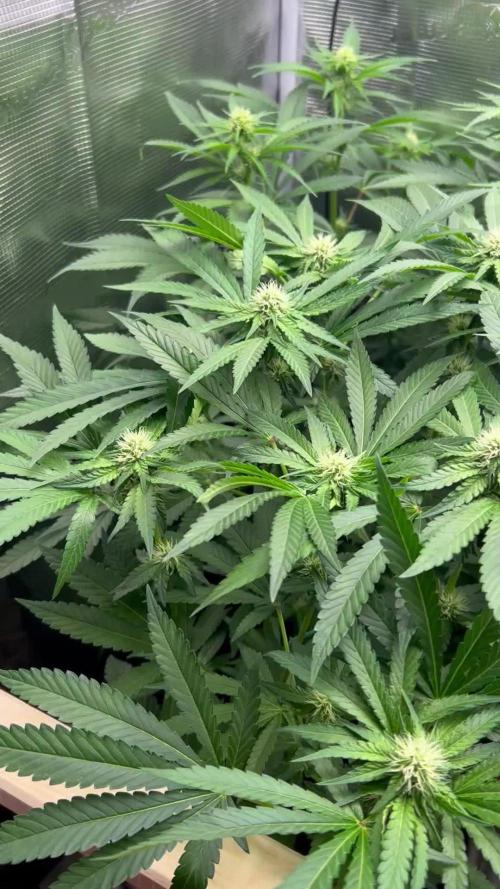
WEEK 4 — Lemon OG in Bloom Mode 🍋
The girls have officially passed the stretch and are now focusing all their energy on flower production. Bud development is progressing well, and overall health is solid.
Today was feeding day — full program again.
To support healthy bloom development and address early signs of calcium/magnesium deficiency (visible on one of the bigger plants), I slightly adjusted the recipe:
💧 Feeding mix (15 L water total):
• 60 ml Biobizz Bloom
• 20 ml Topmax
• 30 ml Effective Microorganisms (EM)
• ~50 ml Molasses (for pH adjustment, target 6.2)
• 20 ml CalMag
• 1.6 g Epsom salt (for magnesium support)
The canopy is dense and vibrant green. Some lower pruning was done earlier this week to improve airflow and light penetration. One plant is under observation due to suspicious growth, but nothing critical so far.
Let’s see how they respond to this feeding. Buds are forming nicely – everything’s on track!
More updates soon.
Keep growing! 🌱🔥 — OnlyBuds

Likes
2
Share

@Grow_for_Happiness
Follow
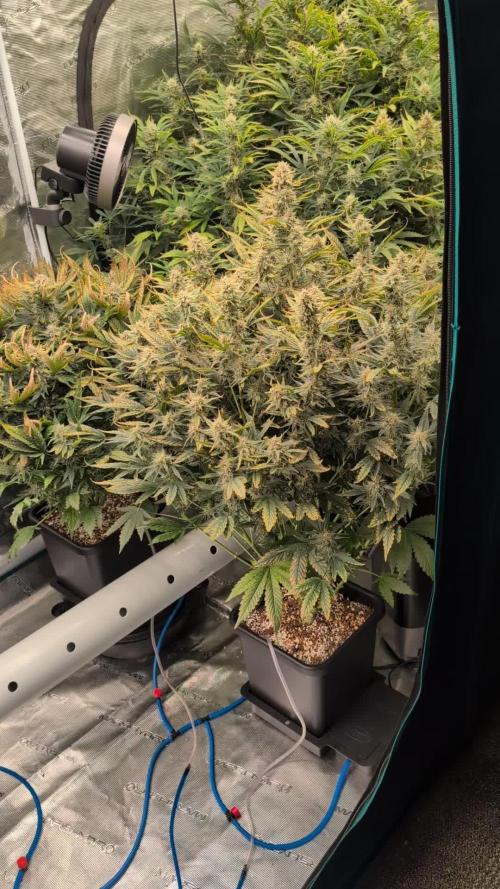
These plants are starting to live up to their name, looking very Yum-yum with the blue colours starting to come in. Front plant has nice long buds that are starting to plump up nicely with colours coming in. Back plant has slightly smaller looking buds, but they seem to be just as colourful, and are starting to smell delicious. Picked a few leaves off, and the buds made my arm sticky AF. Speaking of leaves, the back plant has some pretty dry fan leaves with a decent amount of browning. Looks like advanced tip burn, may be that this strain is a little more sensitive than the others? Other plants on same reservoir are happy, so just gonna let these two keep riding it out. They're looking great otherwise, and the browning is only affecting the older/larger fan leaves on the outside of the plant.
Turned the light up to 100% now getting 600 umol/s
Likes
6
Share


@HUMO_Cultiva
Follow
We start the first week before sprouted! We are excited to look the grow on RDWC!!

Likes
16
Share


@Big_Rade_SCLA
Follow
Hi to everyone.
DAY 74 -- Happy to say I haven't had any major issues so far this year. Made a video to show the progress and the difference in how the plants look. Some are getting stretched/pulled; while others aren't. All are getting partial shade throughout the day to avoid the heat stress. Am considering full sun now that they are bigger.
Count: 50/50 male/female; 6 of each basically from the 12 seedlings.

Likes
26
Share


@Bread_n_Buds
Follow
Time flies, we have arrived in a flash at day 16, it seems like the other day that the first young ladies were appearing on September 1st. "Do you remember.....nanannana Septermber"
She is Cosmic Noodles, a brand new strain from Zamnesia, so with little feedback but lots of expectations that we are here trying to make come true. In this case we are succeeding greatly, the plants are very pretty, one specimen is really gorgeous and super advanced for only being on day 16. The plant is at low/medium internodal distance and develops a very beautiful structure and leaves. We are very very very slightly under fertilization, I am trying to be perfect for the Zamnesia elves and I try to notice, whip myself and fix every mistake, even the smallest one. In this case we are a little under fertilization, in fact the plant is perfect, only that I went easy with the Grow to avoid over instead the Plagron tables, especially if created to measure, are very effective, follow them and you will not have problems.
--- feeding program - As I mentioned I was shy about fertilizing and the seedlings are slightly, very slightly faded, let's learn to notice these small signs and with normal doses after two or three waterings we should be fine. You have to look at the plants guys.
- Power Roots - 1ml/l
- Alga Grow - 2 ml/l (instead of 4 ml/l I made this mistake)
- Pure Zym - 1 ml/l
- Sugar Royal - 1ml/l
- Vita Race - 0.5 ml/l
- The 100% Organic pack by Plagron can be found on Zamnesia at the link:
https://www.zamnesia.io/it/11457-plagron-easy-pack-natural.html
We are giving a lot of humidity with a humidifier and we oscillate between 65% and 70%.
// Strain Description //cross of Alien OG and Rollercoaster Haze, Cosmic Noodles offers excellent yields and extraordinary aromas. This variety is very powerful, contains 25% THC and produces intense and long-lasting effects. Stimulating and relaxing at the same time, Cosmic Noodles causes an energizing cerebral effect that fades over time becoming soothing at a physical level.
- Get a seed of this fantastic strain --- https://www.zamnesia.io/it/10777-zamnesia-seeds-cosmic-noodles.html
- Soil and Fertilizers entirely organic --- https://plagron.com/en buy on www.zamnesia.io
- Growbox and air system --- https://www.secretjardin.com/ - Light - Sp3000 - https://marshydro.eu/
- Music and sound --- I made my girls listen to 432hz frequencies and music from www.radionula.com
- Z --- You can find these seeds, much more from the world of cannabis, mushrooms and an incredible series of accessories and gadgets on the reference site not only mine but of many growers ---- https://www.zamnesia.io

Likes
7
Share


@Herbie
Follow
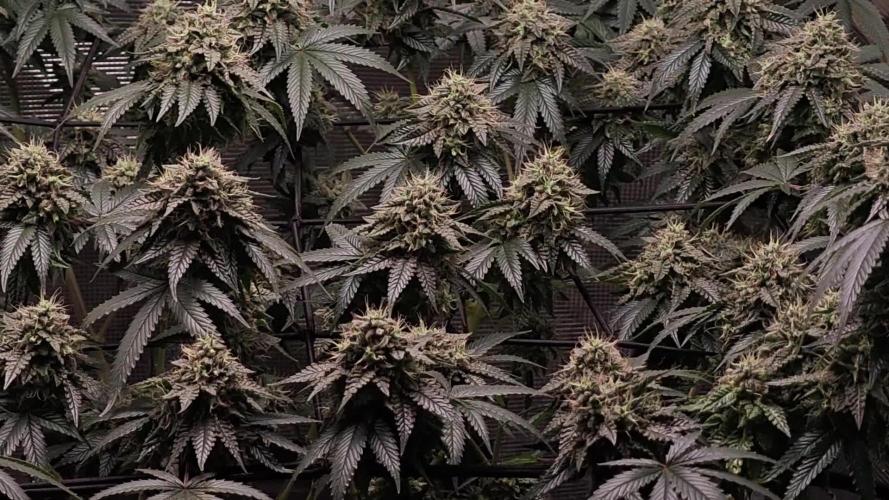
I opened the converted wardrobe door and the first colour I thought of was Orange sovI knew it was time.
I did a lot of experimenting throughout the grow, trying to find my own technique and this girl has been a great help.
Its my biggest haul to date ooking at it altough I can't weigh it without seriously messing around so l just weigh when dry.


Likes
22
Share


@JiggleBudz
Follow
This week we started to give her only water. Very few new pistils are showing and mostly cloudy trichomes. We are in the final stretch now - thinking 4 to 7 days.
Likes
4
Share

@Dr_4NdY
Follow
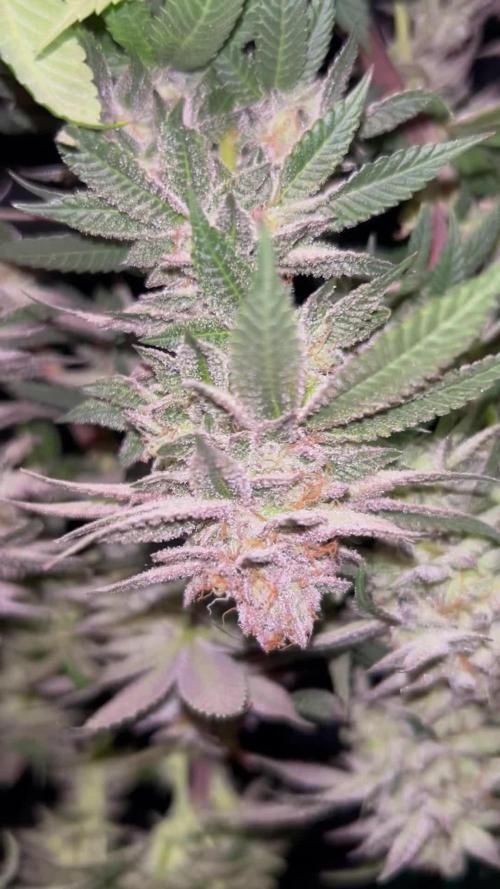
Last week for Studio & Rainbow Gelato
Will chop the S54 today, RG has 3/4 days left
Studio ist really beautiful, it looks like bought cali buds - really proud that she turned out that way
RG is not pretty at all in my opinion maybe I screwed her up somehow, all leafs look health except the browned ones in the middle tops
In her edges are no discolored leafs
Bruce Banner fills its gaps, I moved the light to the back so she gets more
I already started flushing her + 2 weeks overdrive before that - wasn’t so smart cause she takes longer in general - avoidable mistake
All in all happy they turned out like that


Likes
12
Share


@Naturalist
Follow
Rough week, underfed & plants got real hungry, cannibalized like crazy, fed & clipped the worst leaves, they look real droopy as pics were taken just a few minutes before lights out but should recover I think. I hope to flip in a couple weeks so I added a little Bloom in the feed cycle.


Likes
23
Share


@DreamIT
Follow
Sponsored by:
⚖️HUMBOLDT SEESDS⚖️-💡VIPARSPECTRA💡-💐GREEN BUZZ LIQUIDS💐-🛠️WEDRYER🛠️
4/9 monster of height! it has really stretched a lot, I'm very happy. fertilized water today and probably tomorrow too. yeah!
__________________________________________
Personal advertising (contains affiliate links)
__________________________________________
🦄 Highly professional graphics and website, one-of-a-kind genetics, and a legendary story! Anonymous shipping!
✅https: //bit.ly/HumboldtSeedsCompany
__________________________________________
Did you know that Green Buzz Liquids fertilizers are 100% vegan? A complete line of products ready to give the best to each of your plants! Visit the site and see my journals to see how they work 🦄
🤯 And with the code "dreami t" you will immediately receive a 15% discount on your purchases
✅https: //bit.ly/GreenBuzzLiquidsPro
__________________________________________
👀 Are you looking for a good lamp to start with? 👀
🌞Viparspectra has something more than the others, take a look at their site.
⏩ Use "GDVIP" for an extra discount or "DREAMIT3" for an extra 5 %% discount
👀 Search for it on Amazon
✅Amazon USA: https://amzn.to/30xSTVq
✅Amazon Canada: https://amzn.to/38udUVe
✅Viparspectra UE: bit.ly/ViparspectraUE
✅Viparspectra USA: bit.ly/ViparspectraUS
______________________________________________
🌈 Tired of blowing on your weed hoping it dries quickly? Check out the Wedryer website! You will find a well-made accessory that will help your weed dry in just 8-10 days without the annoying risk of finding mold or other annoyances! (no affiliate links)
✅https: //bit.ly/Wedryer_
______________________________________________
📷🥇Follow the best photos on Instagram 🥇📷
https://www.instagram.com/dreamit420/
Backup
https://www.instagram.com/dreamit4200/
🔻🔻Leave a comment with your opinion if you pass by here🔻🔻
🤟🦄💚 Thank you and good growth 💚🦄🤟

Likes
44
Share


@Chedderbob112
Follow
Waiting on a full plant hang dry so will wait at least two weeks maybe three hope ma vegging station holds up n can dae tge damage the now as av said guys this is definitely not the perfect set up am not on good terms with land lord so basically squatting here lol and growing and a got caught with one in this house the land lord doesn’t even know lol 😂


