


Likes
Comments
Share


@tangie
Follow
Chopped her two days into week 14.
What else. Buds. There are a lot of them. And they are quite large. And they look like they will require little effort to trim.
What more can I wish for? I am a very happy man.
Upd 1: Trimming is SO SIMPLE! Not much sticking out to begin with, because of the amazing bud structure and me plucking most bud node fans. Solid nugs which are not bothered by anything, so pulling smaller sub-bud fans is very simple too, while the buds are what I would call moist. I'll call this Moist Trim 😄
✂️✂️✂️ Went for the best trimming tools available on the market (well at least my research concluded so) and LOVING every minute of trimming with the B-500SRF. Why would I or anyone else use something less suitable or less comfortable for such a delicate and long job is beyond me, except if you cannot afford one right now, in which case I wish you to experience it one day.
Fiskars are also very good in therms of the blades, coating and cutting ability and precision, but the spring is just too stiff, like way, way to stiff for something that is to be used for hours on end. One might argue that such spring force helps overcome resin buildup, but please just rinse your instrument regularly in an appropriate solvent (ethy, iso, whatever — consider you instrument materials as well) and wipe it after. Why would you let significant amounts of resin to accumulate on such a gentle and precise tool? Kinda defeats the purpose?

Likes
22
Share


@chupacabra80
Follow
1
glue gelato
120 cm
начал цвести в
34- 35 дней
2
runtz
90 cm еще не начал цвести.
вот вот расцветет
3
weedding cake
120 cm
начал цвести
40-41 день
4
do si dos
130 cm
начал цвести
40-41 день
5
Gorilla glue
120 cm начал цвести
40-41 день
сегодня я промыл
2 мл/1 л
floraClean,
Gorilla glue , wedding, do si dos поели по 3 литра, glue gelato 2.5 литра,
runtz меньше 2 литров,
runtz
мало ест и пока тормозит)))), в основном все нормально,я максимально не трогаю растения хочу посмотреть полный потенциал,я срезал лишь пару листьев и все,думаю это не проблема,

Likes
28
Share


@AlpenZilla
Follow
This week the time had come, the plants were chopped down. They were left to dry for almost exactly 7 days, a little too long as it turned out.
One head bud had to be removed due to the risk of mold.
All in all, the harvest turned out to be smaller, certainly also due to the fact that I could only grow three plants on 50x50cm in their vegetative stage to a limited size at the beginning.

Likes
10
Share


@SnoopyShaggy
Follow
3 autoflowers which is Outlaw Amnesia, Purple Punch, and Strawberry cough are well undergoing veg stage. Since these 3 plant genetics breeded are a mix of 2-3 different strains. The grow results from this seed breeders are amazing no complaints.
I am really looking forward growing single strain very soon from international seedbanks asap once i finish experimenting all of my custom breeder strains.
I am having a crazy overthinking with 2 of my AK47 since they are seeds generated from a hermie AK47 autoflower.
The issue is more of a thought process whether the plant will flower since these 2 of them are under 1 tent with 3 Autoflowers😂, i hope they will follow the autoflower traits and not photoperiod.
If they are not flowering, i was informed to flip the light to 12-12,
If this situation happens, the only possible outcome i can think of is to defoliate/shwazz them and then flip them sf2000 to 12-12 right only i harvested 3 of the Autoflowers.
Officially planted these babies on Nov 9, i will log into GD diaries every Sunday.
Officially added 0.5ml of BigBud per litre, a very minute ammount just to top up some P and K since 3 plants are entering preflowering soon.


Processing
Likes
7
Share


@xX_The_Chef_Xx
Follow
The plants have good roots now and are sucking up the nutes and picking up the place with their growth rates. The Fox farm soil plants are growing up quick. We switched to feeding them straight water for a bit, we saw a little tip burn so pure H20. We keep moving forward with the LST to try and set up our canopy after the flowering stretch. The light got raised a few inches to give the leaves a little bit of a break.

Likes
10
Share


@I_Identify_As_A_Dan
Follow
Week 9 for White Widow by Greenhouseseedco,
This girl is really due a transplant but I still have the soil cooking a few more days.
Don't think ill be topping her anymore ill leave her at 16 tops, but will still be training her a bit to get all the tops with as much even space as possible while also keeping them as flat as possible.
Shes getting another 2 months of veg so.. lets see what she can do.


Likes
1
Share
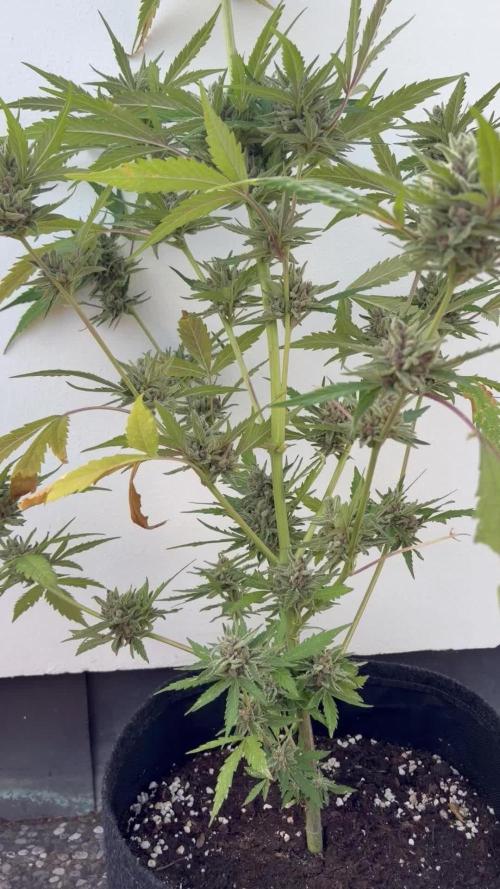

@RooftopFarmer
Follow
Banana Guava – Week 10 (Fast Buds Outdoor 2026)
The weather was okay this week. Banana Guava is almost done and is receiving less nutrients. The plant is fully in flower.
The aroma is extremely strong at this point. Trichomes were checked again and are noticeably more milky than last week. She has reached a good size and is progressing well toward harvest.


Likes
16
Share


@RakonGrow
Follow
Tag 78 :
+ 2L Flaschenwasser
++ Dünger mit wenig CalMag
+ final PH 6.05
Ein Bild zum Vergleich Tag 66 und Tag 78 hinzugefühgt.
Tag 79:
Trichome an den äusseren buds aufgenommen . Das dauert noch bis zur Ernte.
Video hinzugefügt.
Tag 80 :
+ 2L Flaschenwasser (EC 0.325) (16:00 Uhr)
++ CalMag (final EC 0.456)
++ Dünger für Blüte
+ final PH 5.98
Tag 82:
+ 2L Flaschenwasser (EC 0.325) (13:00 Uhr)
++ CalMag (final EC 0.435)
++ Dünger für Blüte (PH 4.95)
+ final PH 6.10 (mit GreenHouse Feeding BioEnhancer als PH+ ) / EC 1.350
Tag 83:
Ein paar Bilder und ein Video. Die Dame hat jetzt das ganze Zelt für sich alleine und bekommt die satten 200Watt für sich . Heute hatte ich so geringe Luftfeuchtigkeit das ich ein nasses Handtuch vor den Luftansaugbereich stellen musste.
Tag 84:
+ 2L Flaschenwasser (EC 0.325) (10:00 Uhr)
++ CalMag (final EC 0.435)
++ Dünger für Blüte (Generative Phase III der Canna Dünger Tabelle) (PH 6.20)
+ final PH 6.0 (Plagron PH- (Phosphor basiert) )

Likes
5
Share


@Dpizzle1986
Follow
Plant is super healthy an bushy. Defoliated 2 days ago an doesn't even look like I touched her...💯🔥
Likes
4
Share


@amazingautoflowers
Follow
Hey All!!,
Today is the 24th - Happy Christmas Eve!
The pictures were taken on the 19th (42 days old) they are looking quite good. They are doing a good job of stacking. Looks like they will be nice dense buds. I will be staying with what I am doing as far as feeding until it's time to flush. It does not look like they will not all finish at the same time. Of the 4 one is really turning purple, a second has more purple buds but the leaves are green, and the last two are just getting frosty but no real color, at least not yet. Also of the 4, one is really tall, two are about exactly the same and then there is one in the middle, taller than the two but ot quite as tall as the one really tall one.
I will follow up next week. I skipped a week as there was nothing significant to talk about, they were just growing well.
I hope everyone has a great Christmas day!
Likes
18
Share


@JohnnyBlaz3
Follow
She is looking nice and healthy, no issues to report. I transplanted her on the last day of this week into 3 gal pots. Upped the nutes by 1ml per gal which is still about half the guides schedule. Will be starting co2 in 7-10 days is my guess. She isnt the biggest lady in the tent but shes battling for second, nice and healthy indeed.


Likes
114
Share


@Natrona
Follow
This week, my Titans are sleeping in a cooler dark room until harvest.
So for your viewing pleasure, I've loaded some videos made of the Titans during there time with me.
I'm wondering what to serve at my Queens Tea Party... I made some butterscotch pistachio bars and modified the recipe for less sugar. 😋 We experimented with topping the bars with black cherry spread, orange marmalade and a mango jelly. All are very tasty as the bit of sour/tart enhances the butterscotch sweet.
A few solar eclipse pics.
Likes
8
Share


@eldruida_lamota
Follow
Que pasa familia, vamos con la segunda semana de floración de estás Zkittelz de Seeds Mafia.
La humedad está entorno al 50%,y la temperatura la tengo entre los 22/24 grados.
Controlamos en ph en cada riego a 6.2.
Y el agua que utilizo de riego suele estar estancada entre 24 / 36 horas.
Cambie el fotoperiodo a 12 horas, hasta aquí todo bien, tienen un buen color, ya van progresando y creciendo a buen ritmo, vemos cómo avanzan estas semanas y como avanza el progreso de las flores.
Mars hydro:
Code discount: EL420
https://www.mars-hydro.com/
Agrobeta:
https://www.agrobeta.com/agrobetatiendaonline/36-abonos-canamo
Hasta aquí todo, Buenos humos 💨💨💨


Likes
7
Share


@Chucky324
Follow
Hello. This is the end of week 9 and the beginning of week 10 of veg.
Quite week for the plants and us. It's above freezing now, but it's one storm after another here.
The plants are dong well and I'll turn over to flowering next week. I'll make clones at that time.
I'm after the best plant so I'll whittle the 14 plants down to 1 or 2 plants when I'm done.
But I have to take 3 clones of each to be sure I get 1 to regrow when it's done. So I'll be doing that this week.
My next trim/prune will be before the 3 week of flowering, before the resin starts to flow.
Through this veg I've been giving a full feeding and then just watering and then a full feeding and then just watering.... You get the idea...
I let the pots dry and hopefully water/feed before I get any wilting.
We've started a new Freak Bros. book. Comic Book #10 Published in 1987. It's the 3rd in the trilogy.
You'll find the first 2 comic books in the story in other diaries. Have a look around in my other diaries and you'll find them.
OK. Have fun out there.
Chuck

