The Grow Awards 2026 🏆 






Likes
Comments
Share
@XanHalen
Follow
Officially week 7
Dec 31:
Came back a week later to very heavy pots, needed 36 hour drying period, not happy, smaller plant has tips of leaves curling down, some like taco, dryed out the pots and went back to normal conservative feeding, need to fine tune the auto irrigation setup before I use it again for sure. All in all, nothing crazy happened. Really cool to see a plant be small, but way bigger after a week of vacation. First grow seems to be going pretty good!
PS: I think my hygrometer is broken, saying 85-100% RA even when I significantly improve airflow and it doesn't seem anywhere near that. Gonna do the salt paste test on the hygrometer
.
Jan 1:
I recalibrated my hygrometer and it’s working great, weird leaf curling of smaller plant still happening but seems to be improving, big plant is frosty and fat for week 7, seems to be at same stage in development as smaller plant but the pheno is beautiful.

Likes
20
Share
@Spudz
Follow
Day 70 — Cruising right along with the grow. Can’t say enough about the Sensi Bloom. I will definitely be using it for the next grow. Both Veg and Bloom. Buds are really filling on the short LB. Getting fat and sticky. Smell is really nice as well. Remind me of the pot from the 70’s. I’m starting to stress a bit about when to harvest. I don’t have a magnifying glass strong enough to see the trichromes. Is there another telltale sign the plant is ready? I’m starting to see the red hairs so is that an indication flowering is winding down? I still think I have a couple weeks, but will be watching them closely. Thanks for reading.

Likes
2
Share
@Barzenegger
Follow
This week I didn't spend much time checking in on the tent, but when I went to check the reservoir, which I expected to be empty, I realized that the system was clogged. About half of the nutrient solution was still in the tank.
I opened the tent to check the moisture of the substrate. It was pretty dry already and the plants were showing some heat stress and the burnt tips had gotten somewhat worse. Being too close to the light didn't help either. They weren't hanging yet, but they needed to drink.
It was clogged in a small part of piping between the tank and the tap, which I realized, was never actually cleaned before. And I did have some organic compounds in there a rather long time ago, which probably caused this in the first place. I unclogged it within a few minutes, and bought some Canna D Block to try out. I will probably refill the reservoir again early next week.

Likes
12
Share
@HIAZ_urbanbudfarmer
Follow
Saturday 16-11-24 , Flowering day # 53 week 8. Harvest day!
Cut branches off plants & hung the 2 front plants off the light.
Put scrog net back in with a large flyscreen laying on top, & spread branches from the back plant over it. This allows complete air flow around the buds. Running a single oscillating fan beneath pointing to the bottom.
Temperature is around 24°C & RH is 55%

Likes
8
Share
@Mo_Powers
Follow
summer is slowly coming to germany. this beautiful plant is growing tall and bushy. at the beginning of the week she showed her sex. harvest is planned for the end of october or mid november. so there is still plenty of time for it to grow. it is vigorous and healthy.😋✊

Processing
Likes
27
Share
@Silverback_Guerilla
Follow
2/17:
I spent a little time rearranging today. I bought some 32" x 14" plastic ventilated storage shelves and cut the legs down on two of them so I have some different-height platforms for the shorties in the garden. I should also be able to easily flush 6 plants in 5 gallon pots, or 9 plants in 3 gallon pots at a time now, that's a win!👈
2/18:
I debated whether to feed or not, and settled on watering them with about 1/2 gallon each. including bembe, cal-mag, signal, humic acid, and a little beastie bloomz.
The new dehumidifier is pulling about a gallon and a half per day from the air, so I should be able to feed them in a coupe of days.
I've reached the ceiling again with my lights and the tall one is still stretching a little bit. I sure hate to have to supercrop her too...my garden is looking so wild and untamed already...😳
2/19:
Rainy day outside, so I'm pulling in 99% humidity, plus the pots are still petty saturated, but the new dehumidifier is keeping up. RH is holding at about 45% today.👍
2/20:
Day 31 of flower...the taller plant grew another couple of inches overnight! Damnit!😟 After emptying the closet (again) today and supercropping more branches (and some of the same branches again), a semi-solution occurred to me that allowed me to raise the lights another 3-4 inches! Now I'm truly maxxed out...
These two plants couldn't be more different.
One twisted-leaf 2-footer that started budding up in the first week of flower, and one beautiful 4-footer that's been very slow to flower..
The structure on the taller/sativa-looking plant is very promising, though...many long colas, and stacking up well...👌
I really needed everybody to finish in the same week so I could get my Spring autos going...😶
I'm still hoping that the big one will hurry the fuck up and finish by the EHD(3/11), but it's not looking possible at this point...
I took photos and videos of all the plants today since I had to empty the closet and it wasn't a feeding day.
2/21:
I fed them today with about 3/4 gallon each including beastie bloomz, tiger bloom, big bloom, signal, bembe, and cal-mag...no grow big this time.
2/22:
The tall one grew another inch...i threatened to bind her up like one of Silky_Smooth's plants if she didn't stop growing immediately.
If she doesn't start budding up with serious urgency, she's gonna piss me off...my Spring auto grow must not be postponed!
2/23:
I ordered some terpinator because I'm not so sure about Signal's efficacy at this point....I'm usually dealing with odors more by now..

Likes
8
Share
@SkunkMonk80
Follow
All flowering nicely, stunted one has fully recovered she behind the other 4 but will do fine with a little training.
Likes
140
Share
@MrJones
Follow
mrjones - Slurricane #7 S1
🌱Slurricane #7 S1
@inhousegenetics_official
👨🌾🏽GD Grower: MrJones
🔹🔹🔹🔹🔹🔹GOALS🔹🔹🔹🔹🔹🔹
🌞Environment - 75/80℉ and 55% Humidity
💧 Feeding - Advanced Nutrients Organic
⚗️Soil - 50% Ocean Forest / 20% Tupur Royal Gold / 10% Earth Worm castings / 10% lobster Compost / 10% Additional Perlite
🍃Training / HST, Will be topping, Cloning, and creating larger plants, and placing to flower under a trellis
🕷️ IPM - Will be using Green Cleaner" 1 OZ per Gallon, and CannControl from Mammoth alternating between product each month for Integrated Pest Management.
💡Mars Hydro LED / Veg Geeklight Monster Board 480W V4 / Flower 480W FC 4800
🔹🔹🔹🔹🔹🔹🔹🔹🔹🔹🔹🔹🔹🔹🔹
📜 Rambling - Week 9 underway the plants are responding very well to the decreased nutrients - the clones are coming along, but trying to ween them off the biodomes is a bit tricky.
🔹🔹🔹🔹🔹🔹🔹🔹🔹🔹🔹🔹🔹🔹🔹
▶️ Sunday - 04.11.21 / Fed 30 Ounces today
▶️ Monday - 04.12.21 / Fed 30 Ounces today
▶️ Tuesday - 04.13.21 / Fed 30 Ounces today
▶️ Wednesday - 04.14.21 /These Mother plants are on cruise control, Fed 30 Ounces today
▶️ Thursday - 04.15.21 / Fed 30 Ounces today
▶️ Friday - 04.16.21 / Fed 30 Ounces today
▶️ Saturday - 04.17.21 / Fed 30 Ounces today
🔹🔹🔹🔹🔹🔹🔹🔹🔹🔹🔹🔹🔹🔹🔹
📜 Cultivar Information - In House Genetics - Slurricane #7 S1
🔹🔹🔹🔹🔹🔹🔹🔹🔹🔹🔹🔹🔹🔹🔹

Processing
Likes
2
Share
@TolaMcFly
Follow
Han empezado a tomar ritmo en general esta cepa la he visto y cultivado y siempre se demora en mostrar flores contundentes , va lento pero seguro , lo mejor que tiene es el efecto que verdaderamente se parece al lsd , no se que habrá hecho Barney’s farms con esta cepa pero es un efecto muy fuerte , adjunte unas flores de otro cultivo , esta semana defoliamos otra vez las hojas más nuevas , dándole pelea al frío que ya afuera alcanza temperaturas de 2º C , de noche la temperatura fructua demasiado las plantas están tomando tonos violáceos y se ven muy pero muy parejos todos los cogollos que se vienen.


Processing
Likes
6
Share
@Weedzoks
Follow
La plante a fortement jauni cette semaine et des taches sont apparues
Flo 23: Arrosage eau
Flo 24: Pulvérisation de 3ml de Vita Race

Likes
19
Share
@TylerBud
Follow
Welcome to the Jungle 😁😎
Girls are enormous , i literally lollipopped them 😅 , later in the flowering i will also make a great defoil of the tops to prevent very serious mold that already attacked my autos ,

Likes
25
Share
@BudHaks
Follow
As you can see, she is getting thicker as days go by! Looking to harvest her in 2 weeks! Minor light burn on the top cola, but other then that no deficiencies at all.

Likes
2
Share
@Wazowskid
Follow
Las plantas van creciendo estupendamente, de momento no les he dado ningún tipo de fertilizante. He aplicado LST.
Likes
19
Share
@potfromgreece
Follow
Sorry for long period!
I was busy doing my super very cheap grow box, i will show it later with my new grow! I already started, but ok.
Now my plant looking good, small, but i like how she react to new light and 18 hours of light. She's slowly growing.
On day 30 i accidentally broke 1 leaf and i decided to smoke it, damn even now even this was a little bit potent, i am expecting good shit now

Likes
226
Share
@Kitties_and_Colas
Follow
~_~_~_~_~_~_~_~_~_~_~_~_~_~_~_~_~_~_~_~_~_~_~_~_~_~_~_~_~_~_~_~_~_~_~_~_~_~_~_~_~_~_~_~_~_~_~_~_~_~_~_~_~_~_~_~_~_~_~_~_~_~_~_~_~_~_~_~_~_~_~_~_~_~_~_~_~_~_~_~_~_~_~
9/18/21
😺 Week 4 of flower!! Everyone is looking pretty good but the mainlined plant seems to be locking out calcium again (and they're clawing slightly, this is on me, I was pushing it lol)..its early but we've increased calcium supplements by 3ml, cut all grow solutions and PK feeds consistent ..we'll update on this again midweek.. thanks for reading grow family and happy harvests!💡🌱 😽💨
Week 4 on YouTube:
https://m.youtube.com/watch?v=EL-n5MUawFY
~_~_~_~_~_~_~_~_~_~_~_~_~_~_~_~_~_~_~_~_~_~_~_~_~_~_~_~_~_~_~_~_~_~_~_~_~_~_~_~_~_~_~_~_~_~_~_~_~_~_~_~_~_~_~_~_~_~_~_~_~_~_~_~_~_~_~_~_~_~_~_~_~_~_~_~_~_~_~_~_~_~_~

Likes
2
Share
@carjos
Follow
I also used seaweed extract, a source for potash, n-p-k 0-0-17. In my first two harvet the bud on the tree smelled like cat box for litter. Granted this is an age old description for types of pot plant. But after adding a recmoended dose the plant smells nice after that. Can add as foliage spray but not in direct light. Some describe this nutrient as a stress relief for the plant. Also I switched from GAIA Power Bloom to Canna Flores. The sweet pepper took well to the Holland based nutrient brand. As for the Jr Mintz, there is actually a hint of mint , the edible tea leaf made a very tranquile hot beverage. And when smoking the dried bud the sessation delivers both head buzz and body buzz. Great for writers and authors who want to sit comfy in their writers chair and work all day by the rainy window.
Likes
34
Share
@ScotlandHaze
Follow
Overall very happy with the grow. Got 24oz of very dense nugs! I also managed to get 2oz of less dense but still pretty bag-appeal, and a shit ton of trim which I made into tidy ass brownies, which have made typing this incredibly difficult😂! Both of these strains are definitely bed time strains. The Critical kush is has the usual overwhelming kush taste, however the peyote(purple nugs) have a very sweet / flowery taste and smell. Disappointed I only done 1 peyote but more than happy with the critical. Would definitely grow both these strains again!
Likes
21
Share
@Dunk_Junk
Follow
22cm vertical growth this week!! Now 62cm tall
She's very bushy.
I tried some stuff this week, bent over some branches etc, trimmed off all leaves on the main stem and some from the lower branches.
I don't usually defoliate this early or this intense, but but sites were being blocked from the light, so they had to go.
lets keep an eye on the results (if any) of that over the next few weeks.
Processing
Likes
10
Share
@Fibro_Witch
Follow
Good growth this week. The inchworms are still munching away so I sprayed with some neem oil. Will be watering in some Big Bloom and molasses later. Really looking forward to this one flowering in a couple weeks. It had the prettiest purple flowers last year!
Likes
4
Share
@TKCS_Pinoy
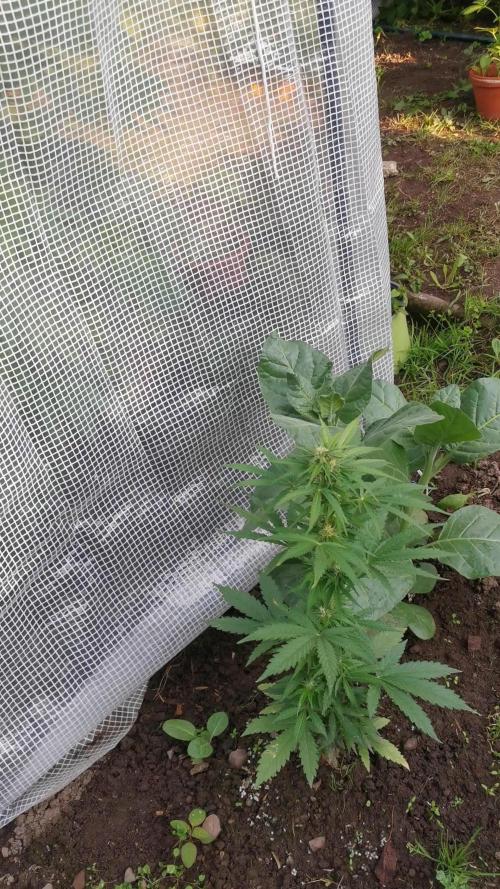
Follow
🌸 Woche - Week 10 Review
🌡️ Wetter: Nach einer Hitzewelle kam die Abkühlung – jetzt eher regnerisch, mit ab und zu einem Sonnenstrahl.
📈 Wachstum: Längenwachstum abgeschlossen, Pflanze konzentriert sich auf die Blüten.
💡 Licht & Energie: Sonne wird trotz wechselhaftem Wetter gut mitgenommen.
🌿 Blattgesundheit: Blätter sattgrün, keine Probleme.
💧 Wasser & Nährstoffe: Während der Hitze viel Wasser gebraucht 💦, jetzt durch Regen etwas entspannter.
🔄 Entwicklung: Überall kleine Ansätze – die Vorblüte läuft richtig gut 🌼.
✅ Fazit: Meine erste Pflanze, dauert länger, aber die Vorblüte macht mich zufrieden.
---------------------------------------------------------------------------------------------------------------
🌡️ Weather: After a heatwave, it turned cooler – now more rainy, with occasional sunshine.
📏 Growth: Vertical growth finished, plant focusing on flowers.
💡 Light & Energy: Sun is used well, even in changing weather.
🌿 Leaf Health: Leaves deep green, no issues.
💧 Water & Nutrients: Needed lots of water during the heat 💦, now rain helps keep it balanced.
🔄 Development: Many small sites forming – pre-flowering going really well 🌼.
✅ Overall: My first plant, taking longer, but I’m satisfied with how pre-flowering is going.