The Grow Awards 2026 🏆 






Likes
Comments
Share
@TheBudWhisperer
Follow
End of the first few days of the transition. They all got a significant defoliation to open up space in the canopy for branching and the plants responded incredibly well to it. Plants 1&2 started to show immediate deficiency signs after defoliation and I upped the nute ratios by about 50%/liter with the Berkana. Voracious feeder and growers these are for sure. That said, their growth rate is phenomenal and the side branching is especially impressive and responsive to training. Veg. Maturity on all of em for the last week so it’s a fast growing strain all around👌.
Well throw down the scrog net in a couple of days after we hack out the lower portions of each plant and take clones for all of em but the runt (#8). The clones will be flowered fast in the aeroponic cloner and pollinated for F3 generation seed. Bud characteristics on this run will then determine which clones get tested first based on best characteristics of the lot.
So far this run has been incredibly impressive but only the bud quality will tell the true tale. Here’s hoping for continued good progress.
***Grow notes: stretching at about 1/2” per day over the last 3 days of transition. Side branching reaching enough maturity to start taking cuts. Minor deficiency signs post-defol. So increasing nute ratios on a slightly accelerated basis continues to be the norm.
Likes
Comments
Share


Likes
4
Share
@Ageddd
Follow
ULH2: Still growing buds
AH1: Strated branching ^^ Bent the plant a little
AH2: Transplant to 25l Tex Pot with Canna Terra Pro


Likes
170
Share
@Master_weeda
Follow
Bonjour à tous les padawans et maîtres jedis jour84 arrosage avec 25 centilitres d'eau ph6.3
Jour87 arrosage avec 30 centilitres d'eau ph6.3
Jour88 pratique de la techniques du tronc fendu (videos explicatives) et arrosage avec 20 centilitres d'eau ph6.3
COMMENT FENDRE LES TIGES DE VOTRE PLANT DE CANNABIS
Pour fendre les tiges de votre plant de cannabis, il vous faudra :
Une lame propre et aiguisée (une lame de cutter fonctionne bien)
Un mètre ruban
Une ficelle ou un adhésif pour marquer les coupures que vous ferez le long de la tige
Un crayon, une baguette ou une brochette pour séparer la tige une fois fendue
1. Tout d'abord, commencez par mesurer la partie de la tige que vous allez fendre. Il faut faire une incision d'environ 10–20 cm juste sous la branche la plus basse de votre plant. Utilisez un ruban adhésif ou de la ficelle pour marquer le début et la fin de l'incision.
2. Ensuite, prenez votre lame et faites une incision en travers de la tige, en commençant par le haut. Attention à faire une coupe propre, jusqu'au centre de la tige.
3. Utilisez votre lame pour tailler en descendant vers le bas, jusqu'à la marque inférieure de la mesure que vous avez prise auparavant. Essayez de tailler aussi droit que possible. Une fois que vous avez atteint votre marque du bas, laissez la lame au centre de la tige, puis utilisez un crayon/baguette/brochette pour ouvrir la partie coupée, puis sortez votre lame.
QUEL EST LE MEILLEUR MOMENT POUR FENDRE LES TIGES ?
Il existe de nombreuses théories sur le meilleur moment pour passer votre tige au couteau, mais la plupart des cultivateurs suggèrent de le faire à la dernière semaine de floraison. Même si certains cultivateurs recommandent de le faire dans les 3 derniers jours avant la récolte, nous recommandons de le faire un peu plus tôt (7–10 jours avant la récolte).
QUELS SONT LES RISQUES À FENDRE LES TIGES ?
Fendre les tiges est une technique à stress élevé très agressive que nous ne recommandons qu'aux cultivateurs expérimentés. Nous ne recommandons également pas de fendre les tiges sur les variétés à autofloraison, car cela peut être bien trop intense pour elles.
FENDRE LES TIGES, ÇA MARCHE VRAIMENT ?
Il existe un solide ensemble de cultivateurs expérimentés qui déclarent que le fait de fendre les tiges peut produire de bons résultats. Malheureusement, peu de données qualitatives le prouvent. Cependant, il semble que la fente des tiges soit originaire des Pays-Bas, où elle est pratiquée par des cultivateurs néerlandais experts depuis les années 1970.

Likes
12
Share
@SparkSupertramp
Follow
First of all, I let the seeds soak in water for 10 hrs and I used the paper towel method for germination.
Likes
13
Share
@RussianGrower
Follow
Привет друзьям со всех уголков мира. Вот прошла ещё одна неделя. Как вы знаете в начале прошлой недели я начал делать клонов для большого проекта. На протяжение всего времени одно растение показывало больший рост чем другое, но это не мешало мне получать клонов от двух растений. Поэтому на протяжение всей недели я продолжал клонировать растения. После того как я взял нужное количество клонов я обрезал центральный стебель, сломав привычку растения выращивать один центральный стебель. На одном растение я оставил две ветки, а на другом, то что поменьше, оставил три ветки, натянув их нитью чтоб улучшалась их мускулатура. Теперь я оставлю растения в покое, дав им отрастить немного свои ветви.
Если вам интересно следить за приключениями травки в России, подписывайтесь на мои дневники!


Likes
33
Share
@Master_weeda
Follow
Bonjour à tous les padawans et maîtres jedis
Je me régale ! Franchement quel plaisir toute les conditions sont réunis pour faire une belle culture et le résultat est très intéressant
Un stretch presque fini est une belle plante avec un beau 108 centimètres
Un arrosage avec 2 litres d'eau ph6.3 à laquelle j'ajoute 5 millilitres de Hesi bloom et la dose recommandée de supervit

Likes
8
Share
@sellem
Follow
Welcome to week 10. First trichome pics coming in. one BPP seems to be getting there, rest is still 1-2 weeks out, my estimate right now, might change in the future.
No watering as of yet, problably next on 16/04.
Watered on 16/04., 1.5L, 5.7PH 1.5 EC, 5ml/L Bloom 1ml/L Green Sensation
Watered the two BPPS only on 18/05, 1.5L, 5.7PH 1.7EC, Same nutes
Trichomes on all seem to ambering up, but still a bit to go. Closely monitoring their progress.


Likes
36
Share
@nonick123
Follow
Día 122 (30/09) Riego con 750 / 1.000 ml H2O de osmosis
Día 123 (01/10) Riego con 750 / 1.000 ml H2O de osmosis
OnionOG #1 huele cada vez más a tierra húmeda, y sus cogollos son duros como pelotas de golf! ⚾
Día 124 (02/10) Riego con 500 / 1.000 ml H2O de osmosis
Hace 35 ºC de temperatura ambiente! Que barbaridad!
Día 125 (03/10) Riego con 750 / 1.000 ml H2O de osmosis
Hoy bajan las temperaturas 25-26 ºC, más normal para estas fechas
Día 126 (04/10) Riego con 750 / 1.000 ml H2O de osmosis
Día 127 (05/10) Riego con 750 / 1.000 ml H2O de osmosis
Las plantas empiezan a doblar sus ramas por el peso de los cogollos! 💪 🚀
Les aporto sujeción con cañas de bambú y cables de sujeción
Día 128 (06/10) Riego con 1 / 1,25 litro H2O pH 6,5 + Kelp Hidrolizado 0,3 g/L
Locura de día con 37 ºC y un aire caliente asfixiante!
💦Nutrients by Lurpe Solutions - www.lurpenaturalsolutions.com
🌱Substrate PRO-MIX HP BACILLUS + MYCORRHIZAE - www.pthorticulture.com/en/products/pro-mix-hp-biostimulant-plus-mycorrhizae

Likes
2
Share
@Dralph
Follow
Crystal meth esta asi... Creo que puede ser pulgon, pero a las demás plantas estan bien, esta en coco en 15L y riego 500ml cada 48h aprox, puede que se me hayan podrido las raizes por poca/mucha humedad?
El indoor suele estar por 30°c y 50/60 %rh , ahora esta en 24°
Finalmente ha muerto Crystal meth...
Nose si volvere a probarla, desde pequeña dio problemas y era demasiado espigada para mis gustos y recursos..
Una de las 4 Blackberrys de fastbuds se ve enorme y esta empezamdo a engordar creo, hojas púrpuras, creo que será la mas productora, la tengo em un armario aparte ella sola con olantas mas bajas con una marshydro ts600 que le penetra perfectamente en todas las ramas


Likes
147
Share
@MrJones
Follow
MrJones Black Berry OG
🔹🔹🔹🔹🔹🔹GOALS🔹🔹🔹🔹🔹🔹
🌞Environment - 75/80℉ and 55% Humidity
💧 Feeding - Using "Super Coco" amended soil. compost teas, Dechlorinated H20 PH/6.5 Fish Fertilizer, about 4 ounces of water per day.
🍃Training / Will be topping and creating larger plants and placing to flower under a trellis
🕷️ IPM - Will be using Green Cleaner" 1 OZ per Gallon, and CannControl from Mammoth alternating between product each month for Integrated Pest Management.
💡Mars Hydro LED / Veg TS-100 / Flower 480W FC 4800
🔹🔹🔹🔹🔹🔹🔹🔹🔹🔹🔹🔹🔹🔹🔹🔹🔹🔹
📜 Rambling - Moving into week 2 here, and these girls are doing well, decided to lower the PH a bit and see how this works with the super coco.
🔹🔹🔹🔹🔹🔹🔹🔹🔹🔹🔹🔹🔹🔹🔹🔹🔹🔹
▶️ Friday - 01.08.21 Tomorrow will be transplanting the seedlings into their 1-Gallon puts, so today just keeping the soil moist.
▶️ Saturday - 01.16.21 Transplanted the seedlings into their new 1-gallon pots, they will veg here until I move them in their 7-gallon final pots for more training and growth before I flip to flower.
▶️ Sunday - 01.17.21 Watered with Dechlorinated H20 PH @ 5.8 / 6.2
▶️ Monday - 01.18.21 Watered with Dechlorinated H20 PH @ 5.8 / 6.2
▶️ Tuesday - 01.19.21 Watered with Dechlorinated H20 PH @ 5.8 / 6.2
▶️ Wednesday - 01.50.21 Watered with Dechlorinated H20 PH @ 5.8 / 6.2
▶️ Thursday - 01.21.21 Watered with Dechlorinated H20 PH @ 5.8 / 6.2
🔹🔹🔹🔹🔹🔹🔹🔹🔹🔹🔹🔹🔹🔹🔹🔹🔹🔹
📜 Cultivar Information - We have created this strain by crossing the best Black Domina available with Very Berry and our own Lost Coast OG Kush, this plant produces large colas with a super intense sweet berry flavor with a sweet-smelling aroma that varies from fruit and berries to sweet candy. This lady offers tight internal stacking giving a perfect structure for those super heavy colas, which is perfect for growth both indoors and out, if grown outside she is fairly resistant to mold and powdery mildew which is a real bonus with such large colas.
🔹🔹🔹🔹🔹🔹🔹🔹🔹🔹🔹🔹🔹🔹🔹🔹🔹🔹
📜SOIL MIX
COCO - 70/30% Tupur Royal Gold 30 GALLON
WORM CASTINGS 5 GALLON
LOBSTER COMPOST 5 GALLON
PERLITE 6 GALLON
INSECT FRASS 2 CUP
ORGANICALLY DONE GROW 5 CUPS
BUILD A SOIL COCO MINERAL MIX 6 CUPS
🔹🔹🔹🔹🔹🔹🔹🔹🔹🔹🔹🔹🔹🔹🔹🔹🔹🔹

Likes
151
Share
@PEAKYPLANTERS
Follow
Welcome back to all, brother gardeners!
WE WANTED TO CELEBRATE WITH YOU
OUR 3 YEARS OF AGRICULTURE ON THE PLATFORM.
GREETINGS TO THE FRIENDS OF @GROWDIARIES WHO MADE THIS POSSIBLE!
My sweet biscuits grow beautifully and today we added a containment net as their stems seem to stretch too much under the light
Best regards
LA REINA PEAKYPLANTERS
Likes
18
Share
@20SYL
Follow
The plants are super vigorous. They’re growing very fast. And the LST is starting to take shape 🌳
Very impressed !
Processing
Likes
1
Share
@Andres
Follow
Let's hope it is. Female. and spring is coming and goodbye cloudy days...
Likes
58
Share
@GreenHouseLab
Follow
Results are starting to come in now, going to be Cake all the way to the end. Time to grab your popcorn and stay tuned in 🤡🎪
Short Phenos is Pure Michigan lean, obvious now with the purple starting to form from bud sites. Tall girl is Sugar Cane Pheno what a stake, huh!?
GHL out 🚀
Likes
14
Share
@SweetKush
Follow
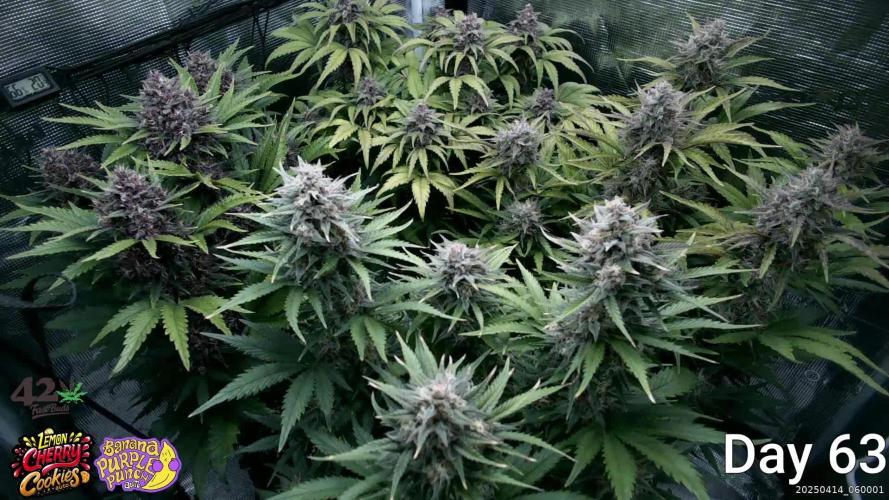
Day 74. The harvest is near. I will start with a 14 day flush this coming week. The Trikoms sparkle like diamonds on the buds and it smells absolutely magical. The harvest won't be that great but the quality of this weed will be absolutely outstanding, I'm sure 😁✌️.
Day 77. The gorilla is approaching the end, The Tricoma are cloudy and are becoming more and more milky to show a shade of amber and orange-colored spouts spread across the buds. I aim to start flushing her at the end of this week, and then give her a 10-14 day flush.

Likes
16
Share
@Dr_Rook
Follow
Han aguantado a la perfección los errores de un novato en interior cómo yo😌 tuvieron un ciclo vegetativo un tanto turbulento con estrés lumínico, estrés por frío, hídrico también ya que las llevabas demasiado cortas de agua y causa de esto un ataque de araña roja 🕸️ a pesar de todo han florecido a la perfección dando 95g en seco de un producto de muy buena calidad 🤩
Ha sido un placer compartir mi primera experiencia en interior con vosotros. Con ganas de empezar el siguiente y seguir aprendiendo y mejorando

Likes
1
Share
@midEastern
Follow
trichs are milky
this time i decided to chop as milky is peak thc and not wait to start amber
this way i see it buds stay green even after a few months in jars
Trimming initially only - and hang down in shaded ventilated place for 10-14 days
Then moving to jars wood boxes for olding process..
