




Likes
Comments
Share


@Dirizhor
Follow
Hi, exciting times, flowering, see some stratching, but not too much.
Plant now drinks 2 liters a time, each 2 days. Befor I was giving 1 liter every 3 days. So water cosumption encreased more then 3 times.
Smell is not strong yet, as expected.
Not much really I need to do escept mixing fertilizer and water the plant.
Processing
Likes
9
Share


@NightsAssassian
Follow
Day 43: Prior to yesterday i had a cal/mag def in my plants that i couldnt fix right away to to my city non essential bus. being closed, finally received what i needed yesterday and began to give the girls cal/mag. The garden has continued to grow despite the def but hopefully it will get better in a week or so because some of the leafs look really bad with spots and being crispy in general. If you have any advice please feel free to share and as always thanks for looking and happy growing. 😀


Likes
37
Share


@DaddyPrime2
Follow
5/5/2024
Pistils pistils pistils
5/8 these plants are fucking exploding! Super exciting to see them like this. Pistils everywhere and they’re just STACKING! don’t even see budlets yet, just pistils. The structure of these plants is beautiful. They handle training fairly well. I topped one and super cropped it and did a bit of lst. I was feeling impatient so I decided to see what happened if I pushed the one a little harder and left the other to grow naturally.

Likes
2
Share


@OldSchoolT
Follow
Been a while been busy with life nearly ready for flipping
Decided to get a different light 🚨
Likes
16
Share


@Daddyhancocc74
Follow
I'm using a 2x2x5 spider farmer tent and technically I start germination on 1/17/23 at 9pm and in the picture I'm using Rockwool but also a small pot with fox farm soil to hold it upright

Likes
12
Share


@Donbehzad
Follow
The LST i did in the past few weeks is starting to pay off. The plants are spreading nice and even, not bad for a first timer but it can be better.
In this week, i’ll try to water more to boost their growth because in the past few weeks i only water them once a week for the reason that I always wait until the top soil goes dry and it took almost a week for that to happen. I read in an article that you should carry your pot after a day of watering the plants to able to know that is the weight of the pot when it has water, so you can determine if the pot is light that means you can water them even the top soil is still wet. I’ll try this method lets see if i’ll end up overfeeding my plants or not.
In this week will be doing same routine like last week, always monitor humidity and temperature. Spread the fan leaves so the leaves underneath can receive enough light.

Likes
13
Share


@TheMightyHermit
Follow
Unfortunate Week...
Honey cream had a couple of "budrot" spots forming due to droplets of water dripping into the flower and not drying (99%humidity nights)...
Thankfully those buds were cut down and she doesn't seem to be producing any more "budrot"..
Apart from that, the smell is amazing on her.
Power Flower is going nicely too, but seems to not have too much smell...
Likes
12
Share
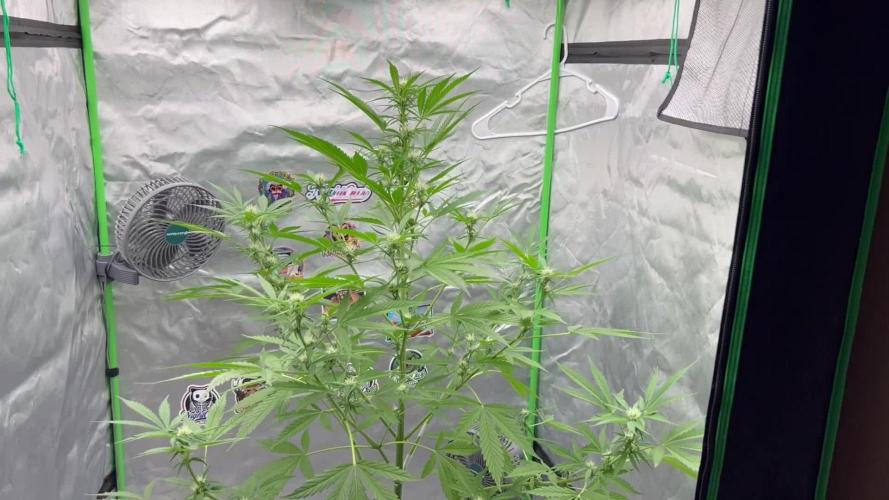

@sanibelisl
Follow
Major changes here at Night Owl summer camp. Have had a rodent problem! Something has figured out a way to get into the dormitory (greenhouse)and had a feast on my plants. Five branches off the Harvey Wallbanger, and two each off the Vanilla Fizz and the 91Grapes. Oh my gosh! I needed to do something else. My wife gave me a spare bedroom for a grow nursery! What a girl I have! So spent the day yesterday moving tents and hanging lights and got the girls all situated in the new dormitory away from some vampire in the night.
Will give an individual plant update shortly.


Likes
17
Share


@rockbo47
Follow
SUMMARY: I've stuck with the transition nutes this week to try and squeeze every last drop of veg growth I can out of her. She's very bushy and needs defoliating really though I am hesitant to as I worry it stunts her development though I have removed around 20% of her leaves that were dying or blocking bud sites and could not be tucked. There are still too many leaves and tucking daily is time consuming but I dont want to mess with her too much.
The RH of the tent is stable around 45-55% now and so I have turned the humidifier off.
DAY 37
------
Friday 29th January 15:00
I TURNED THE HUMIDIFIER OFF COMPLETELY AS RH IS AT 55-60% AT 25% POWER.
Friday 29th January 18:20
I fed Jesus 2.6L as that was the last of the transition nutes I had made and yesterdays 2L didnt cut it. This produced 920ml runoff (35%).
I think that's all her shoots popped now and so it was just a case of adjusting them today. There are 12 shoots I have tied down all reaching out to the sides of the pot evenly spaced and then theres 3 in the middle so that's a total of 15 tops that if I'm lucky and all goes well and the Gods smile upon me will all fill out into nice long colas. [23°C/57%]
DAY 38
--------
Saturday 30th January 12:00
I made 5L of transition nutes with rainwater at a pH of 5.9.
Saturday 30th January 19:00
I fed Jesus 2.2L of transition nutes which produced only 50ml runoff (2%).
Some more slight adjustments on the LST to keep the canopy as flat as possible.
Shes really showing pistils now which makes me wonder if she's actually finished her pre-flower growth spurt in which case I may have fucked up and overdone the LST...I dunno
DAY 39
--------
Sunday 31st January 18:30
I fed Jesus 2.4L of transition nutes which produced only 200ml runoff (9%) which is good as I believe she is going through her final growth spurt now and is drinking more.
I removed 2 large fan leaves that were covering the entire centre of the plant and couldnt be tucked. This has made a huge difference and opened the lower canopy up to more light.
DAY 40
--------
Monday 1st February 11:00
I made 5L of trans nutes at a pH of 6.1 and 5L of increased strength week 3 nutes (extra 0.4ml of each nute) at a pH of 6.1.
Monday 1st February 18:00
I fed Jesus 3L of transition nutes which produced 890ml runoff (30%). She is showing a lot of pistils now and I'm concerned shes finished vegging which isnt too good as I could do with a little more vertical growth. [23°C/49%]
DAY 41
--------
Tuesday 2nd February 11:40
I made 10L of transition nutes with rainwater at a pH of 6.0.
Tuesday 2nd February 18:00
I fed Jesus 3L of transition nutes which produced 800ml runoff (27%).
I lowered the odd branch. It looks like the veg growth is slowing down now. [22°C/59%]
DAY 42
--------
Wednesday 3rd February 18:30
I fed Jesus 3L of transition nutes which produced 660ml (22%). Shes a beast drinking 3L per day now.
I defoliated removing around 20% of the plants leaves, strictly removing older unhealthy ones, ones hanging over the edge that were burnt to a crisp by the heater, and then ones covering bud sites that I couldnt tuck. [23°C/54%]
DAY 43
--------
Thursday 4th February 18:00
I fed Jesus 3L of transition nutes which produced 800ml runoff (26%). I have removed a couple more leaves and ensured the bud sites are open to light. [23°C/56%]

Likes
33
Share


@Wicked_Stix
Follow
This platinum gorilla is looking pretty good. She is pretty bushy even though she got some training this week. I just flipped them to flower so should be seeing some stretch soon

Likes
14
Share


@Stork
Follow
Drying time , to bad i can't dry her in the tent because the rest are not ready yet... i will try my best to make it ideal temp for drying, so i can have the best taste 😋 I hope is sweet 😋 😊


Likes
10
Share


@UGrowGuy
Follow
02/24 Been busy. The room is wild. I have done 0 defoliation at any point. They were tied up and grew all natural. 🤦♂️🏽Big buds everywhere. Thank you for technology. The pics dont do it justice. We are getting some fade as i have completely phased out nuts, except for the bokashi/ffj to ph. The smell is insane. The color change or senescence is accelerated by the hormone Ethylene found in the ripening fruits in the bokashi/ffj mix. Although it may be abscission in this case 🤷♂️🏽 . They have some good frost. Ill get some better pice this weekend before the lights come on. Thanks for scopin.
Likes
1
Share


@dzoseph
Follow
I continued the LST and defoliated a few fan leaves that obstructed light. i bound the other stems of the plant lower to keep it a bit more down since it was growing at a rapid rate.

Likes
25
Share


@I_Identify_As_A_Dan
Follow
Week 7 for Lemon Orange by Greenhouseseedco,
End of week 7 for this cultivar, defenetely keeping 2 at 16tops then 1 at 8 tops will be interesting seeing the different on yield on those.
But do have to say for now the 8 tops is a little slower on growth compared to the other 2 but could be lack of leaf for energy.
Now just let them grow up....

Likes
86
Share


@CANNASIM
Follow
------GENERAL COMMENT------
Flush time, within the end of this week is now flush time.
To summary this week i just kept on my feeding habits, Water with base > Water with boosters, alternating Recharge.
My led seams to be crashing a bit, the colors are not stable as is possible to see in the timelapse.
Trichomes are mostly cloudy, with a slight amber. 9 weeks flowering time will be exact, just need time to flush, they are maturing fast fast, hairs are getting orange in a blink.
------GG.AK47 COMMENT------
Compared to the Blueberry the nugs are thinner, still nice size, a bit less dense, thru the stems there are many popcorn buds, that is also due to the less removal on this girl to test. Loaded with colas and the scent is very sugary too, a bit stronger than the BB, and the hairs are turning orange faster, starting to look very mature. Defoliated a bit to avoid rot, will defoliate more for this reason.

Likes
14
Share


@Terpyboyz
Follow
Alright lads 💪🏻 so we’re starting week 2 today - the girls are all having there own individual issues the joys or running multiple strains again 😂👌🏻, but we’re all looking really wellz so left side is looking a bit N def hungry still so I’ve upped the bio grow to 2ml and the right side is still showing she’s still got some nutes left from repot as shes good I’ve just left that to 1ml bio grow. All the clones are looking nice lush green, all starting to take shape now🕺 wait another 2 weeks until I start to flower them.. and see which of my keepers are as clones then take cutz off them before flowering my actual clones tent, keep the cutz in a separate tent and start popping more seeds of this next round. Either ripper seeds new limited edition or lit seeds can’t decide..😅, anyways gang cheers for stopping by until next week and we can see some bud formation happing 💪🏻
Update - end of week 2 of flowering - I’ve given them all a fair defoliation and taken a lot of lowers of to start focusing it on them tops. Still looking a bit pale lack of N but we should be okay if it seems keep progressing al just up feed to 2ml per litre. Other than that it’s going fairly smooth.


Processing
Likes
17
Share


@Mr_nugs_lover_David
Follow
She's looking stunning, super healthy and big on her 3rd week, I'll be transplanting her in no time, and once Transplanted we'll start to see how I train my plants, thank you so much everyone! Let's see what awaits us with this beautiful pheno of ak420 by seedstockers! 🌱💎🔝
