Likes
Comments
Share
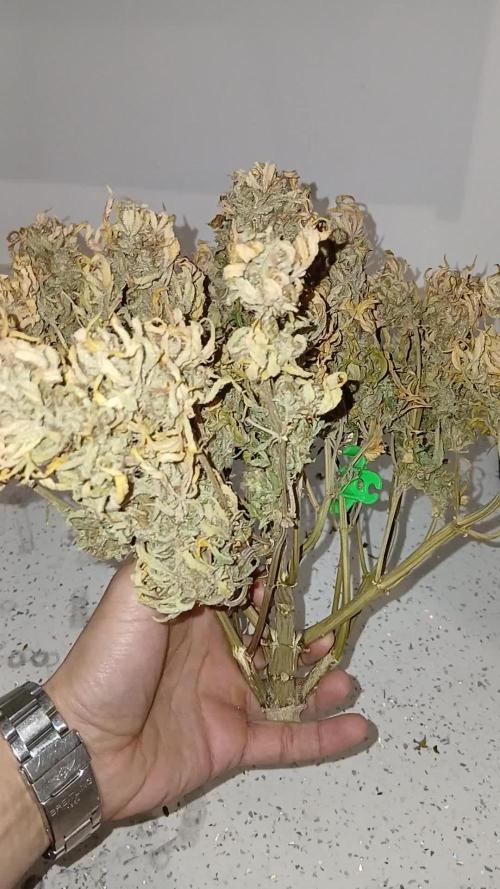
So it's basically day 66 on BK and day 58 on GG thinking about start to flush them... They look gorgeous and full of trichomes, smell still missing but I'm fine with it... Next update in week
Likes
52
Share
@MephistoGenetics, Hi all the happy people here in GrowDiaries. This is my second cultivation ever and it will be fun to try a bigger space than my closet grow. First, I'm just going to say I'm done with the construction of my new growroom. The room is 2.14 meters by 1.7 meters and has a ceiling height of 2 meters. It provides a floor area of ​​3.6 square meters. I use a 54 Watt Lightwawe T5 for germination and 2 Pcs 400 Watt HPS lamps. I have a channel fan that replaces the room air about 40 times an hour to get a comfortable environment in the room, the air enters a fresh air intake from the outside. The air is purified through a carbon filter to then leave the room to the rest of the basement. Then I use that heat to heat the rest of the basement. I will use 10 pcs 15 liter Autopots to grow with and a 100 liter water tank that supplies the pots of water and nutrition. I will grow completely organically in soil and will watercure my buds to get the best possible medicine for me. But there are no cultivation rooms to be displayed here, so I continue with what is most important. I am very excited to see how the new growroom will work and how this Stilton Special will turn out. Strain Name: Stilton Special F1 Genetic heritage - Sour Livers F3 x Northern Cheese Haze F3 Strain behaviour - Stilton grows well from the off, and develops into a stout but branchy specimine that leads to a fine yield of awesome flowers. She's not too stretchy but also is sizeable enough with good growth, to train and shape to your liking. Flowers develop pretty fast and grow to a good size, it may to advised to clear out some undergrowth and if needs be a very gentle defoliation mid-way through the grow, although leaf tucking may suffice well enough.The end product is of top shelf quality and she doesn't lack in yield either.Give your garden, nose, and body a treat and be sure to indulge in a slice of Stilton this year, You won't regret it. Size - 50 - 70 cm Structure - Medium height but bushy Flower Density - 9/10 Indica/Sativa - 65/35 Cycle Time - 65 to 70 days from sprout Yield - 90 to 140 grams as a single plant Best Method for overall high yield - 9-12 per 1,2m x 1,2m sq in 10-15 Liter pots (Soil) Aroma - Very strong, Cheesey/fruity/sour/spicey/ with a dash of coffee. Taste - Dank berries Effect - Good hybrid powerful but balanced effect Medicinal Benefits - TBA Best Grown - Indoor/Greenhouse Cannabinoids - TBA Extract information - Ideal extract candidate - High in resin, oil and terps. -------------------------------------------------------------------------------------------------- 2017-09-25. Week 5 starts. Added a video of the girls. Gave the girl water and nutrients. This girl is 24 cm high and have grown 7 cm in 7 days. I flushed the girl yesterday with 40 liters of tap water. Im lowering the humidity in the room with a dehumidifier and try to have 50% air humidity. ---------------------------------------------------------------------------------------------------------------- 2017-09-29. Installation of the New light rail in the grow room. Its Advanced star light V 5.0. Added a video of it.
Likes
34
Share
@JonnyKush
Follow
Day 38 I am very happy with how they are growing. finally begins to flourish, the LST seems to have paid off. from last week I started giving green sensation 1ml / l without adding anything else. thanks for viewing it is my first growth if you see errors comment and correct me. hit like and follow me for updates. happy day and good luck with your growth 🌱💚
Likes
17
Share
Our Permanent Marker from Zamnesia has responded very well to the application of the techniques, it has started the flowering phase very well and is preparing to prepare our gifts. ** Remember that we are growing a plant worked with the techniques indicated and another left to grow without pruning to preserve its speed; in the previous/next diary you will find the other plant of the same variety. Here we are talking about a very effective Main Lining, a bit difficult at the beginning but now very successful. Generally speaking, it is performed like this: first topping cut at the 2/3rd internode maximum, the plant is allowed to continue for another three internodes and then topping again. The lateral branches can be worked with topping again but I recommend doing it only if the plant is responding well. We are in a 100% organic configuration, the soil is recycled Promix + 1/3 fresh soil + 10% Perlite + RQS Mycorrhizae Mix (4 g in the mix, 1 g under the small fiber pot). We are fertilizing with // 1 ml/l Power Roots - 1 ml/l Pure Zym - 1 ml/l Sugar Royal - 3 ml/l Alga Bloom - 1ml/l Power Buds We sprayed 5 ml/l Vita Race Foliare once a week. For all the info https://plagron.com/ All nutrients are available from Zamnesia: https://www.zamnesia.io/it/531-growshop/476-fertilizers We always have RQS's excellent mycorrhizae running through the soil. https://www.zamnesia.io/5778-mix-micorrhiza-easy-roots.html Try this variety, it is a top strain of recent years very high level of thc ---- // https://www.zamnesia.io/it/12508-zamnesia-seeds-permanent-marker.html Brief description of Zamnesia // Here is a good opportunity to enrich your genetic library with another award-winning variety: Permanent Marker was crowned Strain of the Year 2023 by Leafly, thanks to its intense aromas, high levels of THC and its physical vivacity. Originally created by JBeezy and Seed Junky Genetics, our team managed to secure a cutting of this modern top cultivar, so you can grow it comfortably at home, whether indoors, outdoors or in a greenhouse. Permanent Marker fits perfectly in any environment! The whole world of growing and more is at Zamnesia: just take a look at the site and you will find "all the best that nature has to offer" in various shapes and colors. -- // www.zamnesia.com
Likes
9
Share
@420Guru
Follow
Iv added the Coco Coir Pellets into my net cups and covered them with clay pebbles. 1 layer of clay pebbles under the Coco Coir Pellets first.
Likes
19
Share
@Zeno63
Follow
Der Grow ist nun durch , bin mit dem gesamten Verlauf sehr zufrieden. Es gab nie Probleme, alles lief nach Plan. Es wurde kein großes Entlauben, noch Topping oder sonstiges gemacht, lediglich die großen Blätter wurden entfernt. Gesamtgenommen , würde ich es wieder so machen, es war einfach ein ruhiger entspannter Grow. Die Lampe von Greenception, der Dünger von Biotabs, und auch der Blumat, funktionierten super in einer Symbiose zusammen. Auch wenn das Ergebnis nicht riesig ist, ist es wie in der Vorwoche bereits erwähnt für mich absolut in Ordnung. Da ich nicht viel benötige und es mehr ein Hobby ist . Die gesamte Lichtleistung habe ich durch 3 geteilt, es sind schließlich 3 Pflanzen im Zelt, damit man ein korrektes Ergebnis erhält. Ich danke für die Free Seeds @SuperSativaSeedsClub, und kann Sie bedenkenlos weiterempfehlen. Rauch und Endergebnis werde ich selbstverständlich nachliefern. Das Nassgewicht beträgt 145gramm ------------------------------------------------------------------------------------------------------------------------------------------------------------------------------------------------- The grow is now finished, and I am very satisfied with the entire process. There were never any problems; everything went according to plan. No major defoliation, topping, or other interventions were done; only the large leaves were removed. Overall, I would do it the same way again, as it was simply a calm and relaxed grow. The lamp from Greenception, the fertilizer from Biotabs, and the Blumat system worked perfectly together in symbiosis. Even though the result isn't huge, as I mentioned last week, it's absolutely fine for me. I don't need much, and it's more of a hobby. I divided the total light output by 3, as there are 3 plants in the tent, to get an accurate result. I thank SuperSativaSeedsClub for the free seeds and can recommend them without hesitation. I will, of course, provide updates on the smoke and final results. The wet weight is 145 grams. Die letzte Woche lief ebenfalls alles glatt. Habe das Wasser runter gedreht, und die Pflanze von ihren Resten zehren lassen . Bin sehr zufrieden, und bedanke mich bei SSSC für die gesponserten Samen.
Likes
46
Share
@Capo420
Follow
Awesome Week💚 Following some great discussions with more experienced growers, I really think we got things back on track! 🙏 To those Growmies I really raised the ppm this week we topped out around 630 PPM This was in an attempt to balance out some nutrition issues. I think the ladies have responded very well. 😃🌱💪 Raised the light up to 24in as well a few days later after seeing positive changes due to feeding regiment. Started preflowering, showing pistols on all plants. Counting down these last 7-8 weeks when the ladies beauty comes out 🤩 Will update throughout the week with photos and videos. Happy Growing! 🤙💚💪🌱😎🌱💪💚🤙
Likes
23
Share
Primeras semanas de flores.passaggio da 18/6 a 12/12 .adesso care piante sacre mie, ora datemi dei bei fiori per la mia terapia ...Om namah shivaya 🙏
Processing
Likes
6
Share
@russrahl
Follow
Beginning of week 4 in flowering and everything is coming along quite nicely. plants are loving there Remo nutes! just switched this tent over to a self watering drip system cause it was getting to be a real pain watering these girls by hand. Their siting in 7 gallon fabric pots and boy do they drink a mad amount of water/nutes! the pots are just packed with roots! really loving the Remo lineup of nutes so far! go Remo! Go Sports! Buds are starting to form nicely! Started to open up the bud sites a bit by tucking what i could but had to snip a few leaves up top to open a few lower sites up trying to get through.
Likes
27
Share
4/1/2023 Week 7- Day 1 of Veg (Day 59 overall) Water Change Day!!! Water was really low it was just above the hump in the Res cutting it close to not having enough water in the system to keep it going. They drank a lot making it close going the full 14 days. I am still going with the previous grows and adding 36 Gallons but even looking at the root I think the SILICA is working and the roots are further along at this point than in previous grows. This next two weeks will watch how much they drink and how low my Res starts getting, and will make a decision on changing the water weekly from here on out or still keep on the plan of every other week until Week 4 of Flower. Added 36 Gallons Mammoth SILICA= .5Mil/Gal = 18Mil CALMAG= .5Mil/Gal = 18Mil Root Drip= 1Mil/Gal = 36Mil FloraMicro = 5.4Mil/Gal = 194Mil FloraGrow = 4.2Mil/Gal = 151Mil FloraBloom = 4.6Mil/Gal = 166Mil ORCA = .5Mil/Gal =18Mil PPM= 536 PH=5.84 PPFD=500 Tent Temp= 76.5 Water Temp= 71.4 Humidity= 58% 4/2/2023 Week 7- Day 2 of Veg (Day 60 overall) Not much today, PH was at 5.81, I brought that back up to 5.90. I took care of some badly needed defoliation in each of the back sides .. I was able to see some really good clone material to use on the lower backside of each of the plants. I will be taking two clones from each to breed over the next few weeks depending on when I am going to flip them. 4/3/2023 Week 7- Day 3 of Veg (Day 61 overall) A little FIMing, A little Topping, and a Little bit of defoliation. Might have to take my clones during the week this week, I am trying to wait until Saturday to hit week 8 but again they are getting all over the place and I need to trim some of the sides and lower areas. 4/4/2023 Week 7- Day 4 of Veg (Day 62 overall) I decided to take my clones and clean up the lower half of the plants. I took 2 clones from each plant to go into the cloning machine. 4/5/2023 Week 7- Day 5 of Veg (Day 63 overall) Water Temp is sitting at 73. Right in my ideal range for my setup. Ideal range 70-74 My Temp Tent is my ideal zone75.6 Ideal for this grow 70-78 The lights are still waiting the switch to flower to get maxed out... The Humidity is coming in right at 60% I love it.. I took so much off yesterday I figure it was a good day to let them rest. 4/6/2023 Week 7- Day 6 of Veg (Day 64 overall) I needed to Defoliate some and I topped a little. The plants might force me to flip them soon. Next Wed is the 10 week mark half way through the 20 weeks. The net is Bingo... Which means that If/when the plants hit the net I will have to flip them. The Net is set to the max height that I can let them get based on the Breeders Stretch report 75%. 4/7/2023 Week 7- Day 7 of Veg (Day 65 overall) #3 is 22 inches Tall, #2 is 19 Inches Tall. Net is set at 24 inches. Net is also set as my Bingo point, if they hit the net then I have to flip no matter what to account for the Breeders recommended 75% Stretch allowance. I think I am going to have to flip right at the 10 week mark of the Competition which is Wed 12 Apr. I topped a little, I de-foliated a lot to start getting it ready for the anticipated Flip.
Likes
20
Share
Flower Week 7 Day 49 to 55 - 5/6 to 5/12 They both look very healthy this week. The calyx are swelling with maturing hairs, the pistols are orange, the trichomes are mostly white, and the leaves are fading/changing colors - still not ripe enough for me, but flushing with half nute feeds now. Feed this week was another auto pot reservoir flush feed at 400ppm total before add-ins. I used 400ppm of Bloom concentrate mix (recipe week 5). And then, I also added 1ml/gal of CaliMagic (General Hydroponics 1-0-0). PH balance this week was for 5.8 where I plan to maintain it until harvest. Next week will continue the same half nute feed. I will continue to monitor the signs of trichomes, pistols, and calyx for a better harvest and allow the buds to mature more.
Likes
52
Share
Lacewings seemed to have mostly killed themselves by flying into hot light fixtures. I may have left the UV on which was smart of me :) Done very little to combat if anything but make a sea of carcasses, on the bright side its good nutrition for the soil. Made a concoction of ethanol 70%, equal parts water, and cayenne pepper with a couple of squirts of dish soap. Took around an hour of good scrubbing the entire canopy. Worked a lot more effectively and way cheaper. Scorched earth right now, but it seems to have wiped them out almost entirely very pleased. Attempted a "Fudge I Missed" for the topping. So just time to wait and see how it goes. Question? If I attached a plant to two separate pots but it was connected by rootzone, one has a pH of 7.5 ish the other has 4.5. Would the Intelligence of the plant able to dictate each pot separately to uptake the nutrients best suited to pH or would it still try to draw nitrogen from a pot with a pH where nitrogen struggles to uptake? Food for stoner thought experiments! Another was on my mind. What happens when a plant gets too much light? Well, it burns and curls up leaves. That's the heat radiation, let's remove excess heat, now what? I've always read it's just bad, or not good, but when I look for an explanation on a deeper level it's just bad and you shouldn't do it. So I did. How much can a cannabis plant absorb, 40 moles in a day, ok I'll give it 60 moles. 80 nothing bad ever happened. The answer, finally. Oh great........more questions........ Reactive oxygen species (ROS) are molecules capable of independent existence, containing at least one oxygen atom and one or more unpaired electrons. "Sunlight is the essential source of energy for most photosynthetic organisms, yet sunlight in excess of the organism’s photosynthetic capacity can generate reactive oxygen species (ROS) that lead to cellular damage. To avoid damage, plants respond to high light (HL) by activating photophysical pathways that safely convert excess energy to heat, which is known as nonphotochemical quenching (NPQ) (Rochaix, 2014). While NPQ allows for healthy growth, it also limits the overall photosynthetic efficiency under many conditions. If NPQ were optimized for biomass, yields would improve dramatically, potentially by up to 30% (Kromdijk et al., 2016; Zhu et al., 2010). However, critical information to guide optimization is still lacking, including the molecular origin of NPQ and the mechanism of regulation." What I found most interesting was research pointing out that pH is linked to this defense mechanism. The organism can better facilitate "quenching" when oversaturated with light in a low pH. Now I Know during photosynthesis plants naturally produce exudates (chemicals that are secreted through their roots). Do they have the ability to alter pH themselves using these excretions? Or is that done by the beneficial bacteria? If I can prevent reactive oxygen species from causing damage by "too much light". The extra water needed to keep this level of burn cooled though, I must learn to crawl before I can run. Reactive oxygen species (ROS) are key signaling molecules that enable cells to rapidly respond to different stimuli. In plants, ROS plays a crucial role in abiotic and biotic stress sensing, integration of different environmental signals, and activation of stress-response networks, thus contributing to the establishment of defense mechanisms and plant resilience. Recent advances in the study of ROS signaling in plants include the identification of ROS receptors and key regulatory hubs that connect ROS signaling with other important stress-response signal transduction pathways and hormones, as well as new roles for ROS in organelle-to-organelle and cell-to-cell signaling. Our understanding of how ROS are regulated in cells by balancing production, scavenging, and transport has also increased. In this Review, we discuss these promising developments and how they might be used to increase plant resilience to environmental stress. Temperature stress is one of the major abiotic stresses that adversely affect agricultural productivity worldwide. Temperatures beyond a plant's physiological optimum can trigger significant physiological and biochemical perturbations, reducing plant growth and tolerance to stress. Improving a plant's tolerance to these temperature fluctuations requires a deep understanding of its responses to environmental change. To adapt to temperature fluctuations, plants tailor their acclimatory signal transduction events, specifically, cellular redox state, that are governed by plant hormones, reactive oxygen species (ROS) regulatory systems, and other molecular components. The role of ROS in plants as important signaling molecules during stress acclimation has recently been established. Here, hormone-triggered ROS produced by NADPH oxidases, feedback regulation, and integrated signaling events during temperature stress activate stress-response pathways and induce acclimation or defense mechanisms. At the other extreme, excess ROS accumulation, following temperature-induced oxidative stress, can have negative consequences on plant growth and stress acclimation. The excessive ROS is regulated by the ROS scavenging system, which subsequently promotes plant tolerance. All these signaling events, including crosstalk between hormones and ROS, modify the plant's transcriptomic, metabolomic, and biochemical states and promote plant acclimation, tolerance, and survival. Here, we provide a comprehensive review of the ROS, hormones, and their joint role in shaping a plant's responses to high and low temperatures, and we conclude by outlining hormone/ROS-regulated plant-responsive strategies for developing stress-tolerant crops to combat temperature changes. Onward upward for now. Next! Adenosine triphosphate (ATP) is an energy-carrying molecule known as "the energy currency of life" or "the fuel of life," because it's the universal energy source for all living cells.1 Every living organism consists of cells that rely on ATP for their energy needs. ATP is made by converting the food we eat into energy. It's an essential building block for all life forms. Without ATP, cells wouldn't have the fuel or power to perform functions necessary to stay alive, and they would eventually die. All forms of life rely on ATP to do the things they must do to survive.2 ATP is made of a nitrogen base (adenine) and a sugar molecule (ribose), which create adenosine, plus three phosphate molecules. If adenosine only has one phosphate molecule, it’s called adenosine monophosphate (AMP). If it has two phosphates, it’s called adenosine diphosphate (ADP). Although adenosine is a fundamental part of ATP, when it comes to providing energy to a cell and fueling cellular processes, the phosphate molecules are what really matter. The most energy-loaded composition for adenosine is ATP, which has three phosphates.3 ATP was first discovered in the 1920s. In 1929, Karl Lohmann—a German chemist studying muscle contractions—isolated what we now call adenosine triphosphate in a laboratory. At the time, Lohmann called ATP by a different name. It wasn't until a decade later, in 1939, that Nobel Prize–-winner Fritz Lipmann established that ATP is the universal carrier of energy in all living cells and coined the term "energy-rich phosphate bonds."45 Lipmann focused on phosphate bonds as the key to ATP being the universal energy source for all living cells, because adenosine triphosphate releases energy when one of its three phosphate bonds breaks off to form ADP. ATP is a high-energy molecule with three phosphate bonds; ADP is low-energy with only two phosphate bonds. The Twos and Threes of ATP and ADP Adenosine triphosphate (ATP) becomes adenosine diphosphate (ADP) when one of its three phosphate molecules breaks free and releases energy (“tri” means “three,” while “di” means “two”). Conversely, ADP becomes ATP when a phosphate molecule is added. As part of an ongoing energy cycle, ADP is constantly recycled back into ATP.3 Much like a rechargeable battery with a fluctuating state of charge, ATP represents a fully charged battery, and ADP represents a "low-power mode." Every time a fully charged ATP molecule loses a phosphate bond, it becomes ADP; energy is released via the process of ATP becoming ADP. On the flip side, when a phosphate bond is added, ADP becomes ATP. When ADP becomes ATP, what was previously a low-charged energy adenosine molecule (ADP) becomes fully charged ATP. This energy-creation and energy-depletion cycle happens time and time again, much like your smartphone battery can be recharged countless times during its lifespan. The human body uses molecules held in the fats, proteins, and carbohydrates we eat or drink as sources of energy to make ATP. This happens through a process called hydrolysis . After food is digested, it's synthesized into glucose, which is a form of sugar. Glucose is the main source of fuel that our cells' mitochondria use to convert caloric energy from food into ATP, which is an energy form that can be used by cells. ATP is made via a process called cellular respiration that occurs in the mitochondria of a cell. Mitochondria are tiny subunits within a cell that specialize in extracting energy from the foods we eat and converting it into ATP. Mitochondria can convert glucose into ATP via two different types of cellular respiration: Aerobic (with oxygen) Anaerobic (without oxygen) Aerobic cellular respiration transforms glucose into ATP in a three-step process, as follows: Step 1: Glycolysis Step 2: The Krebs cycle (also called the citric acid cycle) Step 3: Electron transport chain During glycolysis, glucose (i.e., sugar) from food sources is broken down into pyruvate molecules. This is followed by the Krebs cycle, which is an aerobic process that uses oxygen to finish breaking down sugar and harnesses energy into electron carriers that fuel the synthesis of ATP. Lastly, the electron transport chain (ETC) pumps positively charged protons that drive ATP production throughout the mitochondria’s inner membrane.2 ATP can also be produced without oxygen (i.e., anaerobic), which is something plants, algae, and some bacteria do by converting the energy held in sunlight into energy that can be used by a cell via photosynthesis. Anaerobic exercise means that your body is working out "without oxygen." Anaerobic glycolysis occurs in human cells when there isn't enough oxygen available during an anaerobic workout. If no oxygen is present during cellular respiration, pyruvate can't enter the Krebs cycle and is oxidized into lactic acid. In the absence of oxygen, lactic acid fermentation makes ATP anaerobically. The burning sensation you feel in your muscles when you're huffing and puffing during anaerobic high-intensity interval training (HIIT) that maxes out your aerobic capacity or during a strenuous weight-lifting workout is lactic acid, which is used to make ATP via anaerobic glycolysis. During aerobic exercise, mitochondria have enough oxygen to make ATP aerobically. However, when you're out of breath and your cells don’t have enough oxygen to perform cellular respiration aerobically, the process can still happen anaerobically, but it creates a temporary burning sensation in your skeletal muscles. Why ATP Is So Important? ATP is essential for life and makes it possible for us to do the things we do. Without ATP, cells wouldn't be able to use the energy held in food to fuel cellular processes, and an organism couldn't stay alive. As a real-world example, when a car runs out of gas and is parked on the side of the road, the only thing that will make the car drivable again is putting some gasoline back in the tank. For all living cells, ATP is like the gas in a car's fuel tank. Without ATP, cells wouldn't have a source of usable energy, and the organism would die. Eating a well-balanced diet and staying hydrated should give your body all the resources it needs to produce plenty of ATP. Although some athletes may slightly improve their performance by taking supplements or ergonomic aids designed to increase ATP production, it's debatable that oral adenosine triphosphate supplementation actually increases energy. An average cell in the human body uses about 10 million ATP molecules per second and can recycle all of its ATP in less than a minute. Over 24 hours, the human body turns over its weight in ATP. You can last weeks without food. You can last days without water. You can last minutes without oxygen. You can last 16 seconds at most without ATP. Food amounts to one-third of ATP production within the human body.
Likes
3
Share
@PapaTerps
Follow
ZkyzcraperZ - N.Y.Ceeds Day 62 🚿 She has been watered with 2L of RO tap water, mixed with the defined nutrients and then finally pH'd to 6.5👌🏻This week, I increased her bloom nutrients and reduced the BioGrow nutrients as she is just about to finish up her stretch 👍🏻 🌸 She has also stretched really well and her flower sites have been developed to a point where they are now clearly defined on the plant, she has a really nice structure with good internodal spacing and strong stems! Over the next few days she will finish up her stretch phase and then switch her focus over to bulking her flower 🙌🏻 ✂️ No work on her just yet, as she is still in stretch, but in a few days, I will defoliate and lollipop her, with a goal to improve light penetration and airflow and to remove any budsites that are too far from the light 👍🏻
Processing
Likes
1
Share
Steady week, all the girls seem to just keep getting bigger and bigger! Defoliated which I forgot to take pictures of however, they literally replaced the foliage in days! I Have a slight worry about one of the GG as she seems to be carrying on vegging with no real signs of flowering, just stretching more each day!? This seems strange as the Stardawgs look like they could be ready for flush in the coming weeks.. I am only a newbie so maybe i'm just been a little paranoid!? Either way She's absolutely massive!! Got the Dawgs out for a little photoshoot!
Likes
22
Share
1/25/2024 Vegetation Week 3 Day 1- took 2 Tops today and cleaned up a few lower leaves that were hanging down. The FiM seems to have worked well and looks like I have three branches coming in where it was FiMed. 1/26/2024 Vegetation Week 3 Day 2- took 2 Tops from the sides and took a little of the foliage that was touching the lid. She seems to be doing very well.. Water change day tomorrow.. YAY!! will get a good picture of the roots and see how she is doing. 1/27/2024 Vegetation Week 3 Day 3- Water Change Day! I noticed a slight red coming in on the STEMS which I added a pinch of EPSOM salt to help correct. I added 36 Gallons of Water I added the following Nutes: Silica = .5Mil/Gal= 18Mil CalMag= .75Mil/Gal= 27Mil FloraMicro = 4.2Mil/Gal= 187Mil FloraGro= 3.8Mil/Gal= 137Mil FLoraBloom= 3.0Mil/Gal= 108Mil ORCA = .5Mil/Gal= 18Mil EPSOM- 1 big pinch 1/28/2024 Vegetation Week 3 Day 4- I cleaned her up just a little bit on stuff hanging down. I also made sure the PH is balanced so she could soak up the New Nutes. 1/29/2024 Vegetation Week 3 Day 5- I Got sick, Possibly food poisoned.. Luckily for me the system was able to do what it do and hold it down until I was feeling better. 1/30/2024 Vegetation Week 3 Day 6- I was still to sick to go to my grow room... Possibly food poisoned.. Luckily for me the system was able to do what it do and hold it down until I was feeling better. 1/31/2024 Vegetation Week 3 Day 7- First day back.. Her PH was down to 5.72 so I raised the PH back up closer to 6.0, I took a few pictures and got her height.. Feeling better through prayer so was able to get some pics today.
Likes
12
Share
@DrShotzUK
Follow
All round great strain to grow , responds well to lolly popping technique , produced around 8/9 good main colas ,, covered in resinous terps with a strong earthy smell … I cannot wait to try this one she’s a beautifull looking plant DRSHOTZUK🍀🍀💚💚
Likes
20
Share
Hard to grow in my case, but the results are worth it. Nice trichome production, on the buds as well as on the sugar leaves. I didn't expect much quality with all the problem she had but she turned out beautifully. 227g total from 1 plant tested at 24% THC and <2% CBD 3.02g of kief from the trim
Likes
13
Share
@Nicoweed
Follow
The creamatic and the gorilla are in 100% in flowering phase the northern light seem at 3/4 of her strecht I didn't water them Day 47 they was still full now they eating fast I discover some burn fan leave (the first one do i have to worry) I will watch them close this happen on the gorilla and creamatic maybe some phosphorus defiency , i will maybe consider flushing them
Likes
8
Share
@draco38
Follow
Settimane 10 di fioritura iniziata e hanno un profumo buonissimo e forte, a fine di questa settimana vedrò se raccogliere o aspettare un’altra settimana poiché i fiori in basso non sono ancora abbastanza maturi. Questa è la mia prima esperienza e so di aver commesso errori ma le piante hanno comunque resistito. Avrei bisogno di qualche consiglio per capire se dopo questa settimana devo raccogliere oppure no. Ciao a tutti