




Likes
3
Share


@lalee
Follow
amnesia autoflower is the best strain. I and my friends love this strain. amnesia plant was very strong and beautiful and got much THC and have less smell. I think amnesia is best for indoors and I love amnesia

Processing
Likes
58
Share


@Hilkes_Herbs
Follow
Alright and welcome to week 4, day 22. As you can see something is wrong. I think it's some Mag that is missing so I added some MagO 10 and I hope the problems will go away. If you guys think it is something different, leave a comment and we can discuss this 😎 I raised the water to 1.2 liters a day.
I also wondered how this could happen. Everything is okay at the measurements so how does this occur?
Day 23: The problems are still there but it seems they grew a bit overnight. I added Calcium today because some of you guys tell me it's Calcium deficiency. Well let's check back tomorrow. And wish me good luck! 😁
Day 24: Alright, I suck. I measured the runoff from plant 1 and it was way too high. Just like me sometimes (I forgot to take a picture of plant 4 today, have no clue how that shit happened. Yes I can count to 4 👽). What you guys thinking about EC 3.25 ph 5.9 @ the runoff? I don't think that's good so I lowered the EC in the tank by putting in fresh water.
How did it come this far? Well, I probably did not give enough water. Meaning it was enough for the plants, yes, but there was no or not enough runoff. So the salts (fertilizer) came to EC 3.25 in the substrate.
I'm "flushing" now with EC 1.25 and will check back tomorrow how the runoff will be.
When I measured the runoff from all 4 plants together EC was 2.1 - which is only a little too high, I am trying to reach 1.6 - 1.8 . Let's check back tomorrow. For forgetting the picture of plant 4 today, I made a video.
Day 25: The flushing was good. The plants look healthier again and the runoff is only 1.7 now. EC in the water tank is 1.35, ph 5.5. Also I removed some of the downer leafes. And I created this SCRoG net. So I just have to give them more water each day. So much there's about 20% runoff but I don't think I can measure or calculate 20% runoff. So I'll do it by feeling. Seems to work for now.
Day 26: Looks like the plants are okay again. I only checked the ph and EC which were good.
Day 27: The plants grow against the net. Also there are some waterdrops on the leafes which means that there is not enough air rotating inside the box. Have to check the airflow tomorrow.
Day 28: Last day of vegetation. Just ph'ed down a bit.

Likes
2
Share


@High_Grade_Dadli
Follow
So far so good transplant to a 15 gal...good thing I didn't wait till nxt week...top soil sink to the bottom and was hand for the roots to get tru


Likes
4
Share

@Grow_for_Happiness
Follow
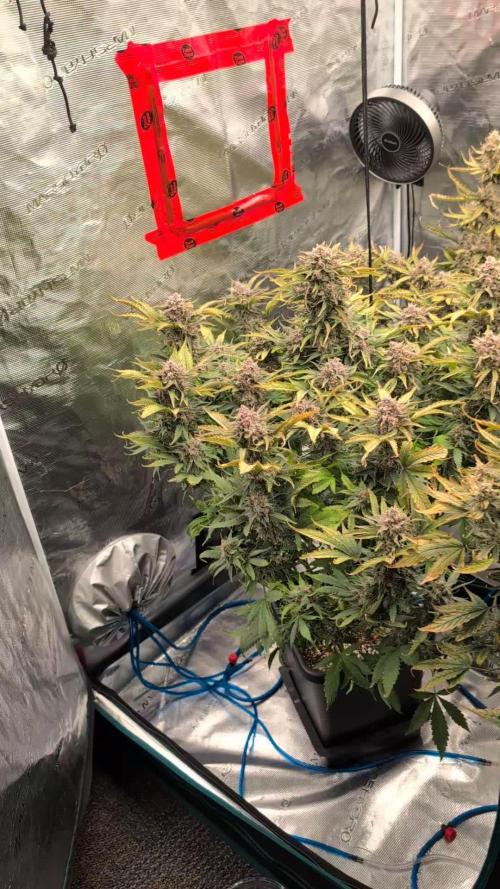
Here we are end of week 9 and this girl is coming right along. Buds have swelled up and are showing some nice colours. Buds got big enough that one of the lower branches broke right at the stalk. No big deal, happens sometimes with no support. A quick garden tie and she's all fixed. Guess no more moving this one around until harvest if I can help it. Speaking of harvest, I would say two weeks at the most, probably closer to 10 days. Trichomes are 70/30 cloudy/clear, with no visible deterioration and no reds. Nice and sticky buds with a stanky fruity smell.
Did give her a small defoliation mid week, just removing and dried/crispy but nothing major. Just removing stuff not producing energy while trying to minimize any shock so she can finish smoothly.

Likes
3
Share


@Jp_tetreault
Follow
The buds are beginning to show, I'm excited for the upcoming weeks.
Next week I will place a plant net, that way more lights might come through.

Likes
38
Share


@kijani
Follow
another uneventful week. the girl is still creating nodes like crazy ... she is growing sideways rather than rushing for the lights. i raised the lights higher to about 12" from the top of the leaves.
i also changed the nutrients from a seedling recipe to an early growth stage recipe that is richer in nitrogen with a higher ec 1.2. i also got to see the roots for the first time, they are looking really nice - white and fuzzy. i made the main nutrient tank more permanent and relocated the used nutrient and fresh nutrient tanks in their own chamber so, it's even easier to do manual nutrient changes (1 container in and 1 container out sort thing). later on, in the week, i noticed the main roots showing a little discoloration, not sure if i should be concerned about this, but she looks healthy.. it was fun using the doser again as i really hate mixing chem's since my days in chemistry labs. looking forward to new aggressive growth this week.
Likes
31
Share


@The_Doctor_Green
Follow
4ta semana de floracion,con un crecimiento notorio en los cogollos,( ya la planta ha dejado de crecer en "altura" para empezar a dedicarse a inflar los cogollos).
El deterioro de las puntas de las hojas no avanzo, gracias a que baje el ph del agua de 6.5..a 6.1,en la semana siguiente le bajare la base de Grow de 3ml a 1ml ,para quitarle el posible exceso de nitrógeno, veremos que sucede con estos cambios,faltan muchas semanas por delante pero creo que va por buen camino.

Likes
65
Share


@Visions
Follow
Wanted to give a shout out to everyone that helped my first growing experience. I believe I have learned so much from all 3 growing experiences especially as a first timer. Good genetics are where the REAL dank comes from. Barneys Farm did not disappoint. These buds grew so smooth I felt like a master grower. I believe this strain could get even bigger results with the right training. I will definitely grow this strain again in 3 gallon pots with lots of HST. With minor training she turned out pretty swell.
The Grow: Growing this strain as I mentioned is practically a damn joke. She responded so well to growing in a solo cup(weeks1-3) that I practically gave her a few ml of water out of a dropper every other day and sometimes 3 days without water. As she grew, I gave some minor training, topped them, and tucked some leaves. I believe with the right training and an extended training regiment in the vegetation cycle for this strain, you could kill yields with this frosty/fast flowering strain. Any defencies I had were quickly cleared with cal-mag. She never actually ran into any problems besides some light burn due to the LEDs being too close in super late flowering. As she grew, her leaves looked more vibrant each day. Her buds simply swelled over time and became so frosty that I have no idea what I am in store for.... She got a good scent around week 3 in flowering and every week after that became more dank smelling each day. She smells like nuts, citrus, skunk, and lemon zest. I believe this strain is a hit when it comes to growing. Overall I'd give her a 10/10 out of any strain I've grown for now. She responds well to any training, nutes, and transplants. This is by far a strong resistant strain. She smells good, grows strongly/quickly, and hopefully the smoke is as good as she smells or eventually tastes. The phantom og is an easy growing strain as I've mentioned several times. I want to also try a better nutrient line(fox farm)for increased results. Not downing the ole OG fox but there is a new line of nutes now days. Until next go on these girls🤘🤤😎
The Dry: These buds are 1 to 2 inches thick. Nice and dense. I love the aroma of citrus and hops they give off. We are currently on day 2 of drying and I can tell yah, these buds smell NOTHING like chlorophyll. This strain is super powerful with terpenes. I believe the cure is gonna give a knock out smell, that's how strong it is. As she is drying, I am drying her at 66 degrees which is nice and cool, a small USB fan at the bottom of the tent. The fan was pointed outwards for the first 2 days. Now going to have it blowing more inwards to the wall to give a little less airflow for 1 to 2 more days the rotate back for a finish on the dry. So far the drying is turning out really pleasant and easy. Day 4 of drying and the outside of the buds are starting to crispn up. Another 2 or 3 days and she should be fully dried. We are now dried and jarred. They are crispy on the outside and the smaller stems snap. They will continue drying as we burp the first couple of days. Ended up taking the buds down at 5 days. Ended up being perfect for these dense nugs!
The Cure: We are idk how many days into the cure. Probably 3 to 4. My roommate and me are taking a smoke now. She weighed at 2 oz give or take. Not the biggest outcome but total harvest between 5 plants all together that includes GD not included, 7 oz which I cant complain. Learning that bigger yields will come from better training. I did however get the sticky icky/trichome regiment down on this girl. I will post more pictures once I get to 2 weeks into the cure. I will say her buds are so good damn sticky. Excuse my language haha but let's be honest, this shit is dried and being rotated/cured and it's what I'd call the sticky shit you'd wish you'd had. 10/10 on quality bud Barney! 🤘 curing is still going well. Very sticky buds as I mentioned earlier. We are weeks or close enough to say these buds have cured up nicely. They have mainted an easy 61 to 62 rh after the first burp. I really over thought this and now its time to perfect the process! The buds turned into hard dense fluffy nugs.( no commas needed).
The Smoke: When you smoke this strain, you feel an earthy taste that initially hits your throat with a hint of diesel on your tongue. Other flavors include berry and nuts which are very prominent in the smoke. The high hits you with a very dry mouth and a slight blur to your eyes. You get a sense of relaxation and happiness with short giggles every now and then. We loaded a huge kied bowl from some of the bowls ard my roommate and I were absolutely blazed. I smoked both phenos and the one phenos that frosted more than she fattened, really knocked me on my ass. 9/10 for a delicious smoke and potent high. The high is perfect for regular smokers especially when you want to change it up. The smells is also amazing in the jar with that nutty, berry, and diesel undertone. As the high hits you with all it's great effects, it hits with a moderate body buzz and strong head high. You'll notice that you cant speak full sentences all the time or you blank out and forget things. Phantom Og is a great evening smoke because once you let the high start climbing down, you start the feel the sandman on your eyes. The highs greatest focal point is the sense of focus. I AM NEO. You may not be able to dodge a bullet but you will kill some time lol. As long as you keep puffing however, you'll always be in a wonderful state of mind. 👽🤞👌
Ups and downs: The ups and down with this grow really derive from my own techniques or any issues or "ups" I had during the grow. Genetically speaking, I had two different phenos of phantom og. The 3 gal fattened much quicker and showed a significant amount of frost while the 1 gal pheno showed double the frost but not as fat of buds. I dont believe this to be a pot size difference obviously. This wasnt a problem but instead I was able to try two different phenos/potency levels based on the new amount of trichomes on the smaller gal. The strain grew extremely well even with higher heat levels and even lower humidity levels during the grow. I never noticed defencies throughout the grow besides the fast amount of water these girls can drink! Make sure you feed these girls nutes in week 3 or 4 or at LEAST start. You'll noticed rapid nitrogen defencies later in growth or any other common decency if you dont start the nute regiment early. I used lst as it shows in the diary. I didnt do much besides topping and pulling some branches but I did learn she responds well to hst. During the veg. Period, I accidentally snapped two branches off each node. Just enough to snap the skin. She recovered quickly without any help(duck tape included) and in return you could see bigger bud growth on the affected branches VS. The branches that were not affected. Phantom Og also produces moderate size buds and can create heavy yields with this training method. This was one of my only downfalls but this grow was for experience. I want to thank everyone for tuning in to my grow. The bud as I said is great for experienced smokers with thc levels of 18% to 24% and a flavor out of this world. After a full report, I will be updating this strain to 9/10. Thanks for looking 💨🤘
UPDATE* 12/9/19 MY FIRST, growing experience won 3rd place in the November 2019 Newbie of the month contest. Thanks everyone that followed and liked 🙏 2020 is going to be a beast🤘
UPDATE* Nebula of @growweedeasy has featured this diary in the 2019 Edition article on growweedeasy.com Thanks everyone for the support☺️

Processing
Likes
14
Share


@Irishvirus
Follow
Switched her to 12/12. I trimmed away some of the growth I deemed not worthy. She's got amazing roots and is already starting to grow a lot every day.
Processing
Likes
15
Share


@eldruida_lamota
Follow
Que pasa familia, como podéis comprobar tienen un pequeño exceso de nutrientes, algunas hojas doblan hacia abajo, no obstante , esta variedad está empezando apestar con un olor bastante peculiar.
Es una variedad que como te descuides también crece bastante, controlamos los parámetros de la temperatura y la humedad en lo establecido, 0 problemas en ese aspecto.
Veremos cómo reaccionas esta próxima semana al overdrive y si notamos ya las diferencias.

Likes
36
Share


@brownbae420
Follow
Day 94
- Trimmed burnt leaves off
- Watered
- Pistils apparent
- Vibe: 😘
Day 96 - Happy 4/20
- Turned lights off
- Dark cycle for 24h
- Vibe: 😍
Day 97
- Chop Chop
- Smelling and looking gorgeous
- Cryo Freeze
- Vibe: 😎
"What we plant in the soil of contemplation, we shall reap in the harvest of action." —Maybe the Bible, or Something

Likes
11
Share


@Dabmastafluxx
Follow
Things are coming along great, iv done a few autos before but never a bunch like this. So far just ph'd water and hi brix mollasses to feed the microbes in the soil. I also do a little dash of the npk grow just to make sure they have what they need :D (video is 5 days after pics)


Likes
9
Share


@SnoopyShaggy
Follow
The purple punch which suffered light stretch is yellowing, the stems are thin comparing to the other purple punch. What surprises me is the fact the yellowing plant forming colorful purple colors
I cant wait to see the bud formation because this 2 grows are fully organic.
Likes
47
Share


@Ultraviolet
Follow
New week. 55-65 DLi.
Development seems a little slow, which can be good or bad. Probably give her a PK boost later in the week.
The dodecahedron is the only Platonic solid that has infinite numerical pathways.
Likes
45
Share


@BodyByVio
Follow
Beautiful flower full of trichomes. Smell and test fantastic. Very fast flowering. She was done on day 49 but I cut her down few days later.
I love the strain, the only thing that I will like this strain to have is a better yield. Beast quality buds I ever grew.

Likes
13
Share


@GrandmasBoy2021
Follow
Week 14,
Week 14 was the last week before Harvest/Havrest! I flushed the plant and trimmed her a bit before harvest. I hope you all enjoy the videos and the pics!
Likes
4
Share


@Nutrient_gro
Follow
Growing this gelato 41 bx feminized along with some autos so it’s gonna veg for a while. May take some cutting eventually. I havnt seen any grows on this yet.

Likes
57
Share


@Mrs_Larimar
Follow
2021-09-03
Last week I topdressed the Ladies with "BioBloom" from GreenHouse Feeding
2 days later i could see alot of mycelium growing on the Surface of the Soil
Plants are doing very well, Buds are bulking
They are smelling very Diesel like
Plants are fading a little, what is totally Ok for me
i think 3 more Weeks for them
Here are some codes
Shopping Link for the LIghts:
Amazon US:
XS1000 10% off: it10mlarimar http://yx-8.cn/0y-6
XS1500 5% off: it15mlarimar http://yx-8.cn/0yA
XS2000 5% off: it20mlarimar http://yx-8.cn/0y2Y
XS4000 5% off: it40mlarimar http://yx-8.cn/0y5k
Amazon Canada
XS1000 10% off: it10mlarimar https://amzn.to/38udUVe
XS1500 5% off: it15mlarimar https://amzn.to/3esVUyr
XS2000 5% off: it20mlarimar https://amzn.to/3l5zAfg
XS4000 5% off: it40mlarimar https://amzn.to/3l7k5Uj
This code works for Europe
https://viparspectra.eu/discount/M.Larimar
And for The fertilisers:
https://greenbuzzliquids.com/en/shop/
Code: mrs_larimar
gives you 15 Percent with a minimum Ordervalue
