The Grow Awards 2026 🏆
Likes
Comments
Share
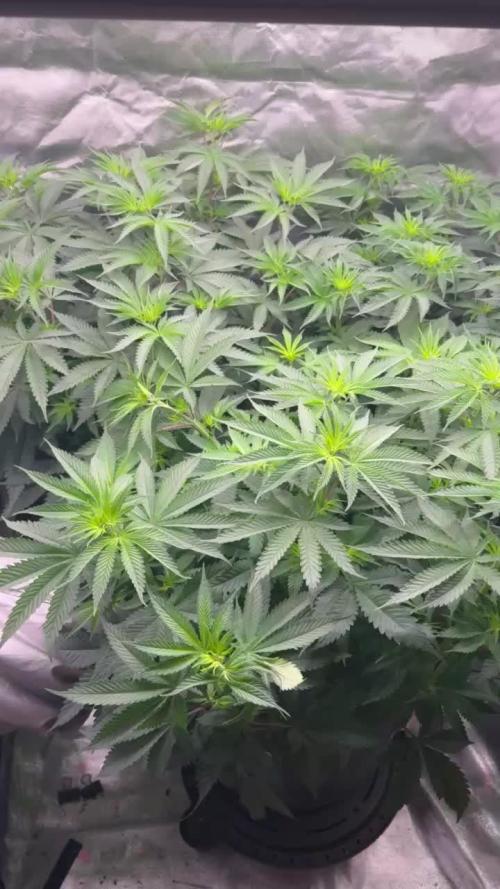
So week 4 of flower is in the books and things are going well. Noticing a cal/mag issue in the jehovas witness but not the others. Growth has been strong and the fatality has taken over she has outgrown my five foot tent so am moving everything to a brand new 5x5 that’s 8 feet tall so I’m hoping I can spread them out some and allow light to reach the middle canopy because I have lollipopped all the lower larfy bullshit. Looking forward to a strong finish.
Likes
9
Share
@Dormando
Follow
BEGIN WEEK 11 - Day 71 - 1/1 - Day 24 into flowering. 1+2 Fert Water. Day 72 - 1/2 - Day 25 into flowering. Soil pH seemed near 7. Needs more acidic soil. 6.0 pH Plain Water. Day 73 - 1/3 - Day 26 into flowering. Soil pH too high over ~6.8. Watered with 5.0 pH water. Day 74 - 1/4 - Day 27 into flowering. Fert Water 1 + 2ml. Day 75 - 1/5 - Day 28 - 4 Weeks into flowering. 5-6pH plain water. Day 76 - 1/6 - Day 29 into flowering. 5pH Plain Water to adjust soil pH too high over 6.8; almost 7. 0.5+1 Ferts added. Finally pH restored to 6.5. Day 77 - 1/7 - Day 30 into flowering. Feed 5pH Plain Water. END WEEK 11.
Likes
4
Share
@Jungle
Follow
Was thinking about going to 12/12 this week, but have put it off till next. Veg filling >1/4 of the 16sq ft net, but I can't wait much longer! Moved from one 13g container to 2x13 (one with plant) plus a 27g reservoir. Expect to be much more stable on nutes now. Remote reservoir keeps temp of nutes down.
Likes
11
Share
@Krissci
Follow
Day 3 - not much training needed.. SO3 is a giant. Smaller buds than the other 2. Lollipopping needed
Likes
10
Share
@Fader1
Follow
fortunately the situation has been recovered! after giving up fertilizers and with the purchase of the humidifier they now look much healthier. some stigmas start to color
Likes
4
Share
@QixxGrows
Follow
Day29: New sets of leaves. I'll repot and switch to proper Veg Lights on the weekend. Day30: I'll repot tomorrow. Day31: Repotting done. She had a crazy amount of roots in the seedling pot. MUCH more than I expected. I switched to Veg lights at 90% power. Day32: Settling in new pot Day33 & 34: I had to perform some maintenance on the tent. Lost some hours due to that. Day35: Growth really looking healthy. Although she's not really stretching high, she does look rather happy. I do like them thicc ;) General: I need to put the camera somewhere else so that the growth can be better seen. Right at the end I'll edit out the white flashes. They're caused by the humidifier running and will be really easy to cut out without losing the gist of the grow :)
Likes
2
Share
Allora....quinta settimana di vegetativa alcune piante mostrano dei segni di carenza date dal fatto che non c'erano i nutrimenti corretti, adesso che finalmente ho tutti i nutrimenti Giusti in teoria questi problemi dovrebbero scomparire, nelle prossime settimane vedremo come si evolverà la situazione, questa settimana le travaserò nel vaso finale poi farò ancora un paio di settimane di vegetativa e quando saranno pronte le metterò in fioritura.
Likes
5
Share
It’s getting cold and damp. Fingers crossed for a couple warm weeks into croptober
Likes
5
Share
@Jankky
Follow
Hoping we won't have to raise the structure, but probably will. They filled out pretty well and are smelling wonderful.
Likes
7
Share
Inicio de la sexta semana y así sigue el avance de la floración. Ésta plata ha crecido a un ritmo impresionante y apesar de ser más pequeña en un inicio que su compañera de tienda, ha superado su tamaño notoriamente. Todo sigue bien y sano como se esperaba. Buenos humos! 👽
Likes
1
Share
Stanno benissimo e in salute, gia si vedono i primi prefiori, e si inizia a sentire un odorino inconfondibile, adesso manca solo una bella defogliata e via fino alla fine!! Cmq mister funkyo top! Talee troppo belle!!! Sicuramente anche il risultato finale sarà top!!
Likes
32
Share
@Roberts
Follow
Critical x Animal Cookies is looking good under the Hortibloom Solux 350. She is starting to bulk and has a nice resin laying going. Colas are are looking good. Nothing else to report at the moment with her. Thank you Hortibloom, and Ripper Seeds. 🤜🏻🤛🏻🌱🌱🌱 Thank you grow diaries community for the 👇likes👇, follows, comments, and subscriptions on my YouTube channel👇. ❄️🌱🍻 Happy Growing 🌱🌱🌱 https://youtube.com/channel/UCAhN7yRzWLpcaRHhMIQ7X4g
Processing
Likes
2
Share
Likes
3
Share
Likes
6
Share
@DrShotzUK
Follow
BANANA PURPLE PUNCH - 420 FAST BUDS This plant started off stunted and looking all round unhealthy but I gave hear time lowered her nutrients and she’s come right back to life forming nice dense dark purple buds … The smell is amazing she smells of berries and lemony woody gassy smell. Nothing like banana if you ask me! Cannot wait to smoke this strain DRSHOTZUK
Processing
Likes
11
Share
This is the week of thanksgiving. Due to me being gone, my heat was a little high around 89 and got higher as the day got brighter. I messed up and think I have caused Northern lights to have heat stress on the roots. I'm hoping that she'll bounce back in a week or two. Resolution is crappy on my video and I apologize for that.
Likes
4
Share
Looking lovely for being into 1 week of flower
Likes
52
Share
You don't become confident by shouting affirmations in the mirror, but by having a stack of undeniable proof that you are who you say you are, outwork your self-doubt. Nitrogen fixation is a chemical process by which molecular nitrogen (N2), which has a strong triple covalent bond, is converted into ammonia (NH3) or related nitrogenous compounds, typically in soil or aquatic systems but also in industry. The nitrogen in air is molecular dinitrogen, a relatively nonreactive molecule that is metabolically useless to all but a few microorganisms. Biological nitrogen fixation or diazotrophy is an important microbe-mediated process that converts dinitrogen (N2) gas to ammonia (NH3) using the nitrogenase protein complex (Nif).[2][3] Nitrogen fixation is essential to life because fixed inorganic nitrogen compounds are required for the biosynthesis of all nitrogen-containing organic compounds, such as amino acids and proteins, nucleoside triphosphates and nucleic acids. As part of the nitrogen cycle, it is essential for agriculture and the manufacture of fertilizer. It is also, indirectly, relevant to the manufacture of all nitrogen chemical compounds, which include some explosives, pharmaceuticals, and dyes. Nitrogen fixation is carried out naturally in soil by microorganisms termed diazotrophs that include bacteria, such as Azotobacter, and archaea. Some nitrogen-fixing bacteria have symbiotic relationships with plant groups, especially legumes.[4] Looser non-symbiotic relationships between diazotrophs and plants are often referred to as associative, as seen in nitrogen fixation on rice roots. Nitrogen fixation occurs between some termites and fungi.[5] It occurs naturally in the air by means of NOx production by lightning.[6][7] All biological reactions involving the process of nitrogen fixation are catalyzed by enzymes called nitrogenases.[8] These enzymes contain iron, often with a second metal, usually molybdenum but sometimes vanadium. Green clover (Fixation) White clover (Fixation) Red Clover. (Fixation) Yellow Clover. (Fixation, deeper roots) Sweet Thai Basil. (Terpenes) Italian Basil. (Terpenes) Chamomile.(Oil production) Borage.(Pest attraction taste) Lavender.(Pest attraction smell) Marigold(Pest attraction visual) Mycorrhizae are beneficial associations between mycorrhizal fungi and a plant’s root system. Mycorrhizal fungi spores germinate in the soil, creating filaments (hyphae) that penetrate the root cells, thus establishing a symbiotic relationship. This collaboration leads to the development of both intra-radical and extra-radical networks of filaments, enabling efficient exploration of the soil for enhanced access to nutrients and water. Consequently, these vital resources are transferred to the plant, resulting in numerous benefits for crop cultivation. Various mycorrhizal products are available in diverse formulations (powder, granular, and liquid), concentrations, and qualities. Ongoing advancements in products, technologies, and research are reshaping our understanding of mycorrhizae. Despite these positive developments, certain misconceptions persist. In the following discussion, we aim to clarify the truths and dispel the myths surrounding mycorrhizae products. MYTH #1 A HIGHER NUMBER OF MYCORRHIZAE SPECIES MEANS BETTER RESULTS. Contrary to common belief, having a higher number of mycorrhizae species in a product does not translate to better results; in fact, it often yields the opposite outcome. A plant can sustain only one association with a particular mycorrhizal fungi species. Introducing multiple species creates competition among them, which is not advantageous for the plant. The initial colonizer does not ensure the highest success; instead, it gains precedence. It is recommended to select a product with a concentrated presence of a single mycorrhizae species known for its effective performance, rather than opting for a product with multiple species at lower concentrations. MYTH #2 ECTOMYCORRHIZAE ARE EFFECTIVE FOR CANNABIS PLANTS. Although ectomycorrhizae can colonize five to ten percent of plant species, cannabis is not among them. Ectomycorrhizae do not penetrate the root cells; instead, they develop around the roots and on the exterior. For cannabis plants, it is essential to seek out endomycorrhizae. Endomycorrhizae are capable of colonizing 70% to 90% of plant species, including cannabis. Unlike ectomycorrhizae, endomycorrhizae penetrate the root cells, forming structures like arbuscules for the exchange of nutrients and water with the plant. MYTH #3 WHOLE INOCULANT (PROPAGULES) PERFORM BETTER THAN ONLY VIABLE SPORES. The propagule count specified on most mycorrhizae products indicates the presence of spores (viable and unviable), hyphae, and root fragments. However, it is crucial to note that only viable spores, those with the capacity to germinate, can successfully colonize a plant’s root system. Spores are to mycorrhizal fungi what seeds are to cannabis plants—a fundamental component enabling fungi reproduction. Consequently, even if a mycorrhizal product boasts millions of propagules, its effectiveness hinges on the presence of viable spores. Without viable spores, the product will not contribute to plant development. Therefore, the genuine value of a mycorrhizal inoculant lies in the quantity of viable spores it contains, as only viable spores can efficiently initiate symbiosis. MYTH #4 ALL METHODS OF APPLICATION YIELD IDENTICAL RESULTS. To establish the symbiosis, mycorrhizal fungi spores must be close to the plant roots. The optimal recommendation is to directly apply mycorrhizal inoculant to the roots, either in powder, granular or slurry form. This method ensures maximum proximity between the spores and the roots, facilitating a rapid establishment of symbiosis. Particularly with crops like cannabis, which have a short growing cycle, employing this technique is the most effective way to obtain optimal benefits. Alternatively, techniques such as blending the inoculant with the soil are effective, but there may be a delay in the establishment of symbiosis. This is because the roots need to grow and come into contact with the dispersed spores throughout the growing media. MYTH #5 MYCORRHIZAE CAN ONLY BE GROWN ON LIVING PLANTS. While the predominant method for commercially producing mycorrhizae involves growing them on the root systems of living plants (in vivo production), it is not the exclusive nor the optimal technique. In fact, this production approach has notable drawbacks that the “root organ culture” method just does not have (in vitro production). In vitro production occurs in meticulously controlled, aseptic laboratory conditions, allowing for the consistent generation of products that are viable, highly concentrated, species-specific, and free from pathogens. Achieving such precision and quality is impossible when relying on the cultivation of mycorrhizal fungi on plants exposed to external conditions. In conclusion, it is crucial to take all these factors into consideration when choosing the appropriate product for your crop to fully harness the wide array of benefits provided by a high-quality mycorrhizal product. STRONGER PLANT – Stress resistance. FASTER GROWTH – Improve plant structure and shorter veg time. INCREASE YIELD – Overall more biomass. IMPROVED QUALITY – Increase cannabinoids and terpenes content.
Likes
1
Share
@Frotty
Follow
it's kind of overgrown for my setup 😅😂