


Likes
Comments
Share


@AestheticGenetix
Follow
i was surprised that she was done on 2/15/25
spidermites had completely taken over one bud so i decided to check trichomes and she seemed ready.


Likes
90
Share


@MrCOCO
Follow
Hi ... It's been a crazy week and it switched to 12/12 on the 40th day of vegetation.🍃🍃🍃 They are ready for sure there is no more to wait ... 🍃🍃🍃Good luck girls during the flowering stage🍃🍃🍃


Likes
Comments
Share


@eldruida_lamota
Follow
Vamos familia, actualizamos la segunda semana de floración de estas Granny’s Home de Seedstockers, salieron las 2 de 3, 66% ratio éxito.
Aplicamos varios productos de Agrobeta, que son increíbles para aportar una buena alimentación a las plantas.
Temperatura y humedad dentro de los rangos correctos dentro de la etapa de floración.
La tierra utilizada es al mix top crop, por cambiar.
De 2 ejemplares me quede con los 2 para completar el indoor, también cambie el fotoperiodo a 12/12 y aplique una poda de bajos, se ven bien sanas las plantas, tienen un buen color progresan a muy buen ritmo por el momento, las flores están empezando a formarse, hasta aquí todo.
Agrobeta:
https://www.agrobeta.com/agrobetatiendaonline/36-abonos-canamo
Hasta aquí todo, Buenos humos 💨💨💨

Likes
2
Share


@Growstopher
Follow
3.23.25
Fastbuds LSD-25 auto #1
Germination 1st week
Only watering with spring water. Going to be using foop nutrients with Humboldts secret cal/ mag and nectar for the gods ph up and down!
Here we go!

Likes
10
Share


@HIAZ_urbanbudfarmer
Follow
Hello Gromie's, all is well with these girls, continue to fill out & mature. Unfortunately I haven't had any Green planet Massive Bloom to give them this grow as I think it would have made a big difference! 5 days1 into week 5 & showing cloudy trichomes & quite a lot of amber as well, calyxs starting to swell & close up, pistills mostly orange. Think they will definitely finish up quicker than last grow, another week or so I think.👍
Likes
49
Share


@Hashy
Follow
Week 3
Light settings
18/6 on at 6.00am off 0.00am
Light power= 46% 109w
Radiator settings
LIghts on
Turn on if temp drops below 21.4c
Turn off if temp goes above 21.5c
Lights off
Turn on if temp drops below 19c
Turn off if temp goes above 19.1c
Humidifier settings
LIghts on
Turn on if humidity drops below 59.9%
Turn off if humidity goes above 60%
LIghts off
Turn on if humidity drops below 49.9%
Turn off if humidity goes above 50%
Extractor settings
temperature 24c with 1c steps
Humidity 62% with 2% steps
Max speed 8
Min speed 1
VPD aim 0.5-0.9
Wednesday 8/2/23 Day 15
5.00pm
Turn pots 90 deg
Thursday 9/2/23 Day 16
8.30pm
#2 Feed 1.5L Ec=1.06 Ph=6.4
Run 80ml Ec=3.35 Ph=5.7
Moved
#2 to left
#2 Height= 13CM Dist= 58CM DLI=18.8
Friday 10/2/23 Day 17
Did nothing
#2 contemplated fiming
Saturday 11/2/23 Day 18
8.00pm
#2 moved to right and fim, should have 5 sets of nodes and then the fim part.
#2 Height= 15CM Dist= 55CM DLI= 20.0
Extractor settings
temperature 25c with 1c steps
Humidity 62% with 2% steps
Max speed 8
Min speed 1
Sunday 12/2/23 Day 19
4.30pm
Leaf tuck all 3
#2 managed to expose a few nodes.
8.30pm
removed humidifier and moved pots nearer centre of the tent.
A bit more leaf tucking.
Monday 13/2/23 Day 20
7.30pm
#2 Feed 2L Ec=1.04 Ph=6.5
Run 50ml Ec=1.67 Ph=6.0
Tuesday 14/2/23 Day 21
#2 Height= 17CM Dist= 53CM DLI= 21.2
Round up for the week.
Again it's been a fairly productive week with the grow. Didn't quite hit my VPD target but I wasn't far from it. There is enough foliage that I managed to remove the humidifier from the tent.
#2 Tropicana Cookies FF is so far the best looking plant out the grow, she has grown extremely quickly and got some real big leaves. I attempted to Fim during the week to slow down the height a bit. Hopefully that has paid off. I'm thinking 1 more week before going 12/12.
Power used for week
Light
(1.96+1.96+1.96+1.96+1.96+1.95+1.95)=13.7Kw
Extractor
(0.05+0.05+0.05+0.06+0.06+0.06+0.07)=0.4Kw
Fans
(0.31+0.30+0.30+0.30+0.3+0.31+0.39)=2.21Kw
Humid
(0.05+0.02+0.0+0.0+++)=0.07Kw
Radiator
(1.44+0.9+1.04+0.68+0.6+0.92+2.61)=8.19Kw
Total for the week=24.57Kw
Back in a week.
Thanks for stopping by.
Likes
21
Share


@BudBrewerz
Follow
Miss Kalini is doing super great, she's packing up a whole lot of thick, dense well reeking buds.
She became this nice bush that uses up half of the space in the tent.
I haven't given her nutrients for a couple off days and don't think I will get her back on them.


Likes
8
Share


@Jonny_Blaze269
Follow
These babies were planted on 4/2, popped soil on 4/5, first feeding 4/6, fed again 4/7, looking great, loving their environment so far.
Wk1, Day1, 4/6/22
Wk1, Day4, 4/9/22, second node forming on all 3 babies
Wk1, Day6, 4/11/22, 3" tall
End of Wk1, 4/12/22, 2nd set of true leaves forming nicely on all 3, no issues

Likes
4
Share


@Organic473
Follow
As she continues to stretch into the holidays and new year I am looking forward to growing this monster outdoor in 2025 probably in a 10 gallon pot.

Likes
6
Share

@bkickstand
Follow
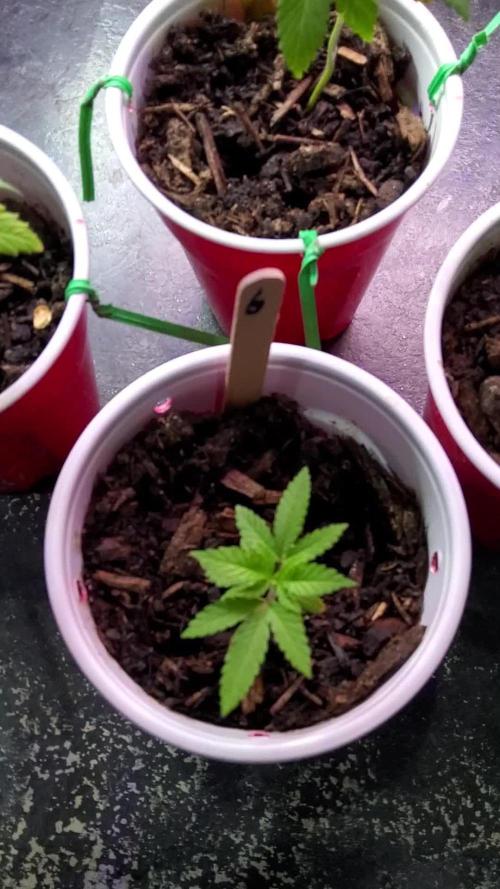
Week 4: still doing well. All but 1 plant lost its cotylenas. But I may have started to much to fast as far as nutrients. If you look closely, a couple leaf tips are yellowing and "burning". Eeks, not good. I found out that Durban Poispn likes an easy start to the nutrientrients. But just wait for it. Because of its tendency to grow quickly and stretch, it will become certainly more hungry throughout its Veg cycle. With that being said, topping and LST will be really important.
All the girls (except DP6, or Runt, have about 3 nodes. Once I get to 5 nodes, I will be topping for the first time.
I measures the girth of the stock. They read as follows:
DP1 girth at 2.02mm
DP4 girth at 1.4mm
DP5 girth at 1.6mm
Wattering amount increased slighly:
DP1 80mL
DP4 60mL
DP5 60mL
Nutrients went up a bit, but I will back my days of feeding to just 1 day per week (Friday, or "diary day" as it's been come be known
Veg 1: 30mL/gal
Veg 2: 30mL/gal
Sweetener: 10mL/gal
Seakelp: 5mL/gal
And now, look for my CO Northern Lights Auto outdoor grow 2026 disry.
See ya over there!
-Keep growing and stay mindful. ✌️
Marigold update: the flower were transplanted outside. They are looking really good, and are now getting their leaf definition. Not too long until the girls transplant outside. Still almost too cold here at night.

Likes
8
Share


@ButterfliesLittleFarm
Follow
Hello Diary,
Milky Way F1 is ready for harvest after exactly 10 weeks.
79 days since I put the seed in the ground.
75 days since Apollo F1 rose from the ground.
All 10 weeks passed without any problems, Milky Way F1 as well as her roommates proved how resilient, fast and hopefully generous they are.
I'm very happy with how things look so far.
Finally, as seen in the photos, Milky Way F1 looks impressive, the flowers are hard packed, full of trichomes.
For the last week, watering was usual, every three days.
After cutting off the stem at the bottom, I put the plant upside down in the grow box to dry.
Here's what the last week looked like.
02/07/2023 - Day 64.
Watering. I watered the plant with about 2 liters of water.
05/07/2023 - Day 67.
Watering. I repeated the procedure as I did three days earlier.
08/07/2023 - Day 70.
Photography and harvesting. I put it to dry upside down and will leave it to dry for at least 2 weeks.
That's it from me. I wrote everything I thought was important.
If you have any questions related to this strain, feel free to write.
Likes
150
Share


@RussianGrower
Follow
Hi, everybody. Today my plants 55 days. They look very good, cheerful. I had a problem with the lamp today. I don't know what's wrong with her after the photo shoot, but she did not turn on even after it cooled down, had to be replaced by a spare, though it has a slightly different spectrum. 😟
I found that the smell was very strong, air filtration fails, the stench goes through a little passive blowing and smells of the whole apartment. When my greenhouse is closed the smell is, but not strong, but when I work in it, it is necessary to ventilate the room for a long time. And for me this dangerously.
But, there is good news, the postman gave me a great fertilizer that will help me get a good and delicious harvest. 💪
Bubblelicious Auto - these plants show a very strong smell, for 4 days it has increased several times, the smell is very strong, but pleasant. The smell of skunk was felt better when you smell a flower, but everywhere smells very strong and sweet smell of Bubble. It is very very sweet, resembles sugar cane, very sweet candy.
Nevilles Haze Auto-very active, the vegetation period is very long. This plant requires a lot of time and patience, but I think it will reward me with a large harvest, I hope so. This plant practically does not smell, but there is a typical smell of Haze. If you want to harvest quickly, this plant will not suit you, be patient, well, I will tolerate.
In General, we will monitor their development. I hope everything will be fine, and my neighbors will not call the police, then I will have a lot of problems, but I'm not afraid of them, because the love of this plant is stronger.
Freedom of the cannabis industry 👍


Likes
18
Share

@J4kpvp
Follow
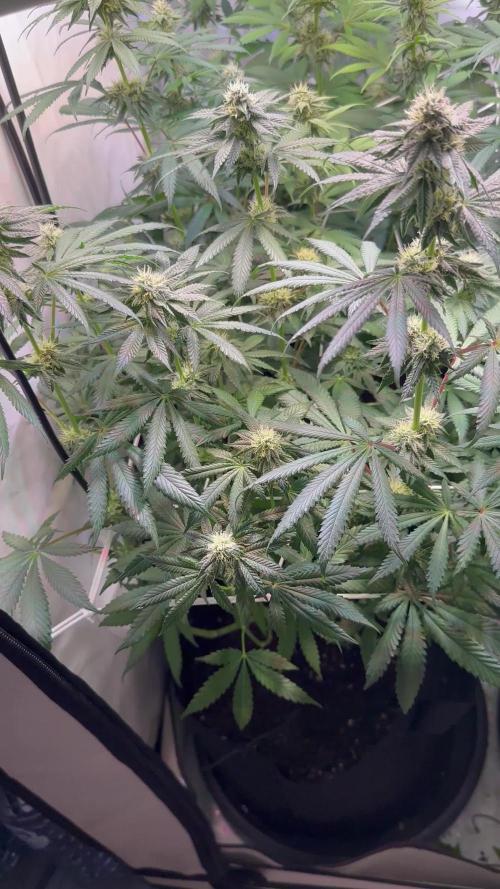
Hello:) this week was kind of confusing, they showed me light signs of deficiencies, so I added a bit of bactrex and orgatrex and then 3 days later they show me signs of overfertilization… So that‘s 3/3 grows so far for me that I used too much fertilizer…
It‘s still looking great overall:) I‘d guess we‘re done in about a month!



Likes
16
Share


@Young_agronomist
Follow
11.05.2023-предпоследняя неделя для ананасового экспресса .
Шишки отлично набрали вес и она стала пить меньше воды .
Перехожу на 10 дней рипена, 2 дня засухи и темноты .
Likes
2
Share


@GhostBlvckPhant0m
Follow
Week 10 for Wockesha she is finally at her end. All phenos look beautiful with different tones of purple through out the bud. All the Pheno had dense buds. Some phenos had better frost factor and some had better weight factor. Will do a whole plant hang dry for 2-3 weeks and then to a jar cure!
Likes
4
Share


@MadeInGermany
Follow
Hey guys :-) .
Today the plant was sprayed again with neem oil.
There weren't any more trips to be seen after the second application, but to be on the safe side, you did it again today get a cure.
That's why the beautiful dark shimmer on the leaves :-).
The ladies are developing well and have 1 week before I change the time to flowering.
Normally I would let it get bigger and train because the tent only has 80x80 and 180 watts are available, so I will switch it over soon enough.
This week it was poured twice with 0.8 l each time (for nutrients, see table above).
Otherwise everything was cleaned and, as always, everything was checked.
Have fun with the update and stay healthy 🙏🏻
👇🏼👇🏼👇🏼👇🏼👇🏼👇🏼👇🏼👇🏼👇🏼👇🏼👇🏼👇🏼
You can buy this Nutrients at :
https://greenbuzzliquids.com/en/shop/
With the discount code: Made_in_Germany you get a discount of 15% on all products from an order value of 100 euros.
👇🏼👇🏼👇🏼👇🏼👇🏼👇🏼👇🏼👇🏼👇🏼👇🏼👇🏼👇🏼
You can buy this strain at :
Clearwater Seeds
Water 💧 💧💧
Osmosis water mixed with normal water (24 hours stale that the chlorine evaporates) to 0.2 EC. Add Cal / Mag to 0.4 Ec Ph with Organic Ph - to 5.8 - 6.4
MadeInGermany
