The Grow Awards 2026 🏆
Likes
Comments
Share
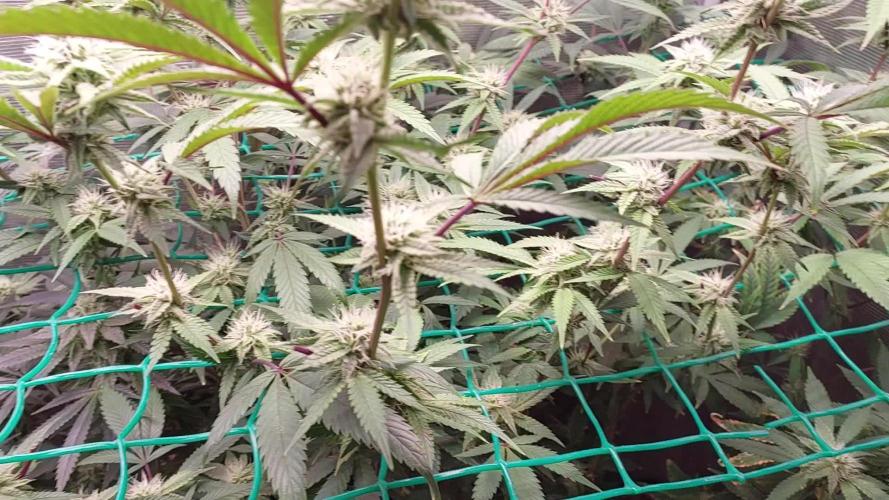
The tops are no different that a photo. Easy to grow Decent yield Terps are decent with floral citrus tones Smokes smooth I will have to try and grow again
Likes
5
Share
@0xcrlt
Follow
July 25 - Day 46 - Watered with 3L of water, BioGrow, BioBloom, and TopMax
Likes
11
Share
@Oyziphar
Follow
18 plants, 5 strains. Each plant has 3 main buds. By means of LST I tried to make them all the same height. Because the plants have now stopped growing, leading is no longer necessary. The plants are still attached to the plant sticks with tie strips to support the buds when they get heavy later on. Lots and large leaves, and therefore a weekly large defoliation every week. The trichomes begin to appear. . The Garlic Mist plants are not that beautiful and do not have a nice flower formation. Plenty of leaves; so a lot of defoliation work. GM # 1 - 92cm - lots of leaves, Even after defoliation, the buds are actually hidden behind the leaves. GM # 6 - 76cm - better leaf / bud ratio than # 1, but the buds don't get that fat either GM # 7 - 79cm - can be compared to # 6 but buds are better developed.
Likes
22
Share
@LSDMan
Follow
(CAN) Une météo parfaite cette semaine. Je dispose des grillages plus gros autour des plants, je dégage également les alentours afin de laisser passer plus facilement les rayons du soleil et de faire baisser l’humidité ambiante. Les plants ont maintenant beaucoup plus d’espace et peuvent se développer pleinement pour prochainement, passer en floraison. Je renouvelle le marc de café autour des plants pour éloigner les potentiels nuisibles. Je pulvérise les plants au purin d’orties le jour 59. Arrosage à l’engrais de croissance le jour 60.
Likes
10
Share
@Reaper
Follow
seeds germinate in rockwool untill roots hit the water i only use calmag and small amount of nutes
Likes
49
Share
@FoTwenny
Follow
🗓️ Week 17: 3/23 - 3/29 📆 Week 7 of 12/12 🌄 The plant is starting to go into senescence and presenting some beautiful colors as she begins to fade. 💡 Received new lighting courtesy of Growers Choice. They sent me the ROI-E420 with the Master Controller. First impression is amazing. Looks and feels like very high quality build. The spectrum seems more blue than the 3000k lm301H Kingbrite bars I have been using. The bars are thinner and packed with a lot of diodes, so they do run a little hotter than the KB at full power. I adjusted and now running them at 90%. For now the Kingbrite bars are being used as side lighting dimmed to about 30-35% depending on Grow room temps.
Likes
3
Share
@GeminiCQC
Follow
As we enter week three, the stem is hardening on the fantasmo as she likes to flop over. No signs of any weird stress other than that plant flopping over, but the Mephisto's wedding is doing its own squat little thing.
Likes
18
Share
Green light is radiation with wavelengths between 520 and 560 nm and it affects photosynthesis, plant height, and flowering. Plants reflect green light and this is why they appear green to our eyes. As a result, some growers think that plants don’t use green wavelengths, but they actually do! In fact, only around 5 – 10% of green light is reflected from leaves and the rest (90 – 95 %) is absorbed or transmitted to lower leaves [1]. Green wavelengths get used in photosynthesis. Chlorophyll pigments absorb small amounts of green wavelengths. Light that doesn’t get absorbed is transmitted to leaves that are shaded out from direct light. This means that leaves at the bottom of the canopy get more green light than leaves at the top. A high proportion of green wavelengths compared to other colors tells lower leaves that they are being shaded out, so they are able to react accordingly. Lower leaves may react by opening or closing their stomata or growing longer stems that help the leaves reach brighter light [1, 2, 3]. When it comes to growing cannabis, many cultivators are interested in the quality of light used for the flowering stage. In many plants, flowering is regulated by two main photoreceptors: cryptochrome and phytochrome. Both photoreceptors primarily respond to blue light but can also respond to green, although to a lesser extent. Green can accelerate the start of flowering in several species (although cannabis has yet to be tested) [1, 4, 5]. However, once flowering has begun, it’s important to provide plants with a “full spectrum” light that has high amounts of blue and red light, and moderate amounts of green, in order for photosynthesis to be optimized. Green light mediates seed germination in some species. Seeds use green wavelengths to decide whether the environment is good for germination. Shade environments are enriched in green relative to red and blue light, so a plant can tell if it is shady or sunny. A seed that senses a shaded environment may stay dormant to avoid poor growing conditions [1]. Some examples of plant species where researchers have documented this response are: ryegrass (a grass that grows in tufts) and Chondrilla (a plant related to dandelion) [1, 6]. Although green wavelengths generally tell plants NOT to germinate, there are some exceptions! Surprisingly, green wavelengths can stimulate seed germination in some species like Aeschynomene, Tephrosia, Solidago, Cyrtopodium, and Atriplex [1, 6, 7]. Of course, light is not the only factor affecting seed germination – it’s a combination of many factors, such as soil moisture, soil type, temperature, photoperiod, and light quality. When combined with red and blue light, green can really enhance plant growth [1, 8]. However, too much green light (more than 50% of the total light) can actually reduce plant growth [8]. Based on the most current research, the ideal ratio of green, red, and blue light is thought to be around 1:2:1 for green:blue:red [9]. When choosing a horticultural light, choose one that has high amounts of blue and red light and moderate amounts of green and other colors of light. Not many studies can be found about the effect of green light on cannabis growth or metabolism. However, if one reads carefully, there are clues and data available even from the very early papers. Mahlberg and Hemphill (1983) used colored filters in their study to alter the sunlight spectrum and study green light among others. They concluded that the green filter, which makes the environment green by cutting other wavelengths out, reduced the THC concentration significantly compared to the daylight control treatment. It has been demonstrated that green color can reduce secondary metabolite activity with other species as well. For example, the addition of green to a light spectrum decreases anthocyanin concentration in lettuce (Zhang and Folta 2012). If green light only reverses the biosynthesis of some secondary metabolites, then why put green light into a growth spectrum at all? Well, there are a couple of good reasons. One is that green penetrates leaf layers effectively. Conversely red and blue light is almost completely absorbed by the first leaf layer. Green travels through the first, second, and even third layers effectively (Figure 2). Lower leaf layers can utilize green light in photosynthesis and therefore produce yields as well. Even though a green light-specific photoreceptor has not yet been found, it is known that green light has effects independent from the cryptochrome but then again, also cryptochrome-dependent ones, just like blue light. It is known that green light in low light intensity conditions can enhance far red stimulating secondary metabolite production in microgreens and then again, counteracts the production of these compounds in high-intensity light conditions (Kim et al. 2004). In many cases, green light promoted physiological changes in plants that are opposite to the actions of blue light. In the study by Kim et al. blue light-induced anthocyanin accumulation was inhibited by green light. In another study it has been found that blue light promotes stomatal opening whereas green light promotes stomatal closure (Frechilla et al. 2000). Blue light inhibits the early stem elongation in the seedling stage whereas green light promotes it (Folta 2004). Also, blue light results in flowering induction, and green light inhibits it (Banerjee et al., 2007). As you can see, green light works very closely with blue light, and therefore not only the amount of these two wavelengths separately is important but also the ratio (Blue: Green) between these two in the designed spectrum. Furthermore, green light has been found to affect the elongation of petioles and upward leaf reorientation with the model plant Arabidopsis thaliana both of which are a sign of shade avoidance symptoms (Zhang et al. 2011) and also gene expression in the same plant (Dhingra et al. 2006). As mentioned before, green light produces shade avoidance symptoms which are quite intuitive if you consider the natural conditions where the plants grow. Not all the green light is reflected from the highest canopy leaves in nature but a lot of it (50-90%) has been estimated to penetrate the upper leaves at the plant level ((Terashima et al., 2009; Nishio, 2000). For the plant growing in the understory of the forest green light is a signal for the plant of being in the shade of a bigger plant. Then again, the plants growing under unobstructed sunlight can take advantage of the green photons that can more easily penetrate the upper leaves than the red and blue photons. From the photosynthetic pigments in higher plants, chlorophyll is crucial for plant growth. Dissolved chlorophyll and absorb maximally in the red (λ600–700 nm) and blue (λ400–500 nm) regions of the spectrum and not as easily in the green (λ500–600 nm) regions. Up to 80% of all green light is thought to be transmitted through the chloroplast (Terashima et al., 2009) and this allows more green photons to pass deeper into the leaf mesophyll layer than red and blue photons. When the green light is scattered in the vertical leaf profile its journey is lengthened and therefore photons have a higher chance of hitting and being absorbed by chloroplasts on their passage through the leaf to the lower leaves of the plant. Photons of PPFD (photosynthetic photon flux density) are captured by chlorophyll causing an excitation of an electron to enter a higher energy state in which the energy is immediately passed on to the neighboring chlorophyll molecule by resonance transfer or released to the electron transport chain (PSII and PSI). Despite the low extinction coefficient of chlorophyll in the green 500–600 nm region it needs to be noted that the absorbance can be significant if the pigment (chlorophyll) concentration in the leaf is high enough. The research available clearly shows that plants use green wavelengths to promote higher biomass and yield (photosynthetic activity), and that it is a crucial signal for long-term developmental and short-term dynamic acclimation (Blue:Green ratio) to the environment. It should not be dismissed but studied more because it brings more opportunities to control plant gene expression and physiology in plant production. REFERENCES Banerjee R., Schleicher E., Meier S. Viana R. M., Pokorny R., Ahmad M., Bittl R., Batschauer. 2007. The signaling state of Arabidopsis cryptochrome 2 contains flavin semiquinone. The Journal of Biological Chemistry 282, 14916–14922. Dhingra, A., Bies, D. H., Lehner, K. R., and Folta, K. M. 2006. Green light adjusts the plastic transcriptome during early photomorphogenic development. Plant Physiol. 142, 1256-1266. Folta, K. M. 2004. Green light stimulates early stem elongation, antagonizing light-mediated growth inhibition. Plant Physiol. 135, 1407-1416. Frechilla, S., Talbott, L. D., Bogomolmi, R. A., and Zeiger, E. 2000. Reversal of blue light -stimulated stomatal opening by green light. Plant Cell Physiol. 41, 171-176. Kim, H.H., Goins, G. D., Wheeler, R. M., and Sager, J. C. 2004.Green-light supplementation for enhanced lettuce growth under red- and blue-light emitting diodes. HortScience 39, 1617-1622. Nishio, J.N. 2000. Why are higher plants green? Evolution of the higher plant photosynthetic pigment complement. Plant Cell and Environment 23, 539–548. Terashima I., Fujita T., Inoue T., Chow W.S., Oguchi R. 2009. Green light drives leaf photosynthesis more efficiently than red light in strong white light: revisiting the enigmatic question of why leaves are green. Plant & Cell Physiology 50, 684–697. Zhang, T., Maruhnich, S. A., and Folta, K. M. 2011. Green light induces shade avoidance symptoms. Plant Physiol. 157, 1528-156. Wang, Y. & Folta, K. M. Contributions of green light to plant growth and development. Am. J. Bot. 100, 70–78 (2013). Zhang, T. & Folta, K. M. Green light signaling and adaptive response. Plant Signal. Behav. 7, 75–78 (2012). Johkan, M. et al. Blue light-emitting diode light irradiation of seedlings improves seedling quality and growth after transplanting in red leaf lettuce. HortScience 45, 1809–1814 (2010). Kasajima, S., et al. Effect of Light Quality on Developmental Rate of Wheat under Continuous Light at a Constant Temperature. Plant Prod. Sci. 10, 286–291 (2007). Banerjee, R. et al. The signaling state of Arabidopsis cryptochrome 2 contains flavin semiquinone. J. Biol. Chem. 282, 14916–14922 (2007). Goggin, D. E. & Steadman, K. J. Blue and green are frequently seen: responses of seeds to short- and mid-wavelength light. Seed Sci. Res. 22, 27–35 (2012). Mandák, B. & Pyšek, P. The effects of light quality, nitrate concentration and presence of bracteoles on germination of different fruit types in the heterocarpous Atriplex sagittata. J. Ecol. 89, 149–158 (2001). Darko, E. et al. Photosynthesis under artificial light: the shift in primary and secondary metabolism. Philos. Trans. R. Soc. B Biol. Sci. 369 (2014). Lu, N. et al. Effects of Supplemental Lighting with Light-Emitting Diodes (LEDs) on Tomato Yield and Quality of Single-Truss Tomato Plants Grown at High Planting Density. Environ. Control Biol. 50, 63–74 (2012).
Processing
Likes
10
Share
@yaron
Follow
Week 8!After a rainy week and a half with some sunlight and alot of clouds and 20 degrees celsius the girls look like this. For the coming week we have more sun so they are going to love it. Cheers! Once again to little sunlight these past few days and it is going to rain this weekend so that's a bummer. Hopefully its getting sunnier Cheers!
Likes
62
Share
@nonick123
Follow
Día 71 (30/12) Christmas holidays. Only watering Día 72 (31/12) He recibido mi nueva lampara Mars Hydro FC1500 EVO Led Grow Light (2024 NEW FC 1500-EVO Samsung LM301H 150W LED) - https://marshydro.eu/products/fc1500-evo-led-grow-lights/ - https://www.amazon.de/dp/B0CSSGN5D8?ref=myi_title_dp Procedo a instalarla, de modo que tengo la tienda de 120x60 cm perfectamente cubierta con las DOS (2) lámparas FC1500 EVO Es ideal tener dos lámparas, porque así puedo ajustar la distancia a la lampara en función de la altura de capa planta Ajusto ambas lámparas al 75% de potencia (Total 225W), que es más que suficiente para cubrir el área de 120x60 cm Día 73 (01/01) CBD Auto 20:1 #1 - Muestra una ligera deficiencia con algunas puntas de las hojas dobladas hacia arriba y clorosis... Creo que le voy a dar otra ración de BIO PK 5-8 OG Kush Auto - Está apilando cogollos de forma brutal. Increíble el olor y la cantidad de tricomas que está formando 😍 Día 74 (02/01) CBD Auto 20:1 #1 - Se empiezan a formar tricomas entre los incipientes cogollos OG Kush Auto - Una pena que se haya intensificado la deficiencia de CalMag... en las hojas, porque los cogollos son gordos y densos, y cubiertos de tricomas Día 75 (03/01) CBD Auto 20:1 #1 - Voy a darle un boost para las 4 semanas que le quedan hasta la cosecha con SILICIUM FLASH Hago un pequeño agujero cerca del tallo, espolvoreo 25g de SILICIUM FLASH en el agujero, lo cubro de tierra. Riego con una solución de 2g de BACTREX por litro de agua. OG Kush Auto - Impresionante densidad de los cogollos que empieza a doblar las ramas 😍 La ventana de cosecha se acerca! 💥 Día 76 (04/01) CBD Auto 20:1 #1 - Investigando me doy cuenta de que lo que le pasa es quemadura de luz, ya que la parte externa de la planta sufre clorosis, y la parte interna (donde no alcanza la luz) está completamente verde Ajusto la lampara sobre esta planta para 40 DLI OG Kush Auto - Sigue poniendo los cogollos duros como rocas y muy llenos de tricomas! 😍💥 Día 77 (05/01) CBD Auto 20:1 #1 - On going OG Kush Auto - Empieza la senescencia en las hojas de abanico, acelerada por la deficiencia de CalMag... que ha tenido. 💦Nutrients by Bio Tabs - www.biotabs.nl/en/ 🌱Substrate PRO-MIX HP BACILLUS + MYCORRHIZAE - www.pthorticulture.com/en-us/products/pro-mix-hp-biofungicide-plus-mycorrhizae "GDBT420" 15% DISCOUNT code for the BIOTABS Webshop https://biotabs.nl/en/shop/ With 2 x Mars Hydro FC1500 EVO Led Grow Light (2024 NEW FC 1500-EVO Samsung LM301H 150W LED) - https://marshydro.eu/products/fc1500-evo-led-grow-lights/ - https://www.amazon.de/dp/B0CSSGN5D8?ref=myi_title_dp
Likes
29
Share
Hey guys I think we have hit pre-flowering stage I took a 48hr timelapse from the end of last week into week 5. It’s been a beautiful spring day so I decided to take the babies out and get some real sun.
Likes
14
Share
Likes
17
Share
Gracias al equipo de Seedsman Marshydro XpertNutrients y Trolmaster sin ellos esto no sería posible. 💐🍁 Tangerine Snow F1 Fast: Esta gran cepa es un cruce de cuatro vías 75% sativa de (Boost x Tangelo) con (Lavender x Power Plant). Este híbrido Fast F1 proviene de la genética Cali y cuenta con excelentes terpenos cítricos, alta producción de resina para extractos, altos niveles de THC, muy buenos rendimientos y excelente resistencia al moho. Tangerine Snow F1 Fast se puede cultivar tanto en interior como en exterior. Los tiempos de floración en interiores son de entre 8 y 10 semanas, mientras que el tiempo de cosecha en las latitudes del norte es en septiembre, mientras que en el hemisferio sur los productores cosecharán durante marzo. Las regiones climáticas recomendadas son cálidas, secas, húmedas y cálidas. Se trata de plantas altas, semiramificadas, que superan los 200cm y que presentan un alto vigor con muy buena uniformidad. Al igual que muchas otras variedades con fuerte dominancia sativa, Tangerine Snow F1 Fast ofrece una excelente resistencia al moho, así como a las plagas y enfermedades de las plantas. La combinación de terpenos cítricos y mucha resina la convierten en una cepa de muy buen extracto, cuyo método de "lavado" produce muy buenos rendimientos de hachís. El perfil de terpenos cítricos recuerda a las mandarinas y mandarinas y también tiene notas dulces. La producción de THC ha sido verificada en laboratorio en un fuerte 24%, mientras que el CBD es bajo. El efecto es edificante y energizante, perfecto para usar durante el día y las primeras horas de la noche. 🌻🚀 Consigue aqui tus semillas: 💡TS-3000 + TS-1000: se usaran dos de las lámparas de la serie TS de Marshydro, para cubrir todas las necesidades de las plantas durante el ciclo de cultivo, uso las dos lámparas en floracion para llegar a toda la carpa de 1.50 x 1.50 x 1.80. https://marshydro.eu/products/mars-hydro-ts-3000-led-grow-light/ 🏠 : Marshydro 1.50 x 1.50 x 1.80, carpa 100% estanca con ventanas laterales para llegar a todos los lugares durante el grow https://marshydro.eu/products/diy-150x150x200cm-grow-tent-kit 🌬️💨 Marshydro 6inch + filtro carbon para evitar olores indeseables. https://marshydro.eu/products/ifresh-smart-6inch-filter-kits/ 💻 Trolmaster Tent-X TCS-1 como controlador de luz, optimiza tu cultivo con la última tecnología del mercado, desde donde puedes controlar todos los parametros. https://www.trolmaster.com/Products/Details/TCS-1 🍣🍦🌴 Xpert Nutrients es una empresa especializada en la producción y comercialización de fertilizantes líquidos y tierras, que garantizan excelentes cosechas y un crecimiento activo para sus plantas durante todas las fases de cultivo. Consigue aqui tus Nutrientes: https://xpertnutrients.com/es/shop/ 📆 Semana 7: Ha sido una semana algo complicada, tormentas, frio y lluvia han ralentizado el crecimiento, espero que pronto lleguen dias soleados, continuo con 1/3 nutrientes recomendados en cada riego.
Likes
8
Share
This is my 1st autoflower grow in a while and from fastbuds. So far I am satisfied by the rate of growth. Cant wait to move into my new place and set up another grow tent. 2 are still smaller from starting in the flower room and have not yet started to show pistils.
Likes
2
Share
@draco
Follow
Сутки темнота, лед под корни, вентиляция и обдув работает.
Likes
37
Share
So fat banana finally got the chop. Started off well then had an influx of heat around mid flower, not a major problem as I dealt with it, just could have gone smoother. She flew through veg with no problems or complaints whatsoever. She was resilient and would grow her again. She smells so loud, covered in frost.. I have a few more pictures of the chop to upload but will do it in a little while. Such a unique scent from her, definitely tropical and banana peel type of aroma and taste(from test smoke). Been a pleasure to grow and can honestly say its some tasty smoke. Will do a proper smoke report after this batch has dried and then cured. Thanks for tuning in! Will be back -FlavoursUk
Likes
6
Share
Legend Timestamp: 📅 EC - pH: ⚗️ Temp - Hum: 🌡️ Water: 🌊 Food: 🍗 pH Correction: 💧 Actions: 💼 Thoughts: 🧠 Events: 🚀 Media: 🎬 D: DAY, G: GERMINATION, V: VEGETATIVE, B: BLOOMING, R: RIPENING, D: DRYING, C: CURING ______________ 📅 D36/V32 - 21/05/24 ⚗️ EC: 1.0 pH: 6.0 🌡️ T: 20°C H: 70% 🌊 🍗 💧 💼 LST 🧠 🚀 🎬 1 TL in her new home and one TL of LST job ______________ 📅 D37/V33 - 22/05/24 ⚗️ EC: 1.0 pH: 5.4 🌡️ T: 20°C H: 70% 🌊 🍗 💧 💼 LST 🧠 🚀 🎬 1 TL video and one TL of LST job ______________ 📅 D38/B01 - 23/05/24 ⚗️ EC: 1.0 pH: 5.3 🌡️ T: 20°C H: 70% 🌊 2L 🍗 💧 💼 🧠 As I saw clear signs of blooming, I need to pass to bloom phase so I put B01, in the header. 🚀 Clearly she's starting flowering 🎬 1 TL video and 1 LST video ______________ 📅 D39/B02 - 24/05/24 ⚗️ EC: 1.1 pH: 5.3 🌡️ T: 20°C H: 70% 🌊 🍗 💧 💼 🧠 🚀 🎬 1 TL video and 1 LST video ______________ 📅 D40/B03 - 25/05/24 ⚗️ EC: 0.2 pH: 5.3 🌡️ T: 20°C H: 70% 🌊 15L 🍗 💧 💼 Flush for two days and then flowering nutes 🧠 I think no more LST, she's now full blooming 🚀 🎬 1 TL video ______________ 📅 D41/B04 - 26/05/24 ⚗️ EC: 0.2 pH: 5.3 🌡️ T: 20°C H: 70% 🌊 🍗 💧 💼 Flush for two days and then flowering nutes 🧠 I think no more LST, she's now full blooming 🚀 🎬 1 TL video ______________ 📅 D42/B05- 27/05/24 ⚗️ EC: 1.1 pH: 6 🌡️ T: 20°C H: 60% 🌊 15L 🍗 Calmag - Bloom A-B - Bud Candy - B52 - Big Bud - Seaweed 💧 💼 👉👉👉 Changed res and added nutes 🧠 I think no more LST, she's now full blooming 🚀 🎬 1 TL video