


Likes
Comments
Share


@Ieiogrow94
Follow
Eccoci di nuovo qui!!!
Super eccitato per questa nuova collab con Seedsman, team davvero al top, che mi ha dato l’opportunità di testare questa nuova genetica e di condividere i progressi con tutti voi!!!
Genetica che non ha bisogno di presentazione fantastica di sapore e di odore..
SUPER CONSIGLIATA
Grazie a tutti per il supporto ❤️🍀🔥

Likes
17
Share


@Colin087
Follow
One plant is very small cos when I transplanted it to the 5g pot I brock all the roots off it its slowly starting to come back to life, as for the other ones there doing good lots of new growth starting to come out under main big leaves i am not adding any nutrients yet and will probably start LST by the end of this week
Likes
8
Share


@FrostyGardens
Follow
These ladies were a breeze to grow... Feed them all organic nutes and they loved it... They never gave me a problem and at the end of the grow I was rewarded with huge dense nuggets. One of the best performers all of the genectics in this run.

Likes
27
Share


@CannbellFarms
Follow
I’m overjoyed with the phenos this strain is producing, strong vibrant purples with some serious flavour profiles!
Scent Profiles we have:
Candy Lemon Sherbet 🍬🍋
Sweet & Piney Diesel 🍭🌲⛽️
Sweet & Tangy Tropical Punch 🏝️🥊
Alongside this, these beauties are the frostiest and the most insanely dense koala looking nugs I’ve ever produced!

Likes
17
Share


@CanadianFillmore
Follow
Howdy growfessors 👽, chopped down two LSD, what a great strain! One of these two ladies performed way better than the other and I'm excited to see just how much more weight and bud she packed on.
Thanks for stopping by growfessors 👽🌳💚
July 11 update, one LSD plant 92 grams, the second plant 95 grams, 187 total. Plants have a great fruity, berry taste and great heady high.


Likes
113
Share


@DeaneR
Follow
Wow! She grew this week 😜! The buds are stacking up nicely and the sugar leaves are starting to frost up with trichs. Surprisingly, not much odour yet😕. Her tent mate BlueCookie is real sticky and fragrant.
Added B-52 to the nutrient mix this week. Watered on Apr.21 FL 25 and Apr.24 FL 28, with 1/2 gallon (nutrients as listed above) poured slowly topside.
Lightly defoliating every other day or so. I'll likely try to reveg. this girl after harvest ( for clones), so I have left some larfy buds down low for that purpose.
That's about it for now. Not much to do other than feed and water her....and of course watch her bloom😍.
Thanks for stopping in!
Peace,
DeaneR😎

Likes
9
Share


@Atom_x_Andromeda
Follow
Sprout’n Fast everyday 4th-5th node started already both plants phenos short n stocky really like these genes might make some seeds

Likes
7
Share


@PCGrows
Follow
First week of full flower, clear budsites and she’s stretch good! LST is really keeping all budsites relatively same size and all getting super purple/black
Likes
24
Share

@Grow_for_Happiness
Follow
Busy week this week, both in the garden and in life, hence the later update than usual.
Early week gave the girls a good leaf stripping on the inside of the plants. Also removed any scraggly growth that was not getting any sun. As usual really helped open them up to more airflow and light penetration. At start couldn't even see the sun through them! Next day both looked great with no visible signs of stress.
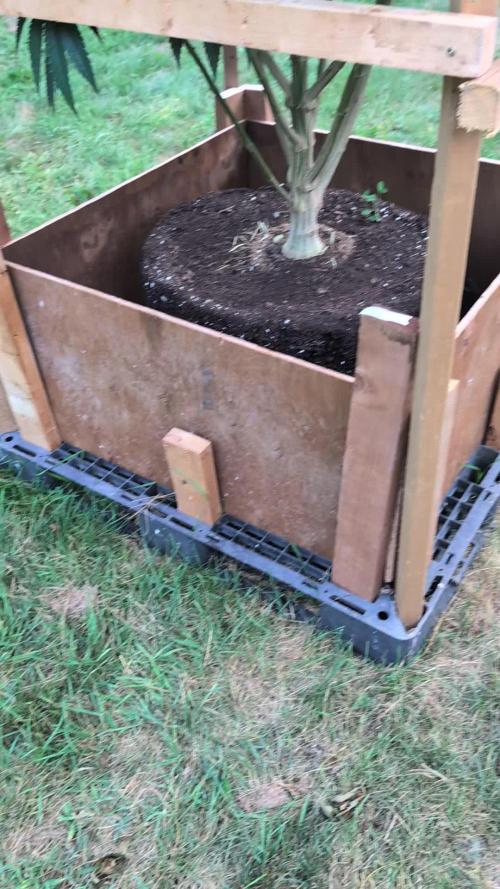
Now I'll say it was a VERY hot week this week, daytime highs 32°C feeling like 42°C with 90% humidity and the girls were thirsty AF, dropping heavy every night, . Watering every evening, hose on full soaker setting for 3 minutes per plant, roughly 35 liters of water each! Even with all the water, the bigger plant was looking sad, and I had a sneaking suspicion that it just did not have enough root space. So I tuned into my inner MacGyver again, and came up with a solution. Using no nails or screws, I was able to fashion a 3x3 bed for her! All thanks to growing on plastic skids. Just slid 2x4 PT into the slots in a 3x3 square, and then slid 1/2" PT sheet (cut to size) on the inside of the wood. Afterwords cut the fabric pot, and lay it down to make the perfect base inside the new bed to prevent soil from coming out. Topped it up with three wheel barrow of garden soil that I had left from the spring load, watered and hoped my idea worked. The next day, she's looking happier than ever, and I haven't seen a droopy leaf on her since! Now she's really ready to bring on some serious bud weight. Mentioning that, I also added the second layer of horizontal trellis, as well as vertical trellis around the smaller plant.
Temps look cooler for the next two weeks, and not much of any rain forecast, even though we desperately need it. At least with forecast being 25°C highs and 10°C lows the girls should slow down on water intake, trying to conserve where we can right now but got a keep them fed.
Until next week!
Likes
4
Share

@WalachianGrowinDiary
Follow
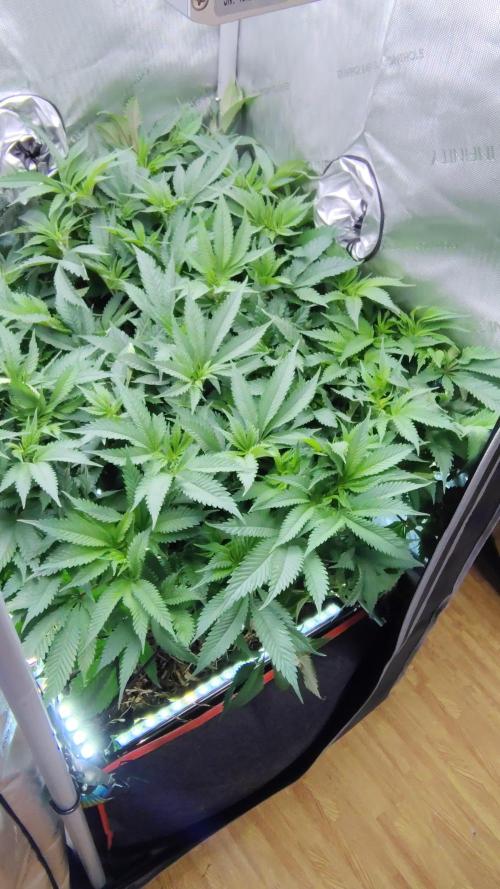
First week of flower day 4 from flip. Before and after flip a little defoliation done. Moist meter Bluemat keeping ať 50mbar and She loves IT. Díky around 3 liters dechlorined clean water. Each week or two watering with Bioenhancer 1g 1l

Processing
Likes
4
Share


Likes
33
Share


@Bread_n_Buds
Follow
Our #11 or rather this new Seeds Mafia creation that we are growing with love is starting to get serious.
It grows well and very regularly, the leaves are clean and it is well proportioned, really beautiful and fast.
We have started with fertilizers for growth which we give in reduced doses together with the rooting agent for the entire vegetative phase.
Music of the week provided by Radio Nula from Slovenia.
https://radionula.com/
Thanks to friends of Seeds Mafia try this and their other creations
seeds > https://seedsmafia.com/en/
Light and tent > https://marshydro.eu/products/marshydro-sp3000-led/?lang=it
Likes
13
Share


@Robeeriegenetics
Follow
Replacement seeds not fairing well lol but chosen mothers are thriving
Likes
376
Share


@Metatronix
Follow
Hello to all my friends and visitors here on GD
As you can see on the photographs from this week growth that after the raw cold days, the girls did get better and recovered, but they also spread out in development, the difference is about two to three weeks between the plants...it's manageable though :)
The SE7000 runs at 520 Watt and about 32cm from the canopy.
I added nutriants at 03.04. the EC is at 2.7 EC I also performed some LST on them, all goes well except the dehumidifier will not come for yet another week.
That's it, I hope to see y'all next week growmies.


Likes
9
Share


@HUMO_Cultiva
Follow
We are happy of the results, but in the next batch we will be put 8 plantas and AC


Likes
13
Share


@DonKrika
Follow
This was the last week that I did defoliation on the plant. I defoliated very heavily the plant this week, I removed most of the fan leaves and a ton of small bud sites that would only generate popcorn buds.
Unfortunately, the defoliation did not go as planned, I accidentally cut my trelluse net and remove one big branch by mistake, but the plant looked like it bounced back and is not showing any problems.
This was also the last week that I gave mycorrhizal and applied foliar spray
DAY 114 - Nutes
PH - 5.83
PPM- 2830
Solution Temp - 18
Watering Volume - 4L
Foliar
PH - 6.29
PPM- 2270
Solution Temp - 20.5
Watering Volume - 200ml


