Likes
Comments
Share
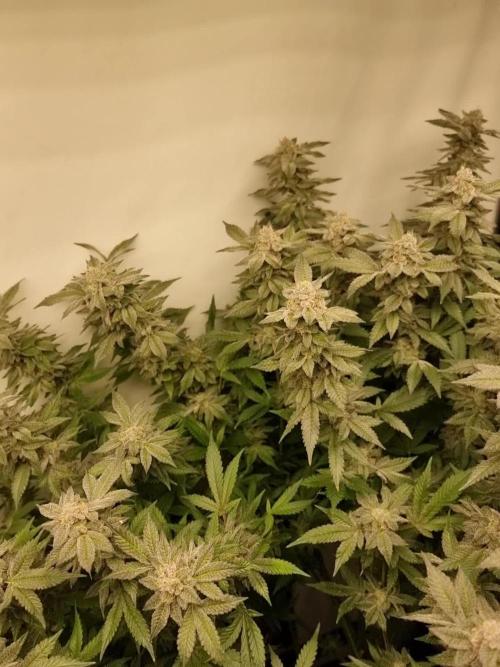
Check out the video! 7 weeks of flowering have passed. Tops are getting really heavy, I might have to buy bamboo support sticks soon. Resin production is insane as you can see. There was mold in one of the head buds and I had to remove a golfball-sized chunk. Some insect made its way in, died there and started rotting. I struggle to keep the humidity down and now I am watering every second day only. And i bought a third fan (typhoon) that blows warm air from the ceiling above the lamp back onto the tops. wish me luck for the last 4 weeks

Likes
17
Share
Seems like the 75-85 day lifetime suggestion from fastbuds is on point and not a overstatement, (KEEP IN MIND THEY ARE FEED BY A DRIP SYSTEM FROM SAME WATER TANK / SAME NUTES) - pheno 1 chewed more nitrogen than her siblings since early on, she got a topleafs fade earlier than expected but she is forgiven because she is finishing crazy fast and feels like shes 2 weeks ahead of everyone else bonus point to her she smells strong and full of ice no matter the top fade, pheno 2 is doing avarage smells 100% same as pheno 1 but seems slower (no early fade full of trichomes too) - Pheno 3 🏅words cannot summon her up, she looks purple already and she smells like a elite photoperoid pheno hunt result, honestly id suggest fastbuds to ask me to cut a stem put it in a glass tube with gel and send it to them via mail to study or replicate her genetics if that is possible, i have never seen such absurdly 10/10 auto in my life, her smell is a John Jones punch in the nose, and not just me saying this ive shown it to my friends and they are shocked (keep in mind im a Berliner who is in toch with some of world LOUD hunter legends if yk yk) something was up with this pheno since sporut we dont know what that is but we want more of this one, she also loved the nute dose we gave her with zero problems . Pheno 4 is simmalar in smell with pheno 1 and 2 but her growth seems to be noticably slower she seems to be a bit behind id say 1 week, maybe because shes under the 6inch osculating fan and shes getting a bit less light she has 0 metabolism problems though so thats fine. Dont get me wrong pheno 1 2 and 4 smell strong and amazing too but miles away from pheno 3 and NO pheno 3 isnt a different strain put in the seed bag by mistake if you toch the stem 4 of the phenos have the exact same cherry cola smell pheno 3 is just the CHOSEN ONE.
Likes
8
Share
All chopped and hanging BIG THANK YOU TO @Kannabia for the opportunity to grow their strain's
Likes
51
Share
High GD community, Week 25, I dont want to start to pessimistic, but all waiting could been for nothing. Bad weather all week long, and its here to stay for a little while. The buds are not dense, so that might save it from budrot. The idea of just tturning the whole plant into hash, becomes stronger than before. I took off some branches of the wild child, so its a bit more open canopy. The greenhouse lady is pretty much save, but theres much less airflow passing there and humidity is skyrocketing. That will be it for this week, See yall soon Grow safe buds 🙏🍀🍀🍀🙏
Likes
4
Share
@JayKane33
Follow
The girls are looking good, vibrant and healthy. I'm watering every other day now, up from every three days because they're up taking more liquids. Top dressing as I see fit, once every 4 waterings. Water mixture always has SuperThrive, Molasses and Potassium within it though.
Likes
10
Share
She is getting bulky and smell awsome it will be some good somke
Processing
Likes
220
Share
Week 2 Mr.B's Six shooter so this one is doing fine, still no water needed since last week, literally no maintenance required, just spraying the soil with 0.25 ml / 250ml organic amino acid concentrate. You know how canna boost smells like soy sauce, well this one smells like that kinda except when i open it my whole basement smells like a chineese wok restaurant lol . Six shooter looks like i got three phenos , this one is an indica pheno looks like , let's see how she grows ! added cal mag to the foliar spray, once only this week, on day 5. amino spray on the soil is daily, until the 10 day mark. still only going to be plain water and secondary nutrients like CO2 and micronutrients . that's the plan anyway. VPD tappering off towards 1.1 as humidity is creeping down from a high of 42 to the high thirties now. going to plant my in soil ppm reader before i water for the first time since transplant lol... maybe not even this week ! low maintenance? will update 🚀
Likes
4
Share
@Hix57
Follow
Le 41e jour se dĂ©roule paisiblement pour mes prĂ©cieuses plantes. Je remarque un lĂ©ger jaunissement des feuilles, probablement dĂ» au dĂ©but de la floraison, Ă  un Ă©ventuel manque d'azote ou Ă  des processus naturels que je dĂ©couvre au fil du temps. De plus, des tĂąches apparaissent sur les feuilles, peut-ĂȘtre en raison d'un dĂ©ficit en calcium, malgrĂ© la duretĂ© Ă©levĂ©e de l'eau dans ma rĂ©gion. Je procĂšde Ă©galement avec prudence en augmentant progressivement le phosphore et le potassium, dans l'espoir de ne pas rĂ©pĂ©ter les erreurs du passĂ© liĂ©es Ă  des excĂšs. Chaque jour, je progresse et je m'enrichis d'expĂ©rience. Merci de me lire et de partager cette aventure avec moi. đŸ™đŸŒ± Remarque : Engrais : lĂ©gĂšre augmentation du phosphore et potassium et un peu d'azote. SymptĂŽmes : taches sur feuilles comme sur les autres cultures. Peut ĂȘtre calcium. Plante trĂšs petites et trapue probablement a dominance indica.
Likes
18
Share
@Kachow
Follow
We have pulled 4 of the 9 Gorilla Cookies as they looked ready, the other 5 we will monitor and pull as required. Some of the Buds look really awesome and they are sticky and smelly :) The 5 left in the tent are on an H20 only diet and will now have more room and light until they get chop chop :)
Likes
30
Share
@Canadian
Follow
This plant have a very strong smell and there are very high THC with a good balance that allows you to still be productive on my day . All popcorn and small buds were chopped into pieces and put in a pot for edibles. The buds that grow from the plant that did very well are very dense and heavy the main cola waited 15.56 grams dry
Likes
6
Share
Decent yield. Good bud quality Easy to grow Frost is on point Terps are that skunky sherby funk Smoke is smooth and gets ya there Recommend đŸ»đŸ’š
Likes
27
Share
Likes
2
Share
Topped at 14 days. Waiting to be transplanted to bigger pot and another topping ahead she missed three-leaf clover. first topping ahead. end of second week with higher expectation
Likes
18
Share
Um Platz fĂŒr andere Pflanzen zu schaffen ernte ich 2 pflanzen.Es hat sich wirklich gelohnt diese Sorte zu klonen.Die Popcorn buds habe ich beim fresh trim abgeschnitten und eingefroren.Daraus mache ich dann gemeinsam mit anderen Sorten etwas bubble hasch.Darauf freue ich mich schon richtig.
Likes
51
Share
@Comfrey
Follow
Dutch Passion Shaman PĂŒnktlich zum Erntedankfest am 5.10. war fĂŒr mich der kritische Punkt ĂŒberschritten. Shamanin 1 hat ihren Headbud und drei weitere BlĂŒten genommen bekommen. Ich habe die beiden Pflanzen in der letzten Zeit tĂ€glich mit einer Taschenlampe abgesucht und nun war es soweit, leichte Faulstellen an den Stielen in mehreren Bereichen der Pflanze. Es waren nur sehr kleine Teile der BlĂŒten, bzw. schlaffe ZuckerblĂ€tter betroffen, ich erkenne das mittlerweile relativ frĂŒh. Die StielfĂ€ule, wie bei @birdmountain hatte sich bei der dunklen Dame an fĂŒnf Stellen gebildet und die angrenzende BlĂŒte befallen. Verlust liegt bei zwei bis drei Gramm trocken. Am Sonntag gab es zum Erntedank Space Tee fĂŒr zwei und der war sehr lecker, mit starker aber angenehmer Wirkung. Ich lasse den frischen Trimm und BlĂŒtenmaterial bei 90 Grad mit einem guten Schuss Olivenöl (zwei Esslöffel ca. eine Stunde ziehen. Die KrĂ€uter aus dem Tee schmecken mit bissl Salz wie Spinat, lecker, und wenn man sich die auch reinzieht, dann wird‘s richtig gut, mit Lachflashs. đŸ€€ 😅 Jetzt bin ich entspannter, was den Erntezeitpunkt und die zu erwartende Wirkung betrifft. Shamanin No. 2 musste dursten, hat recht weit oben eine weitere BlĂŒte verloren, wobei ich die Stelle an einem dĂŒnneren Stiel auch hier vor der eigentlichen BlĂŒtenfĂ€ule entdeckt habe. Hier saß auch ein kleiner KĂ€fer in der NĂ€he, wahrscheinlich hatte der es mitgebracht. Ihre BlĂ€tter beginnen sich zu verfĂ€rben. Es geht weiter, bis nĂ€chste Woche! Danke fĂŒr‘s vorbeischauen. 💚
Likes
2
Share
Cannabis isn't just a plant; it's a test, and most people are failing it. You've been told weed is either medicine or menace, a spiritual gateway or a mind-numbing escape, sacred or sinful. But here's the truth: none of those labels touch the core of what this plant really is. Cannabis doesn't conform to your beliefs about it. It amplifies what's already within you, and that's what makes it dangerous. In ancient traditions, cannabis wasn't a way to pass the time. It was a portal—a tool of transformation—used only by those prepared to meet themselves fully, with no filters and no distractions. Shamans, mystics, and seekers used it to dissolve the ego, not decorate it. Today, however, the plant is everywhere. It's sold like candy, smoked like a trend, and worshipped like a lifestyle. What was once a ritual has become routine. The sacred has been turned into a spectacle. This isn't about whether weed is good or bad. It's about what it does to your soul. Long before cannabis was ever rolled into a joint or packaged for profit, it was a key—handled carefully, reverently, and only by those who understood what door they were opening. At the dawn of civilization, it was never seen as a recreational pastime. It was a sacred tool, aligned with the rhythms of spirit and used only within the context of ritual, fasting, prayer, and solitude. In ancient India, it was offered to Shiva, the god of destruction and transformation—the one who dissolves illusion so that truth can be born. His devotees, the sadhus, didn't smoke for fun. They smoked to die—at least, to the ego. The chillum wasn't an accessory; it was a sacrament. In Taoist alchemy, cannabis was blended with other herbs to refine energy, cultivate inner silence, and trigger visionary dreams. It wasn't used to numb the senses but to awaken subtle perception. Ancient texts describe it as a spirit ally—one capable of sharpening insight or disrupting chi, depending on the user's inner alignment. To the unprepared, it was not a gift. It was a test. Sufi mystics used hashish in ceremonies intended to dissolve the self into divine presence. Yet even among them, the plant remained controversial. Rumi warned against forms of intoxication that imitate awakening while leaving the soul untouched. The plant was revered only when it led to the annihilation of the ego, not the amplification of it. It had to be held like a sword: with respect, or it would cut the hand that held it. Among the Rastafari, cannabis is ganja—the herb of wisdom, the healing of the nations. But it is not merely smoked; it is prayed over. It is brought into reasoning sessions, where words and smoke rise together in a shared search for truth. It is a tool of communion, not escape. It is never separate from the liturgy. In those sacred circles, cannabis is not consumed to forget the world but to remember the divine within it. And yet, here we are. In the modern West, we've turned the sacrament into a souvenir. What once demanded preparation now demands nothing. You can buy weed in drive-throughs, light up between text messages, and scroll through endless content while floating in synthetic calm. The plant is the same, but the context has changed. Without ritual, cannabis loses its compass. When the ceremony disappears, all that's left is sensation. And sensation without direction becomes indulgence. What makes this dangerous isn't the plant itself. It's that we now engage with something once considered sacred as if it were entertainment. Cannabis doesn't offer consistency; it offers amplification. If you're grounded, it deepens you. If you're lost, it magnifies the maze. Most people don't realize they're walking into a temple with muddy feet and then wondering why they see only shadows. The truth is, the plant doesn't decide where it takes you. It holds up a mirror. That mirror reflects everything: your fears, your unresolved pain, your unspoken questions. It doesn't care about your vibe. It cares about your intention. That's why, in most traditions, the preparation was the real ritual. Fasting, chanting, silence, cleansing—all before the first inhale. Not because of superstition, but because they understood that the mind must be stable before it is expanded. Used with reverence, cannabis is not a drug. It's a door. But doors lead both ways. They open to light, but also to shadow. And the most dangerous illusion is believing you can handle both when you've prepared for neither. There's a reason so many people report anxiety, paranoia, or a strange sense of being watched when they smoke weed. Most chalk it up to a bad strain, the wrong dosage, or a chemical reaction. But what if it's not the weed at all? What if the plant is doing exactly what it was always meant to do—stripping away the noise, piercing through illusion, and revealing what's hiding underneath? Carl Jung called it the shadow: the buried aspects of the psyche that you've rejected, forgotten, or never dared to face. Not evil—just uncomfortable. Not malicious—just inconvenient. It's the grief you never processed, the anger you swallowed, and the truths you couldn't bear to confront. The plant doesn't generate these things. It reveals them. Like an amplifier, it doesn't create the music. It simply makes what's already playing louder. And for many people, what's playing is unresolved pain. This is the part of cannabis that nobody likes to talk about. Because it doesn't sell as well as relaxation, good vibes, or being chill. But ask any serious spiritual practitioner and they'll tell you: the path to awakening begins in the underworld. Not in visions, but in discomfort. Not in light, but in confrontation. And cannabis, when used consciously, can be one of the most effective tools for that process. But only if you're ready. Only if you're willing to see your own face without the mask. In mystical psychology, this moment of exposure is sacred. It's not a failure. It's an invitation. The anxiety that creeps in after a puff. The spiraling self-consciousness. The rising paranoia. These are not necessarily signs of malfunction. They are feedback. The system is responding to the shift. What's happening isn't that you're losing control. It's that your filters are breaking down. Your inner guard dogs are panicking because the ego's fortress is being breached. But modern culture isn't built to help you through that experience. There's no shaman. No elder. No circle. You're alone in your room, staring at the ceiling, heart racing, wondering why you feel like you're dissolving. And the truth is: you are. That's what the plant does. It dissolves the artificial. It burns away the performance. And if you're not prepared for that process, it can feel like a nightmare. Not because the plant is wrong, but because the encounter is real. Esoteric traditions understood this. If your internal world is chaotic, cannabis doesn't fix it. It turns up the volume. It invites everything to the surface. For healing to happen, it must. But if you run from that surfacing—if you numb it or distract yourself from it—the cycle repeats. Again and again. High after high. Until nothing feels sacred anymore. Only noisy. This is why cannabis, despite being natural, is not automatically safe. It doesn't distinguish between the ready and the unready. It doesn't decide who should see and who should sleep. It simply opens the curtain. What you do with what's behind it is up to you. And here lies the biggest misunderstanding of all: The belief that the plant is supposed to make you feel better. That's the lie. The truth is that it's supposed to make you see. The pain. The joy. The confusion. It's all information. It's your spirit saying: "Here. This. Look at this." But because we've been trained to fear discomfort, we label these moments as bad trips and walk away with nothing. No reflection. No learning. Just another story about how weed made us anxious. But cannabis doesn't make you anxious. It reveals the anxiety you were already carrying. It doesn't invent the discomfort—it exposes it. And that makes it one of the most honest substances you'll ever encounter. But honesty isn't always kind. Truth doesn't always feel good. And sometimes what it reflects isn't pretty. Yet perhaps it's exactly what you needed to see. One of the greatest spiritual traps is mistaking sensation for truth. And cannabis, more than almost any other plant, tempts us into that illusion. You light up. You feel open. Thoughts seem deeper. Music becomes richer. Synchronicities appear like hidden messages from the universe. Your journal fills with insights you'd never write sober. Everything feels meaningful. Mystical. Even transformative. But the real question is: does any of it actually transform you? The high itself can be seductive. It mimics transcendence. It mimics peace. But imitation is not integration. Feeling expanded is not the same as becoming whole. Cannabis can create the appearance of spiritual clarity without providing the foundation necessary to sustain it. And that's what makes it dangerous—not because it harms the body, but because it can convince the soul that it has already arrived. You begin to believe you've evolved simply because you've felt something profound. But depth is not measured by intensity. It's measured by what you bring back from the experience—and how you live once the feeling fades. Many regular users describe sudden breakthroughs: realizations about trauma, a sense of oneness with life, deep presence, heightened awareness. These experiences are real. The danger arises when those realizations remain suspended in the ether—unanchored and unapplied. They become what esoteric teachers call spiritual inflation: the expansion of the ego around the feeling of transformation without the work required to sustain it. This is what Hermetic and occult traditions sometimes refer to as the false light—experiences that appear enlightened but remain mental simulations. In Kabbalistic mysticism, it resembles the sphere of Hod: the brilliance of intellect divorced from grounded truth. It glows like gold, yet crumbles like ash. You think you've seen the light, when in reality you've only seen the mirror. Insight vs. Identity It's no coincidence that many long-term cannabis users begin to confuse insight with identity. They start wearing the experience rather than integrating it. They sound spiritual. They appear awakened. They quote philosophers and mystics. Yet their lives remain unchanged. Their patterns don't shift. Their relationships don't deepen. Their suffering doesn't dissolve. It simply becomes more poetic. The plant becomes a prop in a performance of progress. Osho once said, "Substances open doors that only silence should open." He wasn't denying their power. He was warning about their instability. A door forced open does not remain open. And the visions offered through altered states can distort reality when the mind is unprepared to receive them. The high can become a pedestal from which you look down on those who haven't seen what you've seen. But often, nothing has been seen clearly. It has only been felt intensely. The problem is not the insight. The problem is what you do with it. An experience, no matter how profound, means little if it never becomes action. A revelation is only valuable when it changes the way you live. Otherwise, the mirror remains just a mirror—and you leave exactly as you arrived. Cannabis can absolutely offer perspective, but unless that perspective becomes practice, it's just stimulation. If it doesn't shift how you show up in conflict, how you face your shadow, how you serve others, how you move through suffering, then it's a spiritual distraction dressed as awakening. And that's the danger. Not the plant. Not the smoke. But the story you tell yourself about what it all means. The high isn't the truth. It's a doorway. But if you stand in the doorway forever, thinking you've arrived, you never actually step into the room. You become addicted not to the substance, but to the illusion of progress. And that illusion is harder to detox from than any chemical dependency. This is why traditions with spiritual depth never worshipped the high. They used it to point to something deeper. They never glorified the vision. They asked what it demanded. Because real awakening isn't what happens on the plant. It's what happens after. It's in the silence that follows. In the choices that emerge. In the humility to realize that seeing something once doesn't mean you understand it. Cannabis offers access, not arrival. But the world doesn't need more access. It needs more anchors. More people who don't just visit the sacred but embody it. Who don't just feel the truth but live it. Cannabis doesn't just affect the mind. It touches the subtle body, the invisible architecture of your being that carries your thoughts, emotions, memories, and energetic imprints. You can't see it, but you can feel it. And when the plant interacts with that field, it doesn't ask for permission. It amplifies whatever is already there. That's why for some, it unlocks intuition, sensitivity, and a heightened sense of presence. For others, it unearths chaos. That chaos isn't random. It's the byproduct of energy that hasn't been cleared. Think of the subtle body as a musical instrument. When it's in tune, cannabis can act like a bow across a string, drawing out resonance, harmony, and even silence. But when that instrument is dusty, out of tune, or misaligned, all the plant does is amplify the noise. And in that noise, people often confuse stimulation for wisdom. You feel more, but you're not necessarily seeing more. You're just louder inside. And when the inner space is crowded, clarity becomes impossible. Traditions that understand this speak of energetic hygiene. It's not a mystical concept. It's spiritual hygiene, in the same way that showering is physical hygiene. Practices like fasting, breathwork, chanting, cold exposure, prayer, and silence aren't accessories. They're clearing rituals. They stabilize the field. They make sure that when you open the door with a plant like cannabis, you're not stepping into a room full of unresolved debris. In Reiki and other energetic healing practices, cannabis is sometimes described as a field disruptor. Not because it's harmful, but because it creates a surge in sensitivity. That surge can help you access subtle energies, but it can also leave you porous. Practitioners who aren't grounded often find their sessions become unstable or chaotic after using the plant. Sensations increase, but control decreases. The same is true in Kundalini work, where cannabis is known to awaken dormant energy before the body is ready to handle it. You feel open, electric, even euphoric, until you don't. Until you crash, spiral, or find yourself unable to ground the experience in any meaningful way. Amazonian shamans say that every plant opens, but every plant also tests. And cannabis is no exception. They believe that each plant carries a consciousness, a spirit, a frequency. And when that spirit enters you, it begins to communicate. Not in language, but in emotion, in memory, in energetic sensation. If you're not clean, mentally, emotionally, spiritually, that communication becomes scrambled. The plant becomes distorted by your own residue. And instead of clarity, you get confusion dressed in insight's clothing. This is why so many people feel drained, unfocused, or emotionally raw after heavy cannabis use. Not because the plant is inherently draining, but because they entered into it unprepared. No clearing, no containment, no reverence. It's like plugging a delicate instrument into a distorted amplifier with frayed wires. The result isn't music. It's noise. And the longer you're exposed to it, the more it wears down your sensitivity. Cannabis interacts with the energy body like fire, interacts with a dry forest. It spreads. It consumes. It brings light, but only if the space is clean. Otherwise, it just burns. Without grounding, without clarity, without intentional boundaries, what was meant to elevate can begin to fragment. You lose focus. You lose willpower. You start living in a fog that feels peaceful, but underneath is a dull kind of stagnation. And here's the subtle danger. You begin to call that fog calm. You begin to associate the dulling of sensation with healing. But healing isn't numbness. Healing is clarity. Healing is the return of power, not its suspension. And cannabis, when used without energetic awareness, can temporarily mask imbalance instead of resolving it. So the question becomes, is your system clean enough for clarity? Have you prepared your inner temple before you invite the plant in? Because cannabis doesn't clean the house. It just turns on the lights. What you see depends entirely on what was already there. Once upon a time, cannabis was only used when the soul was ready. Now, it's used because the week ends here. The shift didn't happen overnight. It was slow, subtle, and disguised as liberation. What used to be sacred became symbolic. What used to be intentional became impulsive. We went from smoke as spirit to smoke as content. And in the process, the plant didn't lose its power. We just lost our way of holding it. In Rastafarian tradition, cannabis wasn't something you did alone in your room to cope with stress. It was integrated into sacred reasoning sessions, ritual gatherings for philosophical and spiritual reflection. The smoke rose with the chants, with the prayers, with the heartbeat of drums. It was a communal ascent, not a personal escape. It wasn't about feeling good. It was about finding alignment with Jah, God, Source, the One. And if your heart wasn't clean, the herb would show you. It wasn't entertainment. It was an initiation. In the African diaspora, especially within Afro-Brazilian religions like CandomblĂ© and Umbanda, cannabis wasn't always central, but the concept behind its use was. Every plant was seen as holding an axĂ©, a spiritual frequency, a purpose, a vibration. To misuse a plant was to misuse its energy, and to do that was to invite imbalance. The ritual determined the effect. The ceremony created the container. Nothing sacred was taken without being earned. There was no casual consumption, only communion. But that's not what the modern world wanted. Ritual requires time, discipline, and humility. Ritual is inconvenient, and capitalism thrives on convenience. So, the plant was extracted from its cultural roots, sanitized for mass consumption, and rebranded as a lifestyle. Now it's wrapped in sleek packaging, endorsed by influencers, and sold with the same pitch as a wellness smoothie. This will make you feel better. No mention of shadow. No mention of mirrors. Just mood boards, pastel fonts, and a shallow nod to mindfulness. The sacred was commercialized. The ceremony was deleted. And cannabis became a product, not a portal. Now people light up while binge-watching shows that feed them more programming. They scroll while smoking, swiping through empty content designed to hijack their dopamine. There is no circle. No chant. No silence. Just stimulation on top of stimulation. And in that layered chaos, the plant becomes fog instead of fire. Numbness instead of clarity. Even the festivals that claim to be spiritual, burning incense, playing ecstatic music, and selling chakra stickers often reduce the plant to background noise. The ritual becomes a performance. The ceremony becomes a costume. And the true essence of the plant, the part that could transform, disrupt, awaken, is buried under layers of aesthetics. But cannabis has no interest in being aesthetic. Its spirit is old, wild, and unapologetically real. It doesn't care about your branding. It cares about your intention. And without a container, its energy spills. It flows into your distractions, into your anxieties, into your unchecked wounds. Without direction, it simply amplifies your current state. That's why some people feel inspired, and others feel stuck. Same plant, different vessel. So when we stripped away the ritual, we stripped away the structure that made the experience sacred. Without that, what's left is entertainment masked as healing. A mimicry of depth. A hollow echo of what once was holy. The plant has not changed. But the way we use it has. And until we reclaim the container, we'll keep wondering why the experience feels shallow, inconsistent, or even chaotic. It's not that cannabis lost its power. We just stopped preparing ourselves to receive it. The ritual was never a performance for the divine. It was a way to prepare you. To cleanse your mind, your energy, your heart. So when the plant opened the door, you walked through it with grace, not confusion. We didn't lose the sacred. We stopped recognizing it. The most dangerous lie is that intention alone is enough. If you mean well, the plant will guide you. But cannabis, like all true spiritual allies, doesn't operate on sentiment. It responds to energy, to readiness, to the clarity of your inner world, not your wishful thinking. Too many seekers approach it with curiosity, but no compass. They light up to feel better, to think deeper, to escape boredom or soften the edges of stress. But they forget that the plant doesn't give you peace. It reveals whether or not peace was already there. Used with discernment, cannabis can be a profound ally. It can help you detach from the noise of the ego, see your patterns more clearly, and soften the grip of your internal narratives. But the key is never the plant itself. The key is who you are when you meet it. Without structure, the experience becomes slippery. Without reflection, the insight evaporates. Without grounding, the openness turns to fragmentation. So how do you use the plant without being used by it? First, by understanding that cannabis should never be your first response. If you feel anxious, don't smoke. Sit with it. Ask it questions. If you're restless, don't escape. Move your body. Breathe deeply. Journal. Only when the body is settled, and the mind is clear can the plant act as a tool of refinement, rather than disruption. Before using, ask yourself, " What am I seeking? Clarity or comfort? Truth or temporary relief? Am I reaching for the plant out of alignment or avoidance? There's a massive difference between using cannabis to explore consciousness and using it to mute what consciousness is trying to tell you. One is sacred. The other is just another loop. The wisest traditions never relied on cannabis alone. It was always one element in a larger spiritual ecosystem. Fasting. Silence. Chanting. Prayer. Breathwork. Cleansing rituals. These were not unnecessary traditions. They were spiritual hygiene. They were the practices that helped prepare the vessel, clear the clutter, and tune the nervous system so that the plant could do its deeper work. Grounding practices matter. Smoke in silence. Sit on the earth. Stay off your phone. Turn off the background noise. Let the plant guide you inward, not outward. Write down what comes. Reflect. Integrate. Take what you learn and bring it into how you move. How you speak. How you love. That's where the real alchemy happens. Not in what you see, but in what you do with what you see. Cannabis without integration becomes a form of spiritual entertainment. You start chasing the feeling instead of doing the work. It becomes part of your identity. You begin to associate your depth with the plant, as if you cannot access wisdom without it. And that's the beginning of dependency. Not chemical, but existential. You forget that the plant is just a mirror. The depth was always within you. The cannabis just helped reveal it. The real journey begins when you can access that state without anything external. You are not meant to live inside the high. You're meant to bring what you found there back into your daily life. The insight is not the prize. The application is. The transformation is. Can you be kind without needing to feel euphoric? Can you stay present without chemical help? Can you walk through conflict, boredom, and routine and still remain awake? This is how you use the plant without losing yourself. By never letting it become your source of meaning. By returning to yourself as the center. The plant may open the door. But only you can walk the path. And if you're not walking, you're just circling. Feeling more. Learning nothing. You don't need more highs. You need more honesty. The kind of honesty that isn't always pleasant, but always real. The kind that strips away the glittering illusions and asks, is this helping me grow or just helping me hide? Cannabis was never meant to be used in isolation. Across cultures, lineages, and centuries, its spiritual use was almost always collective. Not because people couldn't access altered states on their own, but because those who understood the plant knew this. Without a container, power becomes unpredictable. And without community, insight turns to distortion. The plant might open you, but it's the circle that holds you. In the Rastafari tradition, cannabis is not smoked casually. It's part of reasoning sessions, gatherings where the herb is passed with reverence, accompanied by scripture, discussion, chanting, and the pursuit of divine truth. It's not about getting high. It's about getting aligned. Words are shared with weight. Silence is respected. Everyone becomes both student and teacher. Rollers rights, puff puff pass the herb moves clockwise, like time, like energy, like the sacred wheel of life. In that space, cannabis is not the focus. It is the bridge that bonds.
Likes
8
Share
@dreamLife
Follow
Sigue creciendo bien, sĂșper frondosa, semana a semana se le van quitando las hojitas que tapan los brotes y se amarran las ramas mas grandes al contenedor.
Likes
2
Share
Apologies for skipping a few weeks! As mentioned, this is my first diary — they’ll get muuuuch better once we’re back in the proper room. She’s happy and thriving!