The Grow Awards 2026 🏆
Likes
Comments
Share
@bbs42
Follow
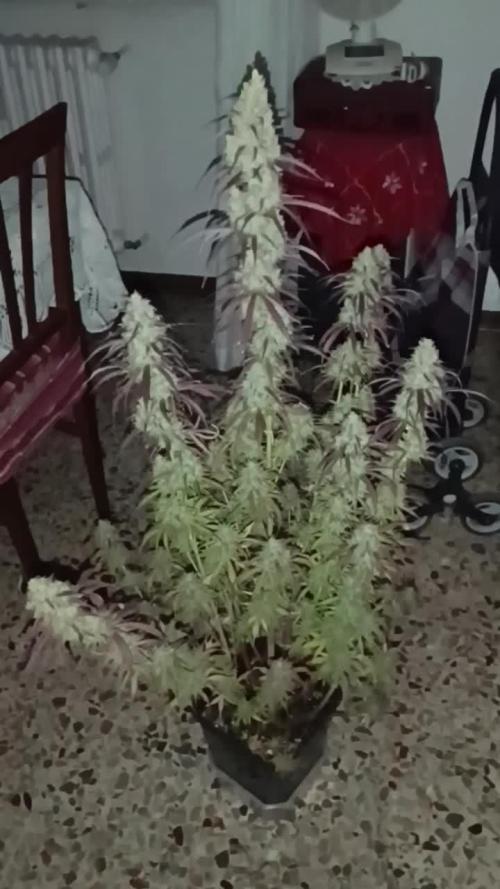
Starting to get some real buds now. Color in leaves changed within 3days. Had me super nervous I screwed up the plant. Thought I was dealing with a ph issue because of how early the leaves changed colors. Green spots on leaves are from me not turing down the light fast enough.
Likes
226
Share
@HighTV
Follow
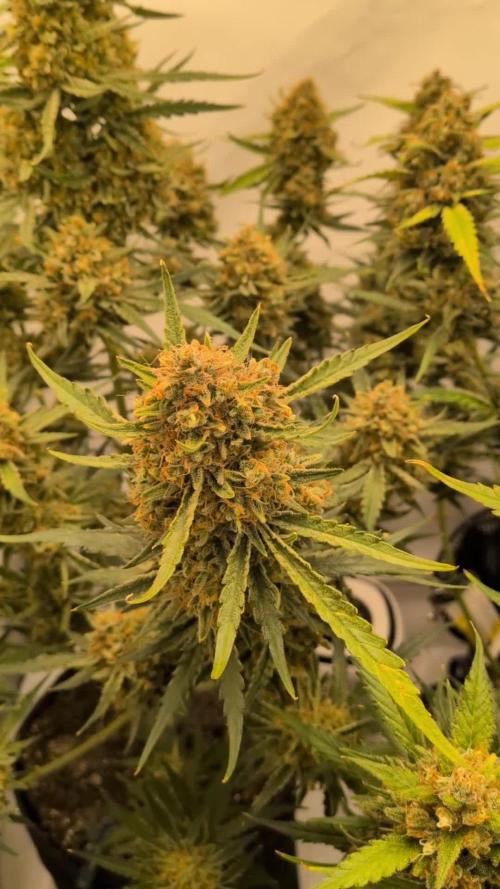
This grow was full of great smells, tastes, and beautiful looking buds with a harvest time of only 10 weeks. Yeah, I would have liked the buds to have came out more dense in some locations, however with such a short life cycle and exotic visuals this strain offers its a good compromise. I was surprised this strain did so well while in hydroponics given its sensitivity to nutrients, but I think the fast earlier growth DWC offers allowed it to sustain. I'm looking forward to doing this strain again with a better nitrogen scheduling and using Great White Mycorrhizae from the start to see how dense we can get these buds. These are the type of buds you can't find in a dispensary anywhere and if your lucky enough to you will be paying top dollar to walk out with them. If you enjoyed this diary and grow please follow me here on GrowDiaries and check this grown out on youtube 😘 https://youtu.be/iI4p-lStgGA000000
Likes
55
Share
What's in the soil? What's not in the soil would be an easier question to answer. 16-18 DLI @ the minute. +++ as she grows. Probably not recommended, but to get to where it needs to be, I need to start now. Vegetative @1400ppm 0.8–1.2 kPa 80–86°F (26.7–30°C) 65–75%, LST Day 10, Fim'd Day 11 CEC (Cation Exchange Capacity): This is a measure of a soil's ability to hold and exchange positively charged nutrients, like calcium, magnesium, and potassium. Soils with high CEC (more clay and organic matter) have more negative charges that attract and hold these essential nutrients, preventing them from leaching away. Biochar is highly efficient at increasing cation exchange capacity (CEC) compared to many other amendments. Biochar's high CEC potential stems from its negatively charged functional groups, and studies show it can increase CEC by over 90%. Amendments like compost also increase CEC but are often more prone to rapid biodegradation, which can make biochar's effect more long-lasting. biochar acts as a long-lasting Cation Exchange Capacity (CEC) enhancer because its porous, carbon-rich structure provides sites for nutrients to bind to, effectively improving nutrient retention in soil without relying on the short-term benefits of fresh organic matter like compost or manure. Biochar's stability means these benefits last much longer than those from traditional organic amendments, making it a sustainable way to improve soil fertility, water retention, and structure over time. Needs to be charged first, similar to Coco, or it will immobilize cations, but at a much higher ratio. a high cation exchange capacity (CEC) results in a high buffer protection, meaning the soil can better resist changes in pH and nutrient availability. This is because a high CEC soil has more negatively charged sites to hold onto essential positively charged nutrients, like calcium and magnesium, and to buffer against acid ions, such as hydrogen. EC (Electrical Conductivity): This measures the amount of soluble salts in the soil. High EC levels indicate a high concentration of dissolved salts and can be a sign of potential salinity issues that can harm plants. The stored cations associated with a medium's cation exchange capacity (CEC) do not directly contribute to a real-time electrical conductivity (EC) reading. A real-time EC measurement reflects only the concentration of free, dissolved salt ions in the water solution within the medium. 98% of a plants nutrients comes directly from the water solution. 2% come directly from soil particles. CEC is a mediums storage capacity for cations. These stored cations do not contribute to a mediums EC directly. Electrical Conductivity (EC) does not measure salt ions adsorbed (stored) onto a Cation Exchange Capacity (CEC) site, as EC measures the conductivity of ions in solution within a soil or water sample, not those held on soil particles. A medium releases stored cations to water by ion exchange, where a new, more desirable ion from the water solution temporarily displaces the stored cation from the medium's surface, a process also seen in plants absorbing nutrients via mass flow. For example, in water softeners, sodium ions are released from resin beads to bond with the medium's surface, displacing calcium and magnesium ions which then enter the water. This same principle applies when plants take up nutrients from the soil solution: the cations are released from the soil particles into the water in response to a concentration equilibrium, and then moved to the root surface via mass flow. An example of ion exchange within the context of Cation Exchange Capacity (CEC) is a soil particle with a negative charge attracting and holding positively charged nutrient ions, like potassium (K+) or calcium (Ca2+), and then exchanging them for other positive ions present in the soil solution. For instance, a negatively charged clay particle in soil can hold a K+ ion and later release it to a plant's roots when a different cation, such as calcium (Ca2+), is abundant and replaces the potassium. This process of holding and swapping positively charged ions is fundamental to soil fertility, as it provides plants with essential nutrients. Negative charges on soil particles: Soil particles, particularly clay and organic matter, have negatively charged surfaces due to their chemical structure. Attraction of cations: These negative charges attract and hold positively charged ions, or cations, such as: Potassium (K+) Calcium (Ca2+) Magnesium (Mg2+) Sodium (Na+) Ammonium (NH4+) Plant roots excrete hydrogen ions (H+) through the action of proton pumps embedded in the root cell membranes, which use ATP (energy) to actively transport H+ ions from inside the root cell into the surrounding soil. This process lowers the pH of the soil, which helps to make certain mineral nutrients, such as iron, more available for uptake by the plant. Mechanism of H+ Excretion Proton Pumps: Root cells contain specialized proteins called proton pumps (H+-ATPases) in their cell membranes. Active Transport: These proton pumps use energy from ATP to actively move H+ ions from the cytoplasm of the root cell into the soil, against their concentration gradient. Role in pH Regulation: This active excretion of H+ is a major way plants regulate their internal cytoplasmic pH. Nutrient Availability: The resulting decrease in soil pH makes certain essential mineral nutrients, like iron, more soluble and available for the root cells to absorb. Ion Exchange: The H+ ions also displace positively charged mineral cations from the soil particles, making them available for uptake. Iron Uptake: In response to iron deficiency stress, plants enhance H+ excretion and reductant release to lower the pH and convert Fe3+ to the more available form Fe2+. The altered pH can influence the activity and composition of beneficial microbes in the soil. The H+ gradient created by the proton pumps can also be used for other vital cell functions, such as ATP synthesis and the transport of other solutes. The hydrogen ions (H+) excreted during photosynthesis come from the splitting of water molecules. This splitting, called photolysis, occurs in Photosystem II to replace the electrons used in the light-dependent reactions. The released hydrogen ions are then pumped into the thylakoid lumen, creating a proton gradient that drives ATP synthesis. Plants release hydrogen ions (H+) from their roots into the soil, a process that occurs in conjunction with nutrient uptake and photosynthesis. These H+ ions compete with mineral cations for the negatively charged sites on soil particles, a phenomenon known as cation exchange. By displacing beneficial mineral cations, the excreted H+ ions make these nutrients available for the plant to absorb, which can also lower the soil pH and indirectly affect its Cation Exchange Capacity (CEC) by altering the pool of exchangeable cations in the soil solution. Plants use proton (H+) exudation, driven by the H+-ATPase enzyme, to release H+ ions into the soil, creating a more acidic rhizosphere, which enhances nutrient availability and influences nutrient cycling processes. This acidification mobilizes insoluble nutrients like iron (Fe) by breaking them down, while also facilitating the activity of beneficial microbes involved in the nutrient cycle. Therefore, H+ exudation is a critical plant strategy for nutrient acquisition and management, allowing plants to improve their access to essential elements from the soil. A lack of water splitting during photosynthesis can affect iron uptake because the resulting energy imbalance disrupts the plant's ability to produce ATP and NADPH, which are crucial for overall photosynthetic energy conversion and can trigger a deficiency in iron homeostasis pathways. While photosynthesis uses hydrogen ions produced from water splitting for the Calvin cycle, not to create a hydrogen gas deficiency, the overall process is sensitive to nutrient availability, and iron is essential for chloroplast function. In photosynthesis, water is split to provide electrons to replace those lost in Photosystem II, which is triggered by light absorption. These electrons then travel along a transport chain to generate ATP (energy currency) and NADPH (reducing power). Carbon Fixation: The generated ATP and NADPH are then used to convert carbon dioxide into carbohydrates in the Calvin cycle. Impaired water splitting (via water in or out) breaks the chain reaction of photosynthesis. This leads to an imbalance in ATP and NADPH levels, which disrupts the Calvin cycle and overall energy production in the plant. Plants require a sufficient supply of essential mineral elements like iron for photosynthesis. Iron is vital for chlorophyll formation and plays a crucial role in electron transport within the chloroplasts. The complex relationship between nutrient status and photosynthesis is evident when iron deficiency can be reverted by depleting other micronutrients like manganese. This highlights how nutrient homeostasis influences photosynthetic function. A lack of adequate energy and reducing power from photosynthesis, which is directly linked to water splitting, can trigger complex adaptive responses in the plant's iron uptake and distribution systems. Plants possess receptors called transceptors that can directly detect specific nutrient concentrations in the soil or within the plant's tissues. These receptors trigger signaling pathways, sometimes involving calcium influx or changes in protein complex activity, that then influence nutrient uptake by the roots. Plants use this information to make long-term adjustments, such as Increasing root biomass to explore more soil for nutrients. Modifying metabolic pathways to make better use of available resources. Adjusting the rate of nutrient transport into the roots. That's why I keep a high EC. Abundance resonates Abundance.
Likes
3
Share
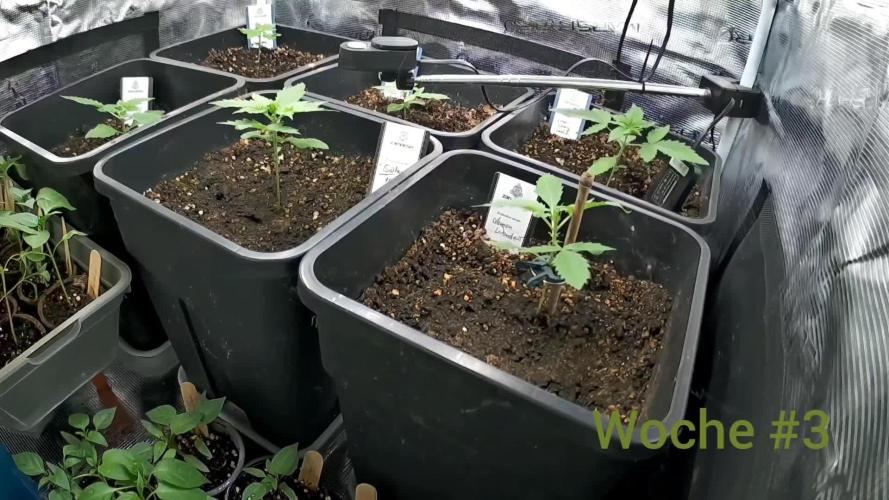
These mystery beans were a gift from a friend who knows I grow a little bit. He claimed they are either blue cheese or NY Diesel, however I take this info very lightly 😅 ******************************************* Day0-1: I threw them all in a shotglass, to my surprise the all seemed to be popping. So I took them out for a better view and put them in a container with wet paper towels. They all seemed, some better than others tho. I've planted them all out together in a big rectangle pot, I will put this one under the blurple light in the small closet to see which ones actually grow up, I will probably make a selection then and plant some of them out. ***************************************** Day3: 7 or 8 of the 20 keemed seeds allready developed into little plant, they just dropped the their shells completely and are starting to open up. I will make a selection of 3 to 5 lucky ladies to continue in a bigger personal pot, the rest will be eliminates or given away.
Likes
3
Share
Eccoci qui... Ormai manca davvero poco ci siamo quasi.... Ora niente più fertilizzanti solo acqua ed attendiamo la maturazione.. Seguiranno aggiornamenti, grazie a tutti per il supporto🔥🌲❤️
Likes
39
Share
Todo marcha como corresponde, esta vez se regó con Flawless Finish para que las plantas se alimenten de los últimos nutrientes y ya secando el sustrato comenzamos la cosecha. Próxima semana finaliza el cultivo. El aroma que mantienen estas nenas me ha dejado encantada!! 😍
Likes
1
Share
Likes
3
Share
Gave them a good strip out! Was a jungle in there,undercarriage included! Smells still amazing one slightly more sour than the other. Ones bud structure is different to the others also. But looking great. Took quite the stretch ! Starting to slow up a bit now thankfully as running out of room !. Exited to see what the next weeks bring. Hopefully a realy nice harvest to come !
Processing
Likes
2
Share
**Encontrarás la traducción a español al final de la descripción** From/Desde: 01/09/19 || To/Hasta: 08/09/19 From day/Desde día: 00 || To day/Hasta día: 07 Blueberry Cookies Diary / Diario de las BlueBerry Cookies: https://growdiaries.com/diaries/38769-dinafem-039-s-blueberry-cookies-at-the-ocean -----IMAGES & VIDEOS----- P6~P9: Among the 4 seeds planted only this Ocean Cookie pushed it's shield out... Cute as a catty😍 -----WEEK SUMMARY----- If you like this week, please hit a like, it costs you nothing! 👊. Thanks in advance 😉! Hi buddies, i'm very happy to welcome you to my new Dinafem's Cookies grow. In this grow I'm going to run 4 Dinafem seeds, 2x Ocean Grown Cookies (this diary) and 2x Blueberry Cookies. The seeds were provided by Dinafem itself, a thing that i want to thank a lot to Dinafem Team, specially to you Mark! 👊 ;). I will try to do my best 🙏. The first week was as expected, buried the seed on Sunday night in a small pot (i'm not sure if it's 0.3 l, but +/-), it be came to seedling on Wednesday afternoon and grown till Sunday as it should be... (AK Déjà vu). Equipment used ----------------- Platinum Grow Lights P300 (93W grow, 180w Flora, full spectrum) DR90 growing tent (90x90 cm) 10 l AeroPot Mid-size Oscillating vent 20w Soil from Bio-Bizz (Light-mix) i will use a small layer of Hard-mix in the bottom of the AirPot and mix the rest with Superguano & Top Vulcan (Both from Top Crop) on transplant. -----WATERING CALENDAR----- Using all week nutrients @ PH 5.8 & EC 0.7 01/09/19: 130 ml 04/09/19: 60 ml 08/09/19: 120 ml *****ESPAÑOL***** -----IMÁGENES & VÍDEOS----- P6~P9: De entre las 4 semillas que he plantado, sólo esta ha expulsado el escudo de la semilla... Cuki como un gatito 😍 -----SUMARIO SEMANAL----- Por favor, si te gusta esta semana dale un like, no te cuesta nada 👊. ¡Gracias por adelantado 😉! Hola compañeros, estoy feliz de presentaros mi nuevo diario de Cookies Dinafem. En este cultivo voy a plantar 4 semillas, 2 Ocean Grown Cookies (este diario) y 2 BlueBerry Cookies. Estas semillas me las ha mandado el propio Dinafem, cosa que quiero agradecer al equipo de Dinafem, especialmente a Mark! 👊. Intentaré hacerlo lo mejor posible. La primera semana fué como se esperaba, planté las semillas el Domingo por la noche en un tiesto pequeño (no se si es exactamente de 0,3 l pero +ó-), se hizo plántula el Miércoles por la tarde y creció hasta el Domingo como debía... (DejaVú de la AK) Equipo usado ----------------- Platinum Grow Lights P300 (93W crecimiento, 180w floración, espectro completo) Tienda de cultivo DR90 (90x90 cm) 10 l AeroPot Ventilador oscilante mediano de 20w Sustrato BioBizz (Light-mix) usaré una pequeña capa de top-mix en el fondo del AirPot y mezclare el resto con Superguano & Top Vulcan (ambas de top crop) cuando transplante. -----CALENDARIO DE RIEGO----- Usando todos los nutrientes de la semana @ PH 5,8 & EC 0,7 01/09/19: 130 ml 04/09/19: 60 ml 08/09/19: 120 ml
Likes
11
Share
Tied down few ecolas to all more light and took off a few big fan leaves
Likes
13
Share
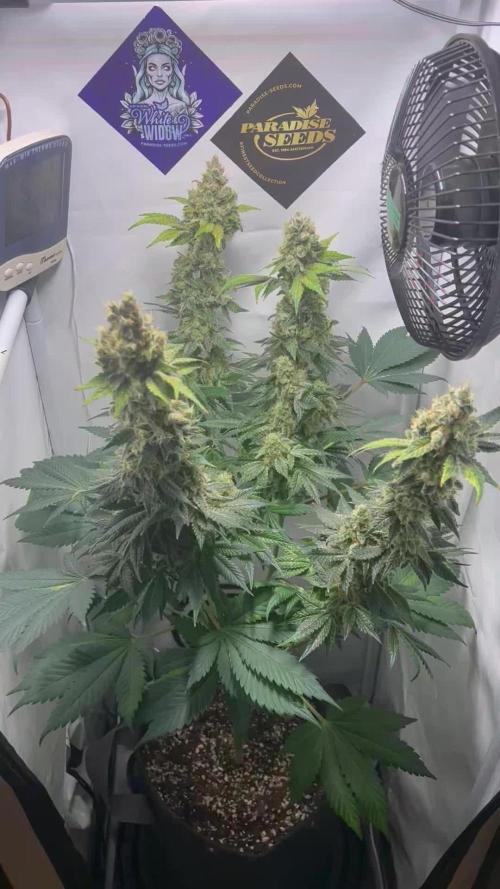
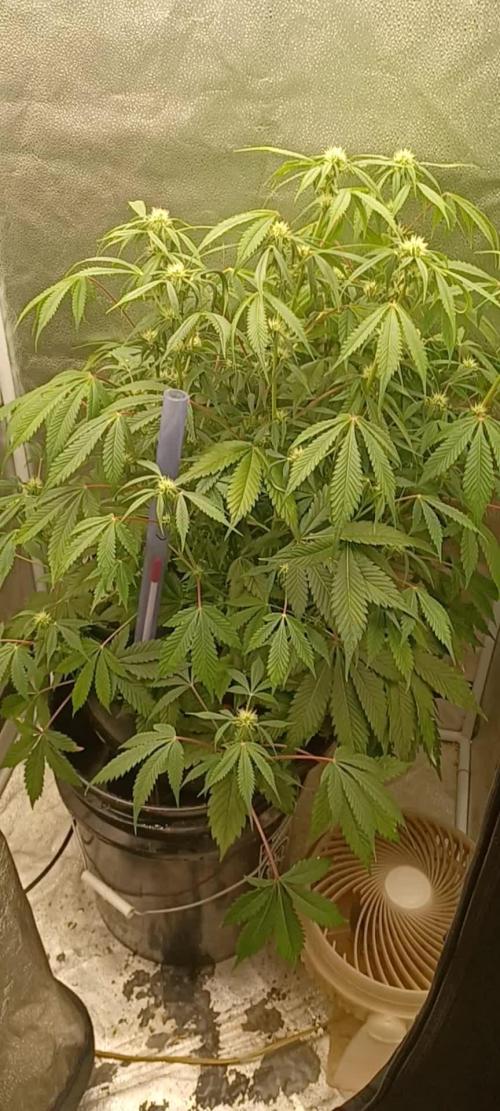
Day 49 The plant is now 49 days old and showing strong, healthy growth. The canopy is filling out nicely with wide, vibrant green fan leaves. The larger fan leaves are a deep healthy green, while the newer growth in the center shows a slightly lighter shade, indicating fresh development. The plant structure looks bushy with multiple tops forming, suggesting that training (possibly LST or topping) has been applied earlier to encourage a more even canopy and multiple bud sites. The side branches are stretching upwards, and the plant appears to be responding well to the training. No major signs of deficiencies or stress are visible. The leaves are well-shaped and the color looks balanced, with no obvious spotting or yellowing. The growth is compact, suggesting the internodal spacing is fairly tight, which is good for building a strong structure for flowering. At this stage, the plant is likely close to transitioning fully into the flowering phase, if not already showing early signs. The canopy is well spread and light penetration looks decent, but a bit more defoliation might help later to open up airflow and light access to lower bud sites. Overall, the plant looks vigorous, healthy, and ready for the next stage of development.
Likes
19
Share
Likes
67
Share
@Hashy
Follow
She was stunted but has produced some nice solid nugs.
Likes
10
Share
@Yolka
Follow
Looks pretty ripe, what do you think? I wish my camera could capture a clear picture of this beauty. The smell is heavier now. I was tempted to fertilize with mineral fertilizer to "improve growth")), but decided not to do it - I'll check the possibilities of the substrate to the end. What I see, I am quite satisfied.
Likes
109
Share
Hey fellow growers week 9 update of my critical purple and pineapple auto grow. Well today all 4 plants are 63 total days old. Critical purple #2 is now in week 6 of 🌸 the other 3 are in forth week of 🌸. This will most likely be critical purple #2's last update as she will be harvested this week hopefully! No big changes this week from last besides Pineapple auto #2 is still not happy and critical purple #1 is thickening up nicely! Well here's what I did to the ladies this week... 10/30/21 Watered all plants Ph 6.2 178 Ppm 1ml ph down Solution temp 73.2°F 11/3/21 Critical purple#1 & Pineapple auto #1 2ml micro 3ml bloom Ph 6.31 420 Ppm Solution temp 70.0°f Critical purple #2 still flushing! 5ml flora kleen Ph 6.24 185 Ppm Solution temp 74.6 Pineapple auto #2 2ml micro 3ml bloom Ph 6.5 430 Ppm Solution temp 74°f Here's my link for discounts on merchandise from viparspectra: https://www.viparspectra.com/?aff=Wackytabacky420&utm_source=affiliate Coupon code: Wackytabacky420 Well guys it's been a crazy week so I'm gonna wrap this up till next week. Best of luck and Happy Growing!😎🌱💚💪💪
Likes
21
Share
Week 9 is all finished up for the Blueberry Pie. The colors on this plant are absolutely amazing and the entire plant is now covered in trichomes. Still a few white hairs but any day now she will be ready to chop. Can't wait to do the final smoke test on this one.
Likes
10
Share
------------------------------------------------- Day 43 Water: 0.75 Gallon TT Water w/ 0.75 TBSP Blkstrp Mlsses 6.5 pH Humidifier: 50% (LOW-MIST) Dehumidifier: On Fan Speed: High Light on @ 19:00 (27.2° celsius @ 49% RH) Light off @ 13:00 (23.2° celsius @ 47% RH) ------------------------------------------------- Day 44 Water: N/A Humidifier: 50% (LOW-MIST) Dehumidifier: On Fan Speed: High Light on @ 19:00 (27.8° celsius @ 45% RH) Light off @ 13:00 (23.2° celsius @ 44% RH) ------------------------------------------------- Day 45 Water: N/A Humidifier: 50% (LOW-MIST) Dehumidifier: On Fan Speed: High Light on @ 19:00 (28.4° celsius @ 44% RH) Light off @ 13:00 (22.5° celsius @ 48% RH) ------------------------------------------------- Day 46 Water: N/A Humidifier: 50% (LOW-MIST) Dehumidifier: On Fan Speed: High Light on @ 19:00 (28.2° celsius @ 47% RH) Light off @ 13:00 (23.3° celsius @ 49% RH) ------------------------------------------------- Day 47 Water: N/A Humidifier: 50% (LOW-MIST) Dehumidifier: On Fan Speed: High Light on @ 19:00 (28.4° celsius @ 42% RH) Light off @ 13:00 (22.8° celsius @ 49% RH) ------------------------------------------------- Day 48 Water: N/A Humidifier: 50% (LOW-MIST) Dehumidifier: On Fan Speed: High Light on @ 19:00 (28.4° celsius @ 42% RH) Light off @ 13:00 (22.8° celsius @ 49% RH) ------------------------------------------------- Day 49 Water: 1 Gallon TT Water w/ 1 TBSP Blkstrp Mlsses + 0.75ml/L Alaska Morbloom 5.7 pH Humidifier: 50% (LOW-MIST) Dehumidifier: On Fan Speed: High Light on @ 19:00 (28.6° celsius @ 49% RH) Light off @ 13:00 (22.7° celsius @ 49% RH) -------------------------------------------------
Likes
5
Share
Leider musste ich mich von einer Lemon O.G. verabschieden. Hermi von unten bis oben in so gut wie jeder Bud. shit happens. 🤷‍♂️