Likes
Comments
Share
@RakonGrow
Follow
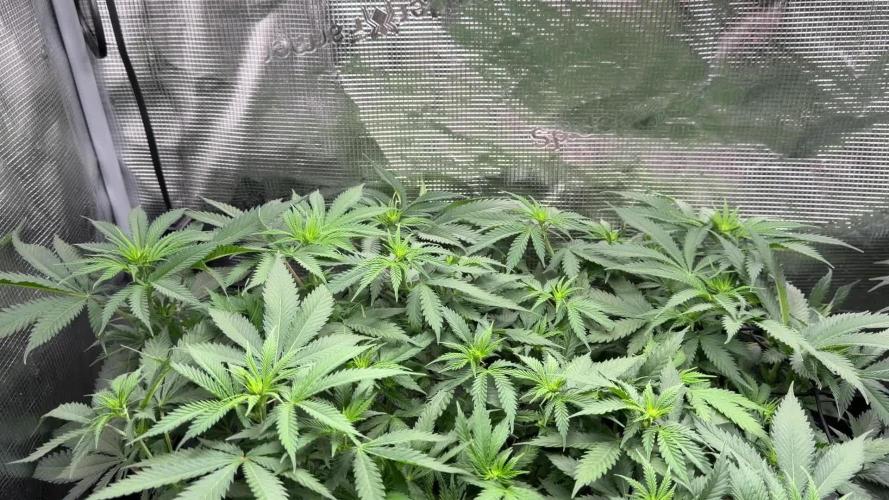
+ Hello and welcome to the last week of vegetative growth. The ladies have been in the flowering tent for a day now and feel refreshingly comfortable at DLI 37.23 . Enough wind is provided . May Gaia have a productive effect . Day 32: +Pantine ++ 2.5 L Bottlewater (EC 0.315) (PH 7.5) +++ Rhizotonic +++ Terrar Vega +++ Cannazym +++ CalMag ++ Final PH 6.0 + EC 0.425 Day 34: looks like the ladies have a problem, the leaves are hanging

Likes
9
Share
Likes
21
Share
3/3 COP is looking great. I should’ve grown her separately because 3/4 plants in the grow tent are indica dominant. I feel that she is the only one that is showing sativa dominant phenotype and is continuing to grow although budding has started. It worries me because I only have a few more inches of space to lift my lights before I may have to super crop her. She’s drinking about 2.5-3 gallons of water every 4-5 days. I also installed another scrog net.
Likes
8
Share
@Cali_Rayy
Follow
Ready to see what this strain can do I like the fact FB420 hast released any pictures of flowers yet kinda leaves it in suspense. Will be updating soon
Likes
2
Share
Forbidden Runtz - Beautiful Sphere shaped Colas forming. Covered in sticky trichomes. Right bud structure. Good nose. Excited to see how this finishes up.
Likes
6
Share
Almost done, 3 seeds by Paradise seeds should be done with a 65 day flowering time
Processing
Likes
41
Share
@Hawkbo
Follow
Everything is still alive thankfully and smells fuckin tremendous. The pictures were taken on day 49 or 50. I'll probly start flushing some of them over the next week the citradellic are lookin close. They kinda all look close even tho I expected some 70 dayers with the mostly sativa crosses but I gotta get in there and check the trichs. Got all the pics I have up, I realized I didnt have any full plant pics of 2, and minimal of 3 so next feed I'll try to get some and next week I'll make sure I get alot of good ones. I feel like I should start the flush soon this strain seems to finish very quick theres already a good amount of amber trichs at day 50.
Likes
6
Share
@rvabudman
Follow
The plant is just "keep on keeping on". Looks beautiful and is nearing the scrog. It is also nearing time for a second round of topping. I plan on keeping the Gold Leaf in veg for a while as the auto is running on 24, so trying to get close as possible to harvest for the auto before I flip the lights. Aiming for an xmas yield for the gold leaf. I also performed some super cropping this week. Wish i had take close up photos on the branches, it work like a charm. The plant growth really took off. In some of the photos you can see the branches are a bit twist and recovering from the super cropping.
Likes
10
Share
@AsNoriu
Follow
Day 29. Best from all but very sensitive to nitrogen, pot is still full and as she takes over all of it , she constantly have few overdose issues. Very responsive to leaf tucking , stem twisting, forms nice canopy, will be biggest producer no doubts in this run. Will try to bend main stem with some LST in few days. Mars TS1000 - Light is solid and does job. For last week output is on max . Still rotate a lot, but am happy with development. I miss more good wind inside, but i live in shared house ;)))))))))))) even really silent air system is still loud on desired speeds ... Hope next week ill send her to flower. Will top up with Worm Castings and Mycorrhizae during training in few days, when girls will be watered next time. Rhythm is good, every 3 days pots are light. 1.5 liters to each went straight in after photo shoot. Day 31. Applied BioBizz Leaf Coat when lights went off. Loads of training was made today too. Day 33. Now girls are trained daily. Top shoot twisting, leaf tucking, rotation around axis , changing positions inside of tent and so on. Always wash hands before any training, it is a must. Still havent made mind, scrog or lst ... Think tomorrow will be watering day and i have to decide which way to go , i am fliping them at next watering 100%, otherwise again rush to harvest before late spring holidays ... Happy Growing !!!
Likes
15
Share
As I predicted the weather last week guess what?... it was a cold and wet week. My main issue its yellowing of the wedding cake. think i as to do with the cold weather as she is the close to the door. I allso burned then a litle with the foliar. The instruction clearly say it may burn withe heat and light aply at night. Guess what?... it was midday.... Black Cream Its Growing Good. Couckush its a litle bit burned. Growing good. Chubby Litle plant for now. Bomberry its starting to become the beast as is leaves size show. Totally diferent genetics Cheers BrotherHood
Likes
14
Share
@Northfork
Follow
8-31-25 all of the girls are doing good no big problems. All of the girls are getting heavy with buds. Really frosty looking really good. Should be about 6 weeks out from harvest.
Likes
10
Share
Day 75 watering with just ph controlled (6,2) water to finish flushing her Day 77 looks incredible frosty now, I Tonino I’m really close to CUt her. This afternoon I will check with microscope and, I’d like 25%amber and 75% milky
Likes
33
Share
@Roberts
Follow
Cali crasher is doing great under the Hortibloom Solux 350. She had a solution change today. She is about mid bulking now. She should be ready for harvest in about 3 weeks. Thank you Doctor's Choice, and Hortibloom. 🤜🏻🤛🏻💪🏻❄️🌱 Thank you grow diaries community for the 👇likes👇, follows, comments, and subscriptions on my YouTube channel👇. ❄️🌱🍻 Happy Growing 🌱🌱🌱 https://youtube.com/channel/UCAhN7yRzWLpcaRHhMIQ7X4g
Likes
12
Share
Las plantas gigantes. tuve que colgarlas de los techos, correr muebles. preparar un lugar. Todavia y a un mes y medio del corte enfrasqué el 10 porciento de todo. el año esta asegurado!
Likes
1
Share
Erster Grow, ohne Schnickschnack. Den Growroom haben wir aus/in unserem Gästeklo gebaut. Heizung ist drin, Lüftung ist drin, alles gekachelt. Wir haben einen Boden eingebaut, mit Pressspan-Platten auf einer billigen Holzkonstruktion. Maße vom Gästeklo sind 90 x 110 cm. First grow, no frills. We built the grow room out of/in our guest toilet. Heating is in, ventilation is in, everything is tiled. We installed a floor with chipboard on a cheap wooden construction. The dimensions of the guest toilet are 90 x 110 cm.
Likes
20
Share
¿Cómo se encuentran esta semana? Por aquí por mi zona no para de llover, y la verdad que me beneficia, ya que así reduzco la potencia del humidificador, y aprovecho la humedad del ambiente. Que la seguimos manteniendo en 70% HR. Bueno lo mas destacable: El primer día de la semana le apliqué una poda apical a la mayoría, y una poca FIM a dos de ellas (1 Zkit Kandy y 1 Super OG Kush) Lo que se hace cuando aplicas la poda apical, es corta el ápice principal de la planta, por lo que, los demás brotes, lucharán por el poder de ser el ápice principal, resultando unas cuentas cabezas principales, y ensanchamiento de la planta. Y en la poda FIM, se corta un 70% aproximadamente, del ápice principal, la planta, actuará de manera parecida a la poda apical, pero no pierdes el verdadero ápice principal. Les fue muy bien esta poda, en mitad de semana, ya se ven los brotes más estirados, comenzó la carrera! Y a finales de semana, no se si en ese momento era buena idea o no, pero lo hice, les corté todas las hojas de abanico de la planta😵 con el objetivo, de eliminar las sombras de éstas, dadas sus dimensiones, abarcaban mucho territorio. Resultó ser bueno, al siguiente día se puede apreciar en el video, la estructura que están formado mis pequeñas💪 Muchas gracias, si te has molestado en leer mi pequeño diario de cultivo! Dejen un comentario, si les gustó o si no, jajaja, espero que si, también se pueden consultar dudas y por supuesto, consejos. Buena semana tengáis, paz.🙌
Likes
55
Share
2nd net is up. Early bud formations are promising. holding up to the extremes pretty well, some leaves taking minor damage, but overall, she is holding up, gave her 1 night at 50F see how she would react, stressful. Not advised as it messes with her metabolism, but I want to see if it triggers any anthocyanin response. Love to see her purp up but no signs yet. Remember, For every molecule of glucose produced during photosynthesis, a plant needs to split six molecules of water. This process provides the hydrogen needed for synthesizing glucose and other organic compounds, while oxygen is released as a byproduct. Homework. If Rubisco activity is impaired and it cannot properly function or regenerate its substrate, the plant's leaves are likely to turn a pale green or lime green, a condition known as chlorosis. Essentially, Rubisco activity is highly regulated and susceptible to various environmental and metabolic factors that can cause it to become inhibited, leading to an apparent failure in RuBP regeneration due to a lack of consumption. Rubisco regeneration is intrinsically linked to nitrogen supply because Rubisco is a major sink for nitrogen in plants, typically accounting for 15% to over 25% of total leaf nitrogen. The regeneration phase itself consumes nitrogen through the synthesis of the Rubisco enzyme and associated proteins (like Rubisco activase), and overall nitrogen status heavily influences the efficiency of RuBP regeneration. RuBisCO is a very large enzyme that constitutes a significant proportion (up to 50%) of leaf soluble protein and requires large investments in nitrogen. Insufficient nitrogen supply limits the plant's ability to produce adequate amounts of RuBisCO, thereby limiting the overall capacity for photosynthesis and carbon fixation. Maintaining the optimal, slightly alkaline pH is crucial for the proper function and regeneration of Rubisco. Deviations in either direction (too high or too low) disrupt the enzyme's structure, activation state, and interaction with its substrates, leading to decreased activity and impaired RuBP regeneration. (Lime/yellowing) Structural Component: Nitrogen is an essential building block for all proteins, and the sheer abundance of the Rubisco protein makes it the single largest storage of nitrogen in the leaf. Synthesis and Activity: Adequate nitrogen supply is crucial for the synthesis and maintenance of sufficient Rubisco enzyme and Rubisco activase (Rca), the regulatory protein responsible for maintaining Rubisco's active state. Nitrogen deficiency leads to a decrease in the content and activity of both Rubisco and Rca, which in turn limits the maximum carboxylation rate, Vmax, and the rate of RuBP regeneration Jmax, thus reducing overall photosynthetic capacity. Nitrogen Storage and Remobilization: Rubisco can act as a temporary nitrogen storage protein, which is degraded to remobilize nitrogen to other growing parts of the plant, especially under conditions of nitrogen deficiency or senescence. Nitrogen Use Efficiency (NUE): The allocation of nitrogen to Rubisco is a key determinant of a plant's photosynthetic nitrogen use efficiency (PNUE). In high-nitrogen conditions, plants may accumulate a surplus of Rubisco, which may not be fully activated, leading to a lower PNUE. Optimizing the amount and activity of Rubisco relative to nitrogen availability is a target for improving crop NUE. Photorespiration and Nitrogen Metabolism: Nitrogen metabolism is also linked to the photorespiration pathway (which competes with carboxylation at the Rubisco active site), particularly in the reassimilation of ammonia released during the process. To increase RuBisCO regeneration, which refers to the process of forming the CO2 acceptor molecule Ribulose-1,5-bisphosphate (RuBP) during photosynthesis, the primary methods involve optimizing the levels and activity of Rubisco activase (Rca) and enhancing the performance of other Calvin-Benson-Bassham (CBB) cycle enzymes. Biochemical and Environmental Approaches: Optimize Rubisco Activase (Rca) activity: Rca is a crucial chaperone protein that removes inhibitory sugar phosphates, such as CA1P (2-carboxy-D-arabinitol 1-phosphate), from the Rubisco active site, thus maintaining its catalytic competence. •Ensure optimal light conditions: Rca is light-activated via the chloroplast's redox status. Adequate light intensity ensures Rca can effectively maintain Rubisco in its active, carbamylated state. •Maintain optimal temperature: Rca is highly temperature-sensitive and can become unstable at moderately high temperatures (e.g., above 35°C/95F° in many C3 plants), which decreases its ability to activate Rubisco. Maintaining temperatures within the optimal range for a specific plant species is important. •Optimize Mg2+ concentration: Mg2+ is a key cofactor for both Rubisco carbamylation and Rca activity. In the light, Mg2+ concentration in the chloroplast stroma increases, promoting activation. •Manage ATP/ADP ratio: Rca activity depends on ATP hydrolysis and is inhibited by ADP. Conditions that maintain a high ATP/ADP ratio in the chloroplast stroma favor Rca activity. Enhance Calvin-Benson-Bassham (CBB) cycle enzyme activity: The overall rate of RuBP regeneration can be limited by other enzymes in the cycle. •Increase SBPase activity: Sedoheptulose-1,7-bisphosphatase (SBPase) is a key regulatory enzyme in the regeneration pathway, and increasing its activity can enhance RuBP regeneration and overall photosynthesis. •Optimize other enzymes: Overexpression of other CBB cycle enzymes such as fructose-1,6-bisphosphate aldolase (FBA) and triose phosphate isomerase (TPI) can also help to balance the metabolic flux and improve RuBP regeneration capacity. Magnesium ions, Mg2+, are specifically required for Rubisco activation because the cation plays a critical structural and chemical role in forming the active site: A specific lysine residue in the active site must be carbamylated by a CO2 molecule to activate the enzyme. The resulting negatively charged carbamyl group then facilitates the binding of the positively charged Mg2+ion. While other divalent metal ions like Mn2+ can bind to Rubisco, they alter the enzyme's substrate specificity and lead to dramatically lower activity or a higher rate of the non-productive oxygenation reaction compared to Mg2+, making them biologically unfavorable in the context of efficient carbon fixation. The concentration of Mg2+ in the chloroplast stroma naturally increases in the light due to ion potential balancing during ATP synthesis, providing a physiological mechanism to ensure the enzyme is activated when photosynthesis is possible. At the center of the porphyrin ring, nestled within its nitrogen atoms, is a Magnesium ion (Mg2+). This magnesium ion is crucial for the function of chlorophyll, and without it, the pigment cannot effectively capture and transfer light energy. Mg acts as a cofactor: Mg2+ binds to Rubisco after an activator CO2 molecule, forming a catalytically competent complex (Enzyme-CO2-Mg2+). High light + CO2) increases demand: Under high light (60 DLI is a very high intensity, potentially saturating) and high CO2, the plant's capacity for photosynthesis is high, and thus the demand for activated Rubisco and the necessary Mg2+ cofactor increases. Mg deficiency becomes limiting: If Mg2+ is deficient under these conditions, the higher levels of Rubisco and Rubisco activase produced cannot be fully activated, leading to lower photosynthetic rates and potential photo-oxidative damage. Optimal range: Studies show that adequate Mg2+ application can enhance Rubisco activation and stabilize net photosynthetic rates under stress conditions, but the required concentration is specific to the experimental setup. Monitoring is key: The most effective approach in a controlled environment is to monitor the plant's physiological responses e.g., leaf Mg2+ concentration, photosynthetic rate, Rubisco activation state, and adjust the nutrient solution/fertilizer to maintain adequate levels, rather than supplementing a fixed "extra" amount. In practice, this means ensuring that Mg2+ is not a limiting factor in the plant's standard nutrient solution when pushing the limits with high light and CO2. Applying Mg2+ through foliar spray is beneficial to Rubisco regeneration, particularly in alleviating the negative effects of magnesium (Mg) deficiency and high-temperature stress (HTS). While Mg can be leached from soil, within the plant it is considered a mobile nutrient, particularly in the phloem. Foliar-applied Mg is quickly absorbed by the leaves and can be translocate to other plant parts, including new growth and sink organs. Foliar application of: NATURES VERY OWN MgSO4 @ 15.0g L-1 in a spray bottle. For those high-intensity workouts when 1 meal a day is just not enough! Foliar sprays are often recommended as a rapid rescue measure for existing deficiencies or as a supplement during critical growth stages, when demand for Mg is high. Application in the early morning or late evening can improve absorption and prevent leaf burn. The plant was getting a little limey yellow in the centre. Shortly thereafter, she was back in business, green mostly regenerated. The starting point [of creativity] is curiosity: pondering why the default exists in the first place. We’re driven to question defaults when we experience vuja de, the opposite of déjà vu. Déjà vu occurs when we encounter something new, but it feels as if we’ve seen it before. Vuja de is the reverse—we face something familiar, but we see it with a fresh perspective that enables us to gain new insights into old problems. Confidence is evidence... nothing more. You are confident because you have driven 10,000 times, you are confident because you have spoken 10,000 times. People think confidence is a feeling, but it's not. If you want more confidence, then you need to create evidence, take more shots, collect more data, build more experiences, take more risks; fail, confidence doesn't come first; it is the reward you get for doing the work. no one else wants to do.