


Likes
Comments
Share


@SonGoku848
Follow
Sì va avanti spediti, adesso iniziano a gonfiare i fiori vediamo in queste ultime 3/4 settimane

Likes
8
Share


@I_Identify_As_A_Dan
Follow
Week 8 for Ztrawberry by greenhouseseedco,
End of week 8 for this cultivar, Shes got a nitrogen deficiency that can hopefully be fixed right up by next week.

Likes
3
Share

@Daddy_farmer
Follow
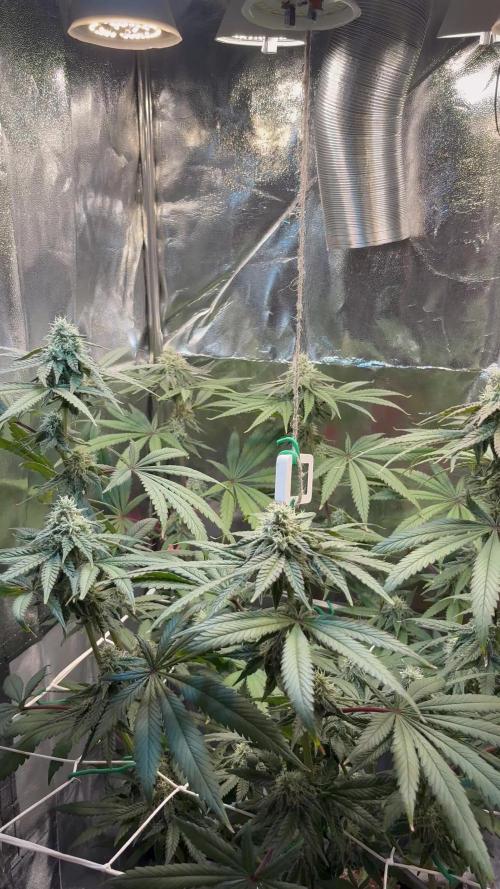
5 week, day 4 on bloom mode. Been a while since I had to disappear for a while. Last couple of days was totally desert down there, but nothing happened visually.
Now water in tray is filling properly. Tomorrow bactrex with a bit of orgatrex are planned for breakfast.

Processing
Likes
Comments
Share


Likes
Comments
Share

@DogDoctorOfficial
Follow
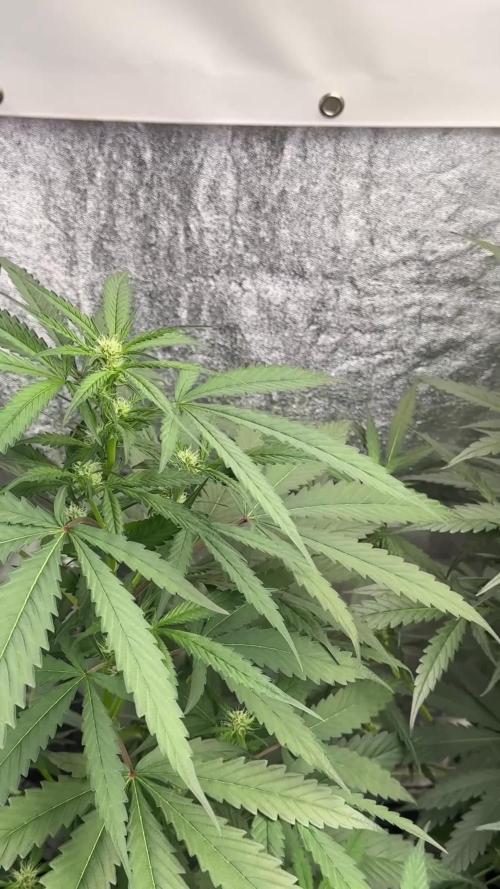
💜 Week 6 – Purple CousKush Auto (Pheno A)
Every Branch Finds Its Purpose
One of the greatest joys of growing multiple phenotypes is watching each plant reveal its own personality over time.
Some rush into flower with explosive enthusiasm, while others take their time, quietly building the structure that will support everything to come. Since germination, this Purple CousKush has chosen the second path. Growing under the same conditions as every other lady in the 8×8 Adventure, she has patiently developed an elegant framework before fully committing her energy to bloom.
Now, as Week 6 unfolds, that patience is beginning to pay off.
The structure she spent weeks building is finally coming to life, with every branch proudly carrying fresh clusters of white pistils. Rather than relying on a single dominant cola, she is transforming into a beautifully balanced plant where each branch has a role to play.
Sometimes the best performances begin with a slow introduction.
🌱 Plant Development
This week has been all about progression.
Standing at approximately 76 cm, she remains one of the taller ladies in the 8×8 Adventure, displaying a graceful sativa-leaning structure with long internodes and excellent spacing between flowering sites.
The stretch is still present but beginning to settle, allowing the plant to redirect more of her energy towards flower production. Bud sites are now clearly established across every branch, and each day the clusters of bright white pistils become a little larger and a little more defined.
The low-stress training performed during the early weeks continues to show its value. Light penetrates deep into the canopy, airflow remains excellent, and nearly every branch has developed into a potential flowering top.
It's easy to imagine how these long stems will eventually carry elegant, well-stacked colas from top to bottom.
She isn't trying to be the most compact plant in the room.
She's building something entirely different.
🌿 Environment & Growing Conditions
Environmental conditions remained stable throughout the week, allowing uninterrupted development.
• 12/12 light schedule from seed
• Future of Grow Black Series LED delivering approximately 850 PPFD
• Mammoth Pro tent with excellent airflow
• Day temperature around 29°C
• Night temperature around 25°C
• Relative humidity averaging 60%
• CO₂ approximately 639 ppm
• pH 6.0
• EC 1.78 mS/cm
The reduction in humidity compared to previous weeks has created an ideal environment for flowering, while the stable temperatures continue encouraging healthy growth without signs of stress.
The foliage remains vibrant, the stems continue strengthening, and every indication suggests she's thoroughly enjoying the conditions provided.
💧 Feeding Program
Growing in a 15 L Plagron Lightmix container and hand-watered with approximately 0.9 litres per irrigation, she continues responding beautifully to the current feeding schedule.
This week's nutrient solution consisted of:
• Terra Bloom – 1.9 ml/L
• Pure Zym – 1 ml/L
• Sugar Royal – 1 ml/L
• Power Buds – 1 ml/L
• Green Sensation – 1 ml/L
The transition into full bloom nutrition has been seamless. Leaf colour remains healthy and balanced, while the developing flowers continue to expand without showing signs of deficiency or excess.
Sometimes the best adjustment is simply knowing when not to change what is already working.
🌸 Phenotype Notes
This Purple CousKush continues to remind me why growing from seed is always such a rewarding experience.
Despite sharing identical genetics, environment, nutrition and lighting with the other plants in this project, she has developed an entirely unique character.
Where some phenotypes chose density and compact growth, this lady has embraced height, openness and elegant branching. Her long internodes may appear unusual at first glance, but they're creating a structure with excellent light penetration and airflow—qualities that often become major advantages as flowering progresses.
Rather than comparing her with the others, I prefer appreciating what makes her different.
Every phenotype has something to teach us.
🔍 Looking Ahead
With the majority of the stretch now behind her, I expect the coming weeks to focus increasingly on flower production.
The framework is already in place.
Now comes the exciting part.
Each flowering site should gradually begin stacking along those beautifully spaced branches, slowly transforming this elegant structure into a canopy filled with long, resin-covered colas.
If she continues following the path she's chosen so far, I wouldn't be surprised if she finishes with a very refined, classic sativa-style appearance despite her autoflower genetics.
She's written the introduction.
Now the story begins to unfold.
💭 Final Thoughts
This week reminded me that successful cultivation isn't about making every plant look the same.
It's about understanding that each one has its own rhythm, its own priorities and its own way of expressing the genetics hidden inside a tiny seed.
This Purple CousKush has never tried to compete with the others.
She simply continues becoming the best version of herself.
Healthy.
Elegant.
Balanced.
Confident.
Watching that transformation unfold is one of the greatest rewards of this entire 8×8 Adventure.
Sometimes the tallest stories are written one branch at a time.
🙏 Thank You
A huge thank you to everyone following this 8×8 Adventure. Your encouragement, questions and shared experiences continue to make this project far more rewarding than if I were growing alone.
A special thank you to the incredible companies helping make this grow possible:
💜 Zamnesia for the fantastic genetics.
💜 Plagron for providing the nutrition that keeps these ladies thriving.
💜 Future of Grow for the outstanding lighting.
💜 TrolMaster for maintaining such a stable environment throughout every stage of the grow.
And finally, thank you to the entire GrowDiaries community. Whether you've been here since day one or have only recently joined this adventure, I truly appreciate every visit, every comment and every word of encouragement.
Until next week...
Growers Love and happy growing! 🌱💚
Likes
24
Share


@Basementganja
Follow
Harvested the Clones!
I'm stoked how #4 grew out, I think she's the winner!
With limited space in my grow, I'm only going to be able to bloom out the rest of the phenos clones to week 3-4.. The show must go on..
It's the price I must pay for using non-ideal cloning methods... Next round of phenohunting will have 100% cloning success, using my new aeroponics cloning machine.

Likes
9
Share


@TheStaffedition
Follow
Привет друзья.
Наше знакомства продолжается с новым сортом автоцветущих растений от Smail_Seeds сорт ORIGINAL AUTO CHEMZKITTLEZ F1 reg.
Сегодня растению 97 дня.
Шишки налились очень хорошо😀
Вы всё сами видите.
Скоро будут феминизированные
Сорт выводим сами.
Смотри мой профиль, у нас всегда есть что то интересное.
Не забудь поставить лайк❤️, если понравилась как прошла неделя
И читайте наш TELEGRAM: https://t.me/smail_seeds
#Smail_Seeds 😀
Processing
Likes
28
Share


@BudsBanditUK
Follow
She has the most amazing smell. Looking very healthy with some chunky looking buds already. Still taking full feeds with no issue. I think this is going to be stunning.

Likes
4
Share


@Hustle786
Follow
This John Snow
Slow Grow
Hope Fully Gets Vegged Bit Longer
To Grow It Tall
420💨💨💨
Likes
4
Share

@Nargileus
Follow
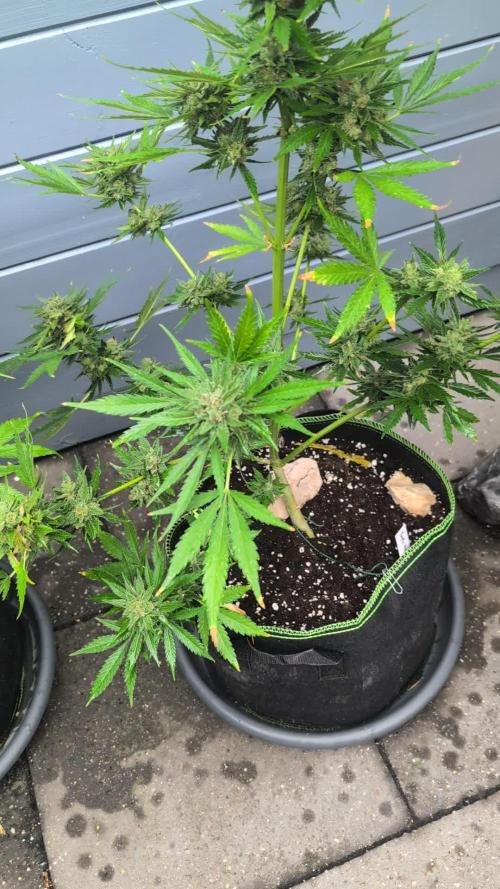
So langsam werden die Trichome immer reifer. Alles riecht wunderbar im Garten. Bei einer pflanze mußte ich einen Bud entfernen, da sich dazwischen ein bisschen Schimmel gebildet hatte.
Likes
44
Share


@Cogollo_eu
Follow
**Encontrarás la traducción a español al final de la descripción**
From/Desde: 10/05/19 || To/Hasta: 16/05/19
From day/Desde día: 78 || To day/Hasta día: 84
You can find the Money Maker Diary here:
** Podéis encontrar el diario de las Money Maker aquí:**
https://growdiaries.com/diaries/25667-gorillamakingmoney-gorilla-vs-money-m
-----IMAGES & VIDEOS-----
5 - HomeMade Organic & Cheap CO2 generator (more info in week summary)
9, 10, 11 & 12: The bud on the right is a Gorilla one, the buds in the left or/and in the middle are Money Maker ones.
15 - Same Gorilla plant buds, one affected by CO2 in the roots and the other not.
-----WEEK SUMMARY-----
The smell is more sweet and intense every day, friends that came home turned them eyes into crystals when they see this little babys. The size isn't awesome, but the high ammount of buds full of crystals plus the strong sweet aroma makes them awesome. Buds are growing and fattenning very very well.
This week i added a boost of HomeMade CO2, i never measured the results of this invention so i can't give CO2 measurements. This method is widely used in home aquariums and there is where it comes from. For those interested i'm going to write here more detailed instructions. The 4 liters i've made will last for about 2 weeks.
---NEEDINGS---
- 250 ml Bottle
- 6~10 l Bottle
- 400 g Sugar / l water
- 1 Envelope of organic baker's yeast / l water (CHEMICAL WILL NOT WORK)
- 3 mid plastic tubes 40~50 cm
- 1 short plastic tube 5~6 cm
- 4 tube adapters
- Hot glue to seal adapters
The process of creating CO2 is simple, mix water, organic yeast and sugar in a bottle, and the sugar will free CO2 in the process of fermenting to alcohol due to the yeast.
1. Make a hole in the center of the big bottle cap, insert an adapter and secure it with hot glue
2. Make 3 holes in the small bottle cap and glue the other 3 adapters
3. Link both caps with one of the mid tubes and insert the other tubes on free adapters
4. Insert a short tube in the bottom of the small cap in the adapter that came from the big cap
5. Watch the Video!!
-----WATERING CALENDAR-----
Plants are beginning to drain the pots a bit faster so from now on i will raise the water ammount on each watering day 0.25 l.
11/05/19 - 1,5 l with All week nutrients -(Nirvana & Blombastic) also Big Bud half dosed @ PH6.4 & 2 E.C.
14/05/19 - 1,5 l with Bud Candy, Big Bud, Nirvana, B52, Bud Factor-X, Sensizym & Blombastic @ PH6.4 & 1.5 E.C.
*****ESPAÑOL*****
-----IMÁGENES Y VÍDEOS-----
5: Generador de CO2 casero, barato y orgánico (más info en el sumario semanal)
9, 10, 11 & 12: El cogollo que sale a la derecha es de una Gorila, el de la izquierda y/o el de en medio son de una Money Maker
15: Dos cogollos de la misma planta, uno afectado por CO2 en las raíces y el otro no
-----SUMARIO SEMANAL-----
El olor es más dulce e intenso día a día, los amigos que vienen a casa a verlas se quedan ojipláticos al verlas. El tamaño no es una maravilla, pero la gran cantidad de cogollos llenos de cristales añadido al aroma que entra por las fosas nasales las hacen increíbles. Los cogollos crecen y engordan de maravilla.
Esta semana he añadido un boost de CO2 casero, nunca he hecho mediciones de los resultados por lo que no puedo darlas. Este método es ampliamente usado en peceras caseras y de ahí saqué la idea. Para aquellos interesados dejo aquí instrucciones más detalladas. Con los 4 litros de agua que he preparado yo da para unas 2 semanas.
---NECESITAMOS---
- Botella de 250 ml
- Botella de 5 a 10 litros
- 400 g de azúcar por litro de agua
- 1 sobre de levadura de postre orgánica (LA QUÍMICA NO FUNCIONARÁ)
- 3 tubos de plástico de tamaño medio 40~50 cm
- 1 tubo de plástico de tamaño pequeño 5~6 cm
- 4 adaptadores para los tubos
- Cola caliente para pegar y sellar los adaptadores
El proceso de generar CO2 es simple, mezcla agua, levadura orgánica y azúcar en una botella, y el azúcar liberará CO2 en el proceso de fermentación a alcohol.
1. Haz un agujero en la tapa de la botella grande, inserta un adaptador y séllalo con cola caliente
2. Haz 3 agujeros en el tapón pequeño y haz lo mismo con los otros 3 adaptadores
3. Conecta los 2 tapones con uno de los tubos y conecta los otros 2 tubos a los adaptadores restantes
4. Conecta el tubo pequeño en la parte libre del adaptador del tapón pequeño que viene del tapón grande
5. Mira el vídeo
-----CALENDARIO DE RIEGO-----
Las platas comienzan a secar los tiestos un poco más rápido, asi que de ahora en adelante incrementaré 250 ml de agua adicionales en cada riego.
11/05/19 - 1,5 l con todos los nutrientes semanales -(Nirvana & Blombastic) BigBud mitad de dosis @ PH6,4 & 2 E.C.
14/05/19 - 1,5 l con Bud Candy, Big Bud, Nirvana, B52, Bud Factor-X, Sensizym y Blombastic @ PH6,4 & 1,5 E.C.


Likes
6
Share


@Creatorknbsland
Follow
Semna de transição para flora!no momento nao apareceu nada de pestilhos brancos!para minha felicidade estao muito grandes e vai ficar maior depois do esticamento! Espero atualizar na próxima semana ja com flores nessas lindas garotas do senhor soma!bom voygem

Likes
8
Share


Processing
Likes
9
Share


Processing
Likes
2
Share


@OGxGxMoney
Follow
Cant believe how fast these grew!! 48-72 hours from germ and four to five days later, these were sitting above ground!!😁😁
Likes
21
Share


@Ultraviolet
Follow
😍 Beauty. Empty water with NPK raw enzymes, amino and humic/fulvic. Checking the EC of the pot, ranges vary but overall sitting around d 1.2-1.6ms/cm. I can notice tips on one, ever so slightly yellow, hints that ec is on the line.
See how long she can go with just water. So far, so good. They are at that size when the growth snowball really starts to pick up. Upped ppfd, first sign of flower showing on 1 plant. Applied a fair bit of IR, which has stretched the stems; they know if they want to reach the high ppfd they need for flower, then they need to stretch accordingly. All you can eat buffet made to order.
Plant perception allows plants to sense the direction, intensity, quality, and duration of light, using this information to direct growth, optimize photosynthesis, and adjust development. This ability to "see" light and respond accordingly is a fundamental survival mechanism.
The interaction between microorganisms and the plant rhizosphere creates an active environment that directly contributes to soil electrical conductivity (EC), facilitating nutrient availability and, consequently, enabling better plant growth. A healthy, microbially active rhizosphere acts as a living, conductive bridge that converts locked-up resources into bioavailable, charged particles (ions) that the plant can directly use to grow. Microbes break down organic matter and minerals, releasing ions (N, P, K, etc.) slowly and in alignment with plant needs. Unlike synthetic fertilizers that dump a high concentration of salts at once (causing instant, great EC osmotic shock), microbial processes provide a steadier stream of nutrients. Beneficial microbes produce osmolytes, antioxidants, and signaling molecules (like auxins and ACC deaminase) that help plants manage drought, salt, and temperature stress. Microbial exopolysaccharides (EPS) create hydrated biofilms around roots, maintaining a more stable water environment. If an excessive amount of soluble nutrients or salts is added (e.g., heavy compost, manure, or excessive mineral amendments), the total dissolved solids can still exceed the plant's tolerance threshold. Intense evaporation, drought, or extreme heat can concentrate salts in the soil solution regardless of how active the microbes are. (Balance). The ability of microbes to buffer the soil is finite. If the input exceeds the biological processing speed, osmotic stress can occur. This is where high CEC comes in useful. Because of this active exchange, the plant creates a localized chemistry that favors what it needs: If the plant needs calcium, it increases exudates that favor calcium solubilization and exchange. The plant can alter the pH immediately around the roots to make specific nutrients more available while locking up others. It doesn't need. The high CEC acts as a buffer against over-fertilization or pH swings. Instead of nutrient antagonism (where too much of one thing blocks another), the microbial activity helps balance nutrient availability. In a high-CEC organic system, the plant acts as a manager, utilizing microbes and root chemistry to pull exactly what it needs from the "bank" of soil nutrients. Nature knows best. I let her feed herself now.
If a leaf is photosynthesizing, it makes ATP (via light reactions) and sugars. If a root is respiring, it burns sugars to make ATP for itself. They do not share a common, transferable "pool." While you don't get a "bigger ATP pool" by adding root ATP to leaf ATP, growing organically allows for better energy allocation. In organic systems, mycorrhizal fungi and bacteria break down nutrients. This requires less direct energy expenditure from the plant to seek out raw minerals compared to hydroponics/synthetic, where the plant might have to push harder roots to find uptake points. Healthy, microbe-rich roots need less energy for defense and can focus on absorption. Plants send sugars (made in leaves) down to roots to feed microbes, which in turn bring back nutrients/salt ions to create a EC of 0.5ms/cm. This symbiotic loop means the plant spends less energy on acquiring nutrients, leaving more energy available for building biomass.
Leaves make Glucose (Sugar) via Photosynthesis. Sugars travel to the roots. Roots use that sugar to fuel respiration to gain nutrients. Nutrients travel back up to fuel more Leaf growth.
Organic growing doesn't create a larger combined ATP pool; it creates more efficient energy usage and resource allocation. Because the plant isn't wasting energy fighting for nutrients or managing osmotic stress from synthetic salts, it has more metabolic energy left over to put into growth.
High Transpiration Rate. Stronger Mass Flow. More water/nutrients to roots. Increased uptake.
It is a "pull" system that acts as the primary conveyor belt for plant nutrition.


