


Likes
Comments
Share


@SkunkyDog420
Follow
Hallo zusammen 🤙.
Habe sie heute geerntet.
Bin sehr beeindruckt von der Geschwindigkeit 53 Tage in der Blüte habe ich noch nicht gehabt , schneller wie eine Automatische und man braucht viel weniger Strom 🤙🤙.
Top.
Wir hören uns in 3 Wochen mit dem Erntebericht.
Rabattcode für den BIOTABS-Webshop https://biotabs.nl/en/shop/ GDBT420, damit erhalten Sie 15 Prozent

Likes
33
Share


@Ju_Bps
Follow
Hello my friends growers,
Week was good,
Buds look stoped to grow up, so i'll start pk 13-14 next week,
I've start to give tera flores and sugar royal this week.
Plant look healthy and buds look nice with lot of pollen, it will be probably a sticky weed :).
Have a good week mate growers, see you next week 😘

Likes
13
Share


@russrahl
Follow
These girls are looking like they are sprayed with fake snow...lol so sticky icky to play with. Took off a lower outside branch for scoping and these girls are looking close. They have signs of some amber and we are gonna let them go a bit longer to harvest closer with the alien tech hopefully. They definitely didn’t like being neglected a little bit and ph/Ec swung a bit in the middle of flowering and cause some issues a bit, nothing major though. Definitely not for the beginning grower that’s for sure, very finicky...lol got the nutrients lowered for the last week and then there getting the chop! Lol got more girls needing the room, but there looking good. Till next week, Cheers 💨


Likes
59
Share

@Hempface86
Follow
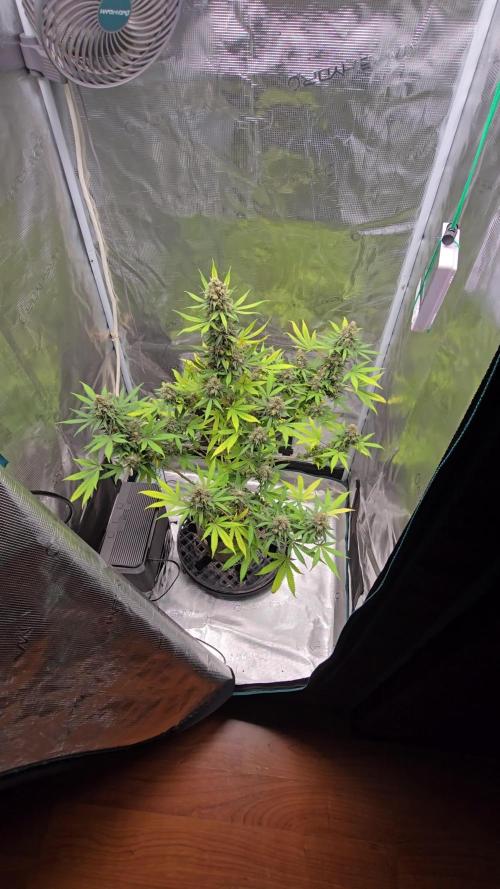
So this is definitely the last update before the chop... My landlord is complaining of the smell, so here we go again lol .. but i'm looking forward to freeing up the space for my king's kush breath =) .. probably later today I'll be trapping her. So in the next day or two I will be doing another update... Again?Have no idea what this strain is, but she's got some frost onthe buds anyway so i'm hoping she's a decent smoke.. The fact that it's not an auto flower means it has a better chance of being or better.. If you know you know .. oh, bed one is doing well.God bless and happy growing 🙏 RIPCK
Likes
8
Share


@Mr_nugs_lover_David
Follow
Beautiful buds on this one guys! Very Short internodes,and the fragrance super sweet and flowery just like her sisters looking forward to keep working with this strain in the future

Likes
93
Share


@TeflonDonFarms
Follow
Halfway through week 7. Couple pictures from Tuesday. Gonna upload more when I get back home to her. Can’t raise the lights anymore. Hoping she is done stretching. She takes up every bit of that 4x5 box. Couldn’t be happier with this grow so far. I think next time I’ll go down to 5 gal smart pots this way I can pump out two of them. Still in disbelief she has grown this fast and started budding that fast as well!! I’m feeding her 2 gallons every 2 or so days. She is a
very thirsty girl and let’s me know when she is hungry too (leaves curl down). I’ve been slowly defoliating the bottom of her. I cut a couple under grown budds from underneath as well. Not sure how she’d respond if I went scissor happy. I also can’t say enough about Advanced Nutrients. Since I made the switch I can tell her leaves are always praying up and overall health seems through the roof! She really is a monster. 31 inches wide by 36 inches tall. She is stacking nicely. Did my best with pictures. Can’t tell if the flash on the phone helps or hurts the pictures.
End of the week- She is doing awesome. Blowing up pretty fast and there is a serious citrus pine smell coming off her when you bump into a budd or it wipes on your finger. For the most part it seems as if she is loving life!!

Likes
77
Share


@SuggaShane
Follow
I’ll try to get better and more pics. Started flushing Gorilla Zkittlez last week, so one more to go. By far the best run I’ve had. Clipped a few lower nugs the other day and usually my past harvest would have a grassy/hay smell right away. But that’s not happening this time. Gorilla Zkittlez has a nice berry/fruity Gasy/diesel smell. And the Gorilla Cookies and like a Grapefruit Diesel smell. It’s wicked. Thanks for following my grow. I appreciate you! 🤛🏽🤛🏽🙏🏼

Likes
2
Share


@thegreatdeadpoolio
Follow
10/23-10/30 final week.
10/24 - this grow is not as ready as I would like it to be but its needed to be on a set schedule since the get-go as this was the first plant in my perpetual. the next plant will be harvested on trich color not time window. 90% cloudy 10% clear hoping the rest of those clear finish up this final week. I usually prefer at least 10% amber.
10/26 - Starting to get amber triches faster than expected, should hit my 10% threshold by tuesday for harvest!


Likes
3
Share


@tontodedoverdee
Follow
So finally this week the plan was looking strong enough to be trained, initially I've lift the plant from his seedling bed, i moved her more on the side of the tent to have more space to bend her and give more open space to the lowest branch, after just 12 hours the plant was already fighting the training pointing the top cola to the closest source of light
Likes
2
Share


@HighZenBerg
Follow
Start of week 6
The ducks are healthy and little white hairs stuck out on the branches. Can’t wait to see them flowering
Also the growth progressed well. They got a lot of leafs and the side branches developed nicely
Keep in touch !
Cheers
HighZenBerg

Likes
19
Share

@Rangaku
Follow
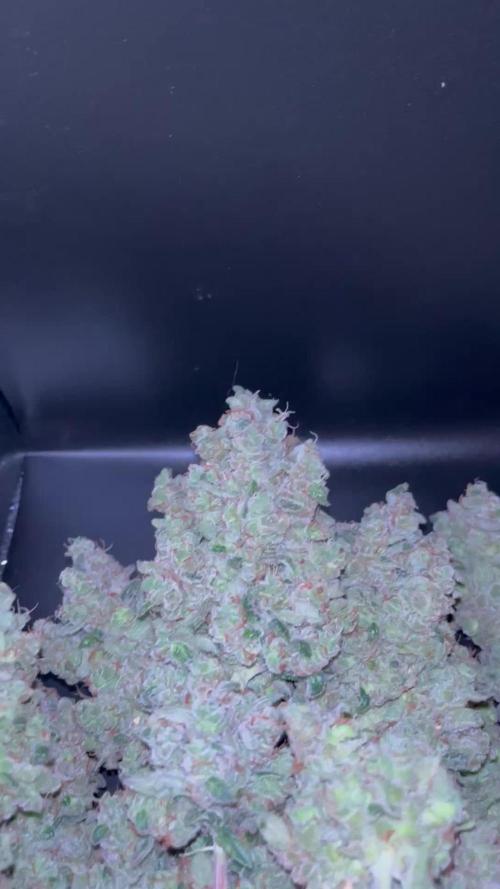
Time for this permanent bluez to get the chop , she was ready at 10% amber . This girl turned out well , really sweet smelling sticky buds prolly end up with around 10oz dry . Smokes great. I didn’t know what to expect with IZI but they’ve proven to be pretty good hey .

Likes
27
Share


@Bread_n_Buds
Follow
Ghost Train Haze automatic by Zamnesia has breathtaking genetics and heritage, we are particularly fond of its parents and we are sure it will be a show. Everything was born in order and in its place for a day we are also giving alga grow and the plant flies but this week we had not given it yet.
Growing projects for autoflowering plants ----- As for autoflowering plants I really love preserving the Main Cola. So I will try to make or grow the plants well or badly without affecting the main cola. Nowadays topping autoflowering plants is very accepted but it is not my favorite thing to transform a baby born to finish in 10 weeks into a baby that finishes in 14, I say at this point I do photoperiodic. But in times of people who only grow autoflowering everything is permitted for goodness sake if you want to do it, do it I will not be the one to stop you. Also because the results are excellent nothing to really discuss about anything except time.
All this to tell us that I recommend for example fimming on plants that tend to grow tall to give power to the lateral branches, LST as much as you want, I don't like too much, spread me out, I need space. HST and splitting are with experience. These are my tips not the absolute truth please do not mistake me for a great sage holder of the truth I speak as I see it.
The first week went only with Power Roots 1 Ml/l and Pure Zym 1 ml/l from now on we will start with ALga Grow. The plants were transplanted shortly after germination because the biodegradable pots were very small. The soil is Plagron Pro Mix 100% organic renewed with 30% new soil and 20% Perlite added. (Pro mix does not have perlite but is airy, we added it anyway)
Plagron fertilizers are available on Zamnesia in convenient Pack formats for all growing styles. I used this with a simple search you can find the other products.
---- https://www.zamnesia.io/it/12119-plagron-top-grow-box-100-naturale.html
Try a seed of this variety that drives us crazy...
---- https://www.zamnesia.io/en/12511-zamnesia-seeds-ghost-train-haze-auto.html
Description Zamnesia // From the day its cotyledons emerge from the substrate, Ghost Train Haze Auto will surprise you with its rapid growth and robustness. When it starts to flower, this short sativa will develop long and compact buds with pungent scents of spice, citrus and fuel.
Growbox and Air System - Secret Jardin DS120w + fans + exhaust fans and DF16 filters kit ---- https://www.secretjardin.com
All the best that mother nature has to offer is at ----www.zamnesia.com
Collaboration request: I am available for collaborations with companies of lights and various growing equipment (please no seed and nut companies) I would like to renovate my 120x120 space that has slightly outdated lights and would like to try some controllers. If you have any proposals available.


Likes
14
Share


@MG2009
Follow
04/14/2022
Getting rid of a grape skunk she just isn't doing anything
Biscotti Skunk looking good but lemon OG is coming along nicely
Been watering by pot weight
(by feel)
No feeding just water they should all be finished soon

Likes
1
Share

@Jessi576
Follow
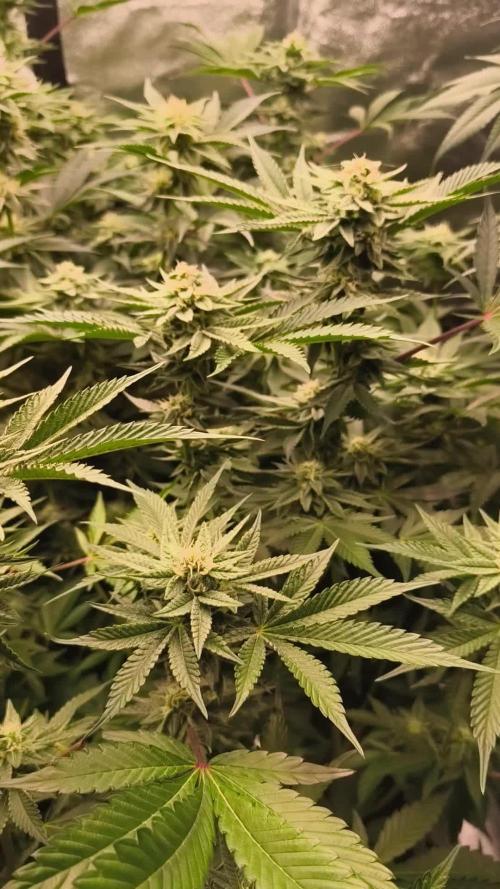
👉 Week 6 Bloom👈
👉11.04.2026 - 17.04.2026👈
👉 Days bloom: 36-42👈
Everything as planned.
Beautiful bud development at every plant at the moment.


Likes
6
Share

@Simba732
Follow
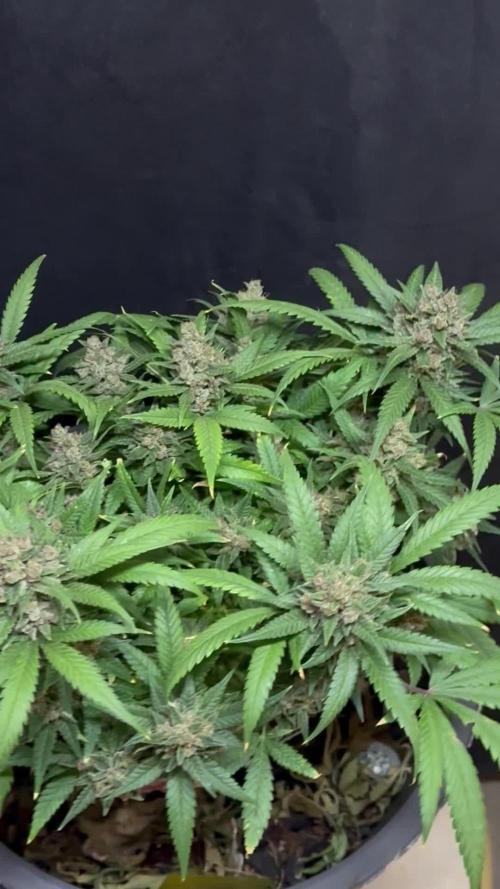
Hello boys and girls we’ve officially reached the finish line! 🕺🏾🎊🍾
It’s been an amazing experience growing this strain.
This week we wrapped things up and flushed using Flawless Finish.
Tropicana’s colors showed out with some buds going purple, her profile is a real nose-pleaser and I’m pretty happy with how my trichomes are looking (all turned milky with very few ambers)
She was thoroughly set free from the salts, and after her final watering 4 days ago I just let her ride it out.
Right after these photos, she’ll be chopped and set to dry! I’ll be back with updates once she’s dried and I begin the curing process. 🤝🏾
It’s been a pleasure growing this beauty alongside all of you thank you for the encouragements.
Mama Tropicana sends her love too 😊
I’ve got other strains running in the garden from Fastbuds and more, so feel free to follow along.
A great harvest season is upon us 🙌🏾😋
Happy growing and happy weekend, gang! 💚


Likes
49
Share


@MadeInGermany
Follow
Hi folks :-)
This week it has developed very nicely 👍 The shoots are starting to grow again, and will soon be ready to be tied down again 👍
I wish you all a nice weekend and let it grow 🍀🌱🙏🏻
Likes
26
Share


@BudBoutique
Follow
! this is my current status, gonna upload my last veg weeks within the next week - got a bit busy around Spannabis - thank you for your understanding! 💚
Welcome to Bud Boutique Grow Diary - really appreciate all your love and support :)
Dont forget to check out my other current grows!
🗓️ This Week:
- Day 17: Transition moving on pretty good
- Day 20: overloaded - its time for another Defo
- Day 20: started K - Boost
- Day 21: strong (last) Defoliation after lollipopping before in last week of veg. Ive got rid of the lower bud sights (popcorn buds) and focusing on Mainbuds only.
Thank you for still staying with me 💚
___________________________________________
--- 🌱 Strain (Sponsor) ---
🏷️ Blue Cinderella 99 FF by MSNL
https://www.marijuana-seeds.nl/blue-cinderella-99-fast-flowering
--- 🥗 Nutrients and Feeding (sponsored by APTUS: APTUS Ambassador) ---
🍸 APTUS: full nutrient schedule extreme
-- Regulator, N-Boost, P-Boost, CaMg-Boost, K-Boost, Allin1 Liquid, Startbooster, Topbooster, Enzym+ every feeding
-- Fulvic-Blast, NutriSpray as Foliar each once a week
🔗 https://aptus-holland.com/
--- ♻️ Grow Control (Sponsor) ---
TROLMASTER: TENT-X + LM14 Light Adapter to dim/sunrise/sunset lights + Temp & rH Sensor all remote on App
🔗 https://www.trolmaster.eu/
--- 🏭 Grow Setup ---
💡LUMATEK Zeus Pro 600
* 🏠🌿 Indoor: Homebox 120x120x200cm (4x4)
* 📐🌀 PrimaKlima exhausting Fan 1180m3/h (running on 60-80%)
* 🌀 Can Light Filter 800m3/h & 1x Fanbox 1x Dyson fan for Air circulation
🔗 https://lumatek-lighting.com/zeus-600w-pro-29/
🔗 https://primaklima.com/de/shop/ventilatoren-de/ec-ventilatoren/pk160ec-tc/
🔗 https://canfilters.com/products/filters/
All Likes and comments are highly appreciated!!!
👨🌾 don't forget to check out my Instagram for daily educational content: budboutiquee
- Bud Boutique
